

- Three layers must align for a Google healthcare ad to ship and stick: category certification, Healthcare and Medicines policy compliance, and landing-page alignment that mirrors the ad's posture.
- The biggest single source of rejection is second-person condition language; rewrite to brand-led or third-person factual framing and most flagged ads clear immediately.
- Each Google Ads format has distinct compliance surfaces: Search is text-classifier-heavy; image ads in Display, Performance Max, and Demand Gen face before/after restrictions and personalization-risk visual patterns; video ads on YouTube layer voiceover, on-screen text, closed-caption, and patient-testimonial consent requirements on top of the static review.
- Landing-page alignment is part of the ad: outcome claims must link to source data and landing-page edits can retroactively disapprove a previously-approved campaign, so treat landing-page change management as part of the ad's compliance lifecycle.
- B2B HCP targeting reopened in May 2025 via Customer Match for eligible health advertisers; B2B and consumer creative must be segmented to keep B2B copy out of consumer placements.
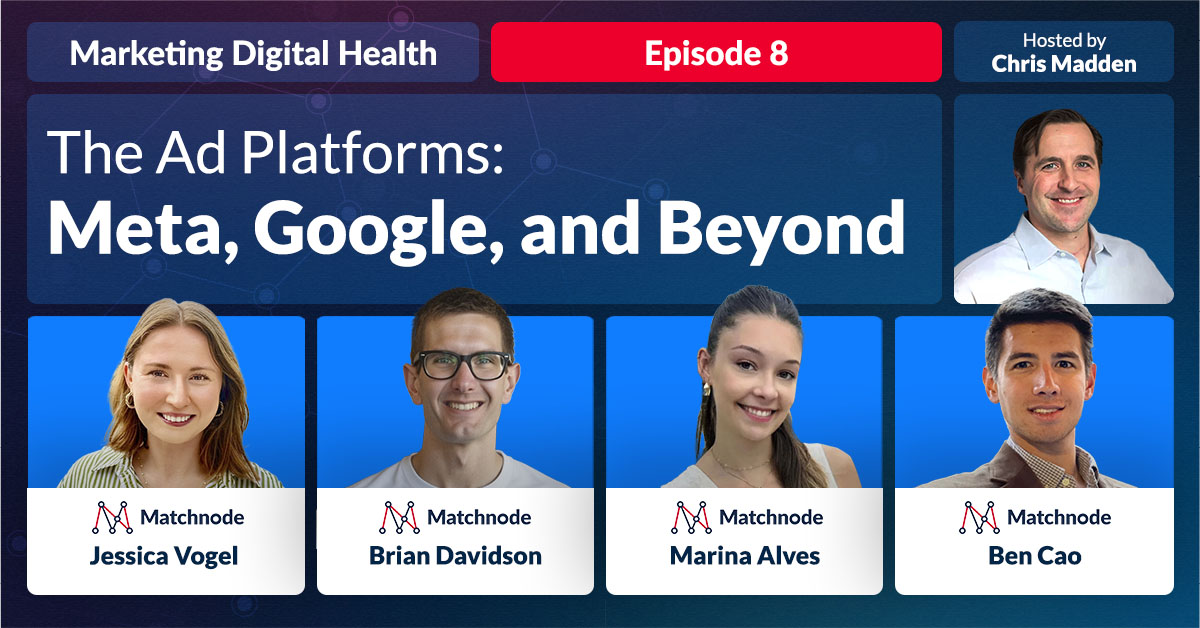
- For the policy framework see Google Ads and Microsoft health advertising policies; for the certification map see healthcare marketing certifications that actually matter; for a working compliant program at scale see our Bicycle Health case study. Audio companion: The Ad Platforms: Meta, Google, and Beyond on the Marketing Digital Health podcast.
9 min read · Pillar: Digital Health Performance Marketing
Ad Copy + Creative Compliance Guide · Updated May 2026
Most healthcare advertisers know the policies exist. Fewer know how to build an ad that survives Google’s automated review, gets approved by a human reviewer if it falls into the manual queue, and still converts at a defensible cost per booked patient. The middle is where the work lives, and it varies meaningfully across Google’s ad ecosystem: Search, Performance Max, Demand Gen, YouTube, Display, and Gmail each have different review pathways and different creative requirements.
This guide is the practical creative companion to the platform-policy framework. It does not re-explain certification programs (covered in depth in Google Ads and Microsoft health advertising policies and healthcare marketing certifications that actually matter). It covers what actually goes in the ad across Google’s full ecosystem: which copy patterns pass, which value propositions trigger health-targeting flags, how each format’s review differs, and what changed for B2B healthcare advertisers in 2025.
With US healthcare and pharma digital ad spend projected at $26 billion in 2026, getting the ad-copy layer right is no longer a small-margin optimization. It is the difference between a campaign that compounds and one that stalls in review queue every Monday morning.

compliance layers that must align before an ad will ship and stick: certification, content rules, landing-page alignment
Google Ads surfaces with distinct review pathways: Search, Performance Max, Demand Gen, YouTube, Display, Gmail
cause of healthcare ad rejection: second-person condition language (“your symptoms”, “do you have X”)
Google reintroduced limited HCP targeting via Customer Match for eligible B2B health advertisers
The policy layer (briefly)
Three things must be true before ad copy work begins. The advertiser must hold the right LegitScript, G2, NABP, or pharmaceutical manufacturer certification for the category being advertised. The ad must comply with Google’s Healthcare and Medicines policy content rules. And the landing page must align with the ad’s claims on the same compliance footing as the ad itself. The full structural framework is in Google Ads and Microsoft health advertising policies. Everything below assumes those three boxes are checked.
Writing ad copy that passes review and converts
Headline: Struggling with anxiety? Try our telehealth therapy today
Why it fails: “you/your” language implies the user has a condition, which Google reads as personalization on an inferred health attribute.
Policy hit: personalized advertising for sensitive interest categories.
Headline: Online therapy with licensed providers, covered by most insurance
Why it works: describes the service in third-person, names the credentialing layer, removes condition language and the second-person trigger.
Same product, same audience, ships clean.
Google’s review system uses automated classifiers plus selective human review. The classifiers fire on language patterns, not just keywords. A perfectly compliant value proposition can trip a personalization flag if it implies the platform knows the user’s health condition.
Headlines that survive auto-flagging
The most reliable approval patterns describe the offering in factual, brand-first language. Headlines that work consistently across categories share four traits: they name the service or program directly, they avoid second-person condition framing, they keep clinical claims tied to a credentialed source, and they signal credibility through certifications, board memberships, or outcomes data rather than emotional appeals.
- Name the offering, not the audience’s symptom. “Virtual primary care for adults” passes; “Get help for your fatigue” personalizes a condition signal and risks rejection.
- Use brand authority instead of urgency. “Founded in 2018 by Johns Hopkins clinicians” carries weight; “Don’t wait, your symptoms could get worse” triggers both the personalization classifier and the urgency-around-health-fears rule.
- Lead with what the patient receives, not what they fear. “Same-week appointments with board-certified MDs” is durable; “Tired of waiting weeks to see a doctor?” puts the platform in the position of having identified the user as someone struggling with healthcare access.
- Cite outcomes only where supportable. “Studied with 90% retention at 12 months” is fine if the study exists and is linked from the landing page; outcome claims without source documentation are the fastest way to trigger manual review and disapproval.
Value-prop language that does not trigger health-targeting flags
The biggest single source of healthcare ad rejection is language that implies the platform knows the viewer’s condition. The classifier looks for second-person condition references, “you may be suffering from” patterns, and direct-symptom queries that would only make sense if the platform had targeted the user based on health information. The fix is almost always a one-word edit from second person to third person or to a brand-led frame.
Will get flagged
- “Manage your anxiety from anywhere”
- “Do you have ADHD?”
- “Tired of feeling exhausted?”
- “Stop your migraines before they start”
- “Your symptoms could mean something serious”
Approved equivalents
- “Virtual mental health care for adults”
- “Adult ADHD evaluation and treatment, online”
- “Telehealth visits with licensed clinicians”
- “Migraine specialty care, in-network with major insurers”
- “Board-certified physicians, same-week availability”
Landing-page alignment is part of the ad
Google evaluates the ad and the landing page as a single unit. An approved headline pointing at a landing page that makes stronger claims, uses second-person condition language, or fails the certification check will be disapproved after the fact, often without a clear notification. Landing pages should mirror the ad’s compliance posture: factual product or service language, named clinical authority, and outcome claims that link to source data. Pages that pass this test also tend to convert better, because the implicit promise the ad makes is the one the page delivers on.
Compliance across Google’s ad ecosystem, format by format
The copy rules above apply across every Google Ads format. The review pathways and creative requirements do not. A campaign that ships clean Search ads can still trip up in Performance Max if asset combinations create non-compliant pairings the advertiser never explicitly assembled. Each surface needs its own creative discipline.
- Search. Text-heavy, classifier-heavy review. Every headline and description gets evaluated independently and in combination via responsive search ads. The patterns above apply to every asset; assume any non-compliant combination will eventually serve and get flagged.
- Performance Max. Google’s AI mixes assets across Search, Display, YouTube, Discover, Gmail, and Maps inventory. Each asset gets reviewed individually, but the combinations Google’s ML produces at serve time are where most healthcare PMax accounts get into trouble. Discipline the asset library to a single compliance posture: every image, headline, description, and video must independently be safe-for-PMax before joining the pool.
- Demand Gen and YouTube. Visual-first formats where the script and on-screen text matter as much as the static copy. Voiceover claims must be supportable to the same standard as written claims. Patient testimonials require explicit consent documentation and stay clear of specific clinical outcome claims unless the supporting study is linkable.
- Display and Gmail. Banner formats where compressed copy creates the most pressure to use shortcut phrases that violate personalization rules. The same brand-led, third-person framing applies; if a 25-character headline reads as “Tired of waiting?” rewrite to “Same-week appointments” and the placement clears.
For the broader operational view of how Matchnode runs Google Ads programs for healthcare brands across these formats, see our Google Ads service overview, which covers Performance Max guardrails, LegitScript-gated inventory, and the conversion-tracking foundation each format depends on.
Image-ad compliance (Display, Performance Max, Demand Gen)
Google reviews image creative through the same healthcare-policy lens it applies to text, with image-specific rules that catch most healthcare advertisers off guard. The classifier flags before-and-after sequences, faces showing visible distress that imply diagnosis, clinical demonstrations of branded prescription drugs, and any image that personalizes a condition the way “your symptoms” would in text.
What gets a healthcare image ad flagged
- Before-and-after visuals for restricted categories (cosmetic procedures, weight loss, mental-health programs, addiction-treatment services). Google’s policy explicitly prohibits these regardless of how strong the supporting evidence is.
- Faces or body shots that imply the viewer’s condition. Someone clutching their stomach next to a digestive-health brand, someone visibly distressed next to a mental-health brand, or a person shown in a state the ad implies the brand can resolve. These trigger the personalization classifier the same way “your symptoms” does in text.
- Clinical demonstrations of branded prescription drugs unless the advertiser holds pharmaceutical manufacturer certification and the asset complies with promotional rules for the drug class.
- Body-part close-ups paired with a treatment brand logo. Eye, ear, skin-condition, or anatomical-region imagery next to a brand that treats that body part reads as condition-targeted even when the copy is brand-led.
- Outcome numbers overlaid on images (“90% see results in 30 days”) without source documentation linked from the landing page. Visual overlay claims are reviewed on the same standard as text claims.
Performance Max asset library discipline
Performance Max is where most healthcare image-ad compliance breaks down. The campaign type asks the advertiser to upload a pool of images, headlines, descriptions, and videos, then Google’s machine learning combines them at serve time across Search, Display, YouTube, Discover, Gmail, and Maps. A perfectly compliant image can be combined with a marginally-compliant headline in a way no human ever explicitly approved, and the combination serves until a reviewer pulls it.
The discipline that works: every image, headline, description, and video in the PMax asset library must independently pass review as a standalone Display banner. If an image would not survive review on its own, it does not belong in the PMax pool. This rules out a lot of borderline lifestyle imagery that performs well in tested Search ads but creates exposure in PMax.
Image patterns that get flagged
- Before/after cosmetic, weight loss, or mental-health
- Distressed person paired with a treatment brand
- Anatomical close-up paired with a condition-specific brand
- Hand on prescription pill bottle showing drug name
- Outcome numbers overlaid without source documentation
Image patterns that approve cleanly
- Branded clinic interior or product UI
- Clinician at work in a modern care environment
- Active healthy-lifestyle imagery without condition implication
- Editorial brand-logo treatments and palette graphics
- Service-team photography with clear staff identification
Video-ad compliance (YouTube, Demand Gen video)
Healthcare video ads run through the same healthcare-policy review as static formats, plus additional review surfaces unique to video: voiceover audio, on-screen text, closed captions, and patient-testimonial documentation. A video that complies as a 6-second bumper can still get pulled when reviewed as a 30-second TrueView placement because of a single caption transcription that drifts from the voiceover script.
What Google reviews in a healthcare video ad
- Voiceover audio. Treated as written ad copy. Every claim, condition reference, and call-to-action is evaluated against the same personalization and outcome-claim rules that govern Search text.
- On-screen text and overlays. Same standard as voiceover. Lower-third disclaimers do not fix non-compliant headlines elsewhere in the video.
- Closed captions. Auto-generated and uploaded captions are scanned. A voiceover that just barely passes review can be flagged on caption transcription if the captions read differently than the audio.
- Visible prescription drug branding. Showing a specific Rx product on-screen requires pharmaceutical manufacturer certification and triggers a separate manual review.
- Patient testimonials. Real-patient claims require documented signed consent, kept on file. Actor-portrayal testimonials need to be labeled on-screen when the content could be mistaken for real outcomes.
What gets a YouTube healthcare ad pulled mid-flight
Most healthcare YouTube ads that pass initial review and later get pulled fail one of three ways. First, the landing page changes (the same retroactive-disapproval pattern as static ads). Second, a viewer reports the ad and human review catches a compliance issue the automated classifier missed. Third, the advertiser updates the video and the new version inherits the old approval status briefly before the system catches up and re-evaluates.
The operational fix is to treat every video version change as a fresh submission requiring re-approval, even if the change feels minor (a caption correction, an end-card swap, a logo refresh). The cost of a pulled video mid-flight in a healthcare program is higher than the cost of a 24-to-72-hour re-review.
What changed in 2025: HCP targeting and what it lets you write
In May 2025 Google reintroduced limited healthcare professional targeting via Customer Match and remarketing for eligible B2B health advertisers. For consumer healthcare advertisers the personalization rules are unchanged. For B2B advertisers reaching licensed clinicians the surface expanded meaningfully, though the segmentation discipline required to keep B2B copy from reaching consumer audiences is non-trivial.
The practical implication for ad copy: B2B campaigns aimed at healthcare professionals can use clinical and technical language consumer-facing campaigns cannot. References to specific drug classes, treatment protocols, mechanism-of-action claims, and peer-reviewed citations all become permissible when the audience is genuinely HCP-segmented. Mixing B2B and consumer creative in the same campaign or audience set is the fastest way to lose those privileges. The certification path for personalized restricted-drug-terms advertising and the full Healthcare and Medicines policy update from July 2025 spell out the boundaries.
The compliance and copy audit every Google healthcare campaign should pass
Run this against every campaign before launch and quarterly thereafter. It catches the highest-impact issues without becoming a bureaucratic gate.
- ✓Do we hold the right certification for every category we advertise (LegitScript, G2, NABP, or manufacturer)?
- ✓Is every headline written in third-person or brand-led voice rather than second-person condition framing?
- ✗Does any active ad use “your condition”, “your symptoms”, “you may be suffering from”, or “stop your X”?
- ✓Does every outcome claim in the ad link to source data on the landing page?
- ✗Are B2B HCP-targeted creatives reachable by consumer audiences through poorly segmented campaigns?
- ✓Is there a landing-page change-log review step before edits go live that could affect an already-approved ad?
- ✗Do any images use before-and-after framing for cosmetic, weight-loss, mental-health, or addiction-treatment categories?
- ✓Would every image in the Performance Max asset library independently pass review as a standalone Display banner?
- ✓Do video voiceovers, on-screen text, and closed captions all meet the same compliance bar as the program’s Search ads?
- ✓Are patient-testimonial videos backed by documented signed consent kept on file?
Why Compliant Google Copy Compounds Across the Account
Google healthcare ad copy is a craft, not a checklist. The same brands win again and again in this channel because they have built operational discipline around the policy edges, internalized the personalization rules to the point that compliant copy is the default rather than the override, and treated landing-page alignment as a creative-team responsibility rather than a legal-team afterthought. The regulatory layer around tracking, separate from ad-copy policy, continues to evolve (the AHA v. Becerra ruling reshaped the HIPAA tracking enforcement context in 2024), but the copy rules above have been stable for years and look likely to remain so.
For a working example of how compliant healthcare ad copy looks at scale, our Bicycle Health case study describes the brand nearly doubling lead volume and producing double-digit declines in cost per lead through disciplined creative testing inside the compliance envelope, not despite it.
How Google AI Overviews Surface Healthcare Policy Guidance
AI Overviews and chat-style search assistants are increasingly the first layer answering “what makes a healthcare ad compliant on Google” before a user clicks any result. Pages that clearly enumerate the do-and-do-not patterns, link to the primary policy sources, and document exceptions for B2B HCP targeting are the ones cited. The shift rewards specificity and structural clarity over keyword stuffing, and it rewards healthcare brands that publish substantive operational guides on their own domain.
Matchnode designs and runs Google Ads programs for digital health brands across virtual care, behavioral health, specialty telehealth, and adjacent regulated categories. For broader channel context see our more ad platforms and paid social services overviews; for the upstream funnel framework these ads feed see the patient journey marketing funnel.
For the longer treatment, see Marketing Digital Health on Amazon.