

- Standard Meta Pixels and Google Analytics tags on patient-facing pages are a HIPAA violation because URLs can carry Protected Health Information without a Business Associate Agreement in place.
- Server-side tracking through a BAA-covered CDP filters PHI before any data reaches Meta or Google, preserving measurement accuracy while eliminating compliance exposure.
- Meta's Conversions API sends conversion events directly from your server to Meta, bypassing browser-based pixel limitations from iOS restrictions, ad blockers, and cookie deprecation.
- Clean attribution signals give Meta's algorithm real conversion data to learn from, which typically produces a 20 to 35 percent reduction in patient acquisition cost over a 90-day window.
- Without accurate conversion data, lookalike audience quality degrades and every campaign cycle effectively starts from scratch with no signal to build on.
- For the marketing metrics that make clean attribution meaningful, see digital health marketing metrics that drive patient growth. For legal background on pixel rules, see HIPAA pixel changes and what they mean.
8 min read · Pillar: Digital Health Performance Marketing
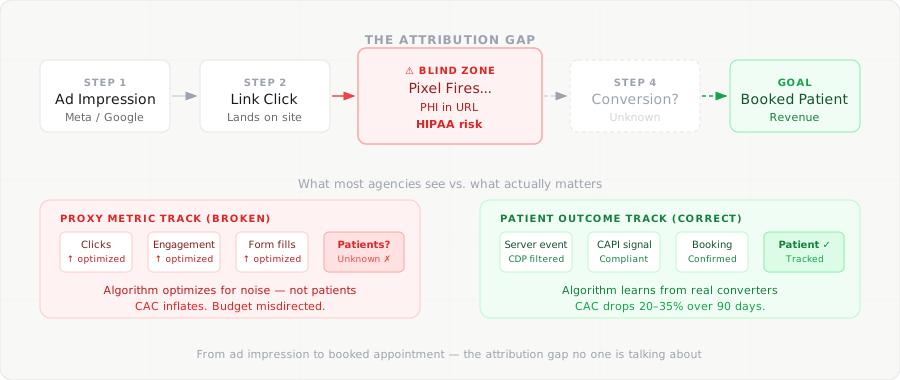
Most digital health brands running paid media today are operating with a fundamental blind spot: their ad platforms report conversions, but those conversions are not patients. They are form submissions, page visits, and clicks: proxy signals that look like progress but do not connect to actual booked appointments. The result is that budget scales toward what looks good in a dashboard, not what actually acquires patients.
Building HIPAA-compliant attribution closes that gap. When conversion events route through a server-side infrastructure that filters Protected Health Information before it reaches Meta or Google, the algorithm stops optimizing toward noise and starts optimizing toward real outcomes. CAC drops. Lookalike audiences sharpen. Budget allocation reflects what is actually working.
This article covers exactly how that infrastructure works: the compliance requirements that make standard pixels a liability, the three-component setup that replaces them, and what changes in campaign performance once the signal is clean.
of healthcare practices unknowingly run non-compliant tracking on patient-facing pages
upper-end patient acquisition cost for behavioral health, the most expensive specialty
typical CAC reduction once clean, server-side attribution is in place
The Rule Change That Broke Standard Tracking
For most industries, attribution is straightforward. A pixel fires on the confirmation page, the ad platform records the conversion, and you get clean campaign data. Digital health broke this model in 2022.
The HHS Office for Civil Rights issued a bulletin in December 2022 stating that standard tracking pixels on patient-facing pages can constitute a HIPAA violation. The reason is that the URL itself can carry Protected Health Information. A visitor landing on a page like /treatment/opioid-use-disorder has, in effect, shared a health signal with a third-party server without consent and without a Business Associate Agreement in place.
The guidance was updated in March 2024 to broaden the PHI definition further. Three months later, a federal court in the Northern District of Texas ruled in AHA v. Becerra that HHS had overstepped, vacating the part of the bulletin that treated an IP address plus a visit to an unauthenticated health-condition page as automatic PHI. HHS declined to appeal in August 2024, so that narrowing is permanent. The rest of the bulletin still stands. For the full legal history, see our companion guide on pixels, HIPAA, and the HHS.
The legal exposure did not disappear with the court ruling. It shifted. More than $100 million in tracking-pixel settlements have been agreed by healthcare organizations from 2023 through 2025 under state wiretap laws, state health-privacy statutes, and the Federal Wiretap Act, with cases ongoing against Teladoc, Henry Ford Health, BJC Healthcare, Eisenhower Health, and others. The practical takeaway: pixels on patient-facing pages remain a legal-review item, not a default deployment.
Bicycle Health ran into this exact problem. After removing tracking pixels to stay compliant with the 2023 OCR guidance, their Meta channel, historically one of their strongest lead drivers, declined significantly. They brought Matchnode in to rebuild the channel without pixels. The result: Meta lead volume nearly doubled year over year and cost per lead saw double-digit declines. The fix required a different technical approach, not a bigger budget.
What Happens When the Signal Disappears
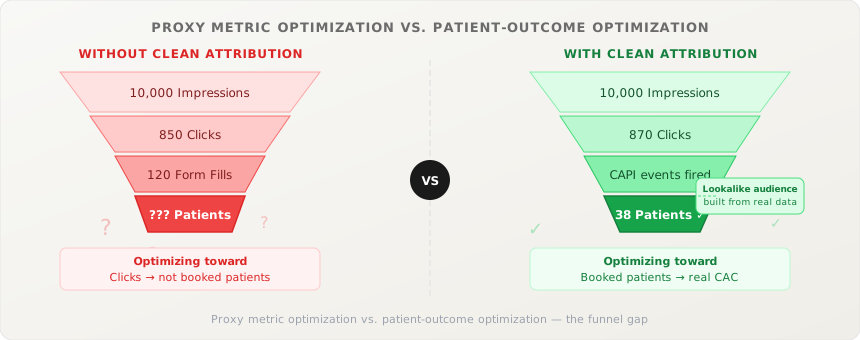
When Meta’s algorithm loses your conversion signal, it shifts to optimizing for whatever it can still measure, usually clicks, video views, or form interactions. These numbers look fine on a dashboard. The problem is that the algorithm is now finding people who click, not people who book.
Without clean conversion data, you also lose access to one of paid media’s most effective tools: lookalike audiences built from real converters. If you cannot tell the platform who your actual patients are, you cannot ask it to find more people like them. Every campaign cycle starts from scratch. For the broader context of identity loss across the web, see the cookieless future for digital health ads.
The Technical Setup That Actually Works
The answer is server-side tracking inside a compliant infrastructure. Instead of firing a browser-based pixel that captures everything on the page, you route conversion events through a layer that filters out PHI before anything reaches a third-party platform. Here is what that setup looks like in practice.
A Customer Data Platform as the Filter
A Customer Data Platform sits between your website and your ad platforms. When a patient event fires (a form submission, a booking confirmation, a scheduling page visit) the CDP catches it before it touches any third-party tag. It strips or hashes identifiers that could be PHI, applies your consent settings, and only then sends a clean signal downstream.
The non-negotiable requirement: the CDP must operate under a signed Business Associate Agreement. Matchnode works with Ours Privacy as its default CDP for digital health clients, though the setup is compatible with any BAA-covered platform a client’s compliance team has already approved.
Meta Conversions API
Meta’s Conversions API sends conversion events directly from your server to Meta, bypassing the browser entirely. iOS restrictions, ad blockers, and cookie limitations no longer degrade your signal. More importantly for healthcare, you control exactly which data fields reach Meta. You are no longer relying on a JavaScript pixel that captures everything on the page indiscriminately. The result is a cleaner, more complete signal that gives Meta’s algorithm something real to learn from. This is how Bicycle Health rebuilt their channel and improved on their previous performance after going pixel-free. For platform-specific guidance on what changed for Meta advertisers in 2025, see Meta’s new data restrictions for healthcare advertisers.
Google Enhanced Conversions
Google’s Enhanced Conversions work on the same principle. Hashed first-party data, typically email addresses or phone numbers, is sent server-side so Google can match ad clicks to verified conversions even when cookies are absent. Paired with server-side Google Tag Manager, your Google campaigns get the measurement accuracy they need to optimize toward the outcomes that actually matter.
What Changes When Attribution Works
Fixing attribution does not just solve a compliance problem. It changes what your campaigns can do.
Without clean attribution
- Campaigns optimize toward clicks, not patient bookings
- Lookalike audiences built from incomplete signals
- No legal sign-off, so campaigns carry compliance risk
- Budget decisions based on incomplete data
- Platform algorithms learn from the wrong signals
With clean attribution
- Campaigns optimize toward booked appointments and acquired patients
- Lookalikes built from verified patient profiles
- Documented setup your legal team can approve before launch
- Budget allocation tied to real cost-per-patient data
- Platform algorithms working from accurate, compliant signals
The Effect on Patient Acquisition Cost
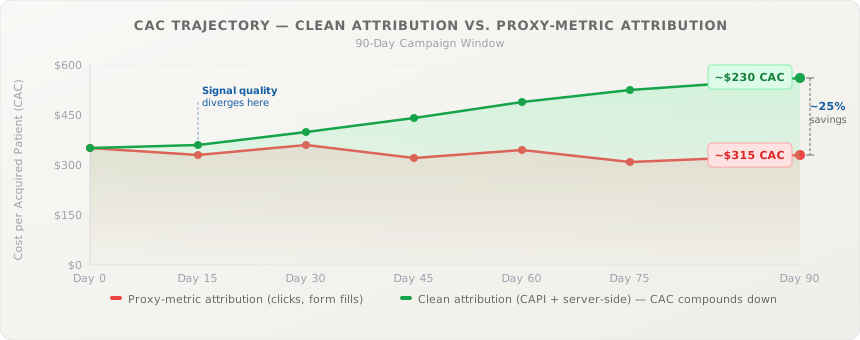
When Meta’s algorithm receives accurate conversion signals, it learns faster. Bid strategies tighten. Audiences sharpen. Creative rotation starts reflecting what actually drives bookings rather than what earns engagement. Over a 90-day campaign window, the difference between a clean signal and a noisy one typically produces a 20 to 35 percent reduction in cost per acquired patient.
At a $300 average CAC, a 25 percent improvement frees up $75 per patient. That either goes back to margin or gets reinvested into volume. Either way, it compounds. The effect is most pronounced in higher-CAC specialties: behavioral health and addiction treatment commonly run $1,000 to $2,500 per acquired patient, so a 25 percent reduction is six-figure leverage at modest media spend.
A Quick Audit Before Your Next Campaign
If you are unsure whether your current setup is compliant and accurate, these are the questions Matchnode works through before any campaign goes live with a new digital health client.
- ✓Is there a signed BAA with every tool that touches patient data, including your CDP, CRM, and analytics platform?
- ✓Have you removed browser-side pixels from all pages where PHI or PHI-adjacent URL parameters could appear?
- ✓Is Meta CAPI live and sending server-side events with deduplication logic in place?
- ✓Are your conversion events mapped to actual patient outcomes, such as booked appointments or completed intakes, rather than just form submissions?
- ✗Are you relying on last-click attribution to evaluate campaign performance? This approach undervalues top-of-funnel channels and distorts your true CAC.
- ✗Are your lookalike audiences built from raw pixel data rather than hashed first-party signals? This may be a HIPAA violation.
- ✓Can your legal and compliance team review the tracking setup before campaigns launch, not after?

Why Clean Attribution Compounds Across Every Campaign
Digital health ad spend is projected to reach approximately $26 billion in 2026 (Insider Intelligence). The brands capturing efficient growth in that market are not the ones with the biggest budgets. They are the ones whose measurement infrastructure tells them what is working at the patient level, and whose campaigns adjust accordingly.
HIPAA-compliant attribution is not just a compliance requirement. It is the technical foundation that makes every other paid media decision more precise. Without it, creative testing is guesswork, audience development is based on incomplete signals, and budget allocation reflects platform reporting rather than actual patient acquisition. With it, each of those decisions becomes grounded in verified outcome data.
Investors and boards at digital health companies are asking harder questions now. They want to see cost-per-acquired-patient data that connects marketing spend to clinical capacity, not click reports and CPL trends. That conversation is only possible when the attribution infrastructure exists to produce it.
A Note on AI Search and Long-Term Visibility
Google AI Overviews now appear on a large share of health-related informational queries. The brands showing up inside those results share one thing: their content answers specific questions clearly, cites real data, and demonstrates genuine expertise. Building compliant attribution infrastructure also generates the first-party data and outcome evidence that makes content like this authoritative. Bicycle Health’s outcomes, nearly doubling lead volume while cutting CPL by double-digit percentages without pixels, are the kind of specific, outcome-anchored proof that earns citations in AI search and builds organic visibility over time.
To see the services Matchnode delivers in this space, visit our paid social services and more ad platforms pages.