Blog

AI-Driven Digital Health Marketing: 2026 Playbook

TL;DRAI is shifting digital health marketing work from rote production to judgment. AI handles the high-volume layer (copy variants, reporting scripts, visual extension, meeting transcription) so the team can concentrate on creative direction, regulatory navigation, and client strategy. At Matchnode, this means faster creative iteration, more durable measurement under privacy constraints, and campaigns that meet healthcare's compliance bar without sacrificing performance. Last reviewed May 2026.
Key Takeaways
  • Meta.ai, ChatGPT, and Perplexity combine to produce copy that's audience-aware: Meta.ai for behavioral patterns, ChatGPT for tone calibration, Perplexity for trend-driven angles.
  • Adobe Photoshop generative AI extends image backgrounds and adapts visuals across formats, freeing the creative team to experiment without traditional design tool constraints.
  • Meta's Advantage+ Audiences and Google's Performance Max replace narrow rule-based targeting with real-time predictive systems that learn from broad signals.
  • Unbounce Smart Traffic dynamically routes visitors to the landing page variant with the highest predicted conversion, extending AI optimization beyond the ad into the destination.
  • ChatGPT and Google Gemini accelerate technical workflows: generating Google Ads scripts, automating reporting pipelines, and comparing tools like RudderStack and Freshpaint in minutes. See our performance marketing guide for how this fits into broader campaign strategy.
  • Internal AI tools (Supernormal for meeting notes, Grammarly for written communication) raise team output quality and let people stay present in conversations instead of scribbling notes.

12 min read · Pillar: Digital Health Performance Marketing

2026 Update: AI in Digital Health Marketing

AI in marketing platforms moved fast between 2024 and 2026. Five shifts now matter most for digital health advertisers.

1. Platform AI is no longer optional. Meta Advantage+ Shopping Campaigns, Advantage+ App Campaigns, and Performance Max in Google are now the default campaign types, not experimental options. For digital health, the right posture is “AI-default with manual guardrails,” not “manual-default with AI tests.”

2. AI creative generation is real for ad variants. Meta’s AI Sandbox (text variants, background generation, image expansion), Google’s Generative AI tools in Performance Max, and third-party tools like Captions, Arcads, and Pencil now produce production-quality variants at scale. The bottleneck moved from creative production to creative judgment: which concepts to test, which to kill, which to scale.

3. LLMs reshape how buyers discover digital health brands. Buyers research solutions through ChatGPT, Claude, Perplexity, and Gemini before ever hitting your site. Answer Engine Optimization (AEO) and Generative Engine Optimization (GEO) are now real growth channels. Structured FAQ content, clear value propositions, and entity-rich pages are how brands earn citation in AI answers.

4. AI cannot bypass Meta’s Health and Wellness restrictions. Smart targeting and AI bid optimization do not work around Meta’s January 2025 data restrictions or the early 2026 lead-generation wave. The right architecture is server-side payload cleansing, clean intermediary domains, and persistent ID systems, layered under AI campaigns. See our guide to Meta’s new data restrictions.

5. Internal AI tooling is a real operational lever. Marketing teams using Claude (Sonnet 4.x and Opus 4.x), GPT-4o, and custom workflows are shipping campaigns faster and with fewer headcount than peer teams without them. The competitive question moved from “should we use AI” to “which workflows give us the biggest output multiplier.”

For HIPAA-safe technical implementation under AI campaigns, see our technical services. For the synthesis pillar across digital health performance marketing, see performance marketing for digital health.

In today’s rapidly evolving digital landscape, artificial intelligence (AI) is reshaping how businesses operate, especially in the health sector. At Matchnode, we’ve embraced AI as a transformative force, leveraging it to elevate digital health marketing to new heights. From refining creative strategies to streamlining technical workflows, AI empowers us to deliver campaigns that are not only efficient but also deeply impactful. This blog takes you behind the scenes of how Matchnode integrates AI into every facet of our work, driving better results for clients and enriching the digital health ecosystem.

Take a look inside at how Matchnode integrates AI across its operations to redefine digital health marketing. We’ll explore how AI drives creativity through enhanced content generation and visual storytelling, optimizes targeting and ad delivery for precision, and streamlines technical processes to increase efficiency. By embracing AI at every level, we not only help our clients achieve measurable results but also contribute to the broader goal of making healthcare more accessible, personalized, and effective in today’s digital-first world.

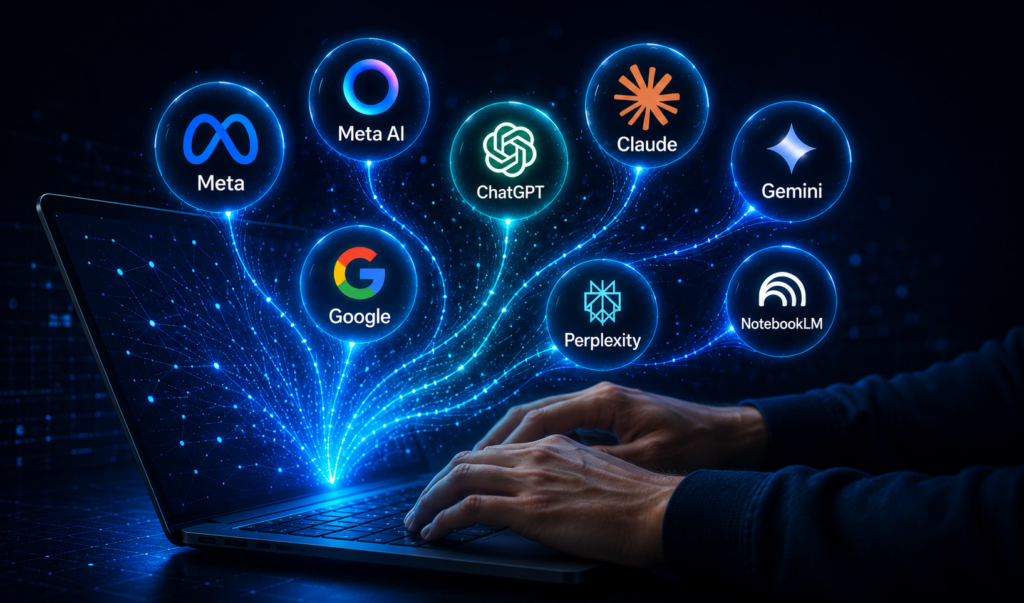
AI-driven digital health marketing showing platform AI tools for Meta Advantage+ and Google Performance Max campaigns

Creative Transformation Through AI

At Matchnode, the fusion of creativity and cutting-edge AI technology revolutionizes how we approach digital health marketing campaigns. Central to this transformation are tools like Meta.ai, ChatGPT, and Perplexity, which enable us to elevate every aspect of content creation.

Meta AI

Meta.ai, with its advanced natural language processing capabilities, allows us to analyze large datasets of audience behaviors and preferences, helping us craft copy that feels personal and relevant. For example, we use Meta.ai to identify patterns in successful ad copy, ensuring our messaging aligns with the interests and emotions of specific audience segments. Whether it’s fine-tuning headlines for higher click-through rates or creating ad variations for A/B testing, Meta.ai ensures every word counts.

ChatGPT amplifies this by adding unparalleled flexibility to our copywriting process. With its conversational prowess, ChatGPT allows us to seamlessly adjust the tone of voice for different demographics, whether a message needs to be empathetic for mental health audiences or more authoritative for professional healthcare providers. It condenses complex blog ideas into engaging formats suited for different platforms, from concise LinkedIn posts to detailed thought leadership articles.

Meanwhile, Perplexity acts as our creative brainstorming partner, generating fresh perspectives and insights based on emerging trends and campaign performance data. By leveraging these AI tools together, we ensure that every piece of copy we create is not only tailored but also optimized for impact.

Visual storytelling is another frontier where AI takes creativity to the next level. Adobe Photoshop’s generative AI allows us to expand image backgrounds, creating visuals that are immersive and adaptable for various formats, from social media ads to full-page web designs. This capability gives our creative team the freedom to experiment, refine, and produce polished visuals without the constraints of traditional design tools.

Moreover, AI helps us analyze customer testimonials to uncover themes that resonate deeply with audiences. By translating these insights into compelling visual concepts, we craft campaigns that feel authentic and relatable. This seamless integration of AI between creative and ad-buying teams ensures our campaigns are not just bold and innovative but also aligned with data-driven strategies, delivering exceptional results every time.

Nano Banana, powered by Gemini’s advanced image generation capabilities, transforms how we approach visual storytelling and creative production. From generating campaign concepts and social media graphics to rapidly testing visual directions for healthcare brands, Nano Banana helps us turn ideas into polished creative assets in seconds. Its ability to blend speed, flexibility, and high-quality image editing allows our team to experiment more freely while maintaining strong brand consistency across campaigns.

ElevenLabs enhances our storytelling capabilities through AI-powered voice generation that feels natural, expressive, and human. We use ElevenLabs to create voiceovers for video ads, podcasts, and multimedia campaigns, allowing us to quickly adapt messaging for different audiences and formats. Whether it’s delivering empathetic messaging for patient-focused campaigns or producing polished narration for thought leadership content, ElevenLabs helps us create audio experiences that feel authentic and engaging.

Precision Targeting and Dynamic Optimization

For the platform specifics on AI targeting in healthcare, including how Meta Advantage+ and Google Performance Max handle Health and Wellness audiences in 2026, see our guide to optimizing digital health ads.

Reaching the right audience is the cornerstone of successful campaigns, and AI has transformed this process from a static strategy into a dynamic, adaptive system.

Platforms like Meta’s Advantage+ Audiences leverage advanced machine learning algorithms to predict and serve ads to users most likely to engage with a brand. Unlike traditional targeting, which relies on predefined demographics or interest groups, Advantage+ Audiences analyze vast datasets in real time to identify patterns of user behavior. This allows campaigns to go beyond surface-level targeting, delivering highly personalized ads to audiences that align with campaign goals. The result is not just increased efficiency but also more meaningful engagement, as ads resonate with users on a deeper level.

On the Google front, Performance MAX campaigns take precision targeting to new heights by utilizing “signals” instead of predefined audience parameters. These signals, such as search intent, browsing behavior, and engagement patterns, inform Google’s AI about users most likely to convert. The system adapts dynamically, constantly fine-tuning ad delivery based on real-time performance data. This ensures ads reach the most relevant users at the right moment, creating a seamless and personalized experience.

Beyond targeting, AI actively optimizes campaigns in real time. It adjusts everything from ad creative iterations to placement strategies and bidding tactics to ensure peak performance. Tools like Unbounce’s Smart Traffic extend this optimization to the landing page experience. By analyzing visitor behavior, Smart Traffic directs users to the landing page variant with the highest likelihood of conversion. This dynamic adaptability means every aspect of the customer journey, from the first ad impression to the final call-to-action, is optimized for success. AI-driven targeting and optimization don’t just enhance campaign performance, they create a cohesive, data-backed experience that maximizes ROI and user satisfaction.

Streamlined Technical Workflows with AI

HIPAA-safe technical implementation, including server-side measurement and Conversions API setup, sits on top of the AI workflow layer. For details on what HIPAA-compliant tracking actually requires in 2026, see our guide to pixels, HIPAA, and the HHS.

Artificial intelligence has become an indispensable ally in simplifying technical workflows at Matchnode, empowering us to tackle complex challenges with precision and speed.

Tools like ChatGPT and Google Gemini are at the forefront of this transformation, helping us create custom scripts that enhance productivity and minimize errors. ChatGPT, known for its conversational and code-writing capabilities, acts as a versatile assistant for generating script frameworks and debugging existing code. For example, when building a Google Ads script to automate campaign reporting, ChatGPT provided the foundation for extracting daily metrics such as spend, impressions, and clicks.

This script seamlessly integrates with Mixpanel, delivering real-time insights that fuel advanced reporting and actionable strategies. Meanwhile, Google Gemini complements this process with its focus on more technical problem-solving, offering robust suggestions for structuring data pipelines and optimizing code efficiency. Together, these tools save hours of manual effort, reduce the risk of errors, and ensure that our reporting workflows are both streamlined and highly accurate. AI’s utility extends beyond coding into strategic decision-making, particularly when evaluating new technical tools. During a recent analysis of RudderStack and Freshpaint, AI provided instant, detailed comparisons of their features.

With ChatGPT’s ability to process and synthesize large amounts of technical documentation, we quickly identified that Freshpaint is tailored for teams seeking a quick setup and minimal coding requirements. It’s a go-to solution for enabling non-technical teams to deploy analytics efficiently.

On the other hand, AI highlighted that RudderStack excels in flexibility and customization, making it ideal for development-heavy projects where granular control is paramount.

These nuanced insights, delivered in moments, allowed us to make informed decisions that perfectly aligned with client needs. By leveraging AI in our technical workflows, we’re not just saving time, we’re building smarter systems that empower our team and deliver exceptional results for our clients.

Elevating Internal Processes

AI has become a driving force behind Matchnode’s technical efficiency, optimizing internal workflows and enhancing our operational capabilities. Tools like Supernormal AI Notetaker and Grammarly are integral to our daily processes, ensuring seamless collaboration and professional communication.

Gemini Notetaker further strengthens our internal collaboration by transforming meetings, brainstorming sessions, and client conversations into organized, actionable insights. With AI-powered transcription, summaries, and task extraction, Gemini Notetaker helps our team capture key discussions in real time while reducing manual administrative work. By streamlining note-taking and improving information accessibility, it allows our team to stay aligned, move faster, and focus more on strategic execution and creative problem-solving.

Supernormal AI Notetaker is a game-changer for capturing the details of virtual meetings. Gone are the days of scrambling to jot down notes while engaging in important discussions. This tool transcribes meetings in real-time, producing comprehensive, searchable records that can be accessed and referenced anytime. Whether it’s capturing strategic insights from brainstorming sessions or recording action items during client meetings, Supernormal ensures that no critical detail slips through the cracks. By eliminating the need for manual note-taking, this tool allows our team to stay fully present and focused on the conversation, fostering deeper engagement and better collaboration.

On the communication front, Grammarly elevates the quality of every written exchange, ensuring our emails, reports, and articles are polished to perfection. More than just a spellchecker, Grammarly provides advanced suggestions for tone, clarity, and style, helping us tailor our messaging for diverse audiences. For instance, when drafting client-facing reports, Grammarly ensures a professional and authoritative tone, while for internal communications, it helps us strike a balance between clarity and approachability. This level of refinement not only enhances the credibility of our work but also strengthens our brand voice across all platforms.

Together, Gemini AI Note Taker, Supernormal and Grammarly streamline our internal processes, enabling us to focus on what truly matters: delivering innovative solutions and exceptional results for our clients.

Current AI Considerations at Matchnode:


At Matchnode, the experimentation with AI agents, such as building on Claude, is advancing rapidly in 2025, unlocking powerful new capabilities. For instance, the ability to extract data from ad platforms and into a database to interact with a code interpreter stands to become a game-changer for QA, reporting, and other workflows.

These tools can help diminish errors and go a step farther than (for example) simply aggregating performance stats by creative asset: the AIs can “watch” and “listen” to videos and “see” still images, automatically generating tags to find new ways to categorize creatives, understand performance, and propose new tests.

As these tools evolve, we are eager to stay ahead of the curve, embracing the possibilities they present to amplify our marketing impact.

The Future of Digital Health Marketing at Matchnode

As the capabilities of artificial intelligence expand, Matchnode is poised to explore a new frontier of innovation in digital health marketing.


Emerging tools like Notebook LM (Language Model) promise to revolutionize how we conduct research and organize information. Notebook LM acts as a virtual research assistant, capable of analyzing complex datasets, summarizing vast amounts of information, and generating insights tailored to specific projects. By integrating this tool into our workflows, we envision a smarter, more efficient approach to campaign planning, where data-driven decisions are informed by AI-generated summaries and advanced contextual understanding. Imagine creating detailed personas or predictive strategies based on thousands of health studies and articles in mere minutes, this is the potential Notebook LM brings to the table.

The future also points toward deeper integration of AI into patient-focused initiatives. Predictive analytics, powered by advanced machine learning models, could help us anticipate health trends, enabling clients to address emerging issues proactively. Beyond trends, AI-powered chatbots are set to enhance patient engagement by delivering personalized, real-time support. These chatbots could provide patients with instant answers to common health queries, reminders for appointments, or guidance on managing chronic conditions, fostering a more connected and accessible healthcare experience. Furthermore, as wearable technology continues to gain traction, the ability to harness real-time data from devices like smartwatches and fitness trackers will open doors to hyper-personalized health campaigns. From crafting dynamic messaging based on activity levels to creating custom content tailored to individual health goals, AI will allow us to meet audiences where they are with precision and empathy. At Matchnode, the future of AI is not just about keeping pace with technological advancements, it’s about redefining possibilities in digital health marketing and creating transformative, human-centered experiences.

AI as a Catalyst for Digital Health Innovation

At Matchnode, artificial intelligence is far more than a tool, it’s a driving force behind transformative change in digital health marketing. By weaving AI into every facet of our creative, technical, and strategic workflows, we have unlocked new levels of efficiency, precision, and innovation. From crafting copy that resonates deeply with diverse audiences to using machine learning for advanced targeting, every campaign we execute is enhanced by AI’s ability to analyze, predict, and optimize. This isn’t just about better marketing, it’s about creating meaningful connections between healthcare providers and the patients who need them most. AI empowers us to translate complex medical information into accessible narratives, deliver personalized messages at scale, and connect patients with life-changing solutions in ways that were unimaginable just a few years ago.

As we look to the future, the possibilities for AI in digital health marketing are boundless. The advancements we’ve embraced so far are just the beginning. Whether it’s harnessing predictive analytics to identify emerging health trends, deploying AI-powered chatbots to foster real-time patient engagement, or integrating data from wearable technology to craft hyper-personalized experiences, the horizon is rich with opportunity. At Matchnode, we’re committed to not just keeping pace with AI’s evolution but actively shaping its application in digital health marketing. Together with our clients, we’re building a future where technology and empathy intersect, delivering smarter, more efficient campaigns that drive meaningful impact within the healthcare ecosystem. The era of AI-powered digital health marketing is here, and Matchnode is proud to be leading the charge toward a more connected and transformative future.

Related Episode

Frequently Asked

Questions, Answered

Is AI replacing human marketers in digital health?
Not at Matchnode. AI is replacing rote work (notetaking, reporting scripts, ad copy iterations, image background extension) so humans can focus on judgment-heavy work: strategy, regulatory navigation, client relationships, and creative direction. The output is better because both layers contribute their strengths.
How do you use AI without violating HIPAA or sharing PHI with model providers?
We never feed PHI or restricted patient data into third-party AI models. AI tools are used on non-PHI inputs: ad creative concepts, anonymized testimonial themes, public market research, ad performance data, and team-internal content. For workflows that touch PHI, we use server-side approaches and approved on-platform tooling (Meta Conversions API, Google Enhanced Conversions) rather than LLM pipelines.
Which AI targeting platform performs better, Meta's Advantage+ or Google's Performance Max?
Different strengths. Meta's Advantage+ Audiences excels at behavioral pattern matching from a strong creative input. Google's Performance Max leverages signals across search intent, browsing, and engagement across Google's properties. Most digital health campaigns benefit from running both with creative tailored to each platform, then comparing CPA and quality of activations downstream. For deeper coverage of cross-platform paid social strategy, see our comprehensive guide to mastering paid social media advertising.
What AI tools are worth budgeting for in 2026?
For most digital health marketing teams: ChatGPT or Claude for copy and script generation, Perplexity for research, Adobe generative AI for visuals (already bundled with Creative Cloud), Supernormal or Otter for meeting transcription, Grammarly Business for team writing quality, and the AI-native ad platform features (Advantage+, Performance Max) which are free with ad spend. The combined annual cost is small relative to the time saved.
How is AI changing creative testing in digital health?
AI is making creative testing higher-volume and faster. We use AI to generate variants on tone, headline, format, and visual style, then ship many more test cells per week than was practical with manual production. The downstream effect is that creative learnings accumulate faster and we can react to fatigue or platform-shift signals within days instead of weeks.

Let's Improve Your New Patient Acquisition

Contact Us