 Listen on Apple Podcasts
TL;DR
Meta, Google, and beyond in digital health is about matching jobs to platforms and designing for constraints. Meta is strong for generating demand. Key takeaway: Understand the strengths and limitations of various paid channels to allocate your budget effectively across platforms .
Key Takeaway
Understand the strengths and limitations of various paid channels to allocate your budget effectively across platforms.


Summary
Meta, Google, and beyond in digital health is about matching jobs to platforms and designing for constraints. Meta is strong for generating demand. It puts stories and proof in front of people who were not shopping for care. Google Search is strong for capturing demand. It connects high intent questions to the next step. YouTube can do both if the creative builds trust and shows outcomes. Programmatic and CTV bring reach, but they need sharp context and landing pages with YMYL level trust, bylines, medical reviewers, and clear actions.
Compliance shapes your stack and your creative. Expect to limit automatic tracking, send filtered server side events, and rely on modeled conversions. Creative and compliance are not tradeoffs. Write for people, then add claims review, risk language, and disclosures. For measurement, build a portfolio view. Use platform lift tests, MMM style baselines, and first party checkpoints, and compare to last click only as a reference. Budgets flow to the channels that can prove qualified sessions, engaged reads, and patient acquisition, not just cheap clicks. The result is a mix that generates interest, meets intent, and keeps trust intact.
About the Guests
Full Episode Transcript
Read full transcript
Chris Madden:
We live in a digital world. Most of us are online most of the day. Now, more than ever, you need a strategy to help your brand stand out and rise above the noise. This is Marketing Digital Health, and I'm your host, Chris Madden.
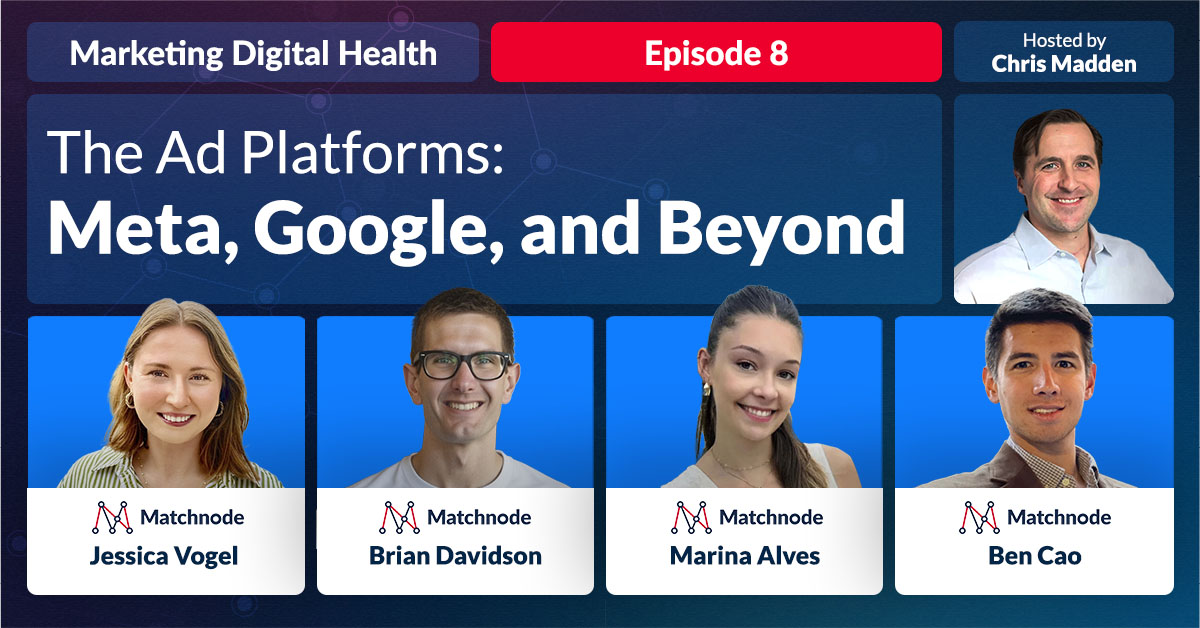
Ben Cao, Brian Davidson, Marina Alves and Jessica Vogel are getting into the specifics of each of the main advertising platforms to give you a better understanding of how to use them to your advantage.
Meta and Google Ads are foundational, with Google Search ads being one of history's great business models, as they so neatly match intent with solution. Digital health companies also tend to test other ad platforms, including TikTok, LinkedIn, Reddit, Nextdoor, programmatic and more.
Ben Cao is a digital marketing strategist focused on performance media and healthcare with deep expertise in programmatic advertising, channel orchestration, and full funnel campaign planning. Ben brings a nuanced view on what makes paid media work in complex high compliance environments. He's led campaigns across platforms for healthcare, pharma, and wellness brands, bringing both a tactical edge and strategic clarity to how digital health companies acquire and retain patients at scale.
Ben gives us a main breakdown of the social platforms.
Ben Cao:
There's a couple different tangents to go down when we're talking about search versus social and then Meta versus Google.
And so Meta and Google are both pretty synonymous with search and social, but in the social ecosystem, there are some emerging competitors to Meta. You've got TikTok, you've got Snapchat, you've got Pinterest, you've got Reddit, and so there are all these different social platforms that are now competing and vying for market share in that social space.
But Meta is still the dominant player. And if Meta isn't your primary strategy for social, then you may be missing the mark, because there's much rich data within Meta to be utilized, and then also such a wide audience. The majority of social users are still on Facebook and Instagram, and so it just can't be ignored when you're building a social strategy.
And then on the Google slash search side, I like to put Google and search together, but Google is a lot more than just search. So when you're thinking in the confines of the search channel, Google is still 90% or more of all of that search volume and capturing all of that advertising budget on search.
And then Google has expanded its reach beyond just search into the display environment, into video on YouTube, into the native space with Google Discovery. And so there's all of these different channels with Google’s marketing ecosystem in their marketing stack that Google has evolved outside of just search.
So when you're thinking of Google, most people think search, and then when you're thinking of programmatic, Google’s still one of the primary dominant players when it comes to programmatic channels as well.
Chris Madden:
Expanding on Meta ads, AI has officially entered the chat. Platforms have incorporated AI and you must adjust as well.
Jessica Vogel is the creative director at Matchnode. We introduced Jess in episode seven when we provided an overview of the paid acquisition funnel in digital health. She's digging into how AI is changing the way we create, test and report on ads.
Jessica Vogel:
There is a whole class of new AI tools that integrate with Meta Business Manager, Ads Manager that can see all of the creative all at once.
And being a visual person, it's really helpful to see creative next to the metrics, quick and fast. Meta does have creative reports that I will use on a whim if we need a quick result, but for regular reporting I've found that some of these AI tools are really helpful for finding results quick and also just display them visually in front of a client, and I can share a link to the report and it just makes the ads reporting and creative performance reporting a lot easier.
The second part of these platforms that I'm seeing with AI is I can find inspiration through Meta Ads Library and a Chrome extension, put it on these platforms and it will read the transcript of said video that I found, and I can say, I want to apply this similar script format to my brand and it will write the script for me.
That is the magic of AI that is just blowing my mind recently.
And then there's the platforms that will say, okay, this one is dropping down. It's not having nearly as high scheduled appointments than it was a week prior. And so that's where I'm like, okay, well this is falling down, it's getting a little bit more fatigued, and so I'm gonna start iterating or looking at a brief or then looking at what is the top performer and compare that to their top performer last week and what's changed.
Chris Madden:
Ben follows with a great point here. Search, social and programmatic all play different roles in healthcare. Those differences really matter.
Social builds community and brand presence. Search captures intent. Programmatic lets you be selective about the context. Showing up on health sites, blogs and publishers can reinforce your credibility. That context can be powerful.
Ben Cao:
These are also universal differentiators, and so when you're loading up a paid social campaign, the way that I think about it is you are building a community and you're also showcasing your brand through these social assets within the confines of a social media platform.
And so you can tell stories and represent a brand in a very special way through your social media profile that you don't get from search and you don't get from programmatic.
The differentiator for programmatic is you can align based off of content very differently than you can for search or social, because now you've stepped out of the confines of that social media platform, and now with healthcare, you can align yourself with healthcare focused content. You can advertise on a WebMD, you can advertise on health blogs, you can advertise on content that is talking about health, technology, news, all of these different things to contextually align with your brand.
And so when you're running a campaign on Meta, you're not necessarily next to healthcare content. You're next to all of the other content that's out there on social media, from sports content to news, to politics. So there's so many different things that your brand is next to.
With programmatic, you can be a little bit more surgical, for lack of a better term, so that you can pick and choose where exactly your content is being distributed and how your brand aligns with these different publishers.
And so that's a very big thing when you're strategizing a programmatic campaign is, how can I tell a story and present a message to my potential patients, potential customers, and also align with different publishers and different brands in that way to say, hey, we do want to be partnered up in a sense with a Forbes or with a WebMD, or with an ESPN or an AOL.
There's so many different ways to construct a programmatic campaign and so many different types of content that you can align yourself with.
Chris Madden:
Brian Davidson is my co-founder at Matchnode. We first introduced Brian in episode seven when he contributed to the overview of the paid acquisition funnel in digital health.
Brian zeroes in on Meta. He says optimization is everything and shares a few things he often sees in accounts that he would like to do differently.
Brian Davidson:
One, unnecessary fragmentation. A lot of times there's campaigns that are competing with each other that aren't segmented for any good reason other than “I want to test a message over here that's different than this message.” That can be done in a much, much cleaner fashion.
A lot of times I see a lack of video. Sometimes these businesses don't necessarily have the marketing resources to create a video, but generally speaking, Meta campaigns perform a lot better when there's a video and a still image alongside each other, even if that video is only served about 10% of the time. That's really, really important.
A lot of times I also see people not optimizing towards attribution. Facebook by default runs on seven day click plus one day view optimization. There's a lot of businesses that haven't gone through intense incrementality testing and have no idea if that view-through is important to growing their business.
So if you haven't gone through incrementality testing, generally speaking, you probably want to optimize for just that click.
Another big thing that we see are changing budgets and people moving things around unnecessarily. When we're making a change on Facebook, either we're making a really big, large, very intentful change, or we're moving things very slowly so that we're not completely disrupting the algorithm and starting over.
Chris Madden:
When it comes to Google, the name of the game in classic search ads was choosing the right keywords and making sure you're not wasting budget on the wrong ones.
Brian talks about how things are evolving with Performance Max and conversion tracking.
Quick explainer: Performance Max is a new type of Google Ads campaign that leans on Google’s AI to find your results across all of Google’s properties, and when you hear him talk about “firing your conversion,” that just means triggering the tracking code whenever someone does the thing you care about, which can be filling a form, booking an appointment, or making a purchase.
Brian Davidson:
A constant sweep for negative keywords is really important.
Sometimes there's an over-reliance on exact match or broad match. Either you're going really, really niche and missing out on conversions, or sometimes you're going too broad and you're getting a bunch of search terms that don't fit your business.
A lot of times I see people that turn on Performance Max, see a flood of spam come in, turn off Performance Max and never come back to it, rather than working and seeing if you can create some nuance or do some things on your landing page or introduce reCAPTCHA, or do different things on how you're firing your conversion back to Google.
Chris Madden:
Your media mix matters, but you can't just spread money everywhere. It's not only about reach, it's about relevance.
Was your ad seen on a billboard, discovered through Google, or surfaced on social? Understanding those touch points tells you whether your dollars are actually working.
Ben helps us put the puzzle together.
Ben Cao:
The buzz word a few years ago was multi-touch attribution. And so what the industry was moving towards was, how can we understand the most logical pathway to a conversion and what were all the touch points along the way?
And so these multi-touch attribution models were created so companies could understand how many times was the customer touched by which channels and what's the impact of each channel on their way to making that decision point, whether it's a purchase or whether it's booking an appointment or whether it's signing up for or subscribing to a newsletter.
There's all these different actions that we're trying to drive, and how can we understand which channel contributes more towards that final action? And so multi-touch attribution is still used today, but it's evolved one step further into more advanced media mix modeling to take all of that attribution data to say, okay, we're going to assign 70% of the credit from a conversion to search.
Well, now we need to understand, is it possible and is it logical to assign 70% of our budget to search, or is there a more nuanced media mix where search can only handle so much, because there's only so much search volume and so much search intent?
We might not be able to spend 70% of a million dollar marketing budget onto search. So we need to understand, okay, what's the incrementality there?
How can we maximize how much money we spend on search and then put the rest of the budget into the channels that contribute 50% to that conversion, 30% to that conversion, 15% of that conversion, and maintain those different touch points with the consumers?
Because the more times that you can capture attention, because that's really what it's about, there's a difference between putting impressions out into the ether and then delivering a message that's actually absorbed by the end user.
And so how can we understand those different touch points and then use modeling and use data to have informed decisions on where we're spending our money?
Chris Madden:
Keeping up with the trends is important, but measuring what works for you is a classic non-negotiable.
Brian talks about Facebook’s Test and Learn platform, which can include splitting your audience or doing audience holdouts to see what is really having an impact on your revenue and your profits.
Brian Davidson:
It's all about structured experimentation on Facebook.
If I'm testing one really, really big thing, I'm gonna use their Test and Learn platform. I'm gonna split my audience in half.
But there's also nuances to creative testing on Facebook. One of the things we like to do is have a separate creative testing campaign. It's difficult to insert a new creative into your champion creative and have it overtake your champion ad simply because Facebook wants to keep serving that ad that it knows is successful.
So it's hard to put a cold ad in and have it overtake the champion. So usually we're constantly running a separate testing campaign, and if we see that ad breaks out within that testing campaign, then we introduce it to the challenger.
Another new way to test on Facebook is they do allow different dynamic copy options. You can insert up to five different captions or headlines with your ad, and we like to take advantage of that as much as possible to learn different messaging nuances.
And then a lot of times we'll take those text champions and then we'll insert them into our image or our video or our landing page and see if we can get a boost there as well.
Chris Madden:
And here's the thing, if something works, try it somewhere else.
Brian’s philosophy is simple: keep testing and keep iterating. Small tweaks can unlock big gains.
In our experience, most campaigns don't fail because the idea is bad. They fail because people stop too soon and fail to capture the gains in the compounding returns of continuous, small improvements.
Brian Davidson:
You don't roll out something and say, well, that didn't work. Sometimes it takes two or three different tries in small nuanced ways to really make a difference.
It could be something like changing an attribution setting. It could be something like decreasing fragmentation. It could be something like a totally new type of creative.
It could be using a different type of campaign. It could be introducing something on the backend, like a value parameter that you're pushing through to the platforms.
There's little things that can make a really big difference over time, and I see a lot of people throw in the towel too quickly, saying, this just doesn't work for our solution. Our solution is too niche.
It's my belief that if you keep working at it and you've got a big enough team, that you can find a solution.
Chris Madden:
Now, digital health brings its own set of challenges and complexities when compared to less regulated e-commerce, for example.
Ben shares his wisdom on how patient privacy and the sensitivity of health data raises the stakes. That's what makes clear positioning, compliance, and careful messaging so critical.
Ben Cao:
There's a few different nuances when advertising digital health as compared to a straightforward e-commerce campaign where you're just getting from point A to point B and the end goal is making a purchase.
There's so many nuances with data privacy and with the messaging that's allowed and with legal compliance, and then also just the personal nature of an individual's healthcare versus buying X, Y, Z product online.
And so because there are all those different nuances and we have to make sure that our advertising is HIPAA compliant, we have to make sure our measurement is compliant, we have to make sure that our messaging is resonating with that end user and patient.
Trying to meld all of those things together while also utilizing all of the data that is available at our fingertips and all of the algorithms and all of the models that are available, it becomes increasingly challenging.
But what makes me excited about the future of digital marketing for healthcare is, because of the new legislation that's being placed and because of the direction that we're moving towards data privacy and consumer privacy, the algorithms are getting stronger and they're getting smarter when it relates to anonymizing user data and tailoring advertising experiences to individuals without being invasive.
And so we're able to separate out all these different programmatic channels and separate out search and separate out social, and then dive very, very deep into what is causing the desired action.
And so we're able to take patients on this journey and customize a messaging flow and customize an experience so that people are able to get the information that they need and get the healthcare that they need in a way that is efficient and non-wasteful for our healthcare advertisers.
Chris Madden:
There are explicit regulations like HIPAA compliance and unwritten rules like being mindful with health related imagery, or empathetic with weight loss messaging.
As Jessica Vogel points out, knowing those boundaries keeps your brand safe and your message effective.
Jessica Vogel:
Especially when working with ads focused on women and working with a client who focuses on perimenopause and menopause while offering weight loss solutions.
Meta definitely has ad regulations where you can't show before and after imagery. There's also things in digital health where it's compliance legally. Some weight loss medications are not FDA approved. You need to have fine print in there and you need to cover all your bases. Make sure that legal is looking through all of the ads and all of the copy.
HIPAA compliance is also like not sharing patient information, but we do have patient permission when it comes to some testimonials. So we've used video testimonials that patients have supplied of their experience with a client, and we're able to clip that up and use it as an ad and they have signed waivers and that's completely good to go.
Chris Madden:
We've covered the two biggest ad platforms: Meta and Google.
Now let's go into more detail about programmatic and its subcategories with Ben.
He highlights how it stands apart from search and social, the advantages of it, and why programmatic deserves a real seat at the table in your media mix.
Ben Cao:
So the main subcategories within programmatic that I focus on are display, CTV, programmatic audio, native, and I'll put rich media and high impact into its own bucket within display.
So display is your standard banner ads, and then also those rich media interactive banner ads that you see that are either animated or interactive and engaging in different ways.
That is the widest, broadest level of programmatic because generally speaking, most websites have banner ads enabled on them. So there's, at this point, millions of websites that are buying and selling display inventory for different advertisers to pick and choose from.
And so because it's so vast, you have all of these different categories to choose from between your different ad formats and sizes. Within display you've got all your different content categories. Within display you have different resellers. Within display there's a lot of data and audience enrichment partners within the programmatic ecosystem that kind of sit over all of those subcategories.
And so the beauty of programmatic that you don't get in social and you primarily don't get in search either is you have all of these different data partners at your disposal to analyze browsing behavior, to analyze that keyword behavior that we were talking about, to analyze other data aggregators to say, okay, we've got these different data sets for people's job titles, for people's browsing behavior, for their different social media aggregation in terms of what they like and what they see on social media.
And so all of these different data packages get bought and sold within programmatic, and you can layer them on to your display, to your CTV, to your programmatic audio.
So the way that I look at programmatic, it's a little bit more transparent and it's a little bit more granular than social, where social you get these black box, you can target this big bucket of people, you can target this big bucket of people, but we don't want to get too specific, because then it starts to open up questions about privacy.
And so with programmatic, because it's a little bit fragmented and you can connect different data sources to different programmatic platforms, you've got this kind of overarching targeting layer that makes programmatic very unique.
Chris Madden:
Ben lists the different subcategories of media formats within programmatic.
The first one is display, short and simple.
Ben Cao:
Display, super wide. You can put a banner ad on just about any website that exists.
Chris Madden:
The next is CTV, which is Ben’s personal favorite.
Ben Cao:
It allows you to reach the household and the living room on the TV device with all of that added targeting and all of that attribution data.
So when you're comparing CTV to traditional TV buying, you're still gonna show up on relatively the same TV shows and the same content. I can target Monday Night Football programmatically and I can buy Monday Night Football advertising traditionally and just call up ESPN and say, hey, I want to show up on your cable broadcast for Monday Night Football.
And so if I do it programmatically, I'm showing up on the same football game and I'm showing up at the same time, but I can layer on targeting job title. I can layer on zip code targeting. I can layer on household income targeting. I can layer on all these different things that you don't get with traditional TV.
And then I can also be extremely specific and surgical about the timing. Do I want every Monday Night Football game? Do I want every other week? Do I want to show up on Monday, Wednesdays, and Fridays for certain programming so that you can be so specific and so customized with connected TV, and you don't get that flexibility with traditional.
The attribution is paramount. We need to measure what the return on our investment is, and so being able to connect the TV ad back to a conversion on a separate device, whether it's someone's mobile phone or their desktop or their laptop or even a tablet, allows you to understand, okay, how effective is this TV marketing?
Is my message hitting the right people and is it driving action? And so that's a huge differentiator between connected TV and traditional TV.
Chris Madden:
The final subcategory is something currently trending right now, and you're experiencing it. It's audio.
Ben Cao:
This is a growing segment of programmatic because of how popular podcasts are becoming and because people are finding new ways to implement audio content consumption into their daily lives, whether it's in their commute, in their drive time through Spotify, Pandora, or other streaming audio components where we're not as heavy into terrestrial radio as we used to be.
And so that advertising space becomes more and more valuable as more and more people incorporate that streaming audio into that piece of their daily life.
And then podcasting, you can do the same contextual alignment with your advertising with podcasts. If you're wanting to advertise a B2B product, there's business podcasts that you can focus on. If you want to advertise B2B within healthcare, there's healthcare podcasts like this very one that you can isolate and say, hey, this is the exact content and the exact audience that I'm targeting for my healthcare product.
And within that audio component, you can be so specific with the types of content and the ways that people are engaging with different content. It's all about capturing that attention, and people are pretty leaned in when they're consuming audio content, and there's a level of trust with audio that is deteriorating a little bit with visual digital content.
We're seeing a trend towards trust with podcast hosts, and them endorsing a product or endorsing a service or a company goes a long way, because these are people that are engaging with their audience on a regular basis, developing that level of trust with their audience.
You don't necessarily have that same connection within a social media platform to develop that level of trust. And so those endorsements within the podcast space are becoming increasingly valuable, and all of that can be bought and sold programmatically.
Chris Madden:
To bring this back to how it all plays out in the world of digital health, Jessica Vogel puts herself in other shoes in coming up with a marketing approach.
In contrast to working on a typical consumer brand, she explains that there's an extra layer of empathy that comes into play here, because it's not just about selling a product, it's about people's lives, their health, their wellbeing, and that kind of responsibility changes the way you think about everything, from the messaging to the creative strategy.
Jessica Vogel:
Everybody has their different health issues. Not always. I would love for everyone to be always healthy all the time, but that's not the case.
For example, one of our clients is Midi Health, women going through perimenopause and menopause. That happens for all women.
So getting into the shoes of someone who could be going through perimenopause, or another client who is focused on mental health. For families, mental health is so, so important, and so I can empathize with patients who are needing therapy or psychiatric services.
There's a lot more pain points to identify with a digital health client or a digital health patient.
You have to almost have a little bit more empathy when you're creating these ads and to be able to get into the shoes of these potential patients, of what are they looking for in a solution.
Chris Madden:
Of course, it's great when you’ve figured out what works and have a winning formula when it comes to messaging or imagery, but the creative testing never stops.
Similarly, we test a lot of technical improvements.
Marina Alves is our technical lead at Matchnode. We introduced Marina in episode seven during the overview of the paid acquisition funnel in digital health.
Marina says there are three types of technical work she focuses on. The first one is when there's a paid ad or campaign that's brand new and needs to be set up and tracked.
Marina Alves:
That's when I'd get involved. Also ongoing would be making sure that everything that's already set up continues to work and nothing's broken, everything's still working as expected.
And the third option would be if there's an improvement to something that we already have set up, that we could change it just to make that better.
So if it's a new page, a new conversion that we want to track, I would get involved into setting up that new conversion. For the maintenance of making sure things that are already set up are working as expected, sometimes like a client goes through a website redesign or they buy a new tool that they're going to install on their website or something like that, that could change and influence the Google Tag Manager triggers or some of the other triggers that you have on your website to fire those conversion tags.
So it happens a lot of time when there's a redesign of a page, it breaks one of the Google Tag Manager triggers. And then when we notice that that's broken, we go in and fix and adjust that and make sure everything, test. It's a very big piece of the job too, testing, make sure everything's working.
And then for improvements, there's a lot of situations for maybe sometimes for Conversions API, sometimes for third party tools, especially like I keep saying form submissions. There are new integrations that come out every day. Sometimes one tool doesn't integrate with another, but one day that tool just decides to release a new integration and then we can finally start tracking something that we have never been able to track before.
So that's another piece of the job too.
Chris Madden:
Brian Davidson leaves us with some final wisdom. I'd summarize it in two ways.
First is maximizing the synergy of relationships with trusted players for the sake of your marketing strategy.
Secondly, when you see an ad with your insurance company's logo in it and saying that a treatment you may need is in network, it feels like that ad is for you specifically.
Brian Davidson:
If I had to give you one really simple piece of advice. If you accept insurance and you're allowed to use that logo, use that logo.
Those businesses spend millions and millions of dollars on their brands, and they're powerful brands. One of our first healthcare clients was eHealth in the Medicare space, and we had a really simple ad showing different insurance companies and blurred out pricing next to them, and I tried so hard to beat that ad.
And I could not beat that ad and beat those logos. They're very powerful logos.
So if you are allowed and it makes sense for your brand, test using insurance logos, not just on your landing page, but actually in the ads.
Chris Madden:
That's a wrap on today's episode.
We've covered a lot from Meta ads to Google Ads to programmatic and other digital ad platforms.
One takeaway is to test everything and to expect to crawl and then walk before you run.
Build a mix that makes sense for your stage, your goals, and your patients. Test, measure and keep refining until you've scaled the number of people that you can help.
It's not just where you advertise, it's how.
Our next episode, episode nine, explores creative strategy and testing, showing how breakthrough ideas and smart iteration can transform patient acquisition.
Frequently Asked Questions
What will I learn from this episode?
This episode covers key marketing and growth strategies specific to digital health — including practical frameworks, expert insights, and actionable tactics you can apply to your own organization.
Who is this podcast for?
Marketing Digital Health is for marketers, founders, operators, and clinicians working in digital health who want to grow patient acquisition, build trust, and navigate the regulatory landscape.
Where can I listen to more episodes?
All episodes are available on Spotify, Apple Podcasts, and at matchnode.com/podcasts/. New episodes cover a new topic in digital health marketing each time.