

- The most important healthcare marketing certification may not be a personal credential. For many regulated healthcare organizations, operational certifications like LegitScript determine whether advertising campaigns can run at all.
- Healthcare marketing certifications serve different purposes. SHSMD, CIPP/US, CHPC, Google Ads Skillshop, and Meta Blueprint each support different roles across strategy, privacy, compliance, and campaign execution.
- Google, Meta, and Microsoft do not treat healthcare certifications exactly the same. Certification requirements depend on the advertiser category, healthcare service, and platform policies.
- Most healthcare marketing courses teach marketing strategy and healthcare fundamentals but spend less time on platform policy, measurement infrastructure, privacy, and operational implementation.
- Operational fluency matters more than certification alone. Successful healthcare marketers combine platform knowledge, privacy awareness, campaign experience, and continuous learning with professional credentials.
- Choose certifications based on your role, not simply their popularity. The best credential is the one that helps you perform the work your organization actually needs.
~9 min read · Pillar: HIPAA-Compliant Advertising · Cluster: Healthcare Marketing Certifications & Compliance
Search for “healthcare marketing certification” and you’ll find dozens of programs promising to prepare you for healthcare marketing. Most of them teach marketing fundamentals with a healthcare lens. Very few explain what actually determines whether regulated healthcare campaigns can run on today’s advertising platforms.
That’s the distinction this guide focuses on. If you’re trying to hire healthcare marketers, build a digital health team, or launch campaigns for a regulated healthcare business, the certifications that matter most are not always the ones that appear on a résumé. Some are personal credentials. Others are organizational requirements that directly affect whether your advertising can be approved in the first place.
We’ll start with the certification that has the greatest operational impact, LegitScript, then explain where personal certifications like SHSMD, CIPP/US, CHPC, Google Ads, and Meta Blueprint fit into a healthcare marketing career.
LegitScript: The Organizational Certification That Matters Most
LegitScript: The Organizational Certification That Matters Most
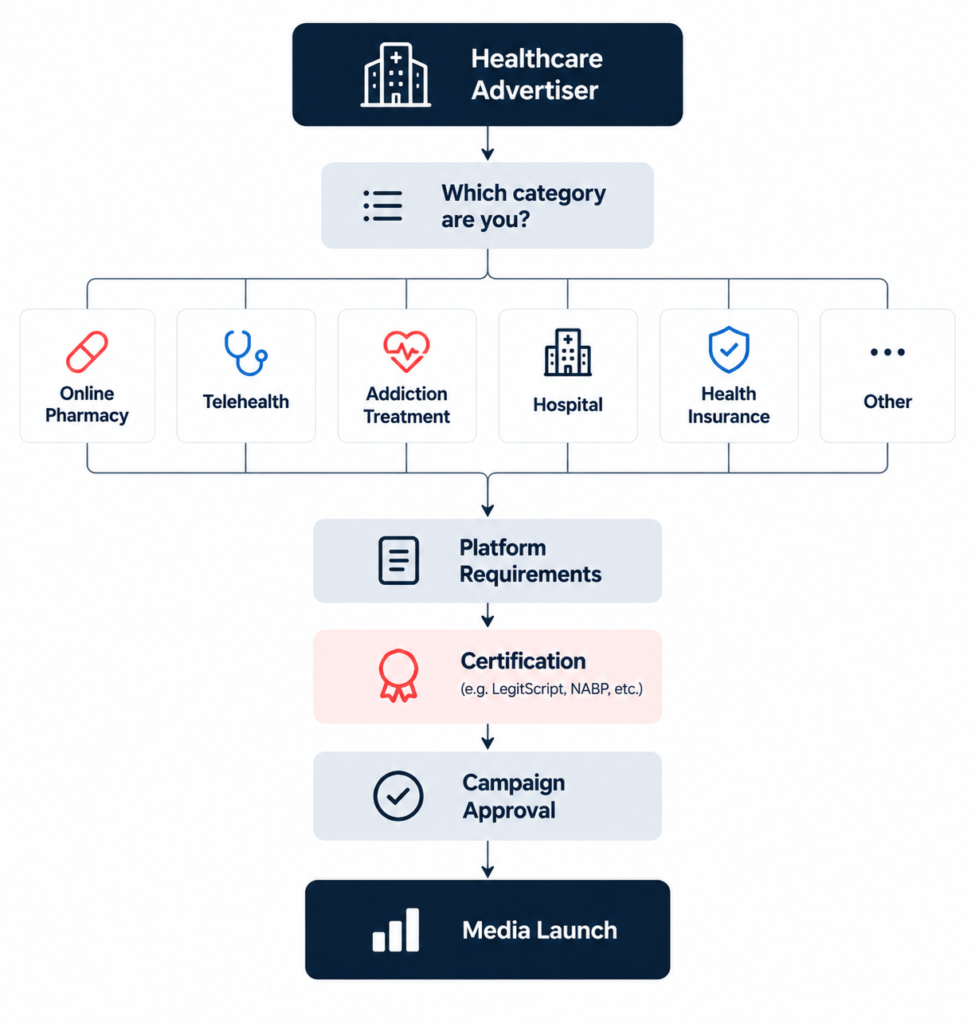
The certification with the greatest operational impact in healthcare marketing is not a personal credential. It’s LegitScript Healthcare Certification, an organizational certification that helps determine whether certain regulated healthcare businesses are eligible to advertise on major digital advertising platforms.
This is an important distinction. LegitScript is not something an individual marketer earns to strengthen a résumé. It is a business-level certification used by advertising platforms when evaluating specific regulated healthcare categories such as online pharmacies, certain telehealth services, addiction treatment providers, and other regulated healthcare businesses.
If your business falls into one of those categories, understanding the certification process should happen before campaign planning, creative development, or media buying. No amount of marketing expertise can compensate for organizational requirements that prevent campaigns from being approved.
The certification process typically involves documenting licensure, business information, regulatory requirements, and other supporting materials before review. The exact requirements depend on the healthcare category, geographic market, and advertising platform involved. Approval timelines vary, so organizations should treat certification as an operational planning task rather than a last-minute marketing requirement.
Matchnode regularly works with healthcare organizations preparing for this process by helping organize the required documentation, planning campaign timelines around certification milestones, and aligning advertising strategy with platform policy. While experienced partners can make the process more efficient, no agency can guarantee approval or bypass the review itself.
Google vs. Meta vs. Microsoft: How LegitScript Actually Fits
One of the biggest misconceptions in healthcare advertising is that every advertising platform treats LegitScript exactly the same. They don’t. While LegitScript plays an important role across regulated healthcare advertising, each platform has its own approval process, policy requirements, and category-specific rules.
Google Ads
Google generally has the most structured certification process for regulated healthcare advertising. Depending on the healthcare category and country, advertisers may need third-party accreditation such as LegitScript or NABP alongside Google’s own healthcare certification before campaigns can run. Requirements vary significantly by advertiser type, so organizations should confirm the policies that apply to their specific business rather than assuming one certification covers every situation.
Meta Ads
Meta also reviews regulated healthcare advertisers, but the process is not identical to Google’s. Certain pharmacy and telehealth advertisers may need LegitScript as part of Meta’s authorization process, while long-term advertising success often depends just as much on clean measurement infrastructure, privacy-aware event design, and ongoing policy compliance.
Microsoft Advertising
Microsoft Advertising generally follows similar healthcare advertising principles and recognizes third-party certification paths for regulated categories. As with Google, requirements depend on the advertiser category and applicable healthcare policies rather than a single universal certification rule.
The takeaway is simple: understand the certification requirements for the specific healthcare category you’re advertising in before building campaigns. Treat organizational certification as an operational prerequisite, not something to solve after media buying has already begun.
What Healthcare Marketing Certification Courses Usually Cover, and What They Skip
Most healthcare marketing certification programs do a good job teaching marketing fundamentals through a healthcare lens. You’ll typically learn healthcare consumer behavior, branding, communications, regulatory basics, HIPAA awareness, and marketing strategy for provider organizations.
Those topics are valuable, especially for marketers entering healthcare for the first time. But they rarely prepare teams for the operational decisions that determine whether regulated healthcare campaigns can actually launch and scale.
Most certification programs spend very little time on platform-specific advertising policies, healthcare measurement infrastructure, Business Associate Agreements (BAAs), server-side tracking, Meta Conversions API, Google Enhanced Conversions, consent management, or the practical decisions required to keep protected health information out of advertising platforms.
Those are the challenges healthcare marketing teams face every day. Understanding platform policy, privacy requirements, and measurement architecture often has a greater impact on campaign success than completing another marketing course.
That doesn’t make healthcare marketing certifications unimportant. It simply means they’re one part of the learning journey. Operational experience, platform fluency, and current regulatory knowledge are what ultimately determine whether campaigns perform successfully in regulated healthcare environments.
The Personal Certifications Worth Evaluating
Once your organization has addressed the certifications required to advertise, the next question becomes which personal credentials are worth pursuing. The answer depends on your role. No single certification prepares someone for every aspect of healthcare marketing, so think of these as complementary rather than competing credentials.
SHSMD Health Care Marketing Credential
The Society for Health Care Strategy & Market Development (SHSMD) offers the most healthcare-marketing-specific credential for professionals working in hospitals and health systems. It focuses on strategy, communications, branding, and market research, making it a strong choice for healthcare marketing leaders rather than campaign operators.
IAPP CIPP/US
For marketers responsible for audience data, measurement, privacy, or compliance, the Certified Information Privacy Professional (CIPP/US) is one of the strongest credentials available. It provides a broader understanding of U.S. privacy regulation that increasingly affects healthcare advertising, measurement, and data governance.
Google Ads Skillshop & Meta Blueprint
These free platform certifications remain essential for anyone managing paid media. While they are not healthcare-specific, they teach the advertising platforms healthcare marketers use every day and provide the operational knowledge needed to navigate campaign setup, policy reviews, and platform workflows.
CHPC
The Certified in Healthcare Privacy Compliance (CHPC) credential is best suited for professionals whose responsibilities extend beyond marketing into organizational privacy and compliance. For most marketers it provides valuable context, but it is generally more relevant for privacy leaders than day-to-day campaign managers.
If you’re early in your healthcare marketing career, start with Google Ads Skillshop and Meta Blueprint to build platform fluency. As your responsibilities expand into strategy or privacy, SHSMD and CIPP/US become stronger long-term investments. None of these replace the organizational certifications that regulated healthcare businesses may need before advertising can begin.
Credential vs. Operational Fluency
Credentials can demonstrate commitment to learning, but they don’t automatically prepare someone to run healthcare advertising successfully. Two marketers can hold the same certification and produce very different outcomes. The difference is operational fluency, the ability to apply platform policy, privacy requirements, and measurement decisions in real campaigns.
Healthcare marketing is no longer just about understanding HIPAA or passing a certification exam. Campaign success depends on making hundreds of practical decisions about audience targeting, consent, measurement, attribution, platform policy, and ongoing compliance as regulations continue to evolve.
The strongest healthcare marketers don’t stop learning after earning a certificate. They combine professional development with real campaign experience, platform fluency, and a working understanding of how healthcare advertising operates in practice.
Credential Without Operational Fluency
- Knows HIPAA at a conceptual level but struggles to apply platform-specific healthcare advertising policies.
- Recognizes the term Business Associate Agreement (BAA) but has never worked through one during campaign implementation.
- Implements tracking based on default platform guidance without evaluating whether the configuration is appropriate for a regulated healthcare environment.
- Treats compliance as a legal review before launch instead of an operational decision that influences campaign planning from the beginning.
Credential + Operational Fluency
- Understands how advertising platform policies affect campaign planning before creative production begins.
- Works confidently with legal, privacy, and technical teams to support compliant measurement and attribution.
- Designs campaigns around operational constraints instead of discovering compliance issues during ad review.
- Continues learning as healthcare regulations, platform policies, and measurement technologies evolve beyond what any single certification can teach.
Choosing the Right Certification for Your Role
The right certification depends less on the certificate itself and more on the work you’re expected to do. A healthcare marketing leader, a paid media specialist, and a privacy professional all need different skills. Start with the role, then choose the credential that supports it.
If you’re early in your healthcare marketing career, begin with the free platform certifications before investing in more specialized credentials. As your responsibilities expand into strategy, privacy, or compliance, add certifications that match the work you perform rather than collecting credentials for their own sake.
Before You Pay for Any Healthcare Marketing Certification
Before investing time and money in a healthcare marketing certification, ask whether the program will actually improve your ability to run healthcare campaigns. The checklist below is a simple way to evaluate whether a certification teaches operational skills or simply adds another line to your résumé.
Healthcare Marketing Certification Checklist
- ✓ Does the program explain how healthcare advertising platform policies affect campaign approval?
- ✓ Does it cover healthcare privacy, consent, and measurement decisions in practical terms?
- ✓ Are instructors active healthcare marketing practitioners rather than only academic instructors?
- ✓ Does it include platform-specific knowledge for Google Ads and Meta Ads?
- ✓ Does it discuss how organizational certifications like LegitScript fit into healthcare advertising?
- ✕ Does it promise that completing the certification makes a business HIPAA compliant?
- ✕ Does it position one certification as the answer for every healthcare marketing role?
- ✕ Does it focus only on theory without demonstrating how campaigns are planned, approved, measured, and optimized?
The best certification is the one that prepares you for the work you’ll actually perform. Healthcare marketing changes quickly, and no single certificate can replace ongoing experience with platform policies, healthcare regulations, and real campaign execution.
The Bigger Picture
Healthcare marketing is changing faster than certification programs can update their curricula. Platform policies evolve. Privacy regulations change. Measurement practices continue to shift. The professionals who succeed are the ones who combine structured learning with real operational experience.
For organizations, the most important credential may never appear on an employee’s résumé. It is the operational readiness that allows campaigns to launch, scale, and remain compliant as advertising platforms continue changing their healthcare requirements.
For individuals, certifications remain valuable because they build a foundation. The best healthcare marketers continue building on that foundation through platform fluency, operational experience, privacy awareness, and continuous learning rather than treating certification as the finish line.
If your organization is preparing for healthcare advertising or evaluating which certifications and operational requirements matter most, contact the Matchnode team. We’d be happy to share what we’ve learned helping regulated healthcare organizations navigate today’s advertising landscape.
If you’d like to hear how healthcare marketers, legal teams, and platform policies intersect in real-world campaigns, listen to the related episode of the Marketing Digital Health podcast below.
For the longer treatment, see Marketing Digital Health on Amazon.