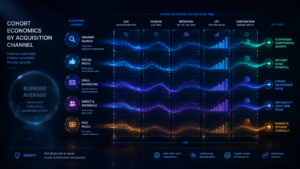

- A digital health funnel needs five distinct stages, each with its own channel mix, conversion event, and HIPAA posture, not a borrowed e-commerce template.
- No-show rates spike once a booked appointment sits more than four days out, a pattern Matchnode sees repeatedly across digital health clients.
- Over 80% of patients research a provider online before booking, making awareness-stage content and trust signals a conversion lever, not just a top-of-funnel metric.
- Happify cut CAC 93%, from $2,000 to $150 per patient acquired, by redesigning the full-funnel test around booked appointments.
- Bicycle Health doubled lead volume while cutting cost per lead 15 to 20%, without relying on browser pixels.
- Compliant measurement means CAPI events routed through a BAA-covered CDP at every stage, from first impression through CRM-reconciled attendance, not a pixel firing on a booking page.
Most digital health teams build their patient funnel like a standard e-commerce funnel, then wonder why the numbers never line up. It cannot work that way. An eligibility layer sits in front of half the traffic before a form is ever filled out. HIPAA constraints rule out the pixel-based tracking that a normal funnel leans on. No-show patterns punish anything that isn’t measured past the click. And a program that runs cleanly in one state can be non-compliant in the next. The patient funnel looks like a marketing funnel at a glance, but it needs its own model, not a borrowed one. See our telehealth patient acquisition playbook for the channel-level version of this same argument.
Mapping the patient journey to a funnel that actually performs requires four shifts: longer consideration windows, channel mix weighted toward trust-building owned content, conversion friction reduced to the absolute minimum, and measurement infrastructure that does not put protected health information on a third-party server. This guide covers each stage, the channels that move patients through it, and where the funnel typically leaks for digital health brands.
With US healthcare and pharma digital ad spend projected at $26 billion, the cost of leaving easy efficiency on the table at any stage of the funnel compounds quickly.
4+ days
out is where no-show rates start spiking on booked appointments, a pattern we see repeatedly across Matchnode digital health clients.
80%+
of patients research a provider online before booking. (Source: Doctors.com/Inc, 2018)
93%
CAC reduction for Happify, from $2,000 to $150 per patient acquired on its pregnancy Medicaid program. (Matchnode case)
2x
lead volume for Bicycle Health, with a 15 to 20% reduction in cost per lead. (Matchnode case)
The stages of the patient journey funnel
The standard funnel maps onto healthcare cleanly in name but messily in practice. Each stage carries different intent, different channels, and very different measurement constraints.
Awareness
A person searches a symptom, scrolls past a friend’s wellness post, watches a podcast clip about insomnia, or sees a brand spot during a sporting event. They do not yet know they are entering a funnel. For digital health brands the awareness stage skews heavily toward owned content and earned trust signals: educational articles that rank for symptom queries, podcast appearances, peer-reviewed research mentions, and word-of-mouth from existing patients. Paid awareness works but underperforms relative to consumer-goods benchmarks because patients discount advertised health claims more than they discount advertised retail claims.
- Most effective paid channel: SEO and owned content lead; paid social (native, education-first creative) supplements reach.
- Conversion event to track: content engagement (scroll depth, symptom-guide completion), not a form fill.
- HIPAA note: anonymous content engagement is low-risk, but avoid embedding third-party pixels on symptom-quiz or condition-checker pages.
- CAC benchmark: awareness spend is not a per-patient cost center; measure it as cost per qualified content session feeding consideration.
Consideration
The person has named their problem. Now they are comparing options: in-person versus telehealth, brand A versus brand B, insurance-covered versus cash-pay. Consideration is where paid search and paid social earn their keep. Branded and category search captures intent that has already formed; paid social retargets people who engaged with awareness-stage owned content. The consideration window for healthcare is unusually long, often 30 to 90 days, and a multi-touch attribution view is essential to credit the channels that actually moved the patient.
- Most effective paid channel: paid search (branded and category) and retargeting-driven paid social.
- Conversion event to track: scheduling page visit, tracked server-side rather than through a browser pixel.
- HIPAA note: this is where standard pixel firing creates the most exposure; route the event through a BAA-covered CDP before it reaches an ad platform.
- CAC benchmark: behavioral health CAC in this range typically runs $1,000 to $2,500 per acquired patient; category and program type shift this materially.
Conversion
The patient books, enrolls, or starts the intake form. This is the most expensive stage to lose a patient at, and it is the stage where most digital health funnels leak the hardest. The cause is rarely the marketing; it is the booking experience. Complex multi-step intake forms, insurance verification friction, identity-verification dead ends, and unclear pricing all push qualified patients out of the funnel at the moment they were ready to convert. Reducing conversion-stage friction usually returns more than reallocating ad budget.
- Most effective paid channel: none, at this stage the lever is the booking flow itself, not media spend.
- Conversion event to track: booked appointment, captured as a custom event and routed through the CDP.
- HIPAA note: booking and intake pages are the highest-risk surface for pixel exposure; confirm no client-side tag fires here.
- CAC benchmark: fixing conversion-stage drop-off before touching ad spend is usually the highest-leverage move available at this stage.
Retention
The patient becomes an active member of the program or a returning visitor. For some healthcare categories (behavioral health programs, chronic-condition platforms, primary care memberships) retention is the entire economic model. The infrastructure here is CRM, email nurture, and satisfaction surveys, aimed at keeping an already-acquired patient engaged rather than acquiring a new one.
- Most effective paid channel: largely owned, email and SMS lifecycle nurture rather than paid media.
- Conversion event to track: attended first appointment and continued engagement over a 30-day reconciliation window.
- HIPAA note: CRM-based nurture must stay inside a BAA-covered system, not a general marketing automation tool.
- CAC benchmark: not a CAC line item, measure this stage on retention rate and program engagement instead.
Loyalty
For other categories (a one-off cosmetic procedure, a single specialist consult), the equivalent of retention looks more like advocacy: reviews, referrals, and word-of-mouth that feeds the next person’s awareness stage. Loyalty and retention share infrastructure, but they require different creative and different success metrics, and a program that owns one without the other typically leaves growth on the table.
- Most effective paid channel: none directly, referral and review-generation programs run through owned and earned channels.
- Conversion event to track: referral submission or review completion, tied back to the original patient record in the CRM.
- HIPAA note: referral programs should never expose one patient’s identity to another; keep referral links anonymized.
- CAC benchmark: measure as cost per referred lead, which typically runs far below paid-channel CAC once a program matures.
What healthcare gets wrong: Most digital health brands copy a direct-to-consumer e-commerce funnel and wonder why their CAC is double the projection. The patient journey is not a 7-day purchase decision. Treat it as a multi-month relationship from the awareness stage forward, and budget accordingly.
Mapping channels to stages
The same channel can play very different roles at different funnel stages. Channel allocation should be planned per stage, not as a single annual budget split.
- SEO and content marketing own the awareness stage. Symptom queries, condition explainers, and pillar-cluster content rank for the broad searches that start a journey. Patience is required, SEO compounds over quarters, not weeks.
- Paid search dominates consideration. Branded keywords are non-negotiable; category and competitor terms get expensive but typically earn back when the LTV math supports it.
- Paid social straddles awareness and consideration. Best-in-class healthcare creative leans on testimonial-style UGC and education, not direct-response asks.
- Email and SMS nurture carry the consideration window. Multi-touch sequences that re-engage a patient three weeks after they downloaded a guide convert at multiples of the initial paid touch.
- Owned events and community shine at conversion and retention. Open houses, member webinars, and patient-led community spaces produce trust signals that paid channels cannot.
Personalization inside a compliant funnel
Personalization moves the needle at every stage, but it has to be built on first-party, consent-gated data rather than third-party audience signals scraped from browsing behavior. Segment by condition category, program type, or insurance status where the data is already first-party and BAA-covered, and personalize creative and offer accordingly. The gain is real: a personalized nurture sequence for a Medicaid-eligible segment converts at a different rate than a generic cash-pay message, and treating both audiences identically wastes spend on both sides.
Patient education as a funnel asset
Education content is not just an awareness-stage tactic, it is funnel infrastructure. A condition explainer that ranks well brings in top-of-funnel traffic, but the same asset, repackaged as an email sequence or a scheduling-page sidebar, reduces drop-off at conversion by answering the objections that would otherwise cause a patient to abandon an intake form. Building education content once and redistributing it across every stage is more efficient than producing stage-specific content in isolation.
Omni-channel patient acquisition
No single channel carries a patient from first impression to booked appointment. A realistic path touches organic search, a retargeting ad, an email nurture sequence, and a direct branded search before conversion. Planning channels in isolation, with separate budgets and separate success metrics, breaks the multi-touch view that a 30-to-90-day consideration window requires. Plan and report on the funnel as one system, not as five disconnected channel budgets.
Compliant measurement across the funnel
The funnel is only as useful as the measurement plumbing behind it. In healthcare that plumbing is non-trivial. Browser pixels firing on patient-intake pages can capture URL paths and form interactions that count as protected health information, exposing the brand and its martech vendors to HIPAA enforcement risk. For the full legal and infrastructure treatment, see our guide to HIPAA-compliant attribution for digital health brands.
Compliant funnel tracking routes all conversion events through a HIPAA-compliant CDP. At Matchnode, we implement Ours Privacy as the default server-side layer before any event reaches Meta or Google. The full operational scope of CAPI buildout, CDP integration, and server-side event tracking lives on our technical services page.
At Matchnode, we structure funnels around booked appointments, not form fills. That distinction is the difference between Happify’s 93% CAC reduction and Bicycle Health’s doubled lead volume, and a funnel that looks efficient on paper but never turns spend into attended appointments.
Three measurement milestones every compliant funnel should hit
1
First ad impression to scheduling page visit
Captured as a CAPI ViewContent event, fired server-side rather than through a browser pixel on the scheduling page.
2
Scheduling page to booked appointment
Captured as a CAPI custom event, routed through the CDP so PHI is filtered before it reaches an ad platform.
3
Booked appointment to attended first appointment
Reconciled against the CRM on a 30-day window, closing the loop between ad spend and a patient who actually showed up.
Measuring what matters, not vanity metrics
CAC, LTV, and LTV:CAC ratio tell you far more about funnel health than click-through rate or impressions ever will. For the full breakdown of which numbers to report on and which to ignore, see digital health marketing metrics that drive patient growth.
What patient acquisition looks like when each stage has an owner
Patient acquisition costs are climbing across categories, with mental health CPL up sharply year over year in recent industry data. The brands that compound advantage will not be the ones who spend more, they will be the ones who treat each funnel stage as a distinct discipline with distinct creative, measurement, and ownership.
FAQ
What is the digital health patient journey and how does it differ from a standard marketing funnel?
The digital health patient journey follows the same named stages as a standard funnel (awareness, consideration, conversion, retention, loyalty) but operates under constraints a standard funnel does not. An eligibility layer filters traffic before conversion, HIPAA rules block standard pixel-based tracking on patient-facing pages, no-show rates punish delayed booking windows, and state-by-state privacy law adds variation a national e-commerce funnel never has to handle.
Which paid channels work best at each stage of the patient journey?
SEO and owned content dominate awareness because patients discount advertised health claims more than retail claims. Paid search and paid social earn their keep in consideration, particularly branded search and retargeting against awareness-stage content. Conversion-stage performance is driven less by ads and more by booking-flow design. Retention and loyalty run on email, SMS, CRM-driven re-engagement, and referral programs rather than paid media.
How do you track patient conversions compliantly across the funnel?
Compliant tracking routes every conversion event server-side through a BAA-covered CDP before it reaches an ad platform, rather than firing a browser pixel directly on a patient-facing page. In practice this means a CAPI event for scheduling-page visits, a CAPI custom event for booked appointments, and a CRM reconciliation step for attended appointments, each filtered for PHI before it lands in Meta or Google.
What is a normal no-show rate for digital health and how does marketing affect it?
No-show rates vary widely by category, but a consistent pattern across Matchnode digital health clients is a sharp spike once an appointment is booked more than four days out. Marketing affects this indirectly: campaigns that drive faster booking windows, along with reminder-based nurture between booking and appointment, reduce the gap where no-shows accumulate.
How long does a typical digital health patient journey take from first ad to first appointment?
Consideration windows for behavioral health, telehealth, chronic-condition platforms, and primary care memberships typically run 30 to 90 days from first touch to enrollment. Some categories, like cosmetic procedures or urgent care, compress closer to 7 to 14 days. Attribution windows in ad platforms need to be lengthened accordingly to credit the channels that actually moved the patient.