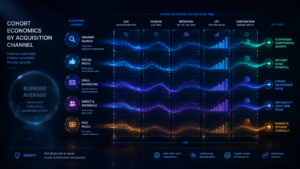

- Behavioral health patient acquisition CAC ranges from $1,000 to $2,500 per patient (BSPKN 2026), driven by a 146% YoY rise in mental health CPL (LocaliQ Healthcare Benchmarks), a 4-to-8 week consideration cycle, and high drop-off rates between form submission and completed intake appointment.
- Behavioral health demand follows two structurally distinct phases: Phase 1 (acceptance and normalization, where audiences acknowledge a treatable condition) and Phase 2 (provider selection). Running Phase 2 conversion campaigns to Phase 1 audiences produces high CPL and low intake completion not because of creative failure but because of phase mismatch.
- Meta paid social is the primary Phase 1 awareness channel for behavioral health telehealth. Google paid search is the primary Phase 2 intent channel but requires healthcare ad policy certification (2 to 4 weeks) and a validated Phase 1 audience pool before it can operate at full efficiency. Most brands should start Meta first, add Google 60 days later.
- Server-side CAPI replacing all client-side pixels is the minimum HIPAA compliance standard for behavioral health paid media. A HIPAA-compliant CDP like Ours Privacy is required to de-identify event payloads before they reach Meta or Google. Substance use disorder campaigns also require 42 CFR Part 2 review by legal counsel.
- Attribution windows shorter than 90 days systematically misattribute credit in behavioral health, making Phase 1 campaigns appear to fail when they are operating within a normal 4-to-8 week consideration timeline. Campaigns need minimum 60 days of budget stability before any major optimization decisions, and intake completion (not form submission) as the primary optimization signal.
- For the HIPAA attribution infrastructure this strategy depends on, see HIPAA Attribution and Tracking Guide. For measurement frameworks, see Healthcare Marketing Metrics. For the Phase 1 patient story content that supports normalization campaigns, see Healthcare UGC: A Patient Story Testing Framework.
Why behavioral health brands see high CPL and low intake completion rates, and how to build a channel strategy, measurement infrastructure, and compliance architecture that converts form submissions into acquired patients.
10 min read · Pillar: Patient Acquisition Strategies
A behavioral health founder running paid campaigns for the first time typically sees the same pattern: the Meta campaigns show a cost per lead that looks manageable, the form submissions start coming in, and then the intake completion rate arrives and the math falls apart. The gap between a submitted form and a completed first appointment in behavioral health is not a minor conversion optimization problem. It is a structural feature of the market driven by a consideration cycle that runs 4 to 8 weeks, by audiences who are not yet ready to commit to treatment when they first encounter a brand, and by a compliance environment that constrains how that gap can be closed with retargeting and personalization. At behavioral health CAC of $1,000 to $2,500 per acquired patient, every structural misunderstanding compounds quickly.
The behavioral health brands that solve patient acquisition do one thing differently from the start: they build for both phases of the behavioral health demand cycle, not just the bottom of the funnel. They know that the audience seeing their Meta campaigns is predominantly in Phase 1 (acknowledging a problem exists) rather than Phase 2 (selecting a provider), and they structure their campaigns, creative, measurement, and budget accordingly. The brands that run direct response campaigns to Phase 1 audiences are not failing because of bad creative or wrong channels. They are failing because of phase mismatch, and phase mismatch cannot be fixed with a new ad format or a lower CPL target.
This article covers the two-phase demand structure that governs behavioral health acquisition economics, the channel prioritization framework that follows from it, the HIPAA compliance requirements that shape every media decision in this category, and the measurement infrastructure required to understand CAC at the intake-completion level rather than the form-submission level. For the HIPAA attribution infrastructure that underpins every measurement decision in this strategy, see our HIPAA attribution and tracking guide. For the performance metrics framework that connects acquisition costs to patient outcomes, see our healthcare marketing metrics guide.
Why Behavioral Health Patient Acquisition Has a Different Economics Model
Behavioral health patient acquisition operates under cost and compliance conditions that make most generic digital health marketing frameworks inapplicable. The CAC range of $1,000 to $2,500 per acquired patient is not a failure of media efficiency. It is a function of the consideration cycle length, the audience sensitivity that constrains targeting, and the number of drop-off points between a form submission and a completed first appointment. Understanding these structural features is the prerequisite for building any channel strategy that produces a defensible cost per patient.
The Two-Phase Demand Structure Most Campaigns Ignore
Most behavioral health patient acquisition campaigns treat awareness and conversion as a single funnel. They are not. Behavioral health demand follows two structurally distinct phases that require different campaigns, different creative, and different measurement signals:
Phase 1: Acceptance and Normalization. The audience has the condition but has not yet accepted that it warrants professional treatment. Content in this phase validates the problem, normalizes help-seeking, and reduces the stigma or skepticism that delays treatment decisions in mental health and substance use categories. The conversion goal in Phase 1 is not appointment booking. It is moving the audience from “I have this problem sometimes” to “this problem is real and treatment is reasonable.” The optimization signal is content consumption and video completion, not form submissions.
Phase 2: Provider Selection. The audience has accepted they need treatment and is actively evaluating options. Creative in this phase needs to build brand-specific trust: outcomes data, patient stories that show the intake process, clinical credibility, and logistical reassurance (insurance coverage, scheduling ease, first appointment expectations). The optimization signal is CAPI intake completion, not engagement rate.
Running direct response campaigns to a Phase 1 audience produces high CPL and low intake completion not because the creative failed but because the campaign is asking for a Phase 2 commitment from a Phase 1 audience. The audience is not ready to book. They are not even ready to acknowledge they need to book. This mismatch is why so many behavioral health brands see strong form submission volume and an intake completion rate that breaks the economics. For the patient journey map that shows where Phase 1 and Phase 2 audiences sit in the decision cycle, see our patient journey and funnel guide.
The 4-to-8 Week Consideration Cycle and What It Means for Attribution
In behavioral health, the window from first digital impression to completed intake appointment typically runs 4 to 8 weeks. This is not a funnel optimization problem; it is the normal arc of a stigma-adjacent health decision. The patient who sees a Meta awareness campaign in Week 1 is making a gradual internal shift over several weeks before they are ready to fill out a form, and the patient who fills out a form in Week 3 may not complete their first appointment until Week 6 or Week 8.
The operational implication is specific: any attribution window shorter than 90 days systematically misattributes campaign credit in behavioral health. The first-touch awareness campaign (typically Meta) shows zero or near-zero conversions in a 28-day window because most of its converts have not completed intake yet. The last-touch intent campaign (typically Google search) captures all the credit for conversion events that the awareness campaign set in motion weeks earlier. This creates a dangerous false signal: early-funnel campaigns appear to fail, late-funnel campaigns appear to have unlimited efficiency, and budget shifts accordingly, which defunds the Phase 1 work that made the Phase 2 conversions possible.

Channel Prioritization for Behavioral Health Telehealth Brands
Channel prioritization in behavioral health is not purely a question of reach or cost. It is also a compliance question, because different platforms impose different constraints on how behavioral health brands can target, what conversion data they can use for optimization, and what HIPAA documentation is required before a pixel or API fires. The right prioritization sequence accounts for all three dimensions.
Meta Paid Social: Phase 1 Awareness Foundation
Meta is the primary starting channel for behavioral health telehealth brands for a specific reason: it reaches audiences who are in Phase 1 at scale. The broad interest and behavioral targeting available on Meta, combined with the video format’s strength for normalization storytelling, makes it the most cost-effective way to build Phase 1 awareness audiences before they are ready to convert. Mental health CPL on Meta now averages $141.17 (LocaliQ Healthcare Search Advertising Benchmarks) and has risen 146% year-over-year, which means Phase 1 campaigns need to be running for 60 to 90 days before they generate the engaged-audience pool that makes Phase 2 retargeting possible.
The HIPAA constraint here is not negotiable: the standard Meta Pixel transmits user-level data to Meta’s servers in a way that creates HIPAA exposure for behavioral health and mental health platforms. Every conversion event must flow through server-side CAPI with PHI stripped before the event reaches Meta’s attribution system. For the paid social infrastructure specific to this platform, see our Meta ads for digital health guide.
Google Paid Search: Phase 2 Intent Capture
Google search is the primary Phase 2 channel. Queries like “online therapy for anxiety,” “telehealth psychiatry,” or “medication management for depression” represent audiences who have already completed Phase 1 internally. They have accepted the problem and are actively looking for a provider. The intent signal is much higher than social, which produces better conversion rates to intake completion, but the volume is lower and the policy requirements are more complex.
Google’s healthcare ad policies require pre-certification for most mental health and substance use treatment categories before ads can serve. This certification process adds 2 to 4 weeks to launch timelines and restricts which landing pages and call-to-actions are approved. Starting a behavioral health acquisition program with Google search, before Meta has built the retargeting audiences and compliance infrastructure, is a common mistake that delays results and burns budget on a channel that cannot serve at full capacity without the awareness layer to feed it. For healthcare-specific Google campaign policy requirements, see our paid search policies guide and our Google healthcare ads guide.
Programmatic and Connected TV: Awareness Scale Layer
Programmatic display and connected TV are not primary channels for most behavioral health brands below $50,000 per month in total media spend. They are scale layers that extend Phase 1 reach once Meta has validated which audience segments respond to which normalization messages. The case for adding CTV specifically is real for behavioral health: the longer ad format (30-60 seconds) supports the emotional arc that normalization content requires, and CTV targeting does not carry the same HIPAA pixel exposure risk as web-based pixel targeting because the conversion event does not flow through a browser that transmits health-related URL data. For the programmatic advertising infrastructure in healthcare digital, see our programmatic advertising guide.
HIPAA Compliance Requirements Specific to Behavioral Health
Behavioral health paid media carries the highest HIPAA compliance risk in digital health. Before any behavioral health campaign launches, three compliance requirements must be in place. These are not optional risk mitigations. They are structural constraints that determine whether conversion data can legally reach the platform, and whether patient data used for audience building is handled in a way that does not expose the organization to enforcement. The regulatory landscape explains why they are non-negotiable.
Three Compliance Requirements Before Any Campaign Launches
Three requirements apply to every behavioral health paid media program:
Server-side CAPI for all conversion events. Standard Meta Pixel and Google conversion tags that fire client-side in the browser transmit URL data and user identifiers that may include PHI (for example, a URL like /mental-health-intake-form/ or /depression-treatment/) to ad platform servers. Server-side CAPI routes conversion events through a server layer where PHI is stripped before the event is transmitted. This is not optional for behavioral health: it is the minimum compliance standard.
HIPAA-compliant CDP for first-party data. When behavioral health brands use first-party patient data for audience building, for example using the email addresses of patients who completed intake to build Meta lookalike models, those email addresses constitute PHI. Ours Privacy manages the de-identification process and maintains the BAA documentation required before this data can be used in ad platform audience modeling. For the technical architecture, see our technical services page. For HIPAA-compliant retargeting alternatives, see our HIPAA-compliant marketing strategies guide.
BAA with every media technology partner. Any vendor that processes conversion data, audience data, or any data that could be used to infer a patient’s health status requires a signed business associate agreement. This includes the CDP, any analytics platform receiving behavioral health page data, and any agency partner with access to conversion event data.
Why Behavioral Health Carries the Highest Regulatory Risk
Standard HIPAA protections for PHI apply to all behavioral health records. Substance use disorder treatment records carry additional federal protection under 42 CFR Part 2, which restricts how they can be used or disclosed even in de-identified form in some contexts. The HHS issued its original bulletin on tracking technologies in December 2022 specifically in response to the practice of behavioral health and mental health telehealth platforms using Meta Pixel and Google Analytics to transmit condition-related page-visit data to ad platforms. HHS updated that bulletin on March 18, 2024. The AHA v. Becerra ruling on June 20, 2024 narrowed some of the bulletin’s scope, and HHS declined to appeal on August 29, 2024, but behavioral health and mental health categories remain at the highest end of regulatory scrutiny for tracking technology use. For the full regulatory timeline and what it means for your attribution stack, see our HIPAA pixel rules guide.
Full-Funnel Measurement for Behavioral Health Patient Acquisition
Measurement in behavioral health acquisition has one non-negotiable requirement: the primary optimization signal must be an intake-level outcome, not a form submission. Everything else in the measurement stack is built to support that requirement.
Why Form Submissions Produce Wrong Optimization Signals
The population that fills out a behavioral health inquiry form includes three distinct groups: high-intent patients who will complete intake, lower-intent browsers who wanted more information, and a significant portion of Phase 1 users who submitted a form as a research action rather than a commitment to treatment. Optimizing campaigns on form submissions preferentially selects for groups two and three, trains the algorithm on the wrong audience profile, and produces campaigns that generate increasing form volume at decreasing intake completion rates. The CPL looks like it is improving. The CAC is actually rising.
This is not a behavioral health-specific optimization problem. It is a structural feature of a high-stigma, long-consideration category where the conversion signal closest to the actual acquisition event (completed intake) is significantly farther from the ad click than in most categories where form submission is an adequate proxy.
CAPI-Powered Intake Completion as the Primary Signal
The conversion event that should govern campaign optimization in behavioral health is the completed first intake appointment, or at minimum the first appointment booking (with the understanding that behavioral health no-show rates run 20% to 40%). Routing this event to Meta or Google through CAPI requires: a server-side integration that fires the event after intake completion, a HIPAA-compliant CDP like Ours Privacy to strip PHI from the event payload before transmission, and a BAA-covered data pipeline that connects the EHR or scheduling system to the CAPI endpoint. For the full attribution methodology, see our HIPAA-compliant attribution guide.
90-Day Attribution Windows and Multi-Touch Signal Structure
The 4-to-8 week behavioral health consideration cycle requires 90-day attribution windows at minimum to capture the full conversion cycle. Without them, the attribution model misses a meaningful share of conversions that are genuinely attributable to first-touch awareness campaigns. In practice, this means:
Phase 1 (Meta awareness) campaigns will appear to have near-zero conversion in a 28-day window and meaningful conversion in a 90-day window. Phase 2 (Google search) campaigns will show strong conversions in any window because they capture intent that Phase 1 campaigns built. A correctly structured multi-touch model credits both: Phase 1 for introducing the brand during the normalization period, Phase 2 for capturing the intent signal when the audience was ready to act.
For the dashboard structure that makes multi-touch attribution visible at the channel and campaign level, see our healthcare marketing dashboard guide. For the creative testing infrastructure that determines which Phase 1 and Phase 2 messages perform best, see our creative testing frameworks guide and our healthcare UGC and patient story framework.

The Behavioral Health Acquisition Timeline
Behavioral health campaigns require structured time investment before optimization decisions are reliable. This timeline reflects the minimum threshold at each phase before moving to the next. Cutting any phase short produces optimization signals that are too early to be accurate and budget decisions that are more likely to defund what was working than what was not.
Behavioral Health Acquisition Readiness: Pre-Launch Decision Framework
Before launching or restructuring a behavioral health paid media program, evaluate readiness across three decision areas: Phase Structure (are campaigns built for two phases or one?), Measurement Infrastructure (is the program optimizing against intake completion rather than form submission?), and HIPAA Compliance (is the legal architecture in place before any conversion data flows?). The items below address all three areas. Any item marked with ✗ that is not resolved before launch will produce either inflated CAC, wrong optimization signals, or compliance exposure, and often all three.
Attribution window set to 90 days before launch. A 28-day or 30-day window will systematically misattribute Phase 1 campaign performance and produce false signals about which channels are working.
CAPI intake completion event configured as primary signal, not form submission. Form submissions include a high proportion of Phase 1 research actions that will train the algorithm on the wrong audience profile if used for conversion optimization.
Phase 1 and Phase 2 campaigns structured separately, not as a single direct-response campaign. Running Phase 2 conversion optimization against a Phase 1 audience is the primary cause of high CPL and low intake completion rates in behavioral health paid media.
Server-side CAPI configured to replace all client-side pixels on behavioral health landing pages. Standard Meta Pixel and Google conversion tags create HIPAA exposure in this category; server-side routing through Ours Privacy is the minimum compliance standard.
Google healthcare ad policy certification submitted before Google search campaigns launch. Certification adds 2 to 4 weeks to launch timelines; starting the process after Meta is live avoids a compounded delay.
Phase 1 (Meta awareness) running minimum 60 days before adding Google search campaigns. Adding search before Meta has built validated engagement audiences means the search campaigns have no retargeting pool to convert and no Phase 1 signal to inform targeting.
Patient email lists used for lookalike modeling are routed through a HIPAA-compliant CDP. Patient email addresses associated with a behavioral health brand constitute PHI; they require de-identification and a BAA before transmission to Meta or Google.
No major optimization decisions made before 60 days of budget stability. Behavioral health consideration cycles require time. Budget shifts based on 2-to-4-week performance data in this category reliably defund Phase 1 work before it can generate Phase 2 conversions.
BAA signed with every media technology vendor that processes conversion or audience data, including the CDP, any analytics platform receiving behavioral health page data, and any agency partner with access to event data.
42 CFR Part 2 reviewed by legal counsel before launching any substance use disorder campaigns. Substance use disorder records carry additional federal protection beyond standard HIPAA; the compliance requirements differ meaningfully from mental health campaigns.
Creative library organized by phase (normalization vs. conversion) before campaign launch, not by format or production quality. Running Phase 2 creative in Phase 1 campaigns is a content-to-audience mismatch that produces consistent underperformance regardless of creative quality.
CAC target defined at the intake-completion level before launch, not at the form-submission level. Knowing the acceptable cost per completed intake (not cost per lead) is the only benchmark that produces defensible budget decisions at behavioral health CAC levels.
The Bigger Picture
Behavioral health patient acquisition at the $1,000 to $2,500 CAC level is not forgiving of structural mistakes. The brands that build the right infrastructure from the start, two separate campaign structures for two separate phases, CAPI-powered intake completion as the optimization signal, and 90-day attribution windows, operate with an accurate cost model. The brands that run a single-funnel direct response program and optimize on form CPL operate with a model that systematically understates their CAC and misleads their channel allocation decisions. The capability gap is not a creative quality gap. It is a measurement and strategy infrastructure gap.
The brands building durable patient acquisition positions in behavioral health today are doing so at a moment when most of the market has not yet resolved the compliance architecture, the two-phase structure, or the attribution problem. That advantage is time-bounded. As platforms standardize HIPAA-compliant tracking requirements and as more behavioral health brands build compliant measurement infrastructure, the structural advantage of having done it first diminishes. The brands that have validated phase-specific campaign structures and intake-level attribution by the end of their first year of digital investment will have a compounding performance intelligence advantage over those still working off of form CPL data. More efficient patient acquisition at the intake-completion level means more people reached by the care they are already looking for. For the paid social infrastructure that this strategy runs on, see our paid social services overview. For the measurement and analytics infrastructure, see our technical services overview.
A Note on AI Search
Generative search is changing how prospective behavioral health patients find care information. Queries like “what does behavioral health treatment actually involve” or “how does online therapy for anxiety work” increasingly surface AI-generated responses that draw on content from providers and clinical information sources. Behavioral health telehealth brands that produce specific, accurate, credible content about their treatment approach, intake process, and patient experience are increasingly visible in these AI-generated results. The same content clarity that improves paid media performance by reducing Phase 1 friction also improves the probability of appearing in AI-generated responses to behavioral health intent queries. For the digital health patient acquisition context that authentic content strategy supports, see our patient acquisition strategies guide.