
- Facebook ads as we know them launched November 8, 2007, alongside free business pages and right-rail sponsored ads, opening the platform's 50M users to any business that would pay.
- Era 1 (2007-2014): pay for page likes, post organic content, reach followers in their newsfeed for free. The like-gate ban and 2014 algorithm change ended this era.
- Era 2 (2015-2018): layer lookalike audiences segmented by value and behavior. Constant audience testing was the main lever for improving campaign performance.
- Era 3 (2018-now): Campaign Budget Optimization launches and the playbook shifts to broad targeting plus thumb-stopping creative. The algorithm finds your buyers if the creative is good enough.
- Key infrastructure added in 2013 still drives everything: the Facebook pixel, Custom Audiences, Lookalike Audiences, and the Conversion objective. Every successful Meta program builds on these.
- The constant across all three eras: a testing mindset, especially of new platform features, has been the single most reliable source of advertiser edge since 2007.
2026 Update: Era 4 and Era 5 Since 2020
This post was originally written in May 2020. It ends with the Era 3 playbook of Campaign Budget Optimization plus broad targeting. Two more strategy eras have since defined Facebook advertising. Here is the abridged version.
Era 4: The Privacy Pivot (2020-2023)
The defining event was Apple’s App Tracking Transparency framework, released with iOS 14.5 in April 2021. Opt-in rates for cross-app tracking dropped to about 17.9% of US Apple users from a pre-ATT 72.6%. Meta reported an estimated $13 billion revenue impact in 2022. The platform response was a multi-year rebuild around server-side data flow:
- Conversions API (CAPI) matured as the server-to-server replacement for pixel-only tracking.
- Aggregated Event Measurement (AEM) deployed to preserve measurement under ATT constraints.
- Cookie deprecation announcements from Chrome reshaped the broader measurement landscape.
The strategic shift: advertisers who built CAPI infrastructure and first-party data capture kept usable measurement. Those who relied on the pixel alone watched attribution and optimization signal degrade.
Era 5: AI-Driven Targeting and Creative (2023-2026)
The defining shift was Meta absorbing audience targeting AND creative production into machine learning systems:
- Advantage+ Shopping Campaigns (2022) and Advantage+ Audiences (2023-2024) expanded the algorithm’s authority across all campaign objectives.
- AI Sandbox (2023) and native AI creative tools (2024-2025) shipped directly into Ads Manager, generating finished video from text prompts, product images, or reference clips.
- The Andromeda engine (late 2024) increased ad-candidate processing capacity roughly 10,000x, evaluating millions of ad-user combinations in milliseconds.
- Advantage+ Leads Campaigns launched in early 2025, extending automation beyond e-commerce into lead generation.
- For healthcare advertisers, Meta deployed a 3-tier data-sharing restriction system in January 2025, with a second wave in early 2026 hitting healthcare lead generation events. See our guide to Meta’s data restrictions for healthcare advertisers.
- TikTok’s US divestiture closed January 22, 2026, ending the federal ban uncertainty. Threads ad placements rolled out. Social commerce crossed $100 billion globally.
- By early 2026, Meta began defaulting new campaign creation toward Advantage+ settings.
The strategic shift: the competitive edge migrated from targeting craft and creative production capacity to creative judgment, testing volume, and the quality of conversion data feeding the algorithm.
Bottom line for 2026: the era pattern in this post (Era 1 page likes, Era 2 lookalike layering, Era 3 CBO plus broad targeting) still describes what happened. The Era 1 and Era 2 tactics are extinct for performance marketing. The Era 3 playbook of broad targeting plus thumb-stopping creative is still right, now running on top of CAPI infrastructure and increasingly assisted by AI creative tools.
For the full 2026 paid social playbook, see our comprehensive guide to mastering paid social media advertising. For healthcare-specific implementation, see our HIPAA-compliant technical services and our companion guide on pixels, HIPAA, and the HHS.
10 min read · Platform Context · Digital Health Performance Marketing
Rise of Facebook Ads, Page Likes, and Organic Reach
Meta’s advertising platform has changed more in the last three years than in the previous decade — and for digital health brands, the changes weren’t just algorithmic. The January 2025 Health and Wellness restrictions, the shift from pixel tracking to server-side CAPI, the rise of Advantage+ broad targeting — each of these grew directly from the platform evolution documented below. Understanding how Facebook’s ad strategy developed from 2007 to today explains why compliant digital health advertising now looks the way it does. For the current execution playbook, see our Meta Ads for Digital Health guide.
Facebook ads as we know them today first launched in November 2007, and since have gone on to become one of the most powerful marketing channels available to brands. But how did they get there, and how has the platform changed over the past 13 years? For one thing, the tactics that work within the platform are constantly changing, and by reviewing feature releases and strategic decisions made by Facebook, you can see a clear path to why the current tactics work, and how often they change.
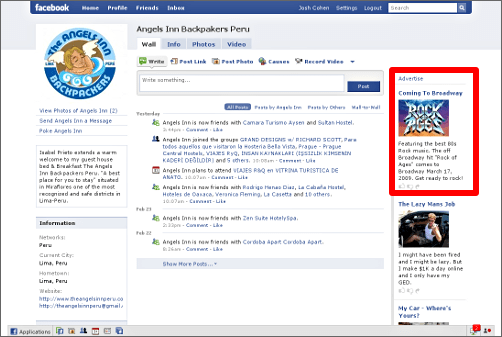
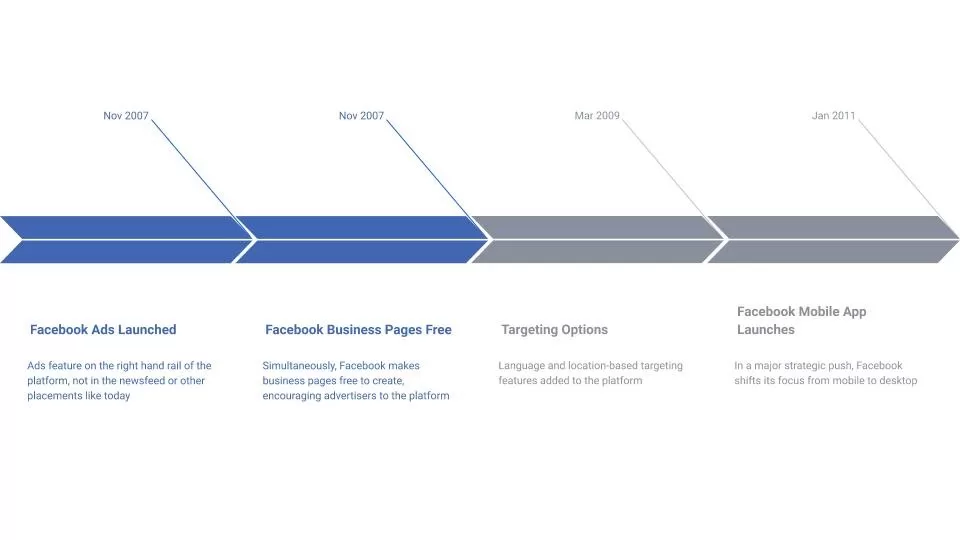 Many of us can remember Facebook spreading through their college campus, high school classes, from their kids, or from the Social Network film, but buying ads in the format we know today was not available until late 2007. On November 8, Facebook announced a number of new features to the platform, including business pages being free, and the introduction of sponsored ads to the right of the newsfeed. Before this announcement, Facebook had a number of for ads on their site, including banner ads, and revenue share agreements (Party Poker being an example of this), but this announcement opened up their massive user base (at the time, around 50 million users) to any business that would pay.
With this new set of tools available to savvy marketers, a playbook quickly developed for driving revenue: (1) Create a business page and (2) pay for ads to acquire new followers (later changed to the page likes we know today). Having someone follow your business page allowed you to post from your business page and have it show up in a user’s newsfeed for free (referred to as organic reach). With an understanding of a follower’s lifetime value to your business, you could appropriately budget a cost to acquire new followers, and use Facebook as a profitable marketing tool similar to email / CRM marketing. This set of tactics – paying for page likes, and pushing organic content through your page – was the leading tactic until 2014.
Gradually, Facebook introduced more sophistication in their ads manager platform, allowing advertisers to target by language spoken, and geography by March 2009. As Facebook grew, and became profitable (first profitable month in Sep 2009), they rapidly increased the pace of feature developments for advertisers. Early adopters that tested new features often found outsized wins, with better targeting leading to lower acquisition costs for new followers, and more engaged followers leading to higher lifetime values, leading to more opportunity to increase CPA thresholds. This trend, of iterative testing, especially of new features, remains equally important on the Facebook platform today. The tactic that drives the best returns 6 months from now is often different from what works today.

Shift to Mobile Experience, and Facebook’s Explosive Growth
In January of 2011 Facebook launches its mobile app, shortly after passing 500 million monthly active users in July of 2010, and this marks a distinct shift for both users and advertisers. Now users can have Facebook on their smartphones, greatly increasing the amount of time spent on the platform (a boon for the supply and demand model for an advertising driven business like Facebook).
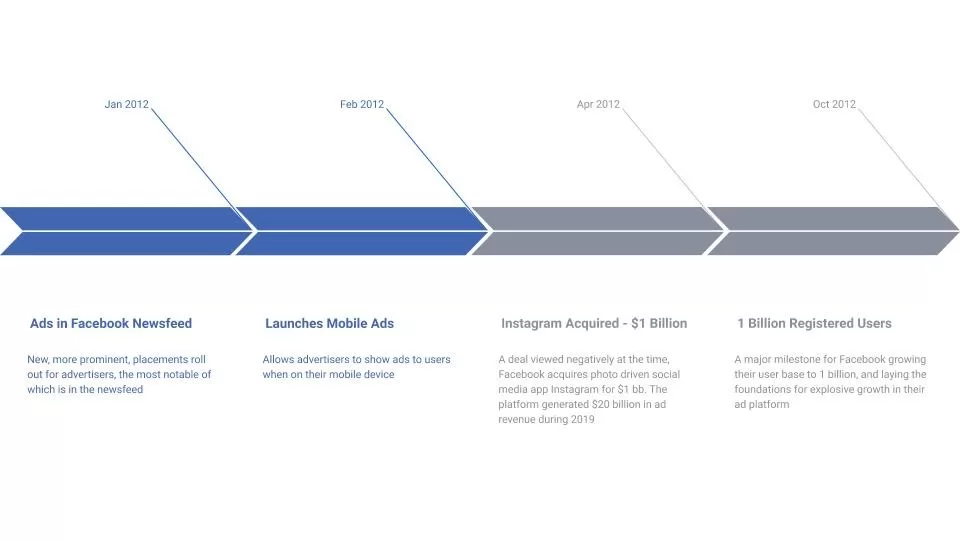 In early 2012 Facebook rolled out the ability for advertisers to place ads in user’s newsfeeds, and to advertise on the mobile app. Now with multiple placements available to advertisers, marketers needed to consider how a user that clicks on their ad in mobile vs desktop experiences their site, and to consider which placement is best for their target customer (desktop vs mobile, soon Facebook vs Instagram). As Facebook goes on to acquire Instagram in April, and IPOs on May 18, and this marks a clear shift in their strategy. As they pass 1 billion registered users mark on October 2012, the speed of new feature launches for advertisers increases greatly. These new features mark the start of a decline in using organic reach through page followings, and marks the rise of a new set of tactics on Facebook.
Facebook Ad Platform Sophistication & Decline of Organic Reach
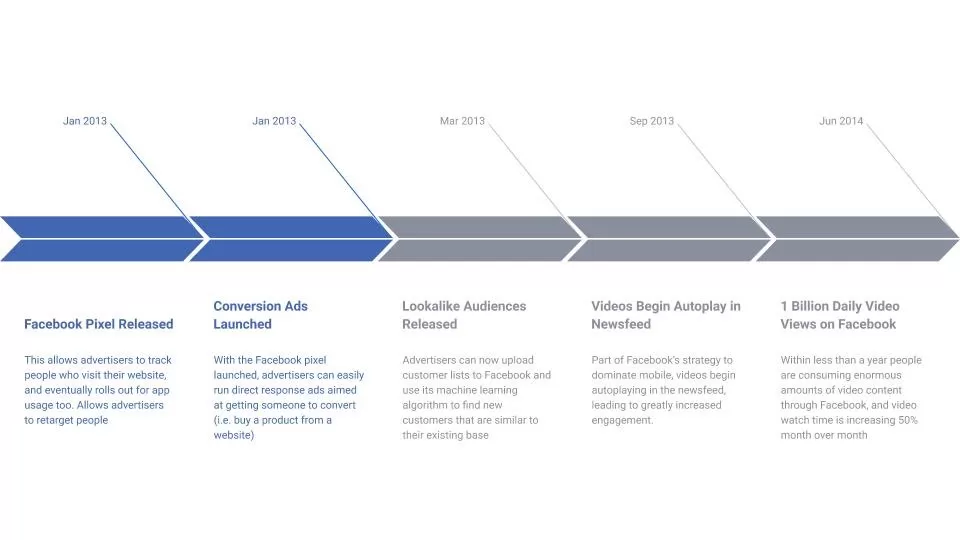
The start of 2013 brought crucial features for Facebook advertisers that are still used today. The Facebook Conversion Pixel, the Website Custom Audience Pixel (eventually merged into the Facebook Pixel of today), Conversion Ads, and Lookalike Audiences were launched. The Facebook pixel is a bit of code to install across a website that feeds data back to Facebook on how a user interacts with a website outside of Facebook. (For the modern post-cookie measurement landscape and how it has reshaped pixel usage, see the cookieless future for digital health ads and, for healthcare-specific restrictions, Meta’s new data restrictions for healthcare advertisers.) Before the Facebook pixel, if a user saw an ad for a pair of shoes and clicked off of Facebook to purchase online, you weren’t able to feed back whether that person bought or not to Facebook. Without that data, a machine learning algorithm like Facebook uses can only optimize to have people click on an ad. It can’t optimize for having someone purchase off your website because there is no feedback loop of data. So the pixel enabled ads direct response marketing, and the creation of the conversion objective ad (aka, ads that are optimized for driving people to “convert”, whether that’s buying a product, signing up for something and giving their email address, etc). Lookalike audiences were the last piece to this puzzle, giving brands the ability to scale up these acquisition efforts.
Lookalike audiences are an algorithmically generated group of people who are likely to be interested in your business because they’re similar to your existing customers. So lookalike audiences give marketers the ability to advertise to a percentage of Facebook’s 100s of millions of users that most closely resemble their existing customers. So, if you sell shoes online and have had the Facebook pixel installed on your site, you can use the data it has collected to create an audience of people who algorithmically resemble them to acquire new customers. While the specific way to leverage lookalike audiences has varied greatly over the past 7+ years, lookalike audiences are still the center of advertisers’ targeting strategy.
In conjunction with these features, Facebook changed how their algorithm prioritized content to show in a user’s newsfeed. A watershed moment in this shift is referred to as “like-gate”. In late 2014 pages were banned from concealing content on their pages if you didn’t like the page (things like content, contests, apps, or rewards), which was a common tactic at the time.
Taking away organic reach tactics like this, as well as changes in how the Facebook algorithm prioritized what content to show led to a decline in page like tactics. In a 2014 Facebook blog post, Brian Boland, Facebook’s VP of Advertising Technology wrote:
- “News Feed is designed to show each person on Facebook the content that’s most relevant to them. Of the 1,500+ stories a person might see whenever they log onto Facebook, News Feed displays approximately 300. To choose which stories to show, News Feed ranks each possible story (from more to less important) by looking at thousands of factors relative to each person.
- Over the past year, we’ve made some key changes to improve how News Feed chooses content”
(Source: https://www.facebook.com/business/news/Organic-Reach-on-Facebook)
Finding a way to balance the value for their users (see interesting content from their friends / genuine interests), and the advertisers that give them revenue for access to those users led to Facebook becoming more of a pay to play platform for advertisers.
Layering Lookalike Audiences & Rising Importance of Data Analysis
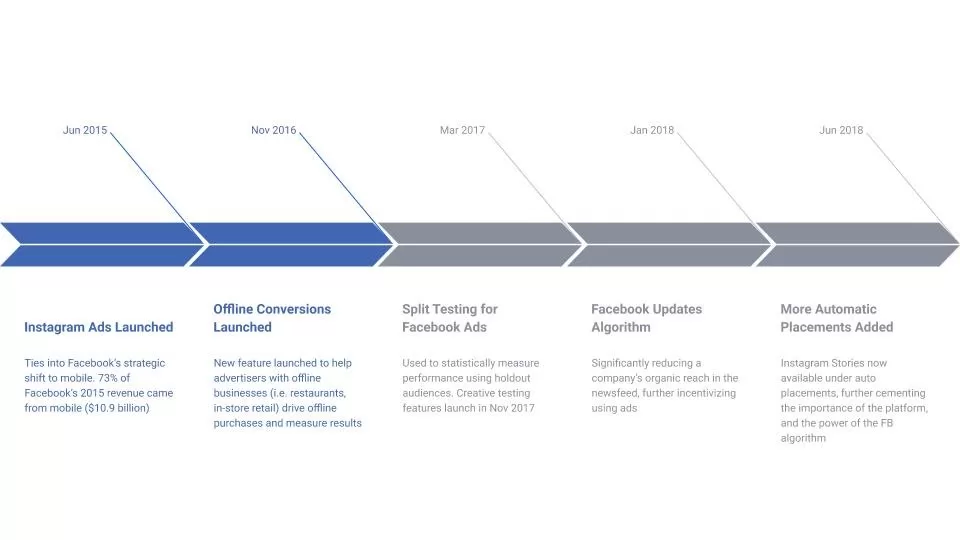
With the decline of organic reach, 2015 saw adoption of building lookalike audiences as the primary tactic within Facebook ads. The main challenge advertisers faced was successfully scaling up campaigns, or profitably increasing ad budgets. The solution?–segmenting customer lists. Segmentation by value (i.e. top quartile of past customers by order value) and importance to your business (i.e. repeat customers / highest order value customers) and layering these lookalike audiences on top of one another became the leading tactic(case and point, here’s a blog post from us in 2018 highlighting this very tactic). Constantly testing new audiences and tweaking existing targeting was one of the main levers available to improve campaign performance from 2015 – 2018.
In conjunction with this, video consumption across Facebook’s platforms was growing rapidly. In 2014, Facebook reached 1 billion daily video views on the platform, and the importance of video was only growing. In September of 2015, Instagram hit 400 million monthly active users, and in the same month Instagram ads went live. Advertisers were able to post up to 30 second videos – 15 seconds longer than that allowed by users. With people spending nearly 1 hour everyday across Facebook’s family of apps in 2016 (excluding Whatsapp) , creating thumb stopping content to break through the noise was crucial. Video often achieved that to much greater effect than still images.
As these two trends grew in importance, the impact of new product features for advertisers increased as well. From Instagram launching Insta Stories in 2016, to offline conversions rolling out, allowing “offline” businesses like retailers, restaurants, or tele-sale operations to measure how digital ads were driving revenue, more businesses came to Facebook to advertise (3 million advertisers in Q1 2016 – source).
More advertisers meant more competition on the platform, and costs increased correspondingly. CPMs (cost per thousand impressions) increased across our clients from 2015 – 2018, as well as other advertisers (Source). This is especially true for placements within the Facebook or Instagram Newsfeed – often the most popular for advertisers. The result?–marketers could no longer rely on cheap clicks and volume to achieve marketing goals.
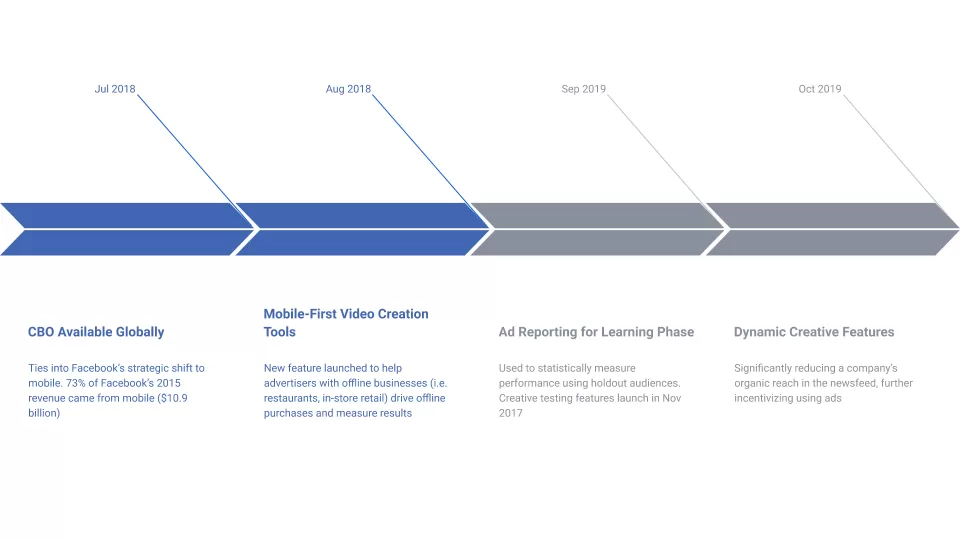
The new tactics that began to emerge from this were largely prompted by Facebook. In early 2018 Facebook announced it was changing its algorithm – decreasing the reach of organic posts from business pages further, and in July of 2018 Facebook entered its current phase of tactics with the global launch of campaign budget optimization.
The Facebook Ads Algorithm and Broad Targeting
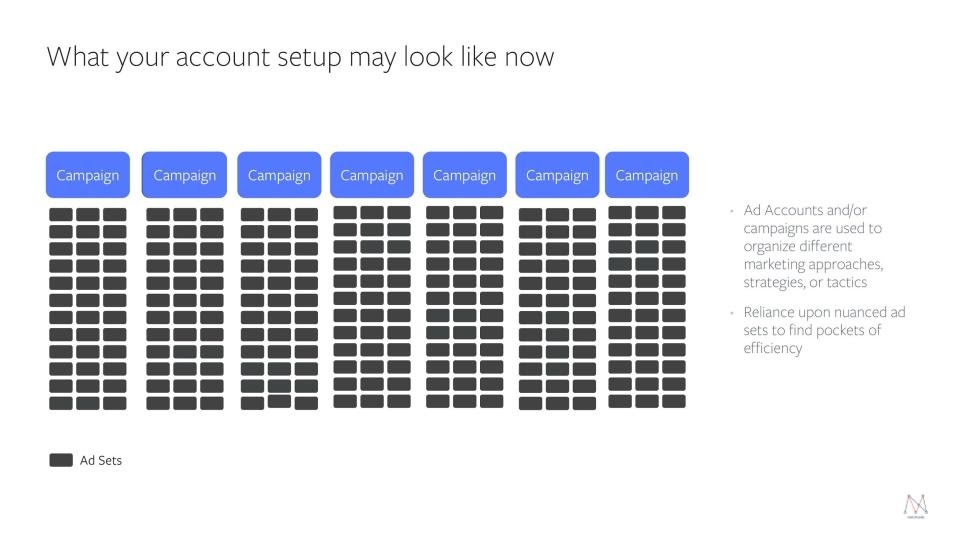
Campaign Budget Optimization allowed budgets to be set at the campaign level rather than at the ad set level, and this new feature ushered in a new era of tactics centered around “broad targeting”. Counter to the rise of layering lookalike audiences, in Q3 of 2018 a new campaign structure began to drive the best results. The idea behind this structure was to consolidate the number of campaigns and ad sets running (often a result of layering lookalikes together to improve performance), broaden your audience targeting, and allow Facebook’s algorithm to determine who to show an ad to. The common structure was 2 or 3 campaigns with a focus on prospecting and retargeting. Beneath those campaigns you have 2 ad sets. One is a high value lookalike audience, like a 1% of past purchasers, and the other completely broad with no targeting.
Why this change?–advertisers who were tasked with scaling up campaigns between 2015-2018 can attest to the challenge of cobbling lookalikes together, so this shift was driven by Facebook as a solution. This new structure is driven by the power of Facebook’s machine learning algorithm. The way a machine learning algorithm works is it learns from a sample of data what success looks like (think a spam filter improving over time, or the lock-screen images on Windows 10 growing in relevance to you as you like/dislike more images) and it gradually finds commonalities between good and bad signals. Facebook’s algorithm learns from your lookalike audience who your target customers are, and gradually learns to source them from the broad targeting ad set. This structure bypasses the “pockets of success” often found with layering lookalike audiences, and allows campaigns to scale up. This is a win for advertisers, with more stable results as ad spend increases, and a win for Facebook as advertisers spend more.
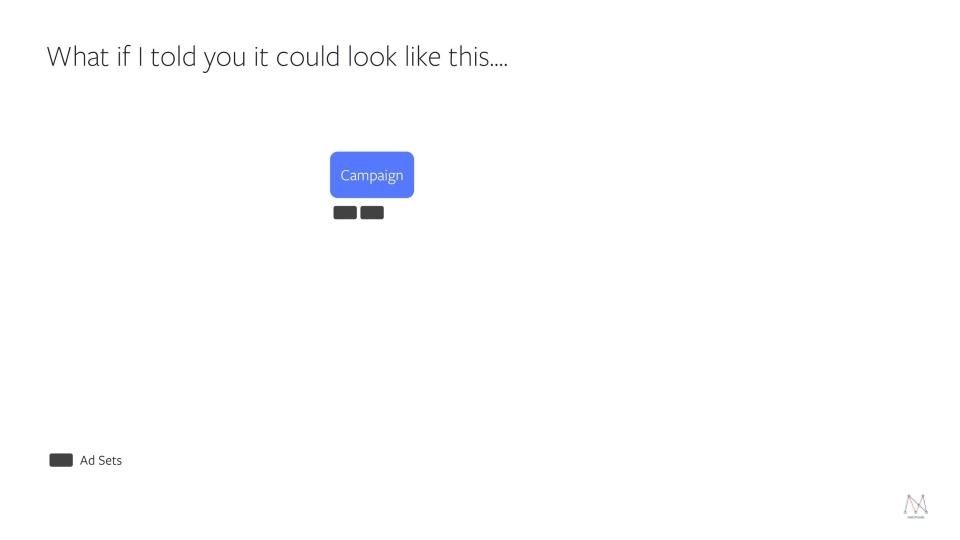
With the rise of CBO in late 2018, the importance of thumb-stopping creative to capture users’ attention rose. Less of advertiser’s time was dedicated to audience segmentation, and was redirected to creative testing. In support of this Facebook launched a wide array of mobile-first video creation tools. “Mobile-first creative” (creative assets designed with how people consume media on their mobile device) consists of things like videos that are 15 seconds or less, and designed to be played without sound (and text overlay if necessary). Our experience with clients has shown mobile-first creative drive strong results – our case study with the Chicago Bulls is an example of that.
As leaning into the algorithm gained wider spread adoption Facebook also began to highlight the importance of the learning phase. Simply put, the learning phase is a period when Facebook’s algorithm is learning how to best deliver an ad (who to show an ad to, which placement to use, when to display, etc), and exits the learning phase once performance has stabilized. The guideline provided is 50 conversions events (i.e. driving 50 unique product sales) within a 7 day period. Making changes to an ad during this learning phase resets the learning phase, and in support of this change Facebook began providing more guidance into the learning phase during mid to late 2019.
As of writing this post in May 2020, a broad targeting campaign structure was the leading playbook. It still is in 2026, now running on top of Conversions API infrastructure and increasingly assisted by AI creative tools. For the current full playbook, see our comprehensive guide to mastering paid social media advertising. We’ve found success with larger lookalikes (rather than a 1%, we often use 3%, up to 10%), and we’ve already found success layering interest targeting to our broad audience ad sets.
That said, the same fundamentals apply to 2020 as they did when Facebook ads launched. Measurement is key, and being able to properly attribute revenue to the appropriate marketing channel is the building block all your efforts will be built from. Good creative to convey the value of your product and capture attention is an ongoing, iterative process. Finally, a testing mindset is crucial. As shown here, Facebook is constantly releasing new features. Testing new features, is one of the easiest ways to gain an edge in the auction. The reality is the specific tactic that works today won’t be the one that works 6 months from now.
For how these platform shifts apply specifically to digital health campaigns today, see our Meta Ads for Digital Health guide.
If you want to stay ahead of the curve on Facebook tactics, contact us here.