

- Blended CAC can make a weak-value channel look efficient because high-value cohorts subsidize it.
- Define an acquisition cohort using the same channel and start period, then measure downstream value at consistent observation windows.
- Evaluate payback and downstream LTV together. The cheapest first visit is not automatically the best place to scale.
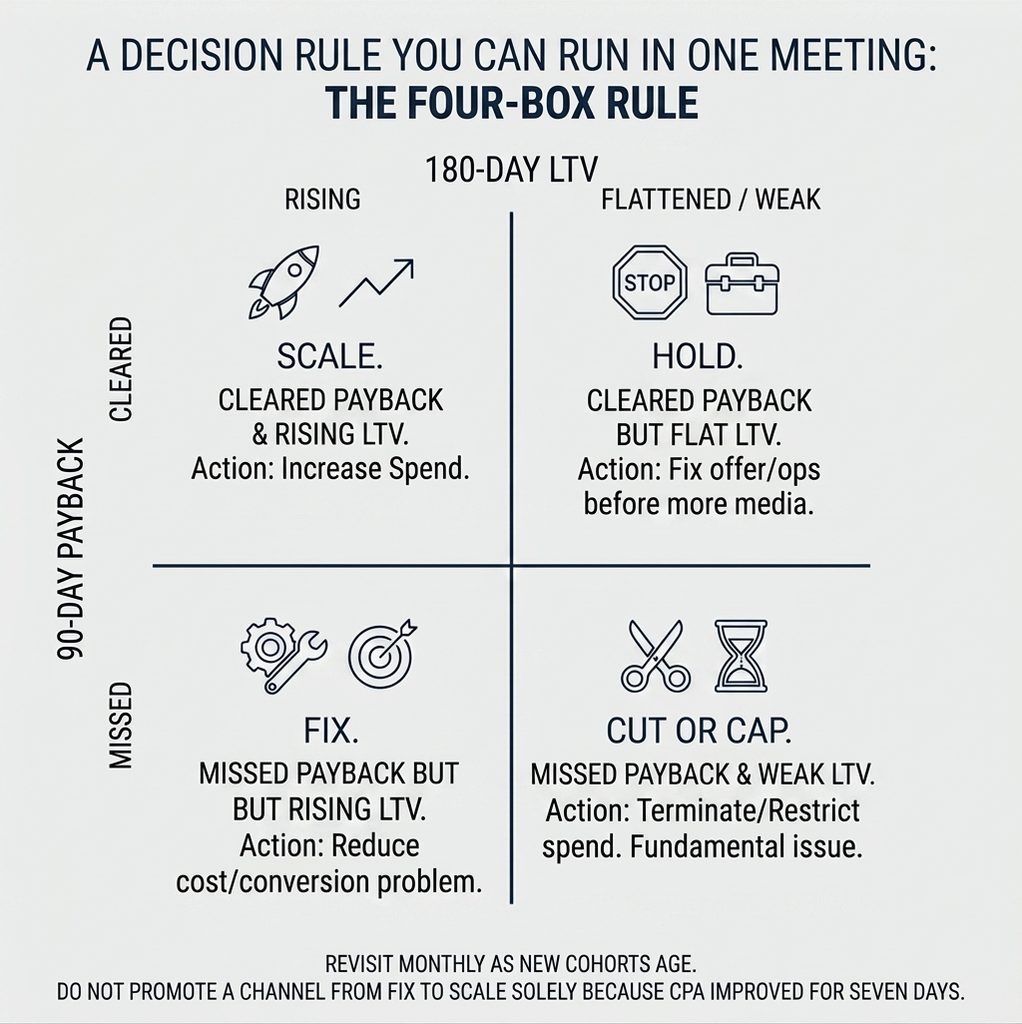
- Use Scale, Hold, Fix, or Cut to turn cohort performance into a clear budget decision.
- Do not treat ads-platform LTV as cohort LTV. Use first-party measurement and the patient value observed after acquisition.
- Use dashboards and attribution infrastructure to make cohort comparisons repeatable, but keep the budget decision grounded in CAC, payback, and downstream patient value.
8 min read · Pillar: Healthcare Data and Marketing Analytics
Growth leaders at digital health brands often scale the channel with the lowest blended CAC, then watch contribution margin stall because those patients do not stay, refill, or complete care. The problem is not only rising media cost. It is measuring success as one company-wide average instead of comparing lifetime value (LTV) and customer acquisition cost (CAC) by acquisition cohort. That comparison is how you decide which channels deserve the next dollar.
Brands that get this right treat blended CAC as a warning light, not a budget rule. They hold LTV, payback, and downstream patient value at the cohort level (same start month, same channel, same offer), then fund channels that clear payback without hiding weak value inside a blended number. Brands that skip the cohort cut keep pouring spend into cheap first visits that never become durable revenue.
This article gives you a working method: why blended CAC misleads, how to define acquisition cohorts within healthcare privacy constraints, a scorecard for comparing channels on LTV, CAC, payback, and scale, an audit checklist before you reallocate budget, and the decision rule Matchnode calls the Cohort Value Cut. Use it with your existing dashboard and attribution stack. For dashboard construction, see Healthcare Marketing Analytics: Measuring Patient Growth. For metric definitions that sit beside this method, see Digital Health Marketing Metrics That Drive Patient Growth.

Early observation window for initial cohort quality
Example checkpoint for reviewing payback progress
Longer observation window for downstream cohort value
Compare channel plus start period instead of relying on a blended average
Treat these as example observation windows, not universal benchmarks. Your actual checkpoints should reflect your care model, revenue cycle, retention pattern, and internal payback expectations. What matters is using consistent windows across cohorts so you can compare acquisition cost and downstream value without blending unlike patient groups together.
The Cohort Value Cut: Stop Trusting Blended CAC
Matchnode’s original contribution on this topic is the Cohort Value Cut: blended CAC can make a channel look efficient while hiding major differences in patient value. Measure LTV by acquisition cohort, not as one company-wide average, and use the combination of CAC, payback, and downstream patient value to decide where the next dollar should go.
A growth leader feels this when paid social “wins” on CAC in the media platform, while finance sees weaker 90-day cash recovery than branded search. The blended number looks healthy because high-value cohorts subsidize low-value ones. Conventional advice still says “scale the lowest CAC channel.” The Cohort Value Cut says the opposite: scale the channel whose cohort LTV clears CAC inside your payback policy, even if first-touch cost is higher.
What an acquisition cohort is in patient growth
An acquisition cohort is a group of patients who started through the same channel (and, when material, the same offer) in the same start period, usually a calendar month. LTV for that group is revenue (or contribution) observed after start, not a company-wide average of all patients ever acquired. CAC for that group is media and attributable acquisition cost for the same start period, not last month’s blended spend divided by all new patients.
If you cannot hold channel and start month together, you do not have a cohort. You have a blended residual. That residual is what makes saturated social look cheaper than it is when branded search patients refill at a higher rate.
The tradeoff you actually fund
Every extra dollar has two clocks: how fast cash returns (payback) and how much value remains after that (downstream LTV). A channel with a 60-day payback and thin 180-day LTV can still starve later months. A channel with a 90-day payback and strong 180-day LTV can look “expensive” in the ad account and still be the right scale bet. Your job is to pick the pair, not the cheaper first visit.
Build Cohorts Without Breaking Measurement Reality
Healthcare measurement is constrained by privacy requirements, platform signal loss, and long, uneven care cycles. Cohort LTV still works if you define start events in first-party systems (qualified start of care, first paid visit, first dispensed order) rather than in the ad pixel. Work with your privacy and legal teams to determine which patient and conversion data can be used for marketing measurement, and route permitted data through vendors and infrastructure covered by the appropriate agreements. Do not wait for perfect multi-touch. Imperfect first-party cohorts beat precise blended fiction.
For teams evaluating the technical side of privacy-aware healthcare measurement, tools such as Ours Privacy can help support first-party data collection and marketing infrastructure designed around healthcare privacy requirements. Matchnode also works with teams on the technical implementation behind these measurement systems.
Start event, cost, and value on one grain
Lock three fields to the same grain: (1) start date of the patient relationship, (2) acquisition channel at start, (3) cost incurred to acquire that start period. Then attach revenue by days since start (30, 90, 180). If finance books revenue on a different calendar, still age it from start date. Mixing fiscal months with acquisition months is how teams accidentally recreate blended CAC.
Where first-party data has to sit
Channel labels belong in the CRM or care-ops system at the moment of start, not reconstructed from last-click 90 days later. If you are still deciding what to collect, read First-Party Data Strategy Starts With the Decision. Without a durable channel-at-start field, every LTV table collapses into “unknown” and finance will force you back to blended CAC.
Callout: Do not use platform-reported “LTV” from ads managers as cohort LTV. Those models optimize for platform events, not contribution after care start. Your 90-day and 180-day tables live in the warehouse or dashboard you control.
Compare LTV and CAC by Channel Cohort
Once cohorts exist, the comparison is mechanical. For each channel and start period, compare CAC, payback progress, downstream LTV, and remaining headroom to scale without mixing in a new offer. Use the observation windows your team has defined consistently across cohorts. That comparison, not last week’s CPA, becomes the budget input.
A decision rule you can run in one meeting
Use this four-box rule. Scale: payback is on track and downstream LTV remains strong. Hold: payback is on track but downstream value has flattened, so fix the offer or operations before adding more media. Fix: payback is behind target but downstream LTV is strong, pointing to a cost or conversion problem rather than a value problem. Cut or cap: both payback and downstream value are weak. Revisit the grid as new cohorts mature rather than reacting to short-term CPA movement.
Channel Scorecard: Where the Next Dollar Should Go
The grid below is a working comparison tool, not a ranking of channels. Fill it with your own closed cohorts and use the same definitions for every channel. Compare CAC, payback, downstream LTV, cohort quality, and scale headroom on the same decision frame. The goal is to identify meaningful differences in cohort economics, then use those differences to decide whether to Scale, Hold, Fix, or Cut. For paid search strategy specifically, see How to Build Compliant Google Healthcare Ads.
| Dimension | Paid search | Paid social | Referral / partners | SEO / content | Lifecycle / CRM |
|---|---|---|---|---|---|
| Typical CAC pattern | Higher, more stable when query intent is specific | Lower headline CAC, volatile as audiences saturate | Cost sits in ops and incentives, not media CPA | CAC is lagged content cost, not weekly media | Near-zero media CAC; measure incremental lift only |
| 90-day payback | Often clears when start-of-care conversion is tight | Often misses if first visit is curiosity, not need | Depends on partner quality, not click volume | Payback is slow; judge on downstream value, not weekly CPA | Payback depends on retention, not only acquisition cost |
| 180-day patient LTV | Usually stronger when branded and condition-specific | Wide spread by creative and offer; do not blend | Can lead if clinical fit is high | Higher when content matches the care pathway | The lever is refill and completion, not new-patient volume |
| Scale headroom | Limited by query volume and compliance copy | High volume, fast saturation, signal loss | Slow scale, high ops load | Slow scale, compounding if first-party capture is real | Scale depends on list quality, consent, and incremental lift |
| Budget move | Use cohort payback, downstream LTV, and scale headroom to decide whether additional spend is warranted | Compare cohort value against acquisition cost before increasing spend or changing the offer | Compare downstream value and operational cost before expanding partner investment | Evaluate compounding downstream value against the effort and cost required to produce it | Evaluate incremental patient value and retention impact against the cost of acquisition or activation |
Reallocate Budget Without Waiting for Perfect Attribution
You do not need a finished multi-touch model to start reallocating budget. Use the cohort comparison to identify where a measured shift from weaker cohorts to stronger ones is worth testing, then watch how the next cohort performs before increasing the move. Keep a written holdout so finance can see the 90-day effect. If HIPAA pixel constraints limit platform optimization, your cohort table still runs on first-party starts. See Meta’s New Data Restrictions: A Healthcare Advertiser’s Guide for platform constraints, then return here for the budget rule.
What “proving growth” looks like to a VP of Growth
Proof is not a cheaper blended CAC slide. Proof is repeatable cohort performance, not one strong month. Look for the pattern across multiple comparable cohorts before treating a channel as ready to scale, using the payback and downstream-value checkpoints your team has defined.
Audit Before You Scale or Cut
- ✓ Channel-at-start is stored in first-party systems for every new patient
- ✓ CAC is calculated on the same start month as the cohort, not a blended quarter
- ✓ LTV is measured at consistent observation windows from cohort start, not from fiscal close
- ✓ Payback uses contribution (after variable care cost), not gross booking
- ✓ Offers and landing pages are split when they change conversion quality
- ✗ Platform LTV or ROAS is used as the budget source of truth
- ✗ Unknown-channel patients are dumped into the cheapest media cohort
- ✗ One company-wide LTV is applied to every channel’s CAC
- ✗ Budget moves on short-term CPA without checking cohort payback and downstream value
- ✓ Privacy requirements and permitted data flows are documented before connecting identity or conversion data across systems
- ✓ Scale, Hold, Fix, Cut labels are written before the budget meeting
- ✓ Next-dollar decision names the cohort, not the channel slogan
The Bigger Picture
Channel saturation and signal loss will keep making blended CAC look like a useful shortcut. It is not. Growth leaders who compare LTV and CAC by acquisition cohort can fund channels that actually produce patient value, and starve channels that only produce cheap starts. That is how you measure success and attribution for budget, not for a vanity dashboard.
Matchnode’s Healthcare Data and Analytics work, together with Patient Acquisition and HIPAA-Compliant Advertising, is built to make this comparison operational. If you want help installing the Cohort Value Cut on your mix, contact the team.