
- Blog & Podcasts, Marketing Digital Health, Podcasts
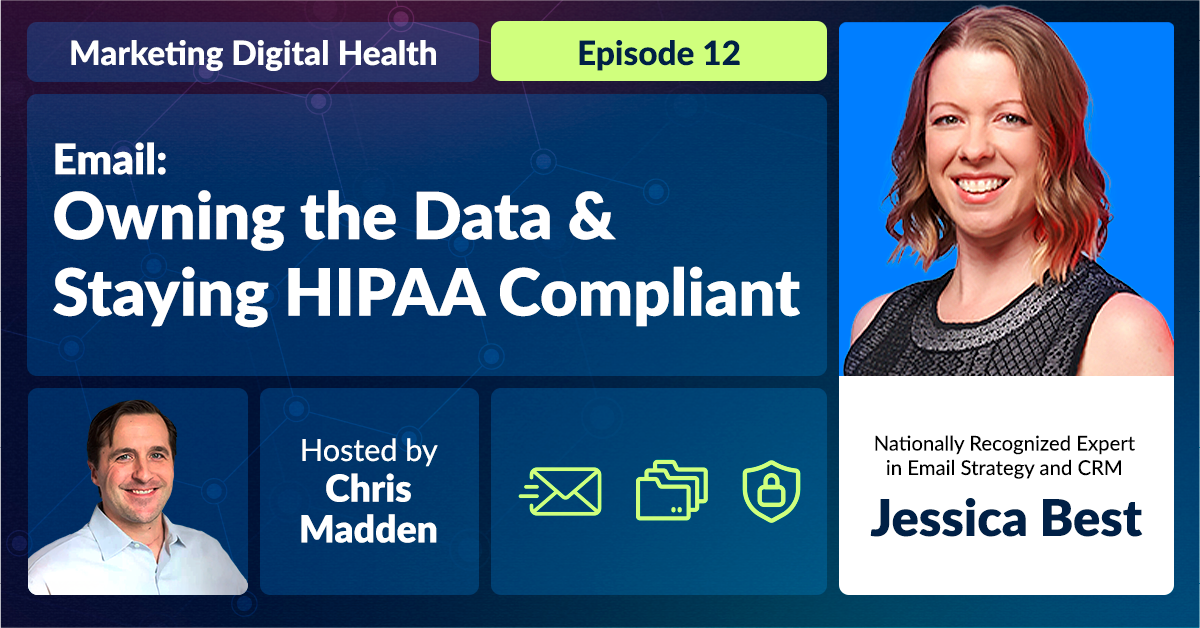
Marketing Digital Health: Email: Owning the Data and Staying HIPAA Compliant


Summary
HIPAA compliant email marketing gives digital health teams control, reach, and a direct line to patient needs. Start by owning your audience with permissioned list growth, clear value exchange, and a preference center that sets expectations. Keep consent records clean. Follow HIPAA basics for marketing, avoid PHI in bulk emails unless you have the legal basis and a BAA with your provider, and segment without exposing conditions. Deliverability is a strategy, not a checkbox. Protect your sender reputation with authenticated domains, engaged segments, and steady sending patterns.
Design lifecycle programs that help people at key moments: a welcome sequence that sets expectations, education series that reduce anxiety, pre‑visit prep that improves show rates, adherence nudges that support better outcomes, refill and follow‑up reminders, and win‑back flows after a gap. Personalize with zero‑party and first‑party data collected transparently, then let subscribers set preferences for frequency and topics. In the inbox, simple templates, scannable sections, and clear CTAs work best. Test subject lines and journeys, not just button colors. Measure what matters: clicks to qualified sessions, form progress, booked appointments, adherence actions, and reactivation. Done well, email compounds trust and lifetime value while keeping privacy intact.
Takeaway
Explore how email marketing allows you to retain control of your audience, personalize outreach, and remain HIPAA-compliant at scale.
About the Guests
This episode brings a veteran email strategist who turns CRM best practices into practical wins for health brands.
We've gotta have a really good subject line, and we should be using data to drive the content of our emails.
Jessica Best
A nationally recognized expert in email strategy and CRM, helping brands—from Fortune 100s to healthcare leaders—unlock better performance through smarter email programs. Whether it's fixing deliverability, rethinking lifecycle strategy, or adapting to changing creative best practices, Jessica brings practical clarity to the most reliable channel in digital marketing: email.
Full Episode Transcript
Marketing Digital Health: Email: Owning the Data and Staying HIPAA Compliant
Chris Madden:
Email marketing isn’t new, but the way we use it is changing fast. And if you’re not thinking about automation data, and even AI when it comes to email. Then honestly, you’re leaving money and momentum on the table. This is Marketing Digital Health, and I’m your host, Chris Madden. Today we’re looking at how email gives you something you don’t always get in other channels.
Direct personal connection with your audience without relying on rented platforms like social media. And with the right setup, it can scale smartly using segmentation. Automation and the first wave of AI powered tools to help us break it all down. I’m joined by Jessica Best. Jessica Best is a recognized expert in email strategy and CRM helping brands from Fortune one hundreds to healthcare leaders unlock better performance through smarter email programs.
Whether it’s fixing deliverability, rethinking lifecycle strategy, or adapting to changing creative best practices. Jessica brings practical clarity to the most reliable channel in digital marketing, which is email. Let’s begin with the first thing that makes email different from every other channel, that subject line.
Jessica Best:
One of the things that’s super important in email marketing is the subject line. It’s not just a headline. This is whether or not they open the email. 40% of that decision depends on the subject line. Now, another 40% depends on the from name. Also not maybe something you think about in other channels. Who do we send it from?
Is it from Chris or is it from Match node? There’s a lot of differing opinions out there and I have some data that says that if I don’t recognize that name, that email doesn’t stand a chance. If it’s gonna come from Chris, I better know who Chris is or Chris at Match Node is a nice combination option.
So these are the ingredients that maybe exist in email that don’t exist in other channels. But the other piece is data. The fact that when I send out an email, I might send it to a hundred people, but there are 10 different groups or three different segments of that list that needs something a little bit different, a different product feature, a different contract size, whatever it is.
All that specificity is really hard to do without an incredibly robust media spend, paid media spend. So typically that’s one of the things that I see people maybe not taking as much advantage of is email’s just a little bit of a different beast. We need to make sure that we’ve got a good blend of image and text.
We’ve gotta have a really good subject line, and we should be using data to drive the content of our emails.
Chris Madden:
There are so many elements to get right in an email. The design, the data, the content, the call to action, and the trade off is real. You want it to look good, but you also need it to work. So I asked Jessica, how do you make smart choices when every brand, audience and funnel looks different?
Jessica Best:
I worked at a very brand driven agency for the last eight years before my consultancy, and a lot of those clients are brand first. We’re talking about beautiful emails. Who cares if they work for everybody? It has to be a balance, especially when you start talking about things like B2B. It can’t be one big designed image that’s not gonna land very well, and a lot of folks here on the go, you get your email on a mobile device.
That image could take. Three seconds to load. I don’t have three seconds. So I think it has to be a good balance of image and text no matter whether you’re B2B, B2C, restaurants or healthcare. If we’re talking about the data that drives results, plain text emails can be really effective, specifically in B2B in a sales automation sense.
Because it can look like it came from Jess at BetterAve or from Chris at match node, and I think that’s pretty powerful. We forget that automation is one of email’s greatest superpowers, and if we can automate those things, that should could, would be done by a human. Otherwise, that human’s time is then freed up for things like phone calls, which I can’t do from the email team.
Plain text emails can work. I would lean towards not making plain text emails the whole arsenal. Even healthcare brands have a brand. There’s something that a visual can tell you faster than five paragraphs of text, whether it’s a happy patient, whether it’s a resolved issue, whether it’s how quickly you can be seen, whatever that is.
It can be really quick to get that through a visual or image as opposed to having to read five bullets.
Chris Madden:
And that’s where automation comes in. The more tech you have behind your emails, the more personalization and efficiency you unlock. And that comes with some setup needs.
Jessica Best:
Depending on which email platform you have, segmentation and automation and data-driven email can be really easy or.
Let’s say really complex, the complexity does come with complication. So there are some pieces of data that are in a system that just does not talk to your CRM, let alone to your email platform yet that it’s gonna be harder to get to. And you probably need either a team member or an expert on the outside to help you integrate those systems to draw up what it looks like to have those systems talk to each other, how often.
Who wins if the data’s different in each system, those types of things. There are some technical requirements there when you get more complex, but the truth is that a lot of this stuff can be plug and play these days. I mean, thank God of all the things that computers can do for us, talking to each other should be one of them, literally in email platforms.
Second most important job is to make sure that it can get the data in. Fast enough to take action on it. And so a lot of the email platforms that we see today, whether that’s Salesforce or Klaviyo, a lot of those we see have prebuilt walkie-talkies to some of the systems that we think are gonna be the most important to feed data into our campaigns.
So automation lifecycle marketing, we gotta have data at every stage. Think about how important it is to know when somebody is a new lead. Versus a cool last lead versus a hot lead that just like they reactivated and they’re starting to engage again. That data has to go back and forth. I need to tell the CRM that somebody’s coming in hot on the other side and starting to open a lot of our emails.
Conversely, the sales team’s CRM updates on, I have a call with this person on Thursday that has to make it over into the email platform, or I’m going to keep nurturing them while you’re physically on the phone with them. So that’s the type of data that there are a lot more prebuilt connections that can.
Sync that back and forth without a person having to oversee it. And my favorite chief here, by the way, if you’re a small team and maybe don’t have a database development team yet, try Zapier. They have an entire marketplace of Zaps apps that connect common CRM tools with common email platform tools. So if the only thing you’re looking for is to really power your lifecycle marketing and you know that those two systems have to talk to each other, that is one of my favorite cheats.
Chris Madden:
AI is taking email to another level, not just in writing content, but in how platforms talk to each other and execute campaigns. But it also raises a question, how much should we rely on AI, especially in healthcare where trust and accuracy matters so much.
Jessica Best:
The keyword or the buzzword, the Peewee Herman word of the year is AI.
For the last two years probably, and one of the things that I find interesting is that in email marketing, we’ve been using AI, artificial intelligence and machine learning ML for about 10 years. And I don’t mean disparagingly. We haven’t been using generative AI, which I think is having its moment right now.
But if you think about the way that data powers decisions in email platforms. That’s artificial intelligence. It’s rules based, or it’s making its own rules, which is that machine learning part of it. We’re letting the computer move faster than human beings that could make those decisions individually.
That’s how we get segmentation. Some of the email platforms out there will say, this is your top 20 most engaged database. I could pull that. I could literally also do that manually, but the computer did it for me. AI did that for me, and I think there’s a sliding scale of. How robust AI is involved in the decisions, and I would say that from an automation perspective, AI has to do this stuff.
I literally can’t do it fast enough to make it make sense. From a content perspective, I have been a little shy at getting AI involved in things like set up my data sync between system A and system B. I don’t want AI to do that. I do want automation to do that. I do want an app to do that, but I want it to follow my specific instructions because that can get messed up in the scariest ways, and I wanna make sure that it follows my pretested.
Process. So I think AI can help with things like, did you mean this? Or you probably want this other piece of data, and it was excluded originally. Do you want Yep, absolutely. I wanted to make suggestions, but I don’t want to take the lead yet on talking between systems and connecting systems.
Chris Madden:
Jessica‘s hesitation with generative AI makes sense. Digital health isn’t the space where we can hand the keys over to a robot and walk away. We still need human involvement as fast as AI is improving. Right now, it is still more like a smart intern than a seasoned strategist.
Jessica Best:
For generative AI. I am a little nervous to give the final writing piece over to.
What I think of as an intern and maybe a new intern, by the way, like I think generative AI is really young and it’s gonna get a lot better, but I love the idea of digging into your own data and figuring out what’s worked, and knowing that if you’ve got seven years of data, there’s some recency required to that data to make it true.
There’s an amount of data to train that model that will make it better, smarter. And I think that’s really important, but it’s also just like an intern. They give you something and they’re like, every time we use the word Chicago in our subject line, it wins. This event isn’t in Chicago, so that doesn’t work for me.
I think just that corrective. Oh, what a great find. We’ll have to put that into our database of things that work really well. What would work if this event is in New Orleans? So almost that second prompt. If you’re using generative AI, let them give you probably bad ideas and then realize, oh, the data that I gave you is including a lot of really specific event data, and so I need to tell you that this event is in New Orleans.
It may be true that putting the venue or the location in the subject line is the part that lifts as opposed to the word Chicago. So continuing to put better data in or train your intern a little bit better to find what’s working and why, as opposed to just rote memorization. What’s working, which I think is where we’re at right now with generated AI.
There’s one layer of processing power and we’re gonna ask it ah, with new information. How else would you answer that question?
Chris Madden:
So we’re all wondering how far will AI really go in marketing? Jessica makes a great point here. AI can think fast, but it can’t think new just yet. It doesn’t replace creativity, but it does accelerate it.
Jessica Best:
I think the future of AI is still on that build campaigns for me side, if I can trust it, if we get to the point where you’re telling me how it’s gonna work best, all right, I’m gonna look at it ’cause. I don’t know. I’m a human brain. And even just if it was a second AI, I think everybody needs a proofer and AI will be no different.
But if we get to the point where AI is PhD level smart, smarter than me, and I’m actually saying, I want the outcome to be this. I want the audience to feel like this. Those are two things that I have to set right, and then the campaign comes out pretty big, like something I wouldn’t have even thought of.
I love the potential future of that. Where I would put an asterisk is. And I don’t know if this will change as AI grows up or not, but right now, by definition, nothing new comes from AI. No new idea, no new play on words, no new concept comes out of AI now. That’s why I say I think that the campaign ideas is a really powerful side.
So if you get to the point where your AI is PhD thinking three and four and five levels deep, what if this is true and this is true and this is true? What if this would be the most powerful combination of those things? I couldn’t have thought that. I think we’re now getting briefed by the machine instead of the other way around.
And I think that can be a really powerful step for AI and email marketing specifically.
Chris Madden:
AI isn’t built to replace relationships. You can’t automate trust. And in healthcare, that’s what makes the difference how connected people feel, not just how quickly we can send them a message.
Jessica Best:
It’s possible that AI will give us the leg up so that we can do the more creative and more, I don’t know, the more strategic thing.
I think that it’s absolutely possible that AI will do the strategy, but the thing that we will bring to the table is the relationship. AI learns that email works really well, and so sending more email probably works better than sending less email, and so it sends more email and it sends more email, and it sends more email.
And it might even still be working because if it wasn’t working, the AI would learn that it’s not working and send less email. But what it’s not doing is building a relationship with someone. It may be harming that relationship with that someone. So AI might have a small window where things work really well.
It’s like getting shortsighted even as a human being. Email works really well. Let’s send a lot of it really good in the short term. Not good for long lifetime value, and it takes a long time. For AI to be with that program long enough that they realize their mistake. We humans, no matter what, I’ve got 20 years of experience and some of those lessons took me more than three months to learn.
So I think that’s the piece of it that we can add of. What does mimicking a true human relationship look like? While AI is still learning, even as smart as you get, even as strategic as it gets, that to me feels like the piece that humans can really own. I don’t think AI is ever gonna replace our salespeople.
It might replace marketing tasks, and which of us would not like to have a very well educated intern on our staff doing some of the stuff that we do over and over and over again. That doesn’t have to be how we spend our time. And so I think not being afraid that AI is coming for the repeat tasks. And being okay with that so that we can think about those things.
What do we wish we could try? I went to a conference and I heard this thing and I thought I would love to try that campaign idea. I have no idea when I would feed that into my schedule. Those are the things that we can be free to test or try or brainstorm on or throw spaghetti against the wall.
Chris Madden:
One thing that hasn’t changed deliverability.
If your emails aren’t landing in inboxes, then none of this matters. Getting past spam filters isn’t just about tactics, it’s about permission, value, and relevance. When you respect your audience’s inbox, they reward you with attention.
Jessica Best:
Yeah, deliverability has been one of the, no matter how advanced we get, email still has this one little mole where she’s so cute.
She’s so effective. And actually I think it’s a gift in disguise because what it really is the gate through which we have to pass, and the key is permission. If we are putting people on our list that have no idea how they got there, they’re gonna call us spam and then we’re gonna be treated like spam, and that’s deliverability.
And it’s more indicators than just calling a spam, right? A high unsubscribe rate if you get a 1.0 or higher unsubscribe rate, really I like to say under half a percent unsubscribe rate. That indicates that there’s a good chunkier or list that isn’t interested or isn’t interested anymore in your list.
Same thing with a low open rate. If your open rate falls below a certain percentage or it cuts in half of what it used to be. Something’s going on there. You’re not as interesting. Not as engaging. Something is not. Living up to expectations and, and boxes. Listen for that kind of thing. They listen for those kind of indicators to determine not just whether to put you in the inbox, but which tab to put you in.
This is my, if I get to it later, if I have time for it, list of things as opposed to being something that I definitely wanna read and engage with. The challenge of deliverability is close to my heart because we can do a lot of great email marketing, design and copywriting, but if that email hits the jump folder or just doesn’t get delivered at all.
It was all a waste, right? And unfortunately, it doesn’t take that high of a threshold of people calling you spam to be treated like spam. So permission is the key. That’s the magic ticket. If everyone on our list expects our email and we’re sending what we said we were gonna send from a value perspective, that’s a pretty good indicator.
But then the third piece really is keeping your list clean Over time. There’s gonna be a port from your list, statistically a third of your list that hasn’t opened in over a year, hasn’t opened or clicked in over a year. They’re just sitting there drawing down your open rate. A lot of us grew up in the grow your list at all costs.
Sorry, more people is better no matter whether they’re cold leads or dead or whatever. And the truth is that the dead weight in your list is actually making you look horse. So we wanna keep that list pretty fresh. We can always go out to those folks and ask. We think you’re not there anymore. Are you still there?
Do you still want something from us? It’s a re-engagement campaign. Or we can just trim ’em and make sure that our open rates stay really healthy with those folks who are still engaged over time. I had a a retail example where a client of mine was sending six days a week, and their total number of average purchases was like 1.7 or something.
We’re here whenever you’re ready for your second purchase of the year, and it was just overkill. And so they wouldn’t remove the inactives from their list, but they ended up sending those folks once a week or once a month instead. So that they were still getting something, but only the best stuff and much, much, much less frequently.
For example, cold leads, lapsed patients, those types of things really need to be treated pretty differently.
Chris Madden:
Your tech stack plays a huge role in that success, and not all email platforms are created equal in healthcare, especially privacy and compliance raise the stakes. It’s about choosing platforms that protect patient data while still giving your marketing team the flexibility to test, personalize and grow.
Jessica Best:
One of the most common questions I get asked is, what’s your favorite email platform? And I was speaking in the National Restaurant Association Show, and half of that room is using something that’s built into their point of sale system, which isn’t. That uncommon retail and that type of thing, that isn’t that uncommon.
For those of us that are in more of a long lead time sales process, or B2B or that are in systems need to be extremely safe. We need to pass extremely high thresholds of safety. We’re not gonna use a credit card swiping machine to keep our patient data. So there’s gonna be, probably in the health space, there’s gonna be an electronic medical record system, whatever that is.
That keeps different data, but also every single piece of this needs to be secure and secure in transit. Your EMR database, you might also have a separate CRM, although a lot of electronic medical. Records platforms are, I think, trying to play a little bit more in that space as well as the email platform space.
I’ll tell you, I’ve not been like blown away by any email functionality inside a non email platform yet. They’re working on, they’re young, just like AI. They’re gonna grow up at some point or acquire somebody, but typically you’ve got that product data. The CRM customer relationship management system, which is great for things like your support tickets, go here, your invoicing questions, your sales tickets, go here.
Those the sales conversations, all of that is for when humans need to touch that relationship. An EMR is, you saw a doctor, A CRM is you talk to a support person, and then the email platform is, if the CRM is the home of that data and marrying that data, the email platform just needs. Access to that data, both directions.
I’ll tell you how people are engaging with emails. If you’ll tell me basically everything about these people now, because in the healthcare space we’re talking about not just personally identifiable data, healthcare data, I would advise that you talk to a lawyer, ’cause I’m not a lawyer, but I have advised people in the past to focus on segment data after data analysis.
And what I mean by that is you have data in in EMR. That is specific and healthcare related that you don’t have to have in an email platform. Now, if your email platform is HIPA compliant, go nuts, but just tread lightly in moving data into an email platform that you don’t actually need. What you really need is that person’s segment has been in the last year, I don’t know what they were treated for.
That’s not as personal as Jessica had a broken finger. Broken finger doesn’t have to go in. Your email platform has. Certain type of insurance coverage or has been treated for a category of things rather than a specific diagnosis. Those are the types of segment things that feel like they actually might belong even in a HIPAA compliant email platform, as opposed to leave some of the medical stuff in the medical record.
Space.
Chris Madden:
Jessica shares one of her favorite campaign stories, a lifecycle campaign for Blue Cross Blue Shield. It’s a great reminder that lifecycle campaigns can do more than convert. They can build lasting relationships, as we learned in our episode on lifecycle marketing. By timing your outreach to match the customer journey, email becomes less of a broadcast and more of a conversation.
Jessica Best:
They had this sort of add-on dental package. You could take any product out there and this is basically your cross-sell and upsell campaign. It starts with prospects, in this case, current clients it, it starts with people who are insured under blue. And then we are gonna try and ask them, do you feel good about your dental coverage?
We’re going to offer you this option at a good rate, at a partner rate exclusive offer some of this language that we know can. Hopefully convert and make people feel really well supported. This campaign starts at this many days after they signed up for their original plan, and then at 90 days again, we’d turn again.
We had these flighted moments where we would sneak in dental articles in their newsletter and they clicked on one that would trigger them. Now it’s time to talk to them again. So there were multiple points along the sort of sales funnel slash customer journey. What is somebody thinking, feeling, and doing all the way along that experience?
And when are they ready for this message and when could it benefit them? Signing up for new insurance happens for most people once a year, and so signing up outside that cycle really is a tough thing to sell. And so we would start to mimic what that actual true customer journey is. Learning from when somebody makes those decisions and then helping.
Supporting when we can help those decisions. One thing I loved about this campaign, they were so into testing, which I love, but you can definitely over test. We got to where we were testing orange buttons versus purple buttons, and I was like, guys, I wonder. Also, neither of those are our brand colors. I wonder if the button color is our most powerful test.
Well, turns out in this case it was because the purple button wasn’t very legible. The contrast between white text and the purple button. So the orange button still on our brand color, the orange button ended up lifting in clicks, or the other one was the button. Contact us or click here in the hero image, versus having a standalone call to action button at the bottom of the paragraph of a sort of sales text or whatever, having a separate button lifted.
That was a good finding in our test results, just knowing how people read an email or skim an email and how people make those decisions. That was a really fun one. I felt like you really, really tapped into. What is the most helpful, relevant, useful way email can support this product or this patient for that matter?
Chris Madden:
Data is at the heart of that. Every click, every open, every interaction tells a story. When you use that information, well, you’re not guessing anymore. You’re responding. That’s what makes modern email marketing so powerful.
Jessica Best:
There are no coincidences left in marketing. We are way too smart for that. What I hear from people is, I don’t have the data for that.
I don’t have the data to do segmentation or automation, and I’m like, aha. Ah, hold on. The clicks that you get in your platform. So another email platform that I’ve used is Pardot. Pardot. It plugs right into Salesforce Outta the box. There’s a connector. You don’t have to build or maintain anything. It’s fussy, but it works.
It has this thing where any link you click in the email, they can take an automated action to assign a topic of interest or a field of data to that contact record. Okay, now I’m talking data like now. You click on it in any email. The trick was we would use the same URL for the series, and so if you clicked on that link in any email, you got one little point of interest.
You were one out of five interested, one star. If you clicked again, you were two out of. And I’m combining this with a home builder client. Functionality wise. In part, the idea was we’re listening for what you’re doing and then almost scoring you based on interest in that product as opposed to, you’ve heard of lead scoring over the course of a campaign.
This is really saying, yeah, but if you’re interested in this product, I got somebody you should talk to. So making that interest area something that we’re collecting in data. Just on the email side, this isn’t. I don’t have to listen for CRM conversations or website visits, although that would be excellent too.
I only have to listen for clicks in the body of the email, and that’s really powerful because you’re winning your spot in somebody’s attention by just being relevant. Oh, I was just looking at that. Yeah, that’s not a coincidence.
Chris Madden:
So what’s Jess‘s lasting advice? Automate the immediate. If someone takes action, whether with a sign up, a click, a form fill.
You should respond instantly. That’s how you turn attention into engagement and start the conversation and don’t stop at the welcome email. Every step of the journey is a chance to communicate, educate, and to move people forward.
Jessica Best:
There were two things I would tell everyone to do. The first one is you have to have an immediate email.
If you have a newsletter and somebody subscribes a welcome email, if you have a lead form on your website and somebody fills out that lead form, I love the sales person for calling them within five minutes. I love that promise. And you still can’t be faster than my automation. Like you have to send an immediate email.
You have less than five minutes of somebody’s attention before they’re probably checking out another offer. So if I get one thing, send an immediate automated email for any digital action taken on your website. If I get two things, think beyond the welcome email in your email automation. I see so many brands that turn on a three email lead, nurture, and nothing else.
What about a new customer? That blue example is actually a customer. It’s a new customer. And part of onboarding that person and giving them all the things that they need and all the information that they want is giving them something that we think they could have. So what is the next moment in the customer journey that you’re not taking advantage of?
Absolutely. Lead capture is a moment. Cool. Lead hasn’t taken action in 90 days. That’s a moment. Lack of action. That’s a moment. What about somebody who wakes back up and it starts to click on everything? That’s a moment. Somebody that has a sales conversation and gets a sales proposal but doesn’t close lapse, lead, nurture.
There are moments all along the customer journey, and I think we get so focused right up front. Email can do amazing things pretty much all along the funnel to increase conversion to the next step. And sometimes that’s just getting that person more ready for the next phone call from sales. But sometimes it means we close the deal.
Chris Madden:
Email might seem like old technology at this point, but it’s still one of the strongest channels we have, especially in healthcare, tied closely to retention and impact. As we heard in our lifecycle marketing episode, it gives you space to personalize, educate, and nurture, trust at scale. And now with AI and automation, it’s becoming an even more powerful engine for growth.
If there’s one thing to take away from today, it’s this. The best email strategies don’t just send. They listen, they respond. They meet people where they are and guide them to where they want to go. So whether you’re building a full lifecycle journey or just improving one campaign at a time, remember, in Digital health, good email isn’t about blasting a list.
It’s about building relationships. With your owned channels in place. The next lever is Partnerships. Episode 13 explores how providers, payers, and influencers can multiply your reach and growth.
Related Episodes
- 42.57
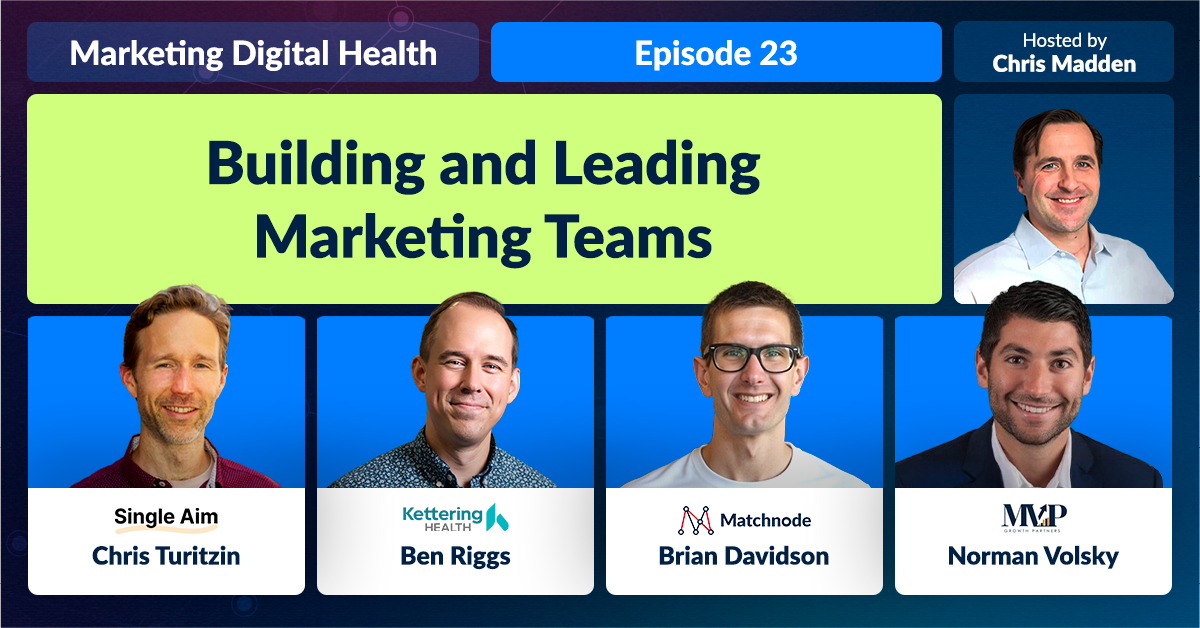
Marketing Digital Health: Building and Leading Marketing Teams
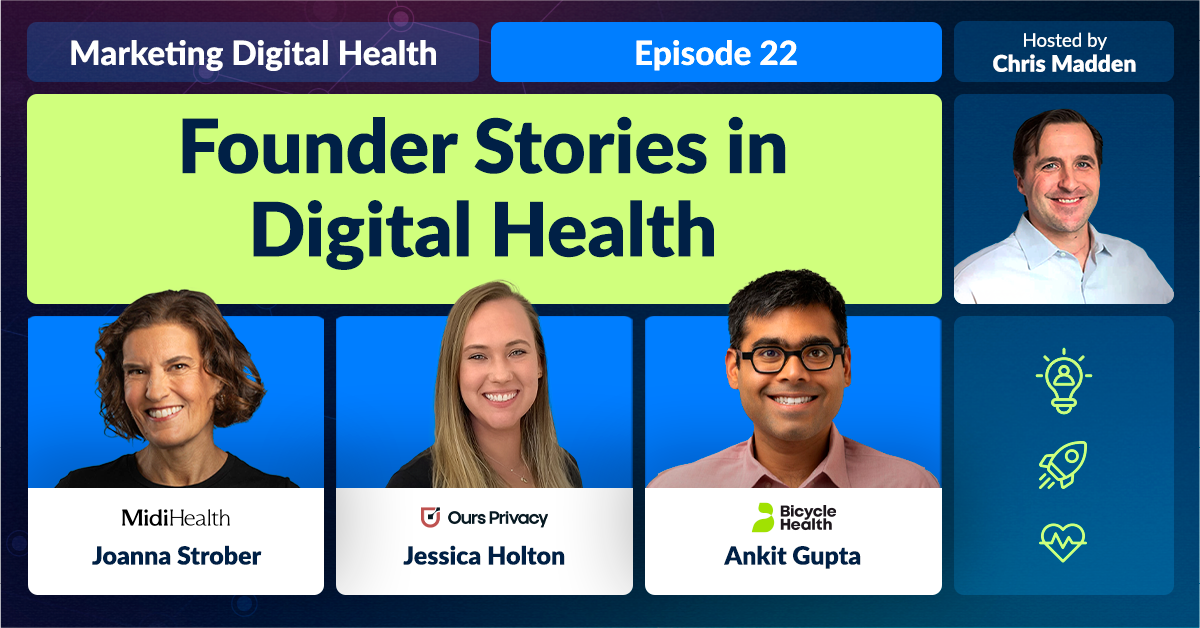
Marketing Digital Health: Founder Stories in Digital Health
- 30.49