
- Blog & Podcasts, Marketing Digital Health, Podcasts
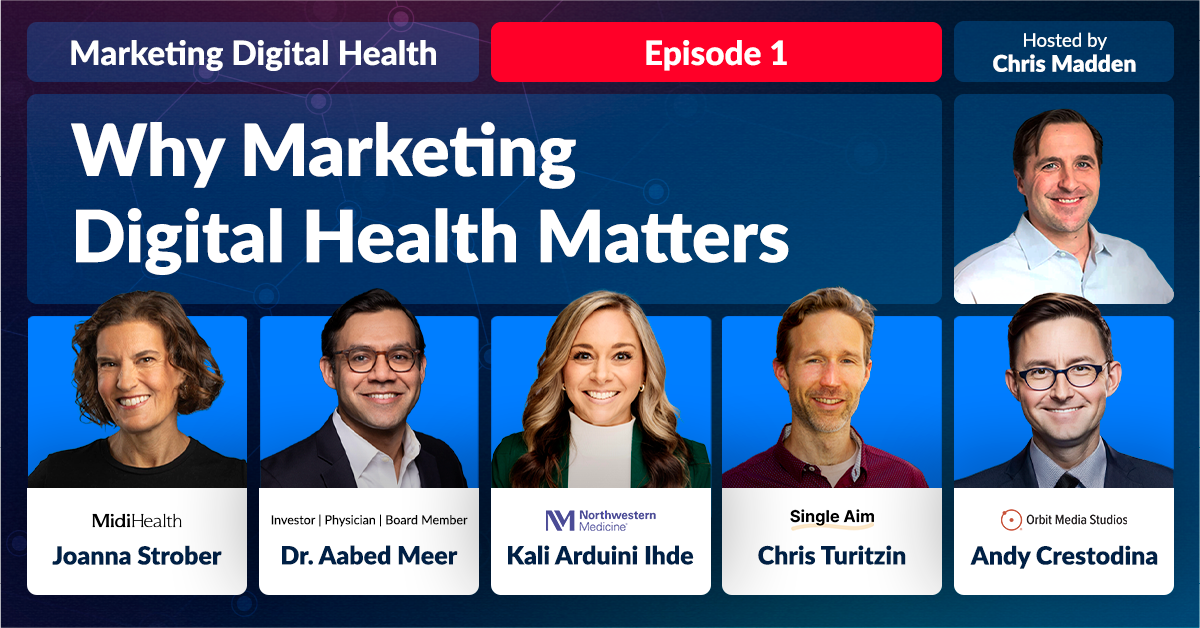
Marketing Digital Health: Why Marketing Digital Health Matters


Summary
Why marketing digital health matters is simple: better information and better access drive better outcomes. In this kickoff episode, we frame the series around a single aim—help people find trustworthy care and help good providers reach the right patients. We start with the adoption reality: innovation only works when it fits real clinical workflows. If your solution adds steps or friction for clinicians, it won’t stick. Next, we map the three growth paths in digital health: direct‑to‑consumer, B2B2C with covered populations (employer or plan unlocks access), and referral‑led models. Each requires a different go‑to‑market motion, and trying to be all three usually dilutes impact. Positioning matters just as much as channels. Define what you stand for and build a story that resonates with the people you serve. Women’s health is a clear example of how unmet needs, clear value, and strong positioning can compound into a movement. On the technology front, we spotlight ambient AI documentation as a practical win, freeing up physician time and improving patient experience when thoughtfully implemented.
Finally, we land on the human stakes. A single, credible piece of content can change a life. For one of our guests, a physician’s explainer video created the trust and clarity to choose the right surgery. That is the power and responsibility of ethical healthcare marketing.
Takeaway
Part of fixing US healthcare is reaching people the right way: trusted, compliant, effective patient acquisition.
About the Guests
Leaders in healthcare and digital health share why marketing is essential to building trust, driving growth, and improving care.
Marketing for healthcare matters, it matters a lot because there you can really make a difference in someone's life. I'm a great example of that. I would've gotten artificial valve, and I would've taken blood thinners this morning. Marketing saved me from that. That video saved me. I wouldn't have gone to New York and had Dr. Stelzer fix my heart had I not been exposed to. Sure it's a piece of marketing, but I didn't think of it as such. My parents didn't think of it as such, and it made a difference in my life.
Andy Crestodina
The co-founder and CMO of Orbit Media, a web development and website optimization agency. Andy is also an author and speaker, known for distilling complex SEO and content strategy concepts into practical, actionable tactics. As a leader at the intersection of content and technology, Andy’s insights are especially relevant as AI transforms how we think about visibility and value in marketing.
[Of the growth models] the one people think about the least in the digital health world, is a referral-based business. If you talk to most doctors, most of their patients are coming from referrals, just like a tradiitonal ophthalmologist or urologist down the street. They have a local network of physicians that refer into them. That's kind of how healthcare works.
Chris Turitzin
A growth advisor and founder of Single Aim known for bringing rigorous product and marketing discipline to the world of digital health. After years of leadership at Meta and digital health companies, he now advises companies like Bicycle Health, Ours Privacy, and other healthcare leaders on how to architect scalable growth systems tailored to diverse business models, from DTC to payor-aligned care.
As a physician and an investor, I see firsthand where clinical needs and technological advancements align as well as where they don't.The best innovations solve real pain points for patients, providers, as well as all the other healthcare, stakeholders. And ultimately, the truly impactful innovations should enhance access to care, enhance affordability, improve patient outcomes. You have to do that without adding complexity for providers.
Dr Aabed Meer
He brings a rare blend of clinical training and hands-on operating experience to healthcare investing. A physician by background, he’s spent the last 15 years backing and building companies across the healthcare landscape. Throughout his career, Dr. Meer has rolled up his sleeves alongside founders and management teams—helping shape strategy, hire leadership, navigate complex payor dynamics, and scale operations. He’s also known for his ability to spot emerging themes early and back companies with a real mission.
The big buzz right now in healthcare and the one that a lot of organizations are either already using or exploring is ambient documentation. So the ability to leverage AI to listen to the conversation between a physician and their patient during a visit and start generating the visit documentation in real time. So this certainly helps physicians stay focused on engaging with their patients while meeting with them.
Kali Arduini Ihde
The Director of Ventures & Innovation at Northwestern Medicine, where she leads system-wide efforts to find, evaluate, pilot, and prove the value of emerging technologies in clinical and operational settings. From AI tools to drones & robots, Kali’s team plays a critical role in shaping how a major hospital system embraces innovation while maintaining patient safety, clinical alignment, and scalability.
Women make most of the healthcare decisions for their families and women spend money to take care of themselves. The economic argument for investing in women's health is actually very strong. And so once you are able to make that argument, and there's people who have capital who can invest in that, that's really when things change.
Joanna Strober
The CEO and Co-Founder of Midi Health, a virtual care platform for women navigating midlife hormonal changes and other underserved health journeys. A serial entrepreneur and investor turned founder, Joanna has built Midi to address the clinical, emotional, and structural gaps in women’s health—reaching millions often through what she calls the “side door” of healthcare. Midi was named TOP 100 Most Influential company in 2025.
Full Episode Transcript
Marketing Digital Health: Why Marketing Digital Health Matters
Chris Madden:
Welcome to Marketing Digital Health. I’m your host, Chris Madden. On this podcast, we’re exploring why marketing digital health matters. Why does it matter? It matters because healthcare in the United States is largely broken, and innovation that increases access, builds trust, and improves people’s lives is a big part of the solution.
We’ve interviewed over 30 innovative leaders who are experts in their fields and who are passionate about improving healthcare for all. I’m excited for you to learn from their perspectives and to leave with takeaways you can use. This is the digital age of healthcare. Patients have never been more informed because of the amount of information available online.
If you’re under the weather, it can be as simple as Googling your symptoms, or if it is more serious, it can be as complex as finding the right cancer doctor. When someone’s health or life is at stake, companies cannot afford to lose your trust. This series is an attempt to sketch a comprehensive overview of how digital health companies are growing today, with topics ranging from positioning to content, brand to paid media, lifecycle marketing to compliance, and most everything in between.
Thanks for joining us. We are excited you are here and excited to share what we are learning about Marketing Digital Health.
For this first episode, our expert guests will give a general overview. Let’s get started with Dr. Aabed Meer, who brings a rare blend of clinical training and hands-on operating experience to healthcare investing. A physician by background, he has spent the last 15 years backing and building companies across the healthcare landscape. Throughout his career, Dr. Meer has rolled up his sleeves alongside founders and management teams, helping shape strategy, hire leadership, navigate complex payer dynamics, and scale operations. He is also known for his ability to spot emerging themes early and back companies with a real mission.
Dr. Aabed Meer:
I see a natural synergy between being a physician and investing in building these companies. It is incredible to be able to see what is happening in healthcare on the front lines, and that allows you to really understand the issues and problems we are facing and then seek solutions that address those issues.
I feel incredibly fortunate to be doing what I am doing. I have had the good fortune of working with a number of incredibly talented entrepreneurs, founders, and management teams, and ultimately this is about improving healthcare, improving care for everyone in this country.
Healthcare is something that everyone deals with, regardless of who they are or where they come from, and there is a tremendous opportunity to improve how we deliver healthcare. Healthcare today is evolving at the fastest pace I have seen it evolve. Part of that is by necessity, and part of it is driven by technological advances that are not just within healthcare, but outside healthcare as well. The way we are going to deliver healthcare and practice medicine 20 years from now is going to be very different from the way we deliver healthcare and practice medicine today.
As a physician and an investor, I see firsthand where clinical needs and technological advances align, as well as where they do not. The best innovations solve real pain points for patients, providers, and all the other healthcare stakeholders. Truly impactful innovations should enhance access to care, enhance affordability, and improve patient outcomes, and you have to do that without adding complexity for providers.
Many healthcare solutions fail when they do not consider what real-world clinical workflows look like. Ultimately, you want technology to empower clinicians and not burden them. Healthcare is often slow to change because physicians are overloaded, the system is overloaded, and adoption only happens when new solutions make care delivery simpler instead of more complicated.
Chris Madden:
That’s a sentiment you’ll hear throughout this podcast.
Our guests are emotionally invested in what they do. They care deeply, which we believe leads to better outcomes for people’s health.
Dr. Aabed Meer:
Healthcare is something that everyone. Deals with, regardless of who they are or where they come from, and there’s a tremendous opportunity to improve how we deliver healthcare.
Healthcare today is evolving at the fastest pace. I’ve seen it evolve. Part of that is by necessity. Okay. And part of it is driven by the technological advances that are not just within healthcare, but outside of healthcare as well. And the way we’re going to deliver healthcare and practice medicine 20 years from now is going to be very different from the way we deliver healthcare and practice medicine today.
As a physician and an investor, I see firsthand where clinical needs and technological advancements align as well as where they don’t. The best innovations solve real pain points for patients, providers, as well as all the other healthcare stakeholders. And ultimately, the truly impactful innovations should enhance access to care, enhance affordability, improve patient outcomes.
And you have to do that without adding complexity for providers. Many of the healthcare solutions that we’re talking about can fail when they don’t consider what real world clinical workflows look like. Ultimately, you want technology to empower clinicians and not burden them. And healthcare is often slow to change because physicians are overloaded, the system is overloaded, and adoption only happens when new solutions make care delivery simpler as opposed to more complicated
Chris Madden:
Aabed names, a basic truth that can be missed. A new healthcare solution isn’t going to get traction if clinics don’t have time to deal with it. Another guest, Chris Turitzin, is going to tell us about the three growth models that can be used in health marketing. And those models are based on regulations which determine how healthcare is paid for in the us.
Christian is a growth advisor and the founder of Single Aim known for bringing rigorous product and marketing discipline to the world of digital health. After years of leadership at Meta and digital health companies, he now advises companies like Bicycle Health, Ours Privacy, and other healthcare leaders on how to architect scalable growth systems tailored to diverse business models from DSE to payer aligned care.
Chris Turitzin:
And to be clear, when I say direct to consumer, I am not saying. Cash day. ’cause that is often a misinterpretation. Direct consumer is just applying to the literal meaning of direct consumer. It is marketing direct to consumers. So these would be companies that essentially advertise online. Any of these, like weight loss companies or women’s health companies or men’s health companies, or the things that you would see on a TV ad, or the things you see when you search on Google, or you would see on Instagram or TikTok.
A lot of mental health companies too, if you talk to those companies, probably like 90 ish percent of their incoming patients are from some direct to consumer channel.
Chris Madden:
Chris says the second category is B2B2C. Meaning people are eligible if they work for a company or have a health insurance plan partnered with that digital health company. Chris likes to call these covered populations. Here’s his explanation.
Chris Turitzin:
These are companies where you have to unlock a population before you can market to them. So usually what that means is an employer or a health plan starts paying for your thing. So these kinds of companies offer like treatment experiences that are slightly abnormal.
So they don’t sit into either a cash pay basis or into a, uh, insurance pay basis, like traditional insurance, like they have a new model. Companies like Omada Health, Virta Health, a lot of these employer based mental health companies like Lyra Health and Spring Health. Advantages of offering slightly less traditional services, actually big advantages in the sense that you can be more flexible in the actual treatments.
But you need to basically get payment permission from an employer or health plan, and then you need to get marketing permission from that employer health plan.
Chris Madden:
Chris says the third category is the one that best resembles traditional healthcare and that it’s based on referrals.
Chris Turitzin:
Interestingly, I think it’s the one that people think about the least in the digital health world, and that’s basically a referral based, um, business.
If you talk to most doctors, like most of their patients are coming from referrals just like traditional, like you know, some ophthalmologist down the street or urologists down the street. They have like a local network of physicians that refer into them, and that’s kind of how healthcare works. And it is also possible on a more of a scaled basis.
I would also say though, building a company like that is very different than building a direct consumer company, and I think many organizations try to do everything and just don’t succeed.
Chris Madden:
We will be hearing a lot more about the growth models in health marketing. Later on in this series. We’ll also gain perspectives from Joanna Strober, who’s the CEO and founder of MIDI Health, a virtual care platform for women navigating midlife, hormonal changes and other underserved health journeys. A serial entrepreneur and investor turned founder.
Joanna has built MIDI to address the clinical, emotional and structural gaps in women’s health, expanding care for millions, often through what she calls the side door of healthcare. MIDI was named a top 100 most influential company in 2025 by Time Magazine. She emphasizes the importance of differentiation and positioning, or as she says, determining what your business stands for right from the start.
Joanna Strober:
It comes down to figuring out what do you stand for, and then making sure that the marketing that you’re doing reflects what it is that you stand for. And I think that’s true for any company, but even more so in digital health, if you stand for weight loss, you’re gonna disappear, right? Because there’s gonna be a thousand other weight loss companies out there.
That are trying to do the same thing as you. So what bigger thing do you stand for? What is your story that you believe in, that you are doing? And then how are you going to put that into a story that’s gonna be resonant to your end users? And what? So really, what is your brand promise? And then how do you execute that throughout everything that you’re doing?
There’s lots of tactics you can use, and I think those tactics are obviously really important, but my suggestion is really nail the value prop first.
Chris Madden:
We’ve reached a point that doing the right thing for a traditionally underserved patient population is also profitable. This is partially due to technology that increases access to information and also increases access to care.
Joanna points to women having been purposefully forgotten about or ignored in medicine, for example. It wasn’t until 1972 that an unmarried woman could be prescribed birth control in the United States. Fast forward to today, and women can buy birth control online, delivered right to their door. They can also do online research on side effects and communicate with doctors about that through a digital platform.
Clearly, things have come a long way, something which has been partly driven by the high proportion of money spent on health by women.
Joanna Strober:
Women weren’t even included in research studies. Most of my lifetime, not until 1992, the people who are making the research decisions and making the funding decisions have historically been men, and so they’ve been more interested in researching and funding things that are oriented toward their problems.
What has happened more recently is that there are women in places of power, in venture capital funds in research organizations who are saying, actually. There’s a pretty big market of taking care of women health. This is not just a nonprofit exercise. Women spend much more money on health than men do.
Women make most of the healthcare decisions for their families, and women spend money to take care of themselves. The economic argument for investing in women’s health is actually very strong. And so once you are able to make that argument, and there’s people who have capital, who can invest in that.
That’s really when things change. I’ve never imagined how fortunate I would be to get to have a company that’s impacting so many women’s lives. We provide care, we also provide listening, and we provide empathy, and all those things are really important, and they’re not things that are found very much in our healthcare system because there’s just not enough time.
We provide time to our providers. To have these in depth conversations with women, to understand their health issues and challenges. And then we provide the expertise to fix those health issues. And honestly, people come for a whole variety of reasons, but really what they’re coming for is they don’t feel right and they want someone to help them to figure out what are their challenges and how can they be fixed.
And that’s what we do. And we have. Expert creating protocols for us on all the different issues that women are experiencing to make sure that you as a woman get access to this empathy, someone who cares about you and someone who knows the science and will give you all of your options. It’s not my job ever to say, you must take X medication.
I don’t make money because you choose a patch, a hormone patch, or a cream or something else. My job is to give you education and to give you whatever prescriptions are appropriate for you or supplements that are appropriate for you to enable you to feel great. And so to me, I mean, literally I get stopped pretty much on a daily basis by someone in our neighborhood who is saying, thank you for midi.
Thank you for helping me to sleep. Thank you for helping my anxiety or my brain fog. I’m told by men all the time, actually, thank you for saving my marriage. I get that a lot. Men pop up on my LinkedIn all the time saying, you really did save my marriage. I wasn’t sure what was gonna happen. And this is, you know, this is magic.
Thank you. So it’s both men and women that were benefiting, even though we’re taking care of the women and you know, when people are provided the right medications, they can thrive and they can feel great and they don’t have to suffer. And that’s really rewarding for us that we’re able to do that.
Chris Madden:
Joanna says, the getting to know your customers is crucial.
She highlights that your business should repeatedly ask, what are my patients searching for? And with that knowledge, you can guide them towards possible treatments.
Joanna Strober:
What we’ve realized is there’s certain things that people are searching for online. They’re searching to lose weight, they’re searching perhaps for brain fog.
But they might not be actually searching for sexual wellness or bone strength or cancer prevention, but they still need those things. And so what we have learned is that there’s our front doors, the reasons why women will come to us, what are they searching for? But then in the visit we can say to them, have you thought about having a DEXA scan because you are skinny.
And you’re 55 and you have a history of osteoporosis. Why don’t we get you a DEXA scan and see whether there’s things we could do for your bones. Women might not be searching online for this, but that doesn’t mean they don’t need it.
Chris Madden:
Joanna says that the problems or issues that patients search for specifically bring them in the door.
Once they’re in the door. The care often expands to other areas of the woman’s health, ultimately caring for the whole person as one integrated system.
Joanna Strober:
And there’s a lot of different benefits they get from staying with us that they don’t necessarily know they’re searching for. So honestly, sexual health is a big one like that.
We thought that sexual health would be a really big opportunity for us, and we were running all these ads, and I loved our ads, right? We talked about the magician, which we thought was so clever, and no one came. They just didn’t click on them. But in a visit after I’ve taken care of your sleep. If the provider says, are you also experiencing vaginal dryness?
Would you like to talk about the fact that sex has become less enjoyable for you? Maybe it’s become painful for you. Would you like to talk about that? They lighten up and they say, yes, I would like to talk about that too. So what we’ve learned is there’s certain things that people search for. We provide that, but then we have lots of side doors.
Different reasons why women are getting care, and our job is to provide all of those.
Chris Madden:
Artificial intelligence is exerting a huge influence on our society, and that very much includes the healthcare space. So we ask. Every guest about ai, Kelly Arduini Iday is the Director of Ventures and Innovation at Northwestern Medicine, where she leads system-wide efforts to find, evaluate, pilot, and prove the value of emerging technologies in clinical and operational settings.
From AI tools to drones and robots, Kelly’s team plays a critical role in shaping how a major hospital system embraces innovation while maintaining patient safety, clinical alignment, and scalability. She is on the front lines of AI in hospital systems and speaks about one of the many ways it’s making things better.
Kali Arduini Ihde:
The big buzz right now in healthcare and the one that a lot of organizations are either already using or exploring is ambient documentation. So the ability to leverage AI to listen to the conversation between a physician and their patient during a visit and start generating the visit documentation in real time.
And so this certainly helps physicians stay focused on engaging with their patients while meeting with them. So lots of great eye contact versus hands on keyboard versus really focusing on getting what they need into the computer system so that the follow up can be done quickly. But it also takes a lot of the administrative burden off of our physicians.
So we’ve seen anywhere from. Five to 20 hours less time spent documenting for some of our physician users, those who really commit to these tools. We’re also seeing improvements in patient satisfaction, better survey outcomes, specifically calling out the direct engagement, the eye contact and things like that as they’re meeting with their physicians.
So I would say that’s one that we’ve been using for over a year now, and just seeing incredible results with both from an experience perspective, but also it’s freeing up physicians’ time. And more often than not, our physicians are giving that time back to their patients.
Chris Madden:
That certainly sounds like a win-win win With Clear ROI. Another win is the ability to go online and research your health concerns or to discover new treatments through advertisements that are really groundbreaking when you consider how our parents used to do those things. Joanna shares how she has come around to supplements and peptides, for example, and how her interest has increased as she learns about the latest research.
Joanna Strober:
I grew up with a doctor father who didn’t actually believe very much in medications. He was. Not a huge fan of supplements, for example. He didn’t think you needed them. He was very worried about things like cholesterol and exercise and was very fundamentally into what you eat. And exercise, I would say is, was very important to him.
He is actually come around a bit on supplements. It’s interesting, I do the supplement work now and I’m actually starting to buy into supplements in a way that I didn’t before. And I think that research that’s happening on them is pretty interesting. So I’ve become. Very interested in whether it’s taking fiber or I’ve started taking a cortisol manager at night, which is a combination of L-theanine, magnesium and ashwagandha.
I think I sleep better, so it’s exciting to me the different research that’s getting done on supplements and I’m starting to become a fan. I would say there’s just emerging research on peptides, like there’s a lot of emerging research that I think is gonna help us to live. Healthier, and I enjoy following all that.
But fundamentally, what is the most important thing that I do? I try to exercise. I try to lift weights. I try to eat healthy. Those are the basics, and I think those are still the things that will matter most.
Chris Madden:
I was really grateful to Joanna for sharing such a personal point of view. I asked each guest how working in digital health has impacted their personal health. Sometimes health marketing can literally save someone’s life. Andy Crestodina is the co-founder and CMO of Orbit Media, a web development and website optimization agency.
Andy is also an author and speaker known for distilling complex SEO and content strategy concepts into practical actionable tactics As a leader at the intersection of content and technology. Andy’s insights are especially relevant as AI transforms how we think about visibility and value in marketing.
While Andy mostly talks to us about marketing strategy and organic content in our series here, he recalls how a piece of marketing collateral led to a life-changing decision about his health.
Andy Crestodina:
Yeah, so me as little boy got a heart murmur. Doctor says, keep an eye on it. Me as middle-aged man, go to the cardiologist.
He says, Ooh, you gotta get that fixed bad valve. You need a new valve. Literally like your valve. you, you’re, this is terminal. You’ve got aortic stenosis, you’ve got a bicuspid aortic valve. You need surgery, but you’re kind of healthy. You know, maybe you don’t need like an artificial valve. That would mean you need blood thinners.
Why don’t you do this Ross procedure? We’re gonna move your pulmonic valve into the aortic position. It’s gonna be great. Like, wait, what? That sounds crazy. Musical heart valves timeout. No, no. Told my parents, they were like, heck no. They looked online and said that other cardiologists themselves, don’t get this, don’t do that.
That’s a bad idea, Andy. But then the referring doctor shared with me a video. This is a true story and it changed my life, and it’s a, maybe partly a marketing case study, but it’s a, there’s a lesson here It, I click this link. I’m on YouTube and I’m watching a video of this, this older gentleman, Dr. Paul Stelzer, talking about his obsession with aortic valves.
He basically says. The focus of my career and my life is this valve. This is all I do. The best way to fix it is to get your other valve in that position. It’s called the Ross procedure, and it has all these advantages. You don’t need blood thinners for the rest of your life. Don’t get a mechanical valve.
It doesn’t need to be replaced. It’s your own tissue. The pulmonic valve. Yeah, you get a cadaver valve there. That’s a lower pressure system. It’s not as big a deal. You need your own valve in the aortic spot. And he, he is just this normal guy. I mean, he just comes across like, so legit. he’s scrubbing in.
You know they’re talking to a patient who’s like, yeah, no side effects. Totally healthy running marathons. Like I showed that to my parents and they were like, book it. We’re going, where is it? New York. Set it up. That video. Converted, if it’s a, we’re using GA4 It’s a key event, but it turned me into a patient and customer of Dr. Stelzer. There was no way to change a mind as fast or as completely as hearing the doctor themselves tell me through a screen that his obsession and focus of his career on life is fixing this valve. He’s done it 400 times, so chill. I’m like, fine. Let’s go man.
Chris Madden:
For Andy, this personal health experience led to a conviction that if a health system or a care provider is doing good work, it’s crucial for them to spread the word through their marketing so that patients are aware of them so that they can get the best possible outcomes.
Andy Crestodina:
If you are in a system that does good work and you are in the healthcare vertical, you’re working with docs that are literally saving lives, not every provider, or just improving people’s health outcomes. Improving people’s lifestyles, helping people get back on their feet or do better preventative care.
Whatever it is, not every company is good. If you believe in what you’re doing, you should feel urgency to market these things, to promote them, to help people make the right choice, to guide people toward you as a good option. I, I think it’s important. This is not trivial work. This is important work. To help guide people away from shady providers and toward the decent ethical brands that care marketing for healthcare matters.
It matters a lot because you can really make a difference in someone’s life. I’m a great example of that. I would’ve gotten a artificial valve and I would’ve taken blood thinners this morning. Marketing saved me from that. That video saved me from that. I wouldn’t have gone. To New York and had Dr. Stelzer fix my heart, had I not been exposed to, sure, it’s a piece of marketing, but I didn’t think of it as such. My parents didn’t think of it as such, and it made a difference in my life.
Chris Madden:
That’s the ideal of effective healthcare marketing. It’s what happens when someone, in this case, Andy, is exposed to an authentic testimony that is backed up by his doctor’s dedication and skill.
If Dr. Stelzer hadn’t done the video, surely fewer potential patients would be aware of him. Good providers like Dr. Stelzer putting real messages out via marketing are making our population healthier. Stay tuned for more episodes in which we’re going to share specifics on how leading companies are crafting and sharing those messages.
In episode two, we focus on branding and positioning to lay the foundation for all that follows.
Related Episodes
- 42.57
Marketing Digital Health: Building and Leading Marketing Teams
Marketing Digital Health: Founder Stories in Digital Health
- 30.49