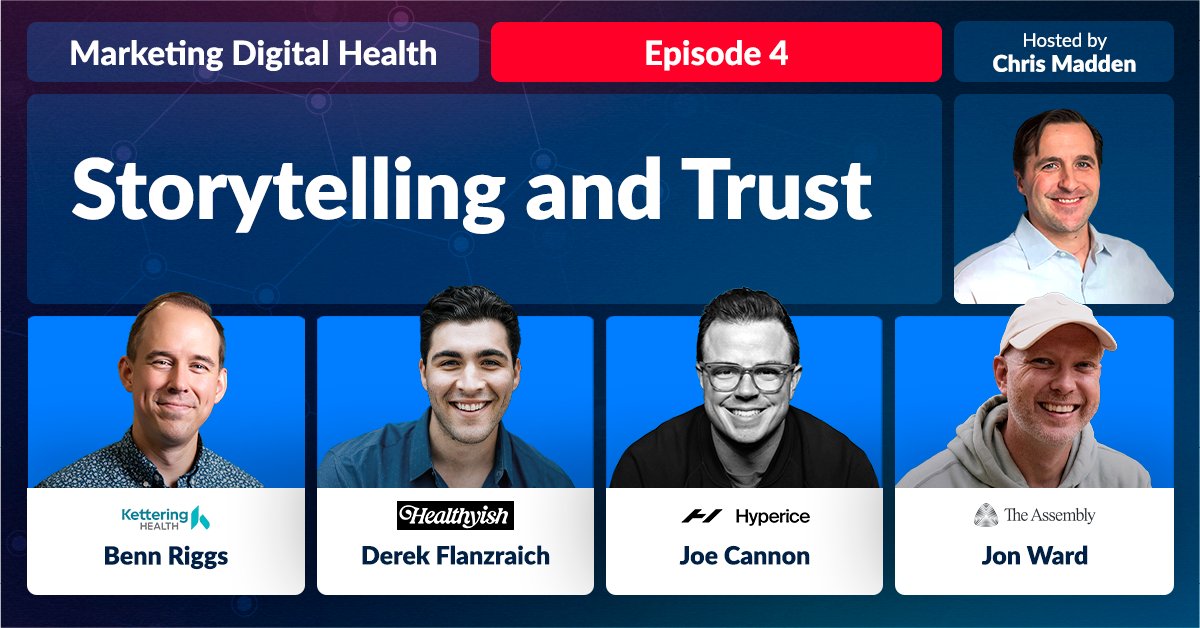


Digital health storytelling works because health is personal. This episode shows how authentic narratives create emotional resonance, credibility, and momentum that carry people from awareness to action. Ben Riggs breaks down the fundamentals—action, emotion, and change—and why structure is the difference between complexity and chaos. “Chronology with meaning” helps audiences understand what matters and why. He argues that trust is earned by answering real questions with expert guidance, and by using plain, accessible language. In healthcare, readers are often stressed or scared, so empathetic UX and readability are non‑negotiable.
From there, Jon Ward unpacks stories that change behavior. Teach people how to use your product, pace adoption, and build rituals; the result is loyalty grounded in lived outcomes. Joe Cannon explains why the most influential community leaders are force multipliers. When trainers, coaches, and clinicians are educated and excited, they carry your story to thousands through hands‑on experiences. Finally, Derek Flanzraich shares a quality bar for health content that actually deserves trust—rigorous sourcing, expert review, and engaging writing—which search platforms later rewarded. The throughline is simple: tell true stories well, meet people where they are, and design for the moments when they are most open to trying something new.
Discover how authentic storytelling builds emotional resonance, patient trust, and long-term brand loyalty in digital health marketing.
This episode brings together a hospital content leader, a wellness category builder, a partnerships executive, and a creator‑driven growth operator. Each shows how honest stories, taught and told well, build trust that translates into real patient and customer outcomes.
There are language choices we reach for to impress people, but the irony is that if you reach for those language choices, you actually don’t impress anyone because they don’t understand you. With storytelling, it’s more intuitive to choose language that is more accessible.
Ben Riggs
Writer and Content Manager at Kettering Health, Ben leads editorial for a multi‑hospital system. He focuses on structure, empathy, and plain language to help people find clarity and care in stressful moments.
To get the athletes bought in, you have to get the trainers bought in. If we can win their hearts and minds, then we can win everyone else.
Joe Cannon
SVP, Global Partnerships at Hyperice. Joe has scaled recovery tech by educating trainers and building partnerships across fitness, military, sports, hospitality, and wellness.
Hey man, I didn’t know this would happen, but this product changed my life… I’m a better dad, a more patient person, a better business owner.
Jon Ward
Founder of theassembly.health and former VP of Sales/BD at Plunge, Jon drives relationship‑first growth, creator networks, and habit‑building customer journeys.
Derek Flanzraich
An entrepreneur working to make health more accessible. He previously founded Greatist, which became the largest health and wellness site for millennials (acquired by Healthline), and launched Ness, a venture-backed health-first credit card startup. Today, he runs Healthyish, a personal holding company across content, investing, and advisory work. His agency, Healthyish Content, creates content for brands like LMNT, Ro, Allara, and Midi. He also writes 5HT, a weekly newsletter with 100,000+ subscribers, where he shares the most interesting and useful health ideas he’s come across that week.
Chris:
Health is personal. It’s emotional, and behind every patient is a story. This is marketing digital health, and I’m your host, Chris Madden. Today we’re delving into the power of storytelling. We’ll explore how authentic, emotionally driven narratives can build real trust and long-term brand loyalty. Our conversation begins with Ben Riggs.
Ben Riggs is a writer and is the content manager at Kettering Health, where he leads content development for a large multi-hospital healthcare system. With deep experience in health storytelling, team management and editorial strategy, Ben brings a thoughtful lens to how hospitals can build trust, clarity, and patient connection through content while navigating complexity, AI disruption, and cross departmental coordination.
After that, we’ll hear from Derek Flanzraich, Joe Cannon and Jon Ward, who provide real life examples of showing how content drives impacts. Trust in healthcare is arguably the most important factor of the whole equation. Ben recalls how his own experiences of being drawn to good storytelling and feeling how it affected him and other people. It’s been foundational to his career as a content manager at Kettering Health.
Ben Riggs:
Whether it was print or digital, or it was scripting that ended up into a movie or TV show. There was kind of this mystery of what was happening in the aggregate. All these choices being made by writers and producers and whatnot, that created this experience of sorts.
And I just, you know, to me it felt like the closest thing to literal magic in a way. I remember watching like the Hunger Games in the theaters when it first came out and sitting there and probably being one of the few people who was overthinking it at the time in the movie. But you know, sitting there as they’re kinda like all running to the weapons and my hands were getting sweaty and I did, I had the thought of, okay, I’m not even, I’m not there. This moment’s fabricated. How am I having this emotional, visceral reaction?
And I remember too, there was like, the question that was popular after that was like, what would you do if you were in the Hunger Games? Like anyone who saw it put themselves there. So I think I got bewitched early on to figure out what the basics of storytelling were.
Come to find out there’s sort of the basics of human life. What are the qualities of being human? Things like, you know, action being the first one. I think we’re sort of verb centric creatures. We write, we dance, we sleep, we talk, you know, life. Life is action. And so I think story at the very bottom is verb, verb centric.
It involves people and the dynamics that make us person. So our psychology, our hopes and dreams and those things we can’t get really our hands around, but are there and shape our decisions. And I think change. You know, I think no one wants to stay static for the most part. And so I think that we see these things in real life. And I don’t think it should be any surprise that these are also the things that are requisite for good storytelling and to that end, then I think it should be no shocker then to find out that storytelling really is, it’s a fairly principle impulse within people.
You know, I’ve said before and have borrowed it from other people who have done a lot more thinking around this, storytelling really is about as ancient a reaction almost as fight or freeze. There’s a book called Wired for Story by Lisa Cron, C R O N, and she says pretty early on in the book that opposable thumbs give us the ability to hang onto things. Story is what gave us the ability to figure out what we needed to hang on to.
The basics of storytelling, verbs, actions. Emotion, change. These are the things that again, make us human and also make for a good story, and that’s no accident.
Chris:
The human fundamentals of storytelling are consistent, but making something that resonates with everyone is hard. As Ben explains, people come from different backgrounds with different stories. What clicks with one person might not interest someone else, even if they have a similar background in life experiences. So how do you do it?
Ben Riggs:
Structure is vital to the chagrin of many of us coming out of middle school who had to learn how to outline with the Roman numerals off to the side.
There’s a book by John Franklin, who was kinda one of the first literary journalists. The book’s called Writing for Story, and he has a whole section about the role of structure and he actually refers to the outline as the English teacher’s revenge based on this shared experience we’ve all had with it.
But I think the point he makes in that book and that a lot of other authors and screenwriters make is that you have to impose structure. That’s effectively narrative, right? I think if you think about maybe the sequences of, you know, of events that lead to change, that’s everyday life. It’s haphazard, it’s chaotic, but, and I think that’s trying to mimic that has been attempted in some books and in some movies, and I couldn’t quote what they are right now, but I don’t think they did very well when it came to capturing our tension and the zeitgeist and even maybe making some money.
It’s, I think, the idea is imposing some sort of order or structure, being thoughtful about really what is it that is being said. Because I think, like I said, you can have this series of events that capture change and you could find that sort of banal and maybe lacks, lacks the attention grabbing opportunities that other stories do. And I think the other stories have a certain structure imposed on them that really there’s not one, despite what others might say.
But I think at the end of the day, it’s what kind of structure provokes sort of the singularity of meaning or theme or focus. So to quote John Franklin again, he talks about how story is really, it’s chronology with meaning. And I think if you’re going to help a reader or a viewer draw out meaning you have to sequence things intentionally.
Even those writers or storytellers who play with time a lot, whether it’s foreshadowing and doing that in crazy places, you know, I think of Christopher Nolan, right? He’s a master of fiddling with chronology, but in a way where, you know, unless you’ve kind of fallen asleep for even just five minute, then you lose track of the thread. But even though he, it feels like he’s all over the place, you’re right where you need to be. He’s right where he wants you because he’s a master of structure and he’s built those stories out in a way to get you to that place right where you should be. We don’t know it as the viewer, but it works.
And then there’s other ways to do this. John McPhee, who wrote a lot for the New Yorker, has a book called Draft Number Four, in which he actually shares all the different kinds of story structures that he uses to write really compelling pieces. Like he’s got one where he writes about rocks and you’re kind of thinking, oh my gosh, who in the world is gonna write something compelling about rocks? But it’s kind of a famous essay. And he goes through the structure that he used in order to bring you along that story.
And so I think that to kind of put a bow on this thought, I think, yeah, finding structure solicits and helps create meaning, but I think too, it helps make sure that things can be complex without feeling chaotic. There’s a lot of good stories that bounce between timelines. Like this is kind of an approach I use a lot where I’ll tell a story, I’ll write a story with the sort of background being some sort of event or something with tension or drama. In the foreground I’m maybe trying to play out something that has happened in the past.
You have to be intentional with that. You can’t just hop back and forth without certain cues, but you do that well and people can pick up on a clear meaning.
Chris:
They’re effective for health marketing too. Ben says, your company should figure out your what early on. By that he means: what kinds of stories do you want to tell? What do you care about and what considerations are there?
Ben Riggs:
There are business related things going on about which service line has some volume opportunity. Do we want to focus our energies to help share about our heart and vascular folks who they’ve just kinda realized they’ve got space to taken some patience? There’s a lot of things that are steering the ship or that we’re trying to keep in mind along the way as we’re choosing stories.
I really believe if you spend a good amount of time with anyone, you’ll find out that even the stories that don’t feel like stories at first glance, that there is something going on there. And so I think that some of the best storytellers are able to capture the drama in something that seems emphatically not dramatic, and not because they’re fabricating it, but just because they were able to sit with a topic or sit with someone and ask the right questions to get certain responses and answers that they were able to follow those trails of thought or trails of experience into like, oh man, this was really going on behind the scenes.
So suddenly one thing that feels mundane or every day suddenly has something else going on entirely behind it.
Chris:
Ben has permission to share an example around reporting and storytelling that he did that reflects the variety of very relatable health situations that people can find themselves in.
Ben Riggs:
I actually, I shadowed a primary care provider for a day because we just wanted to let people in on what’s this look like. It was kind of a writer’s dream because this provider was really willing to help me work with patients to get permission and I stood in exam rooms all day. Patients would come in, I was standing against the wall with my little notebook, and they would have a patient physician interaction, and it was everything from someone falling off their diet while on vacation and had to get back onto it because of his heart condition to helping another woman vet through her medications because she’s coming out of cancer treatment for breast cancer.
And so I think standing in that room, capturing these moments and just being exposed to them. I’ve had my own, obviously, with my own primary care provider, but being in there with these folks made me realize that the drama that we want from a good story, the emotion we want from a good story isn’t just in the traumatic incidences of car accidents or crazy brain tumor stories or that kind of thing. It’s in everyday life.
And so I think good storytellers are also really able to figure out how to frame and position everyday life in a way where it might not be capital D dramatic, but you can connect with it because of the capacity for empathy and the very things that you’re kinda worried about, thinking about yourself suddenly put you in the shoes of someone else.
Chris:
According to Ben, drawing people into the story is one thing, but cultivating trust is another.
Ben Riggs:
In healthcare it’s a little different because you’re not necessarily putting a product out in the market. But you are trying to make sure that you stay top of mind and or that the dots connected in people’s minds are that should they encounter or come across or have a healthcare experience, an illness, an injury, something that the impulse is gonna be to think of us in a positive way.
That they’re gonna have had experiences with us in such a way that what was cultivated was obviously this positive sentiment. I think trust is cultivated in a lot of different ways. I think at the bottom I think about trust and how we just do it in everyday life, and it’s just being true to your word and being consistent and being understanding.
And so the question becomes, well, how do you do that with content? And there’s a lot of ways to do that. You can share it by way of information. So we do content by way of kind of consumer health articles where we’re trying to create that patient provider interaction by capturing maybe a question people are asking about health in some way, shape or form, whether it’s their physical health or their mental health.
And what we’re doing is we’re interviewing physicians, clinicians, others who are subject matter experts and trying to capture their expertise and write informational pieces that help answer these health related questions for folks. That’s one factor that goes into developing trust is are you not just speaking their language, but are you providing value by way of answering questions that they have?
And I think too, it’s something we don’t talk a lot about, but I think you can also answer questions that people didn’t know they were asking. Which I know sounds nebulous and oddly philosophical, but I think sometimes there’s those moments of information about something that people almost, they knew implicitly was important, but they didn’t know they were actually thinking about it a ton.
Chris:
Ben describes an article that his team published on navigating grief.
Ben Riggs:
It’s a few years back and it continues to be one of our highest performing organic pieces out there largely. Probably through SEO, but also because grief is unfortunately probably a pretty heavily searched topic. So there’s a lot of people asking probably around how to understand their grief.
But then we also have ones that perform really well about colonoscopies. People didn’t know they were wondering about those until the moment was presented that they had to start thinking about it.
Chris:
Ben’s advice is to meet patients where they are. When you’re navigating tough topics, make sure to keep language simple. Using fancy jargon can make it so that your message is not understood clearly.
Ben Riggs:
Our education teaches us that when you’re trying to inform someone you have to impress them. And so there’s kind of language choices we reach for to impress people, but we find out quickly that the irony is that if you reach for those language choices, you actually don’t impress anyone ’cause they don’t understand you.
With storytelling, it’s a little bit more intuitive to choose language that is a little bit more, a little bit more accessible. But then also too, I think a lot of it comes down to also like web content, condition pages and service line pages. Trying to build those out and write them in a way that, like I said, isn’t, doesn’t force people to go through paragraphs of either brand heavy stuff that kind of feels like a commercial before they get to actually what’s substantive about, okay, can you take care of what I’m dealing with? Where do I go to find that kind of care? Do I qualify for it? Those sorts of things.
Plain language really is the basis I think, for developing trust. ‘Cause I think that the decisions you make when you’re thinking about plain language, and it’s not really plain language, is a funny phrase ’cause it’s not just about language, it’s also about user experience. So you’re thinking about formatting, you’re thinking about placement of text and formatting of text, and the simplicity of a page and where a click through button is for schedule a visit.
You’re thinking about all these things as it relates to the consumer experience. I like couching it in the conversation of plain language because that’s really what you like. You want it to be plain in a non derogatory sense, like you want it to be simple. You don’t want it to be complicated to have to sift through.
Chris:
Within healthcare specifically, Ben says, content producers should remember that people searching for medical information may be distraught or in pain. Many are going through something personally or have a family or friends struggling that they’re trying to help. They’re likely already under a heavy emotional and or physical strain that can skew how their brain processes information.
Ben Riggs:
But when you add the emotional pressure of a cancer diagnosis, or someone who’s just gone a WebMD and found out their headache might be a brain tumor, but they’re also trying to look for something else out there that feels more credible, maybe people aren’t in this kind of emotional vacuum when they’re reading something from us.
We have to take that into account because a study show that sort of cognitive emotional loads will actually decrease functional literacy. And so if you’re not prepared for that, you know, if you’ve interviewed a subject matter expert on or something about for some condition or service page, and it’s incredibly accurate.
But perhaps it’s in clinician speak that already without having anyone visit, has boxed a lot of people out for probably being able to access it in terms of what it means. But then you add folks who are going through something heavy and hard, and it’s just asking a lot of readers, and it’s asking a lot more of them than should ever be asked for.
And so I think plain language and trust are really connected at the hip, especially within healthcare marketing.
Chris:
To summarize, Ben Riggs emphasizes structure, empathy, and using the simplest words possible. Let’s switch gears for a bit and get some perspective on marketing, wellness products and tap into some of the strategies there.
Jon Ward is the founder of the Assembly and former VP of Sales and Business Development at Plunge. We introduced Jon in episode three around people-based marketing and sales, earned media and influencers. Jon says that building brand loyalty was key to Plunge’s success. Plunge positioned their product as a recovery tool from the product launch. They included real influencers like Wim Hof, who popularized cold plunging globally, starting as a response to an emotional trauma in his life. Who better to create an authentic advertisement to draw in a target audience when potential customers see a strong, healthy 66-year-old man like Wim in peak physical condition, swearing by cold plunges they want in.
Jon Ward:
Wim Hofoff came out and he was doing the breath work and he was kind of like this character, but he was so compelling. He just lived such a unique frame of life. We had seen some of the benefits and, you know, the original founders, Mike and Ryan, like they’re outside the box thinkers and we know when the company launched.
The best part about it was that everybody viewed it as like a recovery tool. Oh, I train a lot. So we had the early stage like the biohacker, the optimizer, the weekend warrior, and they were all getting in. And typically early on it was a lot of men that was buying the product and we called it wife approved ’cause it looked good enough that the wife would probably just okay it.
It’s this, you know, white acrylic tub with like nice lines and the men would start doing it ’cause they were training a lot. And then eventually they would convince the wife to go and then the wife would use it as much or if not more. Because maybe she wasn’t training the way he was, but what she was getting was all these mental health benefits associated with it.
It’s really hard when you have three kids running around the house and your two people trying to manage that, and all you really need is two to three minutes for most people.
Chris:
Even after you have a captive audience, the utility of storytelling continues. One way to use storytelling with existing customers is messaging that helps them understand how to best use your product. For example, by not overdoing it at the start with cold plunging.
Jon Ward:
You’re not gonna go put on 225 pounds on the bench and see if you could do it. You’re gonna start with a normal way and then work up into it. What was happening was they would do it, they would try it, they would get into it, they would start doing it every day. And through the breathing, through the forced breathing and from the cold itself, they were getting the muscle recovery.
They were getting these feelings of nature of this dopamine release that would hit, which the dopamine is like the love drug. So you see your dog or you see your kid and you feel a sense of like love and openness and friendliness. And over time with the breath, it would regulate your nervous system and the dopamine that would come would make you feel better about life.
And oftentimes the brain influences the body. And so if you feel good and you have a great perspective on life and it affirms your body, then you’re synced up. And I would get calls often, hey man, I didn’t know this was gonna happen, but this product changed my life. I’m getting in cold water and I’m a better dad or I’m a more patient person, or I’m a better business owner.
Chris:
That’s how Plunge’s ability to improve people’s lives started going viral. Jon recalls a prominent business executive who gradually came around to embrace the products, and then an even bigger fish in the fitness industry took notice eventually.
Jon Ward:
Like the founder of Under Armour was like, hey, this is the thing, you gotta do it. So he ended up getting into it, and then he calls me on the phone and goes, this is the best thing ever. I could not be doing my businesses. My whole system was completely fried from being an entrepreneur for 15 years. Whatever I have to do to help you guys or support you, I’m in. I’m a better business owner for doing this, and this person’s influencing a lot of people.
The energy of all of that, that happened all of the time, at least three to four times a week, that’s what would happen. So imagine what your life is like when you’re living in that world. I was living in a very airy weird world, and all I was doing was really just providing them cold water and then supporting them.
That’s the energy that I’m taking outside of that experience. That’s actually what people are looking for. They are looking for something, a group, a company, to provide an experience that makes them feel better about life and makes them feel better about their own personal health journey.
Chris:
Plunge told a story with their cold plunges and saunas that turned people into fans, and then even advocates, they led by example. But Jon adds that not every influencer might be right for the role. It’s a tricky game.
Jon Ward:
To be honest, on the affiliate side because some people are just content makers and not all the time business people. So you really have to find the niche on that. And we just found through numbers, we eventually found the people and we found the right audiences and fine tune over time.
Chris:
Hyper Rice is another business that has thrived from forging relationships with influencers of their potential customers, including athletic trainers. Hyper rice designs and manufacturers recovery and movement enhancement products, think massagers, air compressors, and heaters that help athletes and fitness enthusiasts recover.
Joe Cannon is SVP of Global Partnerships at Hyperice. Where he’s helped transform recovery tech from a niche product into a consumer wellness category. From Equinox to the US military to major sports leagues, Joe has helped Hyper ICE as a vital part of movement health, while also challenging the healthcare system to rethink MSK care, wellness access, and preventive innovation.
While word of mouth is strong, it was storytelling and partnerships with the most influential that set off a domino effect for their product’s popularity.
Joe Cannon:
We really focused at the start on fitness and really focused on a vertical and trying to be as authentic to that vertical as possible and as endemic to the space as possible. And Mark Mastro, the founder of 24 Hour Fitness, and a brilliant mind in this space, said at a very early conference that we were at, it was at NAS’s Optima in the fall of 2016 and said, you know, trainers are the heartbeat of the fitness industry. NASM is the largest certifier of personal trainers in the world.
And it was very much the model we had used in professional sports. ‘Cause in order to get the athletes bought in, the trainers have to, the ATCs, the strength and conditioning coaches, the orthopedics, they have to be bought in and they’re the ones who help the athletes learn and try these new technologies.
And so if we can win their hearts and minds, then we can win everyone else. When you think about a fitness club. Personal training is some of the most intimate connection you can have with your member. You have these one-on-one or small group moments, and if you could teach them about what the world’s best trainers that are at the top of their field are doing with the world’s best athletes, they can be a part of this story.
And we tell the story. Like in fitness, we did probably over 200 live trainings my first year at Hyper Rise in clubs. I was an English major, so I went and got my NASM-CPT at the time really fast because I was like, I can go and tell stories and about how the company was founded and Anthony, and hiring an aerospace engineer and doing all these amazing things and get them really excited about the story and the vibrating rollers and making foam rolling faster and less painful because of what it does with the Golgi tendon organ and muscle spindle complex and go on and on and on.
But really it was the story that they got excited about how they could use the product with their people. And so we went in UFC Gym and Crunch and Lifetime, we and Steve Nash gym’s in Canada. We were doing it everywhere we could get in, anyone would take us and could bring three or more trainers. We were there. We just wanted to be in the room and talking to them and hearing their feedback of the product and we learned a ton about what we were doing, but then they go and integrate that technology into their training when they’re training four to five people a day, the multiples there are pretty crazy.
That was always our focus and it was a focus on fitness. And as we’ve built across the fitness channel, we have this incredible team who eats and breathes and sleeps it every day and continues to drive that business forward and make sure we’re integrating and building recovery rooms for people because that creates the experience.
Chris:
Joe recalls that Hyperice was intentional about focusing on the fitness worlds and learned about what athletes do and where they hang out when the game is over.
Joe Cannon:
We met a guy at the time who used to run Hilton’s Wellness Program, a guy named Ryan Crab, who was taking sabbatical, getting his MBA from Georgetown and was going to ended up going, spending about six years at Peloton and.
He was like, if you wanna get in a spa, you gotta start going to these like live love spa shows and go and be endemic to it. ‘Cause what’s after fitness? These people are doing the same thing. They have massage therapists. Our look at these businesses as, and whether it’s physical therapy, whether it’s corporate wellness, fitness or spa, hospitality, it’s like, what’s the connective tissue?
And so for fitness, it’s trainers and it’s the education the trainers provide in spots, it’s the people who are actually doing the work every day. And I think there’s this really cool story where it’s like, where do you go physical therapists? You can teach them to use it. How do they integrate it? More people get to experience it. So that’s always been our key focus is what are those connective tissue points that like can get us across a broad swath of an industry and create experiences.
Chris:
Some partnerships just fit, Joe explains that around 2023 Hyperice launched a program with the Marriott Hotel chain. It resulted in 250 locations where guests can have Hyper Ice and NormaTec devices delivered right to their rooms.
Joe Cannon:
And so it went so well that every one of the locations had to buy more units, but then even better, they added it to the Bonvoy app because customers were getting upset that they would get there and it was already sold out or spoken for.
And so they started buying more and bringing those in. And so now a lot of the industry’s looking at that. It’s like, why would you need to be in room? What would that do? Well, the penetration’s so much higher in room, there’s more people. But when you think about going on vacation with your spouse or your work travel, you’re like, will you try something new this time?
The barrier to entry’s low, like it doesn’t require you to really buy it. You’re getting sent to your room.
Chris:
Joe asks a thoughtful question, where are people more likely to try a new wellness product or service? It might not be where you think. Joe and the team learned that people are open to trying new things more in certain contexts than in others.
They found that when in hotels and traveling, as in the Marriott partnership, people are more likely to try a new thing, like a Hyper Ice recovery device, and then that can be baked back into the storytelling.
Joe Cannon:
So I think there’s, there’s like trying to think about where are people more likely to experience wellness. ‘Cause like we found, like us on a concourse of a stadium during halftime of a basketball game showing people massage guns. Is it really the sweet spot for wellness? It’s like, where are they looking for this?
What are these common traits of these early adopters? For us, a key focus on where are people more likely to engage with new wellness tech or be more willing to experiment with stuff. Airline lounges we’ve done with the Delta One lounges with their Hyper Ice spa, and it’s pretty amazing. But it’s one of those things where it’s like, why would that take sense?
Like, well, it’s packed and it’s because people are willing to take time and those business trailers maybe are indexing a little bit more toward health and wellness. So that’s how we focus on these verticals and a lot of times it’s our partners suggesting we get into spaces and come to us and say, hey, that’s a really cool thing. We wanna plan wellness. How can we do that together?
Chris:
Derek Flanzraich is an entrepreneur working to make health more accessible. He previously founded Greatest, which became the largest health and wellness site for millennials and was acquired by Healthline. He also launched Nest, a venture backed health first credit card startup.
Today, he runs Healthy-Ish, a personal holding company across content investing and advisory work. His agency, which is called Healthy-ish Content, creates content for brands like Elementro, Elara, and Midi. He also writes Five Healthy-ish Things, a weekly newsletter with over a hundred thousand subscribers where he shares the most interesting and useful health ideas he’s come across that week.
Derek Flanzraichzraich:
We actually sat in a room, me and a bunch of very talented friends who were willing at the time to work for free, who also agreed that health content on the internet was totally crap.
We sat around a room and we basically reverse engineered what we thought great content on the internet should be. Google at the time, which was the primary way people find content today, was the primary way people found content. Then Google was at the top of every health search, essentially promoting livestrong.com content, which was part of Demand Media pretty famously.
Explicitly content farms that were not interested in high quality content. And so we didn’t do it for Google, we did it for ourselves. And we asked what kind of content would we trust? And so that started with making sure that every fact that was cited with a scientific study and we actually went to the extreme of ranking and putting in different tiers, journals, scientific journals, and internally we trusted some journals or other journals.
We felt like every piece of content needed to be approved by, not one, but at least two completely legitimate experts. We felt like the articles should cover all topics and to make sure there wasn’t, weren’t missing some part of the topic that we were writing about. We felt like every link that we were linking out should be to also a trusted, trustworthy site that had a high domain ranking.
We felt like every article should have graphics, unique graphics. And we felt like every article should have a voice that was engaging. It was written by an amazing journalist and storyteller and researcher, not the expert that often comes with a biased, one-sided view. All these choices we made because we felt like that was the right way to do content, was really rewarded when Google woke up and decided to start defining for themselves what great health content should look like.
And it turned out that we were it basically, and that led to a very quick and exciting time of growth where Google fell in love with Greatest, and our traffic went from zero to 15 to 20 million unique visitors every month over a short period of time, few years.
And it was because ultimately we were writing content the way that Google was explicitly saying it wanted content in the health space.
Chris:
For consumers, having someone that truly cares, like Derek, helps foster trust. He saw what Google was promoting to users was not in their best interest, and he took action. It ended up making a serious impact.
Health is universal and personal to each of us. Ben Riggs gets philosophical in his view of how marketing collateral needs to reflect real life.
Ben Riggs:
People’s hopes and dreams and plans, their fears. An exam room is a very emotionally visceral place as well as EDs and things of that sort. And so I think that when we think about storytelling as it relates to healthcare, the easy comment would be to say there are stories everywhere. But I think when we go back to what makes for the basics of storytelling, healthcare is ripe with them.
When you think about storytelling, being so central to the human experience and how we develop an understanding of something, anything really, and if you’ve got legitimate marketing or business incentives to help a community understand the mission, the level of care at a certain hospital, there’s a lot of things you can do. Obviously a marketing and advertising and a reputation standpoint.
And then also obviously from the operational side of things, you wanna make sure if you’re promising a certain level of care in your marketing, that people are experiencing that as much as possible in person. You can offer up expertise and you can do a lot of things about your points of access, this, that, and the other, but at the end of the day, it seems painfully obvious, but at some point you wanna show and share that people are choosing your hospital or your health system, or that maybe they’re not outright choosing you.
Perhaps they were referred, but even so there, you want to show the world that people’s patient journeys are intersecting with your facility, your clinicians, your staff and storytelling’s the best way to do that.
Chris:
Ben says there’s a spectrum of storytelling from brief first person Google reviews, for example, to more sophisticated long form narratives.
Ben Riggs:
I think we’re still figuring out what lies over there, what opportunities there are, but I think this is where you’ll find things like the long form written pieces, the videos even on more self-contained social posts that help share abbreviated patient experiences. You have to do that because you wanna capture what it was that people went through when they came to your hospital, to your health system, to that primary care office, and you want to do so in a way that captures the basics of storytelling.
I think that a lot of people got hit to story probably in the last, I don’t wanna call it 10 years in a big way. I think a lot of people were using the word story, like they were using the word content a few years before that and, and much like content, everything became a story.
And so the underbelly of that in some ways became anyone with a team who is producing content marketing pieces thought if I get a person talking about their experiences, then I’ll have written a story and out of fairness to them. That’s true.
But when I think of story, I’m thinking about those things we’ve talked about, verbs, action about. Emotion and not just capturing a sequence of events, but really trying to draw out how someone felt, the things someone thought as they were receiving a diagnosis or they’re going through treatment, or how they felt getting to the other side of something, which was the result of clinical intervention. Those are the things that really make stories seen.
And so what I think we’ve seen sometimes is some places and spaces have thought they’ve shared the story, and for those that can’t see me, I’m using quotes with my fingers because there’s a person, there’s a beginning, a middle and end.
Chris:
Ben Riggs says that Kettering Health has focused on telling authentic stories accurately with honesty and transparency. Stories that don’t have to, as he puts it, bend the knee to legacy marketing approaches.
Ben Riggs:
That’s kinda where we have found a home with storytelling, whether it be video or written, if we’re just trying to capture and really understand what are the basics of good storytelling and make sure we’re doing a good job too of intersecting our brand into it. ‘Cause it would be silly to do this without thought to how are people walking away from a story with a better understanding of who we are?
You know, again, that seems patently obvious ’cause we’re not journalists in the formal sense, but in some ways we are journalists in the sense that we wanna capture real life and tell it authentically and honestly.
Chris:
There are dedicated people like Derek who fight for truth and committed storytellers like Ben, who boldly pursue authenticity. Successful health marketers are those that care. About the patient, about the details and about the truth.
Get those things right and you’ve got a head start. Stories connect people and create meaning for them, but a good strategy can bring them to action.
In episode five, we’ll dive into organic strategy for digital health. How to plan, prioritize, and create content with purpose so your marketing drives real patient impact.