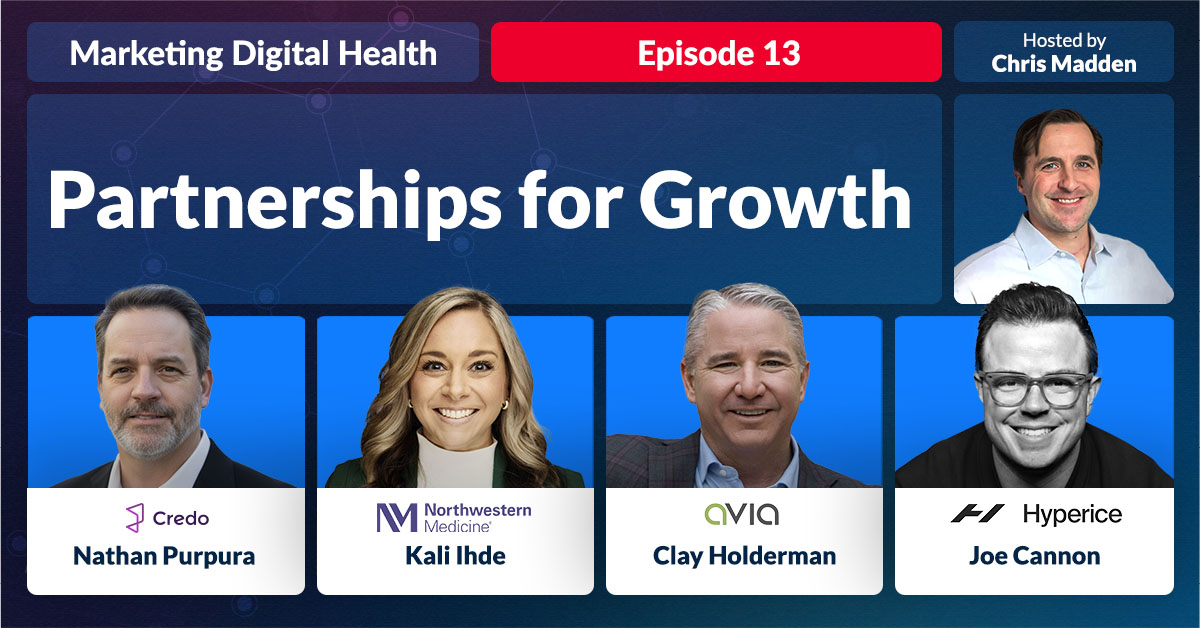


Digital health partnerships work when value is clear for every party. This episode lays out how to find the right fit, run a clean pilot, and scale. Nate Purpura explains how to blend direct to consumer motion with health system, pharmacy, and employer distribution. The mix lowers acquisition costs and builds credibility if you choose partners that already reach your best fit patients. Start with a small pilot and a single success metric, for example show rate, cost per start, or time to diagnosis. Plan the rollout before you launch so momentum is not lost.
Kali Arduini Ihde shares how large systems evaluate new technology. They look for clinical alignment, safety, and operational fit, not just a shiny demo. Clay Holderman talks through the change management required to make innovation stick, and where AI adds real value. Joe Cannon brings a category view from consumer wellness, how to win hearts and minds through education, and how to use partnerships with clubs, hospitality, and teams to reach people where they already are. Across the board, line up data sharing, privacy, and owners on both sides. Use influencers and community partners to warm the market while enterprise cycles move. Measure both near term pilot KPIs and long term outcomes so each renewal gets easier.
Learn how partnerships with health systems, payers, and influencers can amplify patient acquisition and credibility.
This panel mixes health system insight, enterprise transformation, consumer partnership playbooks, and growth leadership that blends DTC with distribution partners.
It starts with a good sales team. You really need to sit down with your sales people.
Nathan Purpura
A veteran growth leader in digital health, with deep experience building D2C and B2B2C and partnership-driven models at companies like eHealth and Bicycle Health. Now driving growth at Credo Health, Nate is known for his pragmatic approach to growth strategy, having scaled patient acquisition through a mix of direct-to-consumer marketing, health system and pharmacy partnerships, and employer-driven distribution. His work bridges brand-building, data rigor, and collaborative go-to-market thinking—making him one of the most experienced voices in operationalizing growth in healthcare.
Most digital health, virtual health startups don't really make it out of incubator stage if they can't prove that they have good outcomes.
Kali Arduini Ihde
Director of Ventures & Innovation at Northwestern Medicine, where she leads system-wide efforts to find, evaluate, pilot, and prove the value of emerging technologies in clinical and operational settings. From AI tools to drones & robots, Kali’s team plays a critical role in shaping how a major hospital system embraces innovation while maintaining patient safety, clinical alignment, and scalability.
So lots of different ways that we partner in this space. An obvious role is really to help. Bring together those partnerships, help advise on those partnerships, what are the conditions of success in those partnerships, and then also to help spread the word across our networks about how others can replicate these partnerships.
Clay Holderman
CEO of Avia, a digital transformation and innovation partner to health systems across the U.S. With deep experience in health system leadership, Clay now helps guide systems through the complexities of change management, applied AI, and operational transformation—especially at a time when economic pressures, demographic shifts, and emerging technologies are forcing an inflection point in the industry.
We don't necessarily need to be the activity or the main course. We are a partner to all movement, to all modalities, and so we have built our brand as a very partner centric model.
Joe Cannon
SVP of Global Partnerships at Hyperice, where he’s helped transform recovery tech from a niche product into a consumer wellness category. From Equinox to the US military to major sports leagues, Joe has helped position Hyperice as a vital part of movement health—while also challenging the healthcare system to rethink MSK care, wellness access, and preventive innovation.
Chris Madden:
If you’re trying to win patients and build trust, partnerships can be a huge unlock. I’ve seen them help scaling companies grow faster, reach more people and even change health outcomes for patients. That’s the power of teaming up with the right folks, whether health systems, payers, even influencers.
When it clicks, it’s a game changer. This is Marketing Digital Health, and I’m your host, Chris Madden.
In this episode, you’re gonna hear from leaders who know how to make those partnerships work. Clay Holderman has years of experience building collaborations inside of and between health systems. Joe Cannon, who we introduced in episode four, discusses how Hyperice tapped into pro athletes to turn them into megaphones for recovery products.
Kelly Idhe, introduced in our very first episode, talks about why Northwestern Medicine sees their physicians as critical partners.
But first, Nathan Purpura is a veteran growth leader in digital health with deep experience building D2C and B2B2C, and partnership driven models at companies like eHealth and Bicycle Health.
Now driving growth at Credo Health, Nate is known for his pragmatic approach to growth strategy, having scaled patient acquisition through a mix of direct to consumer marketing, health system and pharmacy partnerships and employer driven distribution. His work bridges brand building, data, rigor and collaborative go to market thinking, making him one of the most experienced voices in operationalizing growth in healthcare.
For Nate, the first move is simple. Get your sales team dialed in so you know exactly who you’re targeting.
Nate Purpura:
It starts good sales team. You really need sit down with your sales people, probably your product people and your CEO, and figure out who’s a really good fit in healthcare.
Your options are usually payers, small, medium, the large health insurers. Oftentimes it’s health systems. Might pharmacy benefit monitor for PBMs and could be pharma, but that’s a bikini channel to try and penetrate sometimes, sometimes you want to go and to B2C through medical groups.
They’re brokers, they’re large health insurance brokers, and even like the Brown & Browns, WTW, Willis Towers Watson, and groups like that.
Chris Madden:
Once you’ve got the sales team focused, Nate drills into a few important questions: what problem are we really solving, who’s actually a good fit, and then, and only then, do you start the drumbeat of content and outreach.
In my experience, that’s the key. Too many companies blast content without ever tightening the focus first. But when you know your target, suddenly the content hits harder and your campaigns feel less like noise and more like signal, because you’re speaking to a focused group about their specific challenges.
Nate Purpura:
What is our product, what issue is it trying to solve in very basic marketing stuff? What’s our product market set where we can sell?
And then from there you have to strategic know what can you support, can you handle what relationships you have. You don’t wanna boil the ocean, you’re trying to pick some verticals.
In some markets there might be regulatory issues that come into play here. You sell everywhere, whether of the easiest states to sell it to, but you really try to build the targeted list of folks that you wanna go after, and then some valuable content and messages to find, generate interest and drive leads into a platform and really basic marketing stuff.
And then from there you try to build a consistent campaign and like, what is our drumbeat, what are we saying that has interest in value, and you’re really pushing that content out through, you know, the channels that you have available. Obviously LinkedIn‘s great for B2B, you know, so there you’re looking at the companies, the job titles, and you’re either using the tools they have to push to certain markets and genres, or you can go to a third party, like a alternative healthcare, something like that, and buy lists, you know, build custom audiences on LinkedIn or do email marketing.
Marketing, who are we selling to, what do we, how is valuable for them, what can we realistically afford to do and make sense to do, and then very methodically go target and distribute content and try and sort of nurture, pull through at a very high level.
Chris Madden:
That brings us to healthcare partnerships at the hospital system level. Clay Holderman is the CEO of Avia, a digital transformation and innovation partner to health systems across the US.
With deep experience in health system leadership, Clay now helps guide systems through the complexities of change management, applied AI and operational transformation, especially at a time when economic pressures, demographic shifts and emerging technologies are forcing an inflection point in the industry.
According to Clay, it’s key to remember that there’s no one size fits all here. Some hospital systems are building with the biggest tech players in the world. Others are scrappier, running small engineering teams inside their own walls.
Clay Holderman:
You see everything from those that are large enough to make partnerships with the mega scalers and really help Microsoft and AWS and others with their health investments and truly creating partnerships where they are helping by making their data available, probably most importantly, in a controlled environment, and helping train these large language models, and these agents within those models and those environments.
And that’s something you see in the Mayo Clinic platform. You see a lot of the larger systems playing with a lot.
On the other end of the spectrum, a lot of health systems have brought in engineering teams themselves and are allowing their researchers or their clinicians to work with engineering teams internally, and then they want to be able to use that IP to make a broader impact outside the walls of the health system and have a return on investment on that IP.
And so you’ll see companies like Abundant Alliance, which is a family of Avia, helping bring multiple health systems together to create companies out of their IP and then help invest and bring the scale in those companies.
So those would probably be the two ends of the spectrum, and then there’s many, many startups where founders are coming to health systems looking for their first proof case or their second customer and health systems are taking equity and co-creation in exchange.
Chris Madden:
Case in point, when Clay was COO at Presbyterian Healthcare Services, they didn’t just buy a product from a digital health partner. They collaborated with the team to shape and improve the product.
His team works side by side with Bright.md to refine triage models and workflows. That’s not just partnership, that’s co-creation. When it works, everybody wins.
Clay Holderman:
Our clinicians help to refine the automated triage models and the workflows and bring forward product improvements that really helped the product become better and helped our clinicians to reduce friction.
So lots of different ways that we partner in this space.
And Avia’s role is really to help bring together those partnerships, help advise on those partnerships, what are the conditions of success in those partnerships, and then also to help spread the word across our networks about how others can replicate these partnerships.
Chris Madden:
Now partnerships with big tech are one thing, but what about right at the ground level where doctors and nurses are working with patients every day?
Kali Arduini Ihde is the Director of Ventures and Innovation at Northwestern Medicine. We introduced Kali in episode one around why marketing digital health matters.
Kali from Northwestern says that’s where the action really is, and if you’re not showing up there, you’re missing the heartbeat of healthcare.
Kali Arduini Ihde:
Sourcing is one of the main activities that we do, which is how do we find and stay in tune with what’s out there, what’s available, what’s possible, and a lot of that is a combination of staying really well connected to leaders within our organizations.
So physicians are the best folks to tell us what they’re hearing, what they’re seeing, what they would like to see from technology.
So we partner very closely with our physician leaders, our frontline physicians, as well as nursing and administrators to understand what are the biggest problems, what do they want to solve and what have they already heard about.
And so that really makes sure that we’re staying aligned with what the organization needs and what our workforce wants.
Then it’s my team’s task to go out and find out and stay connected with what’s out there. So we go to conferences, we stay connected through, you know, the news, through forums, through networks, health systems that get together and share, because it’s important to know what’s available now, what are others exploring, what’s early stage, whether it’s coming from startup companies or some of the bigger players that are really wanting to disrupt healthcare.
But we also look across industries. What are we seeing elsewhere, what are folks finding, are there technologies that sort of span industries, maybe don’t have as strong of a foothold in the healthcare industry, but could, and how can we be at the front lines of bringing that forward.
So naturally with a lot of the trends out there right now, things like generative AI and agentic AI are things that I’m talking about on a daily basis.
Chris Madden:
Kali makes a great point. Partnering with physicians isn’t just about getting their buy-in. It’s about listening to the people who know the pain points better than anyone. That’s how you find the real opportunities.
And speaking of opportunities, Joe Cannon knows how to turn users into raving fans.
Joe Cannon is the SVP of Global Partnerships at Hyperice. If you recall from episode four, his company Hyperice makes recovery tools, and instead of going straight to consumers, they started with the professionals.
When LeBron James and Kobe Bryant use your product, you’ve got credibility before you even run an ad.
Joe Cannon:
When I started the company in 2016, almost every professional athlete had access to a lot of our technology. Now, we had a smaller suite then, but it’s been core to our DNA and still is, and a growing part of our business.
When we build products, it’s always in from the first product, and with Kobe Bryant and our founder, which was the ice pack, was the Hyperice product, which is where our company name comes from.
It was built with feedback from the world’s best athletes, and it was if we could build something that they love, that they could use, that they trusted, then we could, and we, but we priced it at a price point that anyone could afford or reasonably anyone could afford.
We were onto something and so our goal was always to test and get feedback and get ideas and have conversations with those athletes.
That’s why we don’t chase a lot of trends in the wellness space, so fads in the wellness space. It’s because the professional athletes aren’t asking us for it, and it’s not something that is coming up with their trainers and doctors.
So when I started my job as kind of the first commercial employee, it was really to help the brand get out to everyday people. And so that was taking what we learned from professional athletes and bringing that to the everyday person.
We focused on fitness first, but going back to the ego of our brand, which is very limited in the sense of, we’re recovery, we’re activation, we’re movement enhancement, we’re pain management. We are a piece of technology that helps you do the things you love better.
We don’t necessarily need to be the activity or the main course. We are a partner to all movement, to all modalities, and so we have built our brand as a very partner centric model.
We want to be a part of what is happening in a space, whether that’s an Equinox or a Lifetime when it comes to fitness, or in a Marriott or Hilton or Hyatt or Four Seasons in spa or in hotel rooms like we deliver with Westin.
So it’s a very interesting kind of question in the sense of our brand is so partner centric, like we don’t, we are okay showing up as someone else’s brand powered by Hyperice. Like we do over a hundred Nike events a year, and most of the time the only branding we have is our technology being used by the athletes, the attendees, the people coming to the run club or the VIPs getting a massage or jumping the NormaTec boots.
It’s not like, oh, this is a big Hyperice logo. That’s not really our thing necessarily.
We believe in getting people in the boots, getting people to try the guns and really creating experience out of it. So I’d say what makes us an attractive partner to our partners is we do what we say and we say what we do and we deliver on time.
And we are really excited to be a part of it. And I think we’re really grateful to do that. There’s a quote from, you know, rugby, the illustrious, the greatest rugby coach of all time, Jack Clark. And he’d be embarrassed, I’d say that. But at my alma mater Cal, and he always says, grateful for everything, entitled to nothing.
And I think we are that at Hyperice. We really embody that as being really excited to be a part of what our partners have going on and being enthusiastic and being there.
And that’s how we do things in every channel and how we approach it, ’cause our ultimate goal is not logo recognition on a billboard, it’s product on people in boots, people seeing, touching, feeling, loving the product and saying, wow, I thought this was only for the world’s best athletes, but it helps me move and feel better.
Oh my gosh, my hip hasn’t felt this good, or I gave this to my dad for his back and the Venom has changed his life because he uses it every day in the morning.
Thank you. People name our products. That’s amazing to us, like they name them like members of their family. They name Hypervolts, like, oh yeah, Jerry’s always working in our house and Norma, she just crushes the legs for all the family and we got the kids in there.
That to us is that we become part of the furniture and like the healthy habit at home. That’s the dream for us. That’s why we love partnerships is because people experience it and then, if that exit through the gift shop model where it’s like, I really could use these NormaTecs because I travel a lot or whatever I do.
Chris Madden:
There’s value in finding people just as passionate about your product as you are, whether that’s LeBron James or your friend’s dad.
Joe’s word of mouth is opportunistic, but can also be deeply fulfilling and meaningful when the health stories become personal.
Joe Cannon:
It never gets old seeing your product be used by the best athletes on earth on the side of the sidelines, like LeBron using the Hypervolt, or Anthony Edwards wearing the Venom Back wrap or on the sidelines of the knee or leg or shoulder or all at the same time.
That’s amazing. But hearing that someone’s dad who is going through chemotherapy loves the Venom Back because it keeps him warm and there’s a lot of circulatory issues that come with that, or the NormaTec helped them overcome pain or in that way, during that really hard time.
Or even tragically like people’s end of life stories that you hear that people are buying it just to, their parents have a little bit of comfort as they go. It’s heartbreaking, but it’s beautiful that our products can provide the relief people need to just move.
You lose sight of that. A lot of times you’re, you mean brand partnerships or selling or you’re chasing numbers and then you get these stories or these emails from people out of the blue or some of the stuff around the fire.
We had people here in California lose their homes and we had two different stories. One reached out on LinkedIn and someone I didn’t know and said, hey, one of the things I grabbed with 20 minutes to spare was I grabbed my NormaTec, ’cause I use it every day and it helps me train.
I’m so glad I did it, but we’re actually able to get back to our house. And so I just wanted you to know, I thought you might find that to be funny. And I found that to be heartbreaking, but amazing. That was something.
And we had a friend who lost the house and her son plays volleyball, and she was like, oh, he used it every day. I should have grabbed it. I didn’t think about it. And so obviously we sent one. It’s one of those moments that you’re like, this stuff is really important to people.
Chris Madden:
I love that as a clear expression of Hyperice having this partner first mentality. They’re okay being in the background as long as the person’s experience delights. That’s what makes them attractive partners, and good partners are deeply trusted because it’s not about hype, it’s about the results and the proof of people actually feeling better.
And Nate sees it the same way. For him, a good partnership is when both sides win. The health system gets healthier patients at lower costs, and his team gets to prove their solution really works.
But that kind of collaboration takes trust and careful navigation of regulations and privacy rules.
Nate Purpura:
Generally, a good partnership from a service provider standpoint is they’ve got a sizable population that, you know, there’s a match there in terms of they’ve got people that need it, we can provide it if they’re willing to enter a BAA and do all the compliant things to actually give your MX analytics team access to the data claims and help determine who in your pool of patients is what can fit for our program, and then allow us to do direct marketing, particularly if it’s co-branded.
That’s typically the most effective way to build a program. The nice thing about that too is that if our data analytics team, let’s say your data comes back because this is the patient population that we think is really good based on claims history, we know that we can address these issues.
We see that the last five years they didn’t cost X amount of dollars. We know our average patient’s gonna cost five, ten percent of that. It’s a real win-win.
And then we have a prospect database we look at and we know, okay, here’s everybody that we reached out to. Once we run a program and we see who actually signs up, we’ve got a real good foundation for segmentation too, right.
Look at, these are the messages that we used, value propositions that we, we got 20 percent of that market to respond and 10 percent to sign up. So we converted about half of the leads that we got, whatever, right, whatever the number is. Here’s these actual signing up and then we can tweak our offer.
We can go back and say, okay, let’s try something else from a marketing perspective, ’cause we missed 80 percent, we missed men over 50, or women in their thirties or whatever. And if we can look at the claims data and go, we didn’t make a good, we weren’t, we didn’t make an appealing offer as somebody who’s hasn’t been in treatment for three years, but anybody who’s been in treatment in the last six months was into it ever.
You sort of segment out and figure out who’s responding and who’s not responding, and then you can share that back with the partner too. We say, look, this is a group that, you know, we’re just missing from a marketing perspective or we talked to our enrollment team, it worked out that actually they weren’t a fit for the, and so we either need to update our service to help service this population, or we should redirect those folks to something else.
So that’s really the foundation of a good partnership. And if we’re a good servant of your goals, we are a good partner.
So if your goal is to keep people healthy and lower their costs and lower the costs on your system and we help you do that, it’s a great partnership.
And then it’s all about transparency and we all the work for it. There’s so much privacy and regulation around data privacy and healthcare that you have to be really careful and take that very, very seriously and build a lot of trust.
But if you do that, you can work out, you build some fantastic partnerships and have, you know, tremendous success.
I generally tell people like, the juice is worth the squeeze. If you can do these kind of programs, set it up the right way, it is very, very high value because typically from an acquisition standpoint, a member acquisition standpoint, it’s a very cost effective, but it’s very low cost to go acquire these patients once you have the program set up the right way.
And then these programs typically perform well. Most digital health, virtual health startups don’t really make it out of incubator stage if they can’t prove that they have good outcomes.
Chris Madden:
What stands out to me here is the transparency. Nate’s team looks at the data, shares what’s working, admits what’s not, and adjusts. That’s the mark of a strong partnership, and it’s also the only way these programs survive long term.
Next, Joe again highlights Hyperice partnerships. No matter if they’re hospitals or physicians or celebrities, they’re all centered around the same thing: reaching people, getting them to try the product or tech and simply making them feel better.
Joe Cannon:
The goal is once someone tries it, it’s like, did that relieve their pain, did their hip feel better, did their lower back feel better, do they feel like they recovered faster from their run, do they feel less stress after using the products.
That’s the type of stuff where that’s common across the whole human race, everyone wants to feel better. No one wants to be in pain. Your brain’s primary function is to keep your body out of pain.
And so it’s like, what do you want more than that? I think we satisfy a basic human need and a sense of comfort, and so I think that’s pretty common across all of them, and it’s just figuring out what is the connective tissue that we can reach with a partner. What can we provide.
And I think so many times, like we talk to partners and we figure out what they have going on.
We’re not usually going in with a pitch on, here’s this box, put this in, do this, the end, here’s the program, call us if anything happens. It’s, hey, what’s happening in your gym, what’s happening at Fort Benning, what’s happening there with basic training, how many people are you bringing in, okay, how can we provide support.
How is that different than what we’re doing with the SEALs and Naval Special Warfare at BUD/S. It’s having those conversations and better understanding what they need, the tech they need, and not just selling them whatever the box is, selling them something specific to them and providing them support that they feel taken care of.
Chris Madden:
Nate details how COVID changed the healthcare industry. It opened the door to telemedicine and virtual care in a whole new way. Some companies are less progressive than others when it comes to virtual care.
Being a good listener and having people skills is a strategic way to build trust in those partnerships.
Nate Purpura:
Now, COVID sort of opened the door to telemedicine and virtual care in a way that it hadn’t been opened before. So I think very often when talking about a health system, it just depends on how progressive they are, so what their business partners are like.
Sometimes they’re very protection. We’ve got a massive facility downtown in a region where we’re large employer and there’s some resistance to virtual care, and other places know that organically expand access.
Probably a really good sales team. We CRM a good process document, what are the conversations that we’re having, what are we hearing, is that a pain point that we can address. Those are all those sort of human skills and human conversations around being a good listener and being a good problem solver.
And then from marketing standpoint, the best way you can help that group typically is good CRM management. So who are our leads, what conversations are we having, keeping track of those things, making sure that you have answers.
Helping that team stay focused, supporting them with assets, resources, a lot of this sort of traditional MarCom stuff like what’s the best deck, do we have options, have FAQs, you know, those kind of things.
Chris Madden:
Having marketing collateral, leads, a focused, targeted list of accounts, you are ready to roll and things get exciting, but don’t get too excited.
You have to size your partnerships based on what volume your company can handle at the time. You don’t wanna reach too many potential patients too soon if you aren’t operationally ready yet.
For example, if you have only a handful of clinicians and 30 more appointments to fill per week, you don’t want a massive enterprise partner to flood you with thousands of patients that you can’t handle.
Nate Purpura:
You wanna know as best you can, as early as you can, what your member acquisition program is gonna deliver.
You really have to think about it from a direct response basis, so you’re not doing brand marketing, you’re not doing very often, you’re not doing general SEM, you’re not doing general direct to consumer tactical things.
You know, you start putting a message out there and you’re opening the doors, you’re trying a bunch of different strategies and tactics to try and create awareness to drive people in.
With B2B2C, it’s very direct response. So typically, I know you have this issue, we treat this issue and we’re gonna try a bunch of direct response tactics to get in front of you, make you aware of it and see if you convert.
And once you know how those things perform, then you really gotta be able to scale it from a support and care standpoint.
I wouldn’t wanna go outreach to a hundred thousand patients if I can only handle four or five thousand. So supply, very often it’s like, where are you at in the company, how many people can handle the lot, other you donation drive, gas acquisition campaign that drives a bunch of leads in and your sales team got through telephonic enrollment, for example.
Or you need to onboard patients with other humans and you overwhelm that group, ’cause then you burn your credibility with the partner and with the number. And I called, I outreach, I couldn’t get an appointment, that sucked.
The next time I email that patient or, you know, mail them, call them anywhere, acquisition status is, they don’t have any trust and you can actually deliver.
So that’s usually the first barriers in understanding what is your threshold from servicing. And then you can build off of that, right. We can service this many leads. We could service this many patients. We think our marketing is gonna drive four or five, twenty, fifty percent response rate. So you back into the math that way, right. And that’s really where you start.
You know, tactically if you’re going B2B2C and you want to deploy digital channels outside of something like TV to frequent example, targeted digital, you know this, you need to have, you know, usually about ten thousand records to build some audience.
There’s a lot of areas to that too, from a HIPAA compliance perspective, is do, does the partner have opt-in for those kind of communications, what are you communicating.
I typically recommend like build your content strategy around, at least from a branding, a digital perspective, build your content around what I call value added communications.
There’s a CMS for Medicare and Medicaid Services standard for value added communications. And I use CMS guidance ’cause they are the strict, so if you’re adhering to CMS rules and you’re pretty much covered for people on exchange plans or people on Medicaid, things like that. Medicare‘s typically restricted.
So in that arena, you know, you’re never saying, Chris, I know that you’ve got ulcerative colitis or cataracts or something. I, you never say that.
What you can do on a digital platform is just general education. And now, do you know that treatment A is now available for people with cataracts and here’s why it works, and you maybe don’t, you typically don’t promote your company so much as what it does.
You know, one issue is gonna be just distribution. What is your product and service, right. Can you get it. Typically the value proposition to the end user where the partner is digital health spaces, where we’re gonna lower your costs.
We just have a massive lag of access to clinicians and treatment options through most of the country. There’s various businesses that I’ve been in. The problem is better or worse, but it typically takes two to three weeks to see a specialist.
In some cases, things like opioid use disorder or rehab, opioid use disorder treatment program. Either if you get on a plane and fly somewhere, ’cause there’s just nobody in your area. And very often what you’re doing in the digital health space, you’re offering digital access to a clinician or a treatment program.
And then that program is a high value in terms of getting people into treatment and keeping them in treatment.
That’s often the sales point of like, we’ve got virtual, we’ve got really good retention because it’s less expensive. The patient can do it from their phone or they can do it from home. So they might have to take an hour from work or get in the car or drive somewhere.
So a lot of the value with these programs is typically like access and adherence to treatment, ’cause those bring cost out some more preventative care, more upfront treatment.
So at the end of the day, that’s what you’re offering is, is we’ll get more care to your patients sooner and keep them on it so that we bring your costs down. And that’s obviously very appealing for employers.
It has some appeal for payers. The pharma can, it can get tricky. It depends on what your product did. And then same thing with health systems. It just really depends. For things like mental health, sometimes there’s a parity issue where they wanna make sure they’ve got a treatment that they can offer, but they don’t have enough clinicians in house.
And so when you bring a virtual offering there for something like addiction medicine, where there’s not a lot of specialists, if you can centralize virtual care for them, that’s sort of open value you add.
Yeah, it just really depends on the offering and the vertical that you’re going after. But generally it’s better access, better adherence, better health outcomes and lower costs.
Chris Madden:
According to Nate, creating awareness is the best thing you can do when you’re doing a targeted B2B2C outreach program. A big part of that is general education.
Nate Purpura:
The people that you’re outreaching to just get awareness of, oh, I didn’t know that medicine for opioid use disorder was available, or that I could do virtual care, virtual cognitive behavioral therapy through an app.
That’s fantastic. That’s really interesting. You know, this company’s telling you about that, so you create some wellness on digital channels instead of like the best thing you can do when you’re doing a targeted B2B2C outreach program.
And if you can time that around when your direct response, so let’s say your partner’s going to email their members or mail them, or you’re gonna do a series of outbound calls. If you lay the groundwork ahead of time to create awareness of this great new treatment program, that people are aware of it and are interested in it, and maybe they click through your ad and go learn on your website, but they don’t know that it’s covered, then when you follow up with a direct offer, you’ll increase your risk.
That’s right in your conversion ’cause you built a trust there. So in terms of thresholds, that’s where digital becomes high value. But you need to have, you need to be able to do it and you need to be able to build a custom audience that way.
And you’ve gotta get a large enough population to come to your site and engage with content to be able both.
So that’s really where having a partner agency that knows how to do things and can get very creative with you, or having a good skill set, a good team internally that knows how to activate from a digital marketing standpoint in a compliant way in the healthcare space.
Chris Madden:
Joe Cannon wraps things up with two very good points. One, when it comes to partnerships, don’t get tripped up by contracts or negotiating for things that only work for you, over committing.
Joe Cannon:
Being too focused on the contract or things that just work for you. I see it a lot with other businesses where they get so obsessed with having every I dotted and T crossed that like they lose the spirit of the partnership.
Gary V said a long, long time ago, you always want all your partnerships to be 51 percent in their favor, if not more. And ’cause that will create more for you longer.
That’s where people get tripped up is like it has to be a specific win in this way and that’s where I see like struggles happening.
Chris Madden:
Joe‘s wrap up point number two. Wellness is having a moment.
Joe Cannon:
I think some of the stuff about reduction in chemicals in food is super important and something that we’re happening, but I think the next phase of where this is going is MSK issues.
Musculoskeletal conditions are the number one reason for calling out of work, workplace absenteeism, a huge cost to our healthcare system, and right now in so many ways, we’re not adjusting to that.
We are waiting until it ends. We’re not being proactive and I think a lot of people are thinking about physical proactivity and like working out and training and running and HYROX having just a massive moment and what they’re doing.
But I think long term it’s like how are we taking care of our bodies to prevent breakdown. Joint replacements are an all time high and what are we doing to really slow that process.
We’ve been focused on this at NormaTec for 25 years and Hyperice for 15 on taking care of people’s body, taking care of the world’s best athletes’ bodies so they keep going, so we can reduce these non-contact injuries we see from repetitive strain.
And that’s what we’re seeing in general pop too. How can we do that in a way that really helps allow people to get out ahead of it and really provide research that allows healthcare companies to make those decisions.
‘Cause right now people are voting for that with their healthcare dollars. They’re getting saunas. They’re buying red light panels. They’re buying cold plungers. They’re buying NormaTec and Hyperice products.
And in so many ways, NormaTec is medicine. NormaTec is a class two medical device that has over 30 years of medical research that has all kinds of incredible outcomes and some things that weren’t even contemplated.
There was a study that came out about NormaTec affecting arterial stiffness in younger populations. What does arterial stiffness have to do with anything. Yes, there’s some physiological benefits, but there’s some massive benefits for cardiovascular health reduction.
How does something as simple as the NormaTec pneumatic compression device affect outcomes that are not just joint or soft tissue related or diabetic wound care related or lymphedema or DVT.
All important issues, but how can it improve cognitive function, how can it improve cardiovascular health. The outcomes there are pretty crazy when you think about where this can go from the use of this product that was built for post mastectomy lymphedema in the late nineties, right.
There’s some pretty crazy outcomes that are coming, and I think we’re at the forefront of learning it. It’s just we need that healthcare adoption and that conversation with healthcare leaders, payers, partners, and doctors to say, hey, we’re already doing this with the world’s best athletes. We’re already doing with this, with special forces in the military.
Well, why aren’t we offering this to people who are working in construction and warehouses and otherwise.
We’re super pumped about it at Hyperice, what’s to come and how we can really begin to impact healthcare policy and healthcare services.
More than that, preventative healthcare is the future of healthcare, and we want to get there.
Chris Madden:
And that’s what I love about this conversation. Every guest in this episode from Nate to Clay, from Kali to Joe, sees partnerships as about long-term connection and never about transactions.
They’re about trust and human relationships. They’re about delivering something meaningful and valuable.
If you take anything from this, let it be this. Find partners who care as much as you do and treat them like teammates, not just channels.
That’s where the magic happens.
Sometimes growth comes through others. Episode 14, our next episode, takes you inside B2B2C models, showing how covered populations built via employers and health plans are reshaping digital health acquisition.