

Digital health paid acquisition works when you respect how people actually make health decisions. This episode maps the funnel from demand generation to demand capture and shows how creative, targeting, and measurement fit together. Meta excels at generating demand. It puts resonant messages and proof in front of people who did not plan to shop for care today. Google search excels at harvesting demand. It helps people who already have high intent find the next step. Winning strategies use both. Lead with stories and value props that speak to specific patient pain points, then meet intent with credible landing pages and clear CTAs. Compliance shapes the stack. Expect to design filtered events, server side pipelines, and limited data sharing rather than clicking a platform checkbox. On page, healthcare is a YMYL category, so trust signals are non negotiable. Include bylines, medical reviewers, citations, outcomes, and clear next steps. The math matters too. If you earn more per user than competitors, you can outspend them at the auction. That edge can come from payer contracts, retention, and better product economics. Put it all together as a repeatable media system: test creative fast, protect signal quality, align pages to intent, and measure to patient acquisition, not vanity metrics.
Explore strategies for building brand awareness and engaging patients through targeted digital advertising.
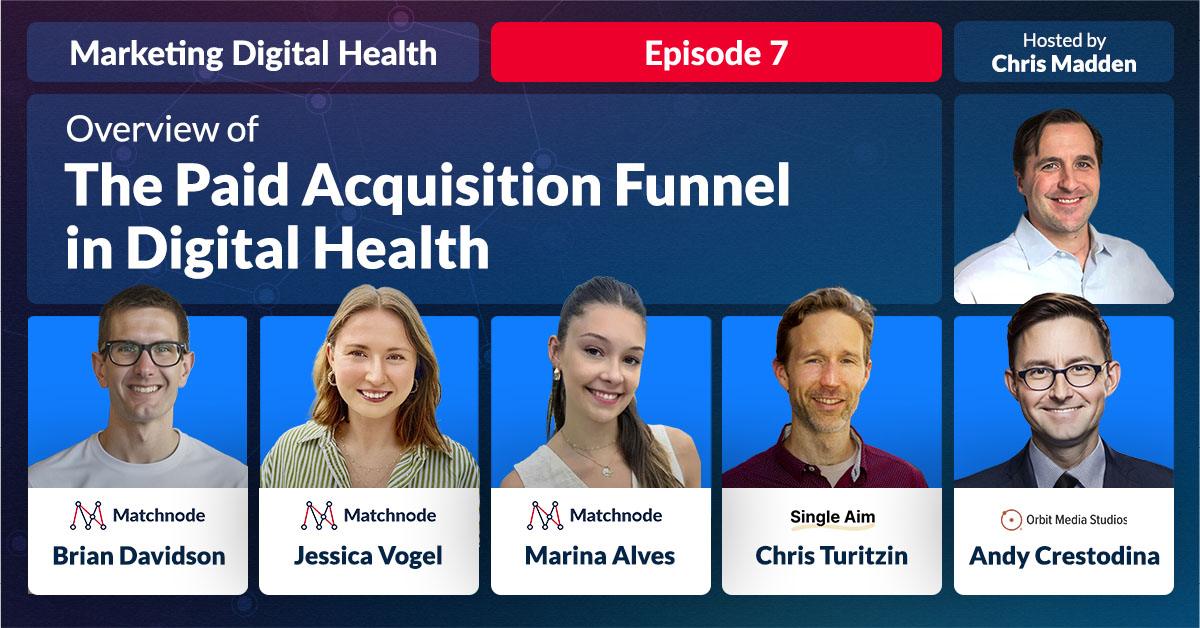
This episode pulls together a media strategist, a creative director, a technical lead, a content and UX thinker, and a growth architect to show how paid acquisition works end to end in health.
Google (search) traditionally is fantastic at harvesting and fulfilling demand. I've got a ailment for X, I put it in my search engine and boom, I'm seeing the answer. The flip side is Facebook or Meta ads, which is fantastic at generating demand. These...are very different concepts as far as search for something, find solution versus the feed showing you something that you probably had a pulse on but you didn't necessarily know that you were looking for when you jumped on Facebook.
Brian Davidson
co-founder of Matchnode, Brian has helped redefine marketing for digital health companies by focusing on performance-driven strategies that deliver real results. With deep expertise in strategy, advertising, and digital health, he’s worked with brands to optimize campaigns, scale patient acquisition, and navigate the evolving digital ad landscape.
Identify what are the pain points of my patients that are converting, what is the company solving for here? And then that's where I would apply my messaging. That can come from testimonials.
Jess Vogel
a creative director with deep expertise in digital health marketing, helping brands craft campaigns that drive real impact. From testing messaging to balancing creative strategy with rapid iteration, she understands what it takes to make creative work in patient acquisition.
There are a lot of tools, for example, in meta ads where you just check a checkbox and that automatically tracks a bunch of stuff for you. With clients, that's not an option. Most of the time for my technical job, it makes it more difficult 'cause it's easier. Check checkbox and everything gets sent through. That's a lot easier for me. But with the restrictions, sometimes you have to manually filter through everything that you want to send or not send. And that's a big difference. You don't have as much freedom to just send everything that you have available let the ad platform do its thing.
Marina Carvalho Alves
is the Technical Lead at Matchnode, where she helps digital health companies design compliant, high-performing acquisition pipelines. Her work touches everything from platform tracking to HIPAA-compliant data flows, making her the go-to expert on the technical foundation behind effective health marketing.
in search, Google has a name for these kinds of pages. YMYL ("your money or your life"), in which the visitor is really making a serious decision that will impact their life. Which doctor should I use? What procedures should I get? I. How serious is this? Should I get a second opinion? Is this person credible? We don't make any buying decisions anymore without doing some research first. And for healthcare, we do a lot of research. It's important, it's a big decision.
Andy Crestodina
the co-founder and CMO of Orbit Media, a web development and website optimization agency. Andy is also an author and speaker, known for distilling complex SEO and content strategy concepts into practical, actionable tactics. As a leader at the intersection of content and technology, Andy’s insights are especially relevant as AI transforms how we think about visibility and value in marketing.
So if you can get to a point where you're actually making more money off of your users than your competitors, then that's the golden territory where you basically can win the market and you can get that by having unique insurance contracts or strong customer retention..
Chris Turitzin
a growth advisor and founder of Single Aim known for bringing rigorous product and marketing discipline to the world of digital health. After years of leadership at Meta and digital health companies, he now advises companies like Bicycle Health, Ours Privacy, and other healthcare leaders on how to architect scalable growth systems tailored to diverse business models, from DTC to payor-aligned care.
Chris Madden:
In this episode, we’re diving into the basics of the paid acquisition funnel in digital health. These are the advertising touchpoints that are part of your customer’s journey. They can fall anywhere from first hearing about your business to the moment they book an appointment to become a patient.
This is Marketing Digital Health, and I’m your host, Chris Madden.
Now, when it comes to health in the ad space, there are some unique challenges. Unlike other industries, digital health brands face strict rules when using paid channels. But don’t worry, we’ll walk you through how to navigate those restrictions and make the most of your ad budget. This is the work that we at Matchnode specialize in.
For our clients, we’re running high velocity tests that are either technical or most frequently creative in nature to learn and improve return on investment, usually driving new patient appointments or other digital health sales conversions.
If your company is just starting to scale with paid media, you may have a lot of questions or strategies to consider. That’s where Brian Davidson comes in. He’s my co-founder at Matchnode, and he knows this stuff inside and out. Brian has helped redefine marketing for digital health companies by focusing on performance driven strategies that deliver real results, with deep expertise in strategy, advertising, and digital health.
Brian has worked with brands to optimize campaigns, scale patient acquisition, and navigate the evolving digital ad landscape. He describes the scenario where things are moving in the right direction and a business is ready to throw gas on the fire.
Episode-07_Matchnode_20251008_R…
Brian Davidson:
They’ve already proven out to some degree that their offering is working, that there’s a marketplace for it, that they’re able to help patients or validate that their product is working or their service is working, and people come to us saying, this is great. I’ve got these channels that are working.
Some people are finding us organically. Email marketing might be working, or we’ve got something going with direct mail. Can we start to scale this using paid channels?
Chris Madden:
You’re likely familiar with many of the paid channels Brian mentions that you can tap into like TikTok, X, LinkedIn, and Reddit. Still, he points out that the big players in the space continue to be Meta and Google. The key here, he says, is balance. It’s all about figuring out how to spread your budget across those platforms in a way that makes sense so that you can hit your targets.
A quick heads up, when Brian refers to LTV, he’s talking about lifetime value. That’s an estimate of the total value, whether revenue or profit, a business can expect from a customer over the course of their relationship.
Brian Davidson:
Media mix really matters, and it really first starts with your budget. One, how big is your budget? But two, just as importantly, is your budget scalable?
Meaning if you could acquire a customer for X, would your budget expand because it’s done profitably? If the answer is that you’re doing it profitably, I usually say that your budget should be unlimited, and we want to push each channel as hard as you can until you start to see that point of diminishing returns.
However, every business isn’t in a world where they’re automatically acquiring a customer in the black. A lot of people are acquiring customers actually at a loss and hoping that the LTV will make it up, or they’re still in growth mode and they just need to acquire users, period, to validate their product and maybe raise another round.
It’s all about the results.
Chris Madden:
If something is working and helping your business grow, you want to double down. Similarly, you want to pull back on tests that do not deliver the expected results.
That’s why Brian says getting the media mix right is so important. Here, he talks about surfacing a product or service. You see something online that does indeed interest you, that you did not know about or think to search directly for when you woke up that morning. For example, a digital health company might introduce a new solution to a health problem that you suffer from.
Brian Davidson:
It comes down to generally two specific principles, however that line is beginning to blur.
One, Google is fantastic at harvesting demand. I’ve got an ailment for X, or I am wondering about Y, I put it into my search engine and boom, I’m seeing the answer. Paid search can absolutely surface solutions to different health problems.
The flip side, Facebook or Meta is fantastic at delivering demand and surfacing demand and generating demand. So a user might be on their feed and they may have Googled a few things earlier in the day, they might be going on with their health life, and using the power of their algorithm, they are able to surface a product or service that fits your exact need and services that demand the same way that your search would.
Those are very, very different concepts as far as search for something, find solution, versus the feed showing you something that you probably had a pulse on, but you did not necessarily know that you were looking for when you jumped on Facebook.
Trying to understand your CAC on both of those different platforms is really important.
Chris Madden:
CAC is something we will hear a lot about in this discussion. CAC, or the acronym CAC, stands for customer acquisition cost.
Brian Davidson:
We are going to push the most budget towards wherever you are going to find the most efficiency.
For some businesses, it is Meta. For other businesses, it is paid search. Sometimes paid search can be extremely, extremely competitive and very, very costly. Unless you are converting those clicks at a very high rate, it might be cheaper actually for you to be advertising on Meta.
Sometimes, however, the conversion rate on Meta can be a little bit lower than it is on Google. So really trying to find that media mix is really balancing both this demand generation as well as this demand fulfillment principle, but also chasing CAC and chasing efficiency.
Chris Madden:
Brian says it is all about optimizing the media mix, balancing the demand generation and the demand fulfillment principles, while also settling on an efficient CAC with the desired volume.
Social and search are both hugely important, Andy Crestodina says. Andy is the co-founder and chief marketing officer of Orbit Media Studios. We introduced Andy in episode one around why marketing digital health matters.
He’s quick to point out how different search and social are from one another when you consider how and when a potential customer comes across them.
Andy Crestodina:
From a distance in digital, they just look like two different channels. Oh, I’m going to promote this thing in both channels.
But in fact, they are not just different, they’re opposite channels. The psychology of the visitor in these channels, the way that we use them, the reason we go to them is wildly different.
An easy way to think about that is that nobody goes to a search engine to browse around, and similarly, nobody goes to social media mostly with a plan of action and a specific need.
In other words, visitors to websites from search tend to be busy, and visitors to websites from social tend to be bored.
It’s really great for content discovery. It is great for innovators. It is great for inventors of new things and things that were unexpected, things that were visual, things that were emotional and provocative, things that were personal and collaborative. Social blows it all away. It is incredible for those channels. There is nothing more personal. It is literally social media.
Search is like a research tool. It is long form text content that answers questions, and your job is to satisfy an information need. In search, we meet expectations. In social, we are a little bit unexpected.
The psychology of the person who landed is very different. If a skilled content strategist can actually look at a topic or a headline and quickly have a sense for which channel would have a natural advantage, and maybe how to adapt it for a different channel.
One final point. Search has a ceiling. There is only X number of people searching for a given topic per day. Things do not go viral in search.
Social, I am amazed. Have you ever seen the analytics for a social media viral event? It is incredible how many people there are in the world.
I am careful of my biases, but what I find interesting is to find the topic-channel fit. Does this topic have an advantage in search or social? And then try to construct it specifically to perform in one or the other.
Chris Madden:
Chris Turitzin says that while Meta and Google Ads make sense for B2C digital health companies, they are only a part of the marketing mix for those acquiring patients directly for B2B2C companies.
The requirement is to be part of a covered population, whether through your employer or your health insurance plan.
Chris Turitzin is a growth advisor for digital health companies and is the founder of Single Aim Marketing. We introduced Chris in episode one. Here Chris refers to B2B2C specifically.
Chris Turitzin:
Because every nine out of ten people will not be eligible for your thing. So you will be burning through money, and those systems do not have any good way of targeting people that would be eligible for your thing.
A lot of those companies generally feel pretty frustrated by the paid channels.
SEO is a channel though that I think a lot of them do invest in.
Chris Madden:
When taking a referrals approach, Chris advises marketers to apply some built-in skepticism. He shares the pitfalls he has seen and what to watch out for.
Chris Turitzin:
What you see a lot of times is a company going in, spending a lot of money on paid, realizing a year down the road that the CACs are too high, because everyone else in the market is depending on referrals and has basically zero dollar CAC, and then kind of scrambling to adjust from there.
Chris Madden:
Healthcare is a great example of a category where you need a ton of information at the top of the funnel, according to Andy Crestodina. He explains how that translates into an individual’s online search activity, which underlines the importance of where a product or service is present.
Andy Crestodina:
It takes just seconds after you have a healthcare question before you are looking for an answer online, even though you may not be in need of any services or procedures at all.
Then farther down the funnel, it is the ultimate example of a category where the visitor is making an insanely important decision, like the highest stakes in search.
There is more to it than search, but in search, Google has a name for these kinds of pages, YMYL, “your money or your life.” The visitor is really making a serious decision that will impact their life.
Which doctor should I use? What procedure should I get? How serious is this? Should I get a second opinion? Is this person credible?
We do not make any buying decisions anymore without doing some research first, and for healthcare, we do a lot of research.
Chris Madden:
It is important. It is a big decision.
Andy adds that it is pretty rare these days to have just one touchpoint with a brand. Everything is connected. It is a multi-channel world out there where nearly everything we see or hear is intentional, whether it is word of mouth, a billboard, or a search ad.
It is all about companies trying to meet people where they are.
He also contends that Google and Meta basically run the show when it comes to search and social.
He says that lately Google has been rolling out more visual, algorithm driven products, and with all that new inventory, things are getting interesting.
But here is the twist. Thanks to AI, the line between search and social is starting to blur.
Andy breaks down what this shift means and where things are headed.
Andy Crestodina:
It is not as clean as it used to be. These things are moving closer to each other.
One of the things that made me very aware of that was when I learned some of the trends about how people are using TikTok as a way to get answers. There is enough content there that people will search for a topic and find the answer there.
So social media and social content is satisfying information needs now.
YouTube is always in the middle. It is a place for content discovery. It is also a place where people go to get answers.
There is a big gray area in between.
Probably what is still relevant as a way to think about the targeting on these. In search, you target people based on what they are thinking. It is keyword-based targeting, so you know what they are thinking, but not who they are.
In social, you can target people based on demographics and behavior, so you know who they are, but not what they are thinking.
So in that way, there is still contrast.
I can target people. Is my offer or content something that aligns best with the moment and their current information needs?
An example I used to give was if you think you have bedbugs in your house, you are using Google three seconds later.
But you cannot in social media target people who think they might have bedbugs. It could happen to anybody.
On the other hand, there are some products like, I have a pair of sunglasses. They are tinted blue mirrored shades with clear frames. I never would have looked for that. I love them. They are badass. These are Gas shades.
I saw them on social media and immediately bought them. That was content discovery. So there are lots of things where no one is looking for them. You have to market them in a different way.
Other things, yes, people look for it, but you cannot target them in social media, because they do not fit into a demographic. There is no behavior that indicates whether someone needs an exterminator.
I do not think that it is as clear a line as it used to be. I think there is lots of overlap now. I think that human behavior is more diverse. These channels have more overlap.
If you search for something and use the YouTube videos in search results, those YouTube videos are also likely being pushed in front of eyes on that platform and being discovered as recommendations.
Keyword-first strategies or social targeting, you need help from a pro. Talk to an expert. They are going to help you out.
Chris Madden:
Social, Andy points out, is a fantastic discovery tool for healthcare for several reasons.
One of them is geography. It may be a telemedicine offer, which is maybe less specific to a geography, but I am an advisor to a children’s hospital here in Chicago, and there are big outdoor campaigns.
It is very focused on specific areas. They target certain neighborhoods.
In search, you cannot really do that. That is not how search works. It sort of tries to know where you are and tries to serve things nearby, but in social, you get much better targeting.
They can find their audience very quickly in social, much better than in search.
So geo specific phrases in Google were never great. It shows the map sometimes, sometimes not.
You will get a lot more accurate targeting with paid social for a healthcare program with a geo specific offer, of course, or a physical location.
Search has always been kind of weird for that.
Earlier, we talked about companies paying for ads because organic alone is rarely fast enough or responsive enough.
Andy says time is of the essence when it comes to building your strategy and talks about how spending money on ads saves time in the long run.
It sparks a process that provides necessary velocity. For example, in message testing.
Andy Crestodina:
Organic is really slow. It is just very slow. It takes a long time to build up the things that make it work.
It might be a flywheel effect after it is working. It tends to work better. But building links and topical relevance for search, or growing a social following, or building your email list, it is durable because you publish something and it stays around. That video you made is still there.
But not every brand has the time and patience to go through this long process, or are they comfortable with the uncertainty of organic outcomes or the indirect benefits from the organic outcomes. PR attribution is terrible. It does not feel as direct.
Paid is very fast. You can become visible very quickly. You will get data to then iterate right away. You can see the numbers are stronger.
Sure, it is temporary. Stop paying for that ad and it disappears. But that is a good way to think about it.
Organic is like your vegetables. Go to the gym and write high quality content.
But I need results now. It is not appropriate for that.
Organic, slow but durable. Paid, fast but temporary. They complement each other.
I see accounts in transit and I just wish they had a budget for paid so I could get more data. It is a beautiful thing. Just put a budget on something and you will get traffic, and then I can tell which of these two landing pages has higher conversion rates.
Now I know which to optimize for search. There is a hundred ways in which these channels work together.
I feel bad for the companies where the teams are siloed. Talk to an expert that understands the overlap, and you will get better results for each.
Chris Madden:
Andy also shares with us his tips on making a page convert better. Conversions are what we marketers call the objective or goal that a company is working towards.
For example, filling out a form, booking an appointment, or watching a video.
As part of his diagnostic, he asks a number of pointed questions that get to the heart of the issue.
How does the content reflect the individuality of your business?
Andy Crestodina:
When I am meeting with someone, I sometimes just pull up any page on their site and start scrolling down asking, could this header and paragraph and bullet list, whatever the whole page block, could this be written by anybody, or is this specific to us?
Next one, could this be written by a startup born yesterday, or is this specific to us?
How differentiated is the content?
Most pages were written with a brand-first perspective where they wanted to write something. Maybe it is kind of clever or it gives a feeling, but in the end, you stand back and look at the page and it just tastes like water.
So much content on the web is just not really specific to that company.
What makes content different? Is it well supported with evidence? Is it filled with proof points? Are the team and the people themselves there? Are the faces stock photos, or are these the actual people at the company?
How many things on any of your pages, go to your homepage and just ask, what percentage of these words and images are completely specific to who we are, versus could be written by a startup born yesterday?
That is it. Easy test, and most of the page is stuff that is completely undifferentiated.
That page could be working much, much harder. In fact, the majority of the content on the page should be content that really only you have. Only you could say you are the only company with that certification, those statistics, those people, that evidence, the testimonials, the reviews, the case studies.
Really, it is a lack of evidence that is one of the biggest gaps on these pages.
Chris Madden:
Highlighting what makes your enterprise different is important in all marketing.
As it relates to paid patient acquisition at Matchnode, Brian Davidson takes an incremental approach to doing that by tweaking the message and making adjustments to the marketing budget.
Brian Davidson:
I am looking to slowly tap on the gas. Where can we find efficiencies? Where can we keep learning?
So that is usually about an increase of either 10 percent a week, or maybe 10 percent a month, maybe even just 10 percent a quarter, but enough to run consistent tests on your account.
Testing anything for messaging can make a huge, huge difference. Advertising on these platforms is, are you going with a really specific health benefit, or perhaps you are tapping a little bit further on the worry side of things and tapping into a disease that could go wrong in your life?
Learning that nuance is really important from a messaging standpoint.
There are also pieces around imagery that you are seeing in the ads. There could be things around testimonials that you are running on these ad platforms. There could be things around your onboarding flow that can make a huge, huge difference in your overall CAC.
So I recommend slowly ramping up that budget while continuously running tests.
Chris Madden:
Brian explains that outside of something going viral, paid media offers about the only way to quickly crank up visibility and reach by increasing your spend, once your unit economics are working.
Brian Davidson:
What exactly am I getting back?
You could run a large connected TV campaign. You could run a large podcast campaign. You could run a large radio campaign. You could throw millions of dollars, or hundreds of thousands of dollars, or maybe just thousands of dollars at a PR agency to get you booked on all sorts of earned media.
Most of those platforms, it is going to take a lot of time and it is going to be a bit of a gamble if you are going to get a return.
On paid media, specifically paid digital media, in near real time you are going to start to learn and understand exactly what you are getting out of the platform.
Chris Madden:
The best way to make the most of paid media? Test everything.
Generate ideas with your client and then test them. It is a sure-fire way to both get results and to learn, Brian notes.
There is a lot of research involved on the client’s end and on Matchnode’s end, and in collaboration, AI can help generate different ideas for testing.
Sometimes unorthodox ideas teach you the most.
In general, we want to test concepts that are very different from one another instead of micro tests around button color, for example.
Brian Davidson:
I want to run a scientific test. However, the world is not scientific, and especially on Facebook. When a political event or a birthday or something in your friends’ lives, or even a sporting event, your feed can change on a daily basis.
So it is not always possible to run a pure scientific test on the platform. But whenever possible on both Google and Facebook, I want to run a pure split test where half the audience is seeing one ad, and half the audience is seeing one landing page.
I try to control my variables so that I am only testing one thing at once.
There are those outlier opportunities though, where you might want to try messaging a new ad with a brand new landing page, and you want to insert that as a challenger in your existing campaigns and see how it does.
So there is a little bit of nuance to the science in the testing in that it is not always possible to run a perfectly scientific test, but whenever possible, that is absolutely the way we go.
We try to test very cleanly in a slow way so that we learn.
The biggest thing is messaging and learning what core message resonates, but also just delivery. Is that messaging delivered best through a static image? Is it delivered best from a doctor? Is it best delivered from a patient? Is it longer form or shorter form?
All those nuances really matter.
Chris Madden:
After taking all of those factors into consideration for paid channels, Chris Turitzin describes how a paid acquisition funnel can lead to a position that is defensible and differentiated.
Chris calls it a growth hierarchy of defensibility.
Chris Turitzin:
So the most non-defensible channels are paid channels. Anyone can set up a Meta Ads account, Google Ads account, and start paying for ads today.
If that is what you are depending on, probably you are going to have trouble down the road. You are going to get in some CAC wars with competition, and eventually it will get so expensive you do not really want to be in the business anymore.
So you want to move in differentiated ways that are also hard to differentiate into.
I like to think of this as, first, differentiated conversion. That can be defined as you have really good creative, you have really good landing pages, you have really good conversion funnels, so at some point your conversion is so much higher than others that your CACs go down, and it is relatively defensible.
Then I would move into the differentiated channels category. So you actually get access to channels that your competitors do not have.
For example, if you are doing employer or payer based, getting those relationships is very differentiated and very defensible. Or maybe you have some specific partnerships that will amplify your marketing, like channel partners and stuff that is defensible and valuable.
Which basically leads into a differentiated CAC.
You get to a point where, let us say that you have insurance coverage and your competitors do not have insurance coverage. It will be cheaper because your people will convert better because you have insurance coverage and they do not, which is highly defensible.
And then lastly is differentiated LTV.
Chris Madden:
Just to refresh, LTV is lifetime value, or how much a business can expect to earn from a single customer during the length of their relationship.
Chris Turitzin talks about how these positive, defensible dynamics can compound and create a flywheel.
Chris Turitzin:
So if you can get to a point where you are actually making more money off of your users than your competitors, that is kind of the golden place you want to get to.
So, you know, when we worked at Bicycle, I was trying to move in that direction. We started, of course, with paid. We started with SEO, which is relatively defensible.
And then, over time, paid got very competitive. We still do paid, but it is less that we are just dependent on ads on Facebook and Google.
We have done tons of work on driving conversion and having unique channels that only we have access to, and then having insurance coverage everywhere, so our CAC goes down, and then having unique insurance contracts where LTV goes up. That is, I think, the trick for succeeding in this business.
Chris Madden:
Whether things are going well or not, change is constant.
Your LTV is going up, so you are willing to pay a higher CAC, or tweaks are made to spend in the media mix. Everything can be a moving target.
Brian Davidson:
Cost of acquisition becomes more stable or certain over time when you are spending dollars, but it definitely does fluctuate, and it can fluctuate on things like season. It can fluctuate on things like time of day. It can fluctuate based on your spend levels.
It is really, really important to decipher a stable CAC and start to learn if you can drive efficiency with it, but at the same time, continually running tests to lower that cost of acquisition.
Chris Madden:
Amidst the uncertainty, businesses need to decide how much to spend.
At the outset, it may be more about learning than ROI, according to Brian Davidson.
Brian Davidson:
When you are just starting out in the paid advertising world, I tell this to lots of entrepreneurs, not just in the health space, your initial budget should be the amount of money that you are prepared to lose to learn.
Because sometimes you are just going to be doing things that are not going to be profitable for your business, and you are just going to be learning, what is my CAC and how does that relate to my business?
So I recommend starting, not small necessarily, it could be a somewhat larger number, but you need to go into those initial spends fully understanding that you are here to learn, not necessarily grow profitably.
Chris Madden:
It is not just about spend. For those that need to be extra budget conscious, Jess Vogel is the creative director at Matchnode, with deep expertise in digital health marketing, helping brands craft campaigns that drive real impact.
From testing messaging to balancing creative strategy with rapid iteration, she understands what it takes to make creative work in patient acquisition.
Jess recommends doing a diagnostic on what is working to figure out what to prioritize.
Jessica Vogel:
I would identify what are the pain points of my patients that are converted, what is the company solving for here, and then that is where I would apply my messaging.
That can come from testimonials. If they do not have testimonials, then I would lean into the pain points or create an ask-me-anything where it is not necessarily a testimonial.
You can use stock imagery. It can be a very limited design basis because it needs to look organic, and put in the ask-me-anything of what would a common question that your potential patient would ask, and then we can fill in all the information of, we can do this and it is covered by my insurance, and it is completely virtual, so I do not have to drive 40 miles outside of my town to see a specialist.
So that would probably have been my go-to for someone who just does not really have anything in their assets but needs to drive home a really strong message.
Chris Madden:
While we incorporate classic advertising principles, Brian says the complexity makes marketing digital health a different animal.
Brian Davidson:
One, generally speaking, some of the strategies that work for some health companies naturally work for others. But two, the platforms themselves also have a lot of different restrictions on the type of data that can be used.
Specifically, there is a lot of data restrictions around being able to target specific people based on the condition that they have.
Chris Madden:
Brian says it is crucial to understand how the numerous diverse channels intersect, especially given that Google continues to roll out new products that blur the line between demand generation, your strategy to create awareness and interest in a product or service to generate sales and revenue, and demand fulfillment, which is how you meet customer demand that pre-exists for your product or service.
Brian Davidson:
There are things like YouTube Ads, Gmail Ads, display ads, products like Google Performance Max and Google Demand Generation that definitely are closer to Facebook than a pure search campaign.
In that world, it is really, really important to try to understand, what is that true path to purchase or path to acquisition?
So there are HIPAA compliant tools like Mixpanel that we love to use. There is also incrementality testing that can be done on the platforms.
Facebook actually just rolled out a new beta that we are enrolled in for a new incrementality optimization that we are really excited about.
So trying to not just optimize the platform to grab a conversion of someone that was going to convert anyway on Google, but go look for purely brand new people.
Cannot wait to run that test, but there is still going to be a world where they overlap, and you need to use a tool.
Another tool that we are using right now is called Hows, where we are doing a true incrementality test with geographic holdouts to try to understand how the channels intersect with each other.
So taking a look at the models that are available in a HIPAA compliant way, running geographic incrementality tests, as well as running incrementality tests within each platform, are all different tools that we utilize.
Chris Madden:
All kinds of digital health companies, from broad stroke primary care providers down to condition-specific digital health specialty care companies, can encounter various roadblocks on paid platforms.
Brian Davidson:
There are different restrictions depending on how specific you are in treating a condition. Specifically, if you are marketing towards a specific condition, Facebook can be a little more restrictive.
Whereas if you have a more broad offering, what we are seeing is generally you fall into a mid-tier of restriction because you are advertising health in a general sense versus advertising a cure for a specific ailment.
Chris Madden:
HIPAA is one thing to keep in mind in all of this.
HIPAA is a US federal regulation that, among other things, aims to protect sensitive patient health information.
Marina Alves is the technical lead at Matchnode, where she helps digital health companies design compliant, high-performing acquisition pipelines.
Her work touches everything from platform tracking to HIPAA compliant data flows, making her the go-to expert on the technical foundation behind effective health marketing.
HIPAA puts constraints on health marketers, as protecting people’s personal health data is on the line.
Marina Alves:
There are a lot of tools, for example, in Meta Ads, where you can just check a box and that automatically tracks a bunch of stuff for you. With health clients, that is not an option most of the time.
For my technical job, it makes it more difficult because it is easier to just check a checkbox and everything gets sent through. That is a lot easier for me.
But with the restrictions, sometimes you have to manually filter through everything that you want to send or not send, and that is the big difference.
You do not have as much freedom to just send everything that you have available and let the ad platform do its thing.
You have to be more aware of what exactly you can share. You have the ability to share it, but you are not supposed to share it depending on what your legal team tells you.
So just being aware of all those callouts for every single client, every single website. It is not every time the same restrictions for everybody.
It changes between company to company, website to website, even within the same brand, the same company. They have a portal that is restricted and I cannot send anything through there to the ad platforms, and another page that is just a marketing page where I can send through more information.
So there is a lot of things that depend on what category it falls under.
On more upper funnel events, like a button click or a page view or a search on a search bar, those are usually where we have a little bit more freedom on what we can track.
But when it comes to form submissions or things that are more specific and that, I would say, show more intent and then they are kind of like a proof of what medical condition you may have or what medical treatment you might be looking for, and this shows, oh, that person really does want that treatment or converted on that treatment, that is when we are not allowed to send through those specific conversions and that specific information.
Chris Madden:
It is no surprise that the digital advertising landscape is always changing. That is why it is so important to stay flexible and prepared.
Brian shares how the team at Matchnode adapts, whether it is a major shift in the tools or just staying calm when the rules change.
Brian Davidson:
Our world was rocked in November when Meta announced sweeping changes to the platform and how they were going to classify health advertising and what different people were able to do.
They allowed a new structure where some businesses were allowed to be mid-tier restricted, and some businesses were completely restricted from running anything on the platform that had to do with conversion optimization.
When that news came out, we knew we needed to adapt immediately, and the first thing I did was start a giant brainstorm list on, based on what they said we could do, what would make the most sense for those businesses.
So, for instance, they said you could still optimize your campaigns for traffic. So I thought to myself, well, how can I optimize for the very, very best traffic?
I only want traffic that is going to be on a website for up to two minutes or that scrolls down to the end of a blog post. So how could we adapt our advertising to adapt to that new world, and specifically, how could we alter our signals on the back end to optimize that advertising for a quality visit versus someone who comes to a website and might even be a bot that comes for one second and bounces?
But like all things in advertising, that also kept changing, and Facebook kept changing its messaging from a week-to-week basis.
They were almost saying the quiet part out loud, that this change is actually only coming to satisfy lawyers rather than a fundamental belief or change in the advertising that should or should not be allowed on the platform.
We started to understand that special custom events, when set up properly, were still going to be allowed on the platform.
So we have had to do a massive transition for a lot of our clients in the last few months, moving from Facebook standard events to new custom events that are in a lot of ways more restrictive. However, they were nowhere near as restrictive as the initial messaging that Facebook pushed our way back in November.
Chris Madden:
Brian says it is a balancing act. Share too much data and you could wind up with a lawsuit.
We discuss this tension on the upcoming technical and privacy episodes.
If you do not share enough, do not run any ads, and your company can die out from lack of exposure.
This is one aspect he says is at the top of the priority list.
Brian Davidson:
The most important thing is to understand the law and make sure that you are compliant with the law. We do not want to be doing things illegally.
Once you are confident of where that line is, there are different things that you can be doing on the ad platforms, and even within the current framework, I have seen businesses push it to one end and seen others take a very, very cautious approach.
Frankly, I have seen both paths work to some degree.
So again, it is really, really important that you stay within the law, but you find a product or a service or a strategy that fits where you are comfortable with being.
Chris Madden:
With doing the technical work around digital advertising platforms, he adds that having a strong team makes all the difference given the nature of the tasks.
Brian Davidson:
Increasingly, the technical work is actually what I will call privacy work.
Things like pixels, things like cookies, generally speaking, they are further invasion of privacy than either server-to-server or conversions API or back end signals that are secure.
It is really important to have a technical team that can implement this in a compliant way so you are not leaving anything to chance around being shut down.
Also, increasingly, the pixels and cookies are not even being allowed on the ad platforms themselves. So if you do not have a tech team to implement these important signals in the back end, you are going to be forced to be using only extreme top of funnel tactics.
Chris Madden:
State government regulations can form a patchwork, which can result in a lot of fragmented campaigns.
State-to-state campaigns can also fragment along state lines for insurance network reasons.
Meta and Google algorithms do not like fragmentation, Brian says, because they give better results with larger audiences.
Brian Davidson:
When they have a very large audience and target, they can understand who is at the bottom of that funnel trying to make a buying decision for a product.
But for a lot of different reasons, we cannot necessarily run one giant national campaign for the healthcare companies that we work with.
One, it could just be availability in that state.
Two, it could be that our best ads have an insurance logo on them. However, they do not accept the exact same insurance in every single state. So we still want to run our best ad, and to run that best ad, it might be done on a state-by-state basis.
There are also pieces of different restrictions in different states. We might need to run some states to a specific landing page, whereas some states might have to go to a different landing page.
We have worked with some healthcare companies where they have one offering that is more broad that can go to a variety of states, and they might have a health offering that is a little more niche.
There also might be product availability in different states. So it is really, really important to understand the restrictions and build your campaigns around them.
However, you also want to be mindful of what the algorithms really want to do, and that is to find a really big audience. So it is a constant push-and-pull to find that balance.
Chris Madden:
Brian predicts that Meta and Google are likely to get increasingly specific in their healthcare related products and services.
Brian Davidson:
And launch more and more health-specific advertising solutions rather than restrictions.
These products and services can literally save lives. They can also greatly improve the quality of life. It is a very large sector of growth for the population. It is obviously a large advertising base, a lot of dollars specifically at stake.
So from a capitalism standpoint, they want to cater toward those dollars. But from just their mission of connecting people, connecting people around health solutions is very, very powerful.
So I could see a world where they continue to roll out health-specific advertising products rather than health-specific advertising restrictions.
I do not see search evolving in some fundamentally different way. I do not see Google Shopping evolving in some fundamentally different way. But I do see YouTube, Performance Max, Demand Generation evolving consistently and coming out with new products and being more and more effective.
Generally speaking, I think those are the products that can introduce new healthcare solutions to people, especially things that are on the cutting edge that do not have to do with a specific ailment or specific symptom that you are searching for.
It could be something where, I do not know, I do not necessarily have heart pains, so I am not going to Google search and say, I have heart pains, what are the solutions?
But I could very well see an ad about general heart health and see that on YouTube and be interested and say, you know what, my dad had some health issues back in the day. They definitely related to his heart. I just turned 40. Maybe it is time for me to look into this product.
Maybe there is something innovative about it that really strikes your curiosity.
So I do see it evolving a little bit more closely to Facebook, instead of developing on their own timeline.
Chris Madden:
Like many applications in our society, AI has introduced a powerful new set of tools that have quickly permeated the work of advertising for health brands.
Brian Davidson:
The big buzz in the healthcare world is a lot of AI on the back end servicing things like insurance fulfillment.
But on the front end, on the marketing side, a lot of this is idea generation.
We cannot necessarily turn on things like AI optimize our text and have Facebook scramble up our text for us, because everything needs to be compliant and the client needs to understand exactly what text is running.
But we do use a ton of AI for generating new ideas, new copy, new videos, new pictures.
A lot of times, a lot of the health companies that we work with actually have a limited amount of marketing imagery, so we are using AI to generate a lot of that imagery up front, and it is getting better and better and better and more and more lifelike, and it has been a really big help to business.
We have used a tool called Captions.ai that has been a boom for our design team, and generally speaking, they allow us to test more creative in a much faster way.
Chris Madden:
Marketing in the health space can sometimes feel like a high wire act.
You have to achieve a balance, learning your limitations in ads to protect patient privacy, while also making sure you get your company’s message in front of the right people who need it, in the way that works for your business.
Changes in technology taking place at hypersonic speed might make for a safer and more effective perch on that tightrope.
With the funnel in view, we zoom in on the platforms themselves.
Our next episode, episode eight, takes us deeper inside Meta, Google, and beyond, how each ad platform plays its role in reaching, converting, and retaining patients.