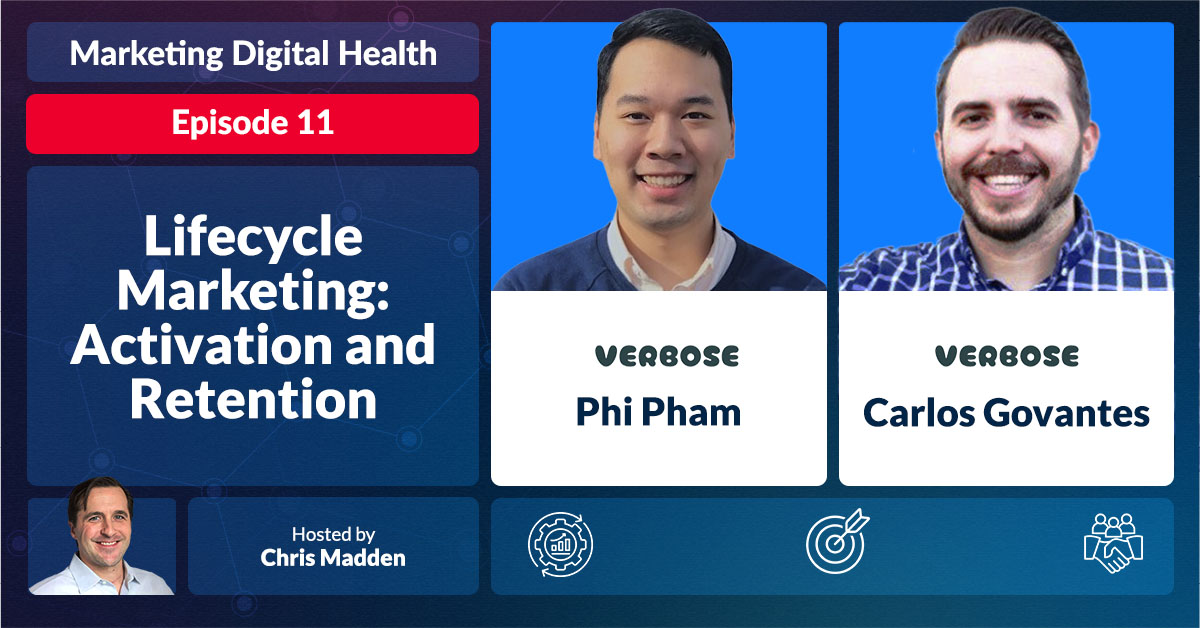


Digital health lifecycle marketing is about helping people over time. This episode turns that idea into a plan you can run. Start with activation. Design a first session that sets a habit and proves value fast. Show the next step before the visit ends. For retention, map journeys for your model, direct to consumer, B2B2C, or referral. Build segments that reflect needs, risk, and motivation. Trigger messages from behavior and clinical context, not from a calendar alone. Education and clinician voice do the heavy lifting in health. Use simple language, clear steps, and gentle nudges.
A durable data layer makes this possible. Define clean events, use consent, and link identities so you can personalize without overreach. Choose channels that fit the moment. Email is for depth, SMS for time sensitive reminders, in product for action, and community for support. Run experiments with holdouts so you can see real uplift. Track what matters. Activation rate, time to value, D1 D7 D30 retention, refill and subscription patterns, reactivation, churn reasons, and lifetime value. Close the loop with outcomes where you can. Keep governance tight. Document campaigns, limit sensitive data, and review content for claims and tone. Done well, lifecycle marketing reduces churn, raises adherence, and increases lifetime value while helping people feel seen and supported.
How do you maximize the help you can offer a potential patient over the longest time horizon appropriate? Implement lifecycle marketing strategies to enhance patient retention, reduce churn, and maximize lifetime value.
This episode brings two lifecycle builders who pair systems thinking with practical execution across data, messaging, and operations.
Lifecycle marketing is really about like sending the right message to the right user at the right time.
Phi Pham
The co-founder of Verbose, a lifecycle marketing agency firm that helps digital health companies scale by embedding dedicated lifecycle teams directly within their organizations. With a strategy-first approach, Phi and his team combine embedded operations, flexible support, and a relentless focus on driving long-term patient engagement.
Lifecycle actually has a huge impact on building trust and relationships with our users. And once we do have that trust, it's life changing for them.
Carlos Govantes
The co-founder of Verbose, where he designs the technology and lifecycle frameworks that power sustainable patient engagement for digital health companies. His expertise covers the full spectrum—from growth strategy to technical setup, including real-world experience solving challenges around event tracking, subscription models, and scaling engagement through smart infrastructure.
Phi Pham:
Lifecycle Marketing is really about sending the right message to the right user at the right time.
Chris Madden:
That’s Phi Pham, and you’ll notice right away he’s not thinking about people as users or numbers in a funnel. He’s thinking about human moments, what messages show up, when and why, and how that sequence can either build trust with the human on the other end or erode that trust.
Phi Pham:
And I think that means more than just sending promo campaigns, it means more about creating meaningful moments across your full customer journey, and how do you do that? I think that’s the issue, is how do you actually create meaningful moments and curate a strong customer journey?
Chris Madden:
Phi Pham is the co-founder of Verbose, a lifecycle marketing agency that helps digital health companies scale by embedding dedicated lifecycle teams within their organizations with a strategy first approach. Phi and his team combine embedded operations, flexible support, and a relentless focus on driving long-term patient engagement.
Lifecycle marketing is what happens after someone becomes that lead or customer. This is Marketing Digital Health, and I’m your host, Chris Madden.
There’s a delicate balance at play as companies do need some level of data to operate. It helps them figure out how to better serve you, but where do you draw that line? The people in these lifecycle marketing campaigns have already filled out the form or bought the first thing such that they are already customers, members, or patients, however they’re referred to.
So in this case, you have the direct information to send the person an email, send them a text message, or even send a direct mail piece to their address because you already have all that information.
It’s worth considering the tools and protections that are in place, to maximize this business potential and serve their customers in the best way possible, while also protecting our privacy in the digital health world. How can you help a prospective patient as much as possible over the longest period of time by implementing lifecycle marketing strategies that enhance patient retention, reduce churn, and maximize lifetime value?
Those are the exact things we’re going to be hearing about from Phi and his co-founder, Carlos Govantes. Their lifecycle marketing agency Verbose specializes in building dedicated, embedded lifecycle marketing teams for digital health companies.
To get us started, Phi says that it’s crucial to get a bird’s eye view of what your program is today.
Phi Pham:
Oftentimes within our platforms, these flows and automations are pretty fragmented. Like you have a post purchase series, you have an abandoned cart series, and it’s hard to get a bird’s eye view of a cohesive view of your customer journey of what’s sending. And so that’s what we start with.
Chris Madden:
If that sounds like a great place to start, then stick around. We’ll be exploring customer journey maps, learning about customer retention, and figuring out how data is utilized to best service patients of digital health companies.
What I loved about my conversation with Phi was how both technical he is and yet also understands that every piece of data represents a human interaction, and he really values the human side in balance with the technical side.
Still, Phi says that the flows and automations within the platforms they work on are fragmented most of the time, which means getting a cohesive view of that whole customer journey can be difficult.
Phi Pham:
I think that’s the main thing that really needs to happen, taking a step back and identifying kind of the gaps and opportunities within your program today. Whether it’s channels, whether it’s messages and branding, whether it’s the data, whether it’s the friction points, just understanding kind of your entire program today and the state of it.
I think from there it’s really taking into account the data of it all. Where are we seeing the most volume flow? Where are we seeing the most engagement? Where are we seeing the most drop off from a retention or churn perspective? Why are we not seeing enough engagement with our platform?
Chris Madden:
To answer all those questions, the lifecycle marketing agency employs a three step system to identify core retention behaviors.
Phi Pham:
Step one, take a step back, look at what’s going out. Step two, identify what the core opportunities are within those gaps of what’s going out today. And three, double dive into the ones that are high impact, high priority, and try to think through what you can do there, whether it’s testing, whether it’s revamping the entire series and the way that you communicate.
I think oftentimes brands think of people as numbers, but specifically with digital health, these people are patients. These people are actual humans that you’re trying to support in their journey. That’s very vulnerable and very emotional, especially in telehealth. And so it’s, how do you drive behavior change? How do you build trust and often guiding someone through their journey with you as a telehealth or as a digital health wellness company.
Chris Madden:
Before we break down the stages of lifecycle, Carlos Govantes is a co-founder at Verbose Marketing. We introduced Carlos in episode ten around technical setup when we went deep on events, signal resilience and attribution.
Carlos gives a concise context of how lifecycle and paid marketing fit together and can also overlap, especially from the point of view of the customer. Having run lifecycle and growth teams, I was curious what Carlos has held onto from his experiences with both. What’s his perspective on the two journeys? How do they fit together? How does he use that knowledge to build now at Verbose?
Carlos Govantes:
For the majority of my career, I was in email lifecycle channels and really early on in particular, thought about it kind of siloed to those channels.
But in a previous stint that I did, I had the opportunity to become head of growth for about a year period. And I really started connecting the dots between paid acquisition and then the handoff to lifecycle. And I think a lot of companies usually have these two teams separated within their marketing organization, and a lot of them operate in those silos.
But honestly, there’s such a close handoff that happens between the orgs that there should be more integration thought about from that.
And what I mean about that is, on the lifecycle side, we’re usually picking up after the paid acquisition or the paid search or whatever it is collects the lead, whether it’s an email, a phone number, even if they can get them to purchase, that’s where the lifecycle journey begins.
There’s been many times where I’ve seen completely different performance or even interest between someone coming from Meta ads versus TikTok ads versus paid search versus even organic. So really incorporating the acquisition source into our lifecycle decisioning.
Chris Madden:
So just to recap: step one, look at what’s going out. Step two, find any gaps. Step three, double down on high impact pieces and rebuild the flows that matter most.
It sounds simple, but it’s not. It’s the difference between spray and pray email setup and something thoughtful, human and effective.
Now, Phi takes us through the three main stages of lifecycle, the first being the so-called awareness stage in the marketing funnel. He calls it a handshake of sorts between the paid acquisition team and a marketer’s lifecycle team.
Phi Pham:
So you have top of funnel where your paid acquisition team is testing in ads, TikToks, CTV, SEO, organic, things like that. If they come to your site, they explore your site and they sign up as a lead.
Understanding that between paid and lifecycle is really important as well because we want to understand how users are first learning about your brand, what they’re interested in, and how they’re coming to your site, and being more interested in the value props.
And so if someone’s running a top of funnel ad on TikTok about a telehealth company and they’re really interested in the doctor interaction and being kind of asynchronous, the lifecycle team should really know that because they can take that handshake and build on top of that with workflows, lives, communications and things like that.
I feel like there’s a huge learning curve typically and a huge building of trust that needs to happen before someone signs up with you. Especially at Thirty Madison and at telehealth, we’re really helping them through a journey that’s really personal and vulnerable for them. And so we want to make sure that they feel like they’re supported every step of the way.
Chris Madden:
When you hear Phi talk about eventing, such as add to cart or browse, he’s talking about behavioral signals that happen on a website or in an app. What users click, where they pause, what they add to cart, what they check out.
It’s how the system knows what to say next and not have to guess.
Phi Pham:
And so that includes welcome series that nurtures them and educates them. That includes abandoned cart, that includes browse, understanding people’s behaviors and really building their journey so that we’re sending the right message to them after they activate.
I think that’s where I love to really work within. It’s like, what does the customer journey really look like? Onboarding, formation. How do you build advocacy with the user so that they’re referring their friends? And then if they’re not having a great experience with your service and they churn, what does that win back experience look like so that we can regain their trust and build a better product over time.
Those are the main three stages of lifecycle. It’s awareness, it’s activation, education, nurturing, and then it’s also post-purchase retention. It’s how do we actually build a better customer experience with our customers.
Chris Madden:
That’s where Phi hands the baton to his co-founder, Carlos. While Phi thinks in flows, Carlos lives in the data fields, schemas and clean naming conventions. He’s the one making sure that what we send is based on something solid.
One class of tools he talks about are CRMs. CRM stands for Customer Relationship Management, and some really common CRMs include Salesforce and HubSpot.
Carlos Govantes:
So if we think about the user updating their cart, there could be an event associated with that product added to cart. If the user makes a purchase, there can be an event associated with that that comes into your CRM tool, purchase event.
You then use that event to trigger your order confirmation or your abandoned cart welcome series, and so on and so forth.
The data schema is what I would say that is the data inside of the event. So you have your abandoned cart event, for instance, and then within the abandoned cart you’d have the product name, the price, the image URL, the link to the PDP, all that kind of stuff.
So you really want to make sure that you have very clearly defined events coming from your website into your messaging platform, and then for each of those events, you have a clear distribution of data that you want to leverage in your messaging.
Chris Madden:
But there can be obstacles to that. Many times, Carlos says, it’s obvious when a transition has occurred within a company.
Carlos Govantes:
Say there’s a different engineering leader or even just different engineers or teams touching the databases while working on projects. And if there’s not really solid core foundational documentation, and sometimes that’s hard to come by, especially if you’re a startup and you’re moving really quickly, the data schema starts getting recreated by a different engineer who’s picking up on the project.
So one thing that I usually like to look in with clients, it’s a really good test to understand, do we have any issues with our data and our platform?
Chris Madden:
The litmus test in this case is what Carlos calls the first name test. Different techs all refer to someone’s first name. Is it actually accurate for your purposes? Because if there’s a mess, you’ve got to find some workarounds.
For example, you might have first name with no spaces, you might have first underscore name, you might just have name. Carlos gets into it.
Carlos Govantes:
So if you go into ESP and you look for a field called first name, if you have more than one of them, there could be an issue with your data schema.
A lot of people upload CSV lists, or the abandoned cart event will have first name, but it’ll be like first underscore name, and then the purchase event, it might be firstname, all one word. So you end up having the same value that means the same thing, but there’s just different ways of naming it.
And when you want to call that data into an email template or an SMS or some other kind of a workflow, the marketer might not know which one should I be using. Sometimes it’s null, sometimes it’s not null. What was the most recently updated one?
And then if you think about your tool, like an Iterable or a Braze, whatever your CRM platform is, you’ll have all of these fields on the user profile. If you have five first names and all of them are populated, how do you know which one you should be using consistently across all of your messaging?
That can lead to breakages with dynamic personalization logic.
First name is just one very basic example. Let’s assume we’re thinking about something else like lifetime purchase history or the last product purchased. If that’s getting updated from various different places, it can cause a lot of issues in your messaging and your logic.
Chris Madden:
This is where things get tactical. Carlos recommends setting up a staging environment so if you break things, you can fix them and test before anything is ever publicly live.
Carlos Govantes:
The technical details, I think things that matter most there, there’s a couple different buckets. One of them is really understanding and mapping out the data that you want to use.
What I’ve come across a bunch is a lot of times companies or individuals will think, I don’t know what I’m going to use this data for, but let’s just get as much data into that platform as possible. We’ll figure it out. It’s better to have more than it is to not have it at all. I don’t know if I 100 percent agree with that.
While yes, it is a nice to have data, you can figure out use cases. If you just add everything to a system, it can create a lot of bloat. And then we start getting into those issues where fields might be misnamed. And then you have to replace it with a different field.
Or maybe you just threw everything in there with one set of engineers or one project, and then a year later you’re trying to solve a very specific use case and they create some new events or new data and it does the same thing that’s already in there. But since that was created a while ago and no one was really using it, no one understood why it was there, so there was just, let’s just create new data that we have a better, clear understanding of.
So I think that’s one part, being very clear on which events you want, knowing exactly how it’s going to be leveraged before you start the building process.
As a marketer, if I want to create a journey around a post-purchase, for example, and I want to know which conditions the user might have, or what age bracket they’re in, so that I can cater the content for them, I want to have a thought about how I’m going to leverage that data and then I’ll provide requirements to my product or engineering partners and say, here’s what I would like the event to look like, because this is the messaging that I want to execute on.
So that’s one part of it. Having that really clearly defined and of course documenting it so that if anyone has to pick up this project at a future date, they have all that context and history and they can pick up right where you left off versus creating something which could conflict with it.
The other thing that some companies just don’t have the bandwidth or resources for, maybe it’s not the time, but I’ve found it so valuable over my career, having a staging or QA environment. Don’t just push things to production because that’s where a lot of this event and repeat data issues occur.
We put an event into production. We were just testing it. We actually need to change the name of it, or we actually need to add some extra fields, or maybe we don’t even need that event after all. Most platforms like Iterable and some of the other ones, you can’t delete events once they’re in there. You can hide them. You can try and clean it up. But it unfortunately stays in there forever, until you move to a new environment and no one wants to migrate their entire system. That’s just too much of a pain point.
So using a staging environment is great because if the events get messed up, if the data gets messed up, who cares? It’s a staging environment. You can hide them. You can worry about that later.
The other thing I like about a staging environment is you can be very meticulous about how you QA things. You can try and push through all those edge cases of a user made this purchase on a browser that’s less than 1 percent used by most people. Did that break any of the data flows or messaging or any of that kind of stuff?
And then as you find those use cases, you can fix them. And then once you have everything nice and clean, now you move it and push it over to production. So you have a clean environment, one. Two, you don’t have any bugs that the user has to experience either.
Chris Madden:
Just as it’s important to pay attention to all of those details, having a robust strategy can usher in success, says Phi, whose embedded lifecycle team Verbose is built for delivering just such a strategy.
Focus on nurturing a prospect instead of just trying to snag more leads.
Phi Pham:
In the past where we’ve worked with agencies that have been a little bit more production heavy with lifecycle programs, you need a lot of hands on keyboard.
Developing emails can be as simple as stacking image classes, or it could be as complex as building pure HTML emails, so you send out to your users, which is a lot more best practice.
And we also worked with agencies that really only did creative for us, but one thing that was missing with my experience all within in-house brands is the strategy of it all.
I think lifecycle specifically really only works when you have a strong strategy, because all the rest funnels down into creative and production.
And so we created what we call an embedded lifecycle agency, which essentially embeds fractional lifecycle strategists onto your team, then augments your current resources so that we can better build out your strategy and build out your program.
I like to help brands move from more of a reactive execution to more of a proactive lifecycle strategy, because oftentimes you have a lot of top down going, hey, let’s send more emails, which, no, we should be a little bit more methodical about it.
And it does bring it back to defining what lifecycle marketing really is, and I think it’s a lot different than thinking of yourself as a channel marketer. Oftentimes, a lot of brands get stuck into the scenario of like, let’s send more emails, let’s send more volume. It’s working. It’s lowering our CAC.
We spend so much acquiring a user as a lead, but then we don’t spend much time nurturing them and actually getting them to make their first purchase. And so email is one of the cheapest channels that you can spend on. And so let’s send more so that we can convert them.
And oftentimes that kind of pigeonholes you into a very promo heavy comms style after sending emails five times a week, saying, hey, we have a discount on site, come and convert.
Chris Madden:
When Phi talks about brand messaging, he describes the handshake between acquisition and lifecycle and says we should picture them like a figure eight. He says that the relationship between the two sides determines what sort of overarching brand messaging a digital marketing team is looking to cultivate with its customers from the top of the funnel all the way down to churn.
Phi Pham:
Having a one-to-one kind of synchronous relationship with your paid team is super important. With the nuts and bolts, it can get very technical. I think especially with lifecycle, there’s a CRM component of things. What data are we getting from our users? What data can we use to really personalize experiences and what’s really core to a strong lifecycle program is the data infrastructure and how you’re leveraging it.
Obviously, when you’re getting users in from paid, really the only thing that we have is the paid source. What channel are they coming in from as well as the messaging or the creative that we’re getting them from.
I think there’s a lot we can do with landing pages as well, especially if you add lead capture to landing pages because it really shows the content on the landing page and the handshake of like, hey, this person came in on a landing page that had X, Y, and Z. Let’s continue to dive deeper into that messaging within the email or SMS channels because we have a deeper relationship with those channels.
And so I guess, number one, is like understanding that with your paid team, the messaging that’s happening and how do you pass that data onto the lifecycle team so that they can double down on that. Because if a specific value prop is hitting, then you’ll definitely want to double down and make sure that you’re nurturing that over time.
Chris Madden:
One suggestion from Carlos is to consider using unique welcome messages that depend on which ad a user may have seen.
Carlos Govantes:
If you saw a UGC ad on TikTok, you might want to follow up in your welcome email referencing back to that ad.
And that can be accomplished by tagging your ads and having parameters passed through during the acquisition. So like a lead collection box, think about like maybe there’s a UTM that gets passed in, and then you can save that in your CRM tool so that when the welcome email kicks off, you can have either a dynamic module or even splits or branches in journeys that can say like, okay, this user came from this channel.
So we’re going to A/B test and we’re going to do a whole bunch of content to see which type of content really drives users to the next stage of the funnel for TikTok versus an organic customer who might already know more about the company because they’ve been doing the research, they came to the website via some other means.
Whereas a person who saw a TikTok video or Meta ad, it may have just come across their timeline, caught their eye really quickly, they clicked on it. Maybe they didn’t spend a lot of time on the website, so there might need to be more education and trust building with whatever the business is versus that organic searcher.
Chris Madden:
Carlos makes a great point here. Not all leads are created equal. The message that works for someone coming from TikTok might not resonate with someone who found you through Google search. Lifecycle teams need to know where people are coming from so that they can meet them there.
Carlos Govantes:
So if I am looking at all of my sources, I really want to build funnels by source.
You know, what’s the lead acquisition to conversion time for users that are coming through from organic? What does it look like if they’re coming from paid search or TikTok or Meta or wherever else?
Most of the time, it logically makes sense. If someone’s coming organically or via a search channel, they’re going to have higher conversion rates. It might be a shorter turnaround.
The tricky part is the world is not linear. So a person does not only find a website organically, or they do not only come through via paid search. Usually if they’re searching for a brand, it’s because they previously saw a TikTok video or a Meta ad or something else, or maybe they heard it from a friend.
That’s where it becomes a little bit more tricky. There’s tools like multi-touch attribution to help understand where your leads are coming from and what different touch points they’ve had.
We’ve actually worked with a ton of clients and others even in-house, trying to solve the very tricky attribution issue. I wish there was an out of the box easy solution for it. But again, like so many things in life, it comes down to like, can you build something that’s consistent and that enough people internally can have alignment on? And then can you look at that over an extended period of time to have some kind of consistency again with it?
Whether you’re using GA4 or some other multi-touch tool or even in platform metrics, it always gives you a different answer.
Where I’ve seen the most challenges at different stints and other clients is when they try and use multiple sources and then marry the stuff together.
So if I’m looking in Iterable, for instance, at in platform metrics and I’m reporting on Iterable revenue per email, and then one of the analysts is using either internal database or Google Analytics 4, then we’re reporting two different numbers and a lot of questions come from executives.
Why is revenue down here? It’s like, well, actually you’re comparing revenue in platform to the centralized database, which is coming from some kind of weighted attribution system.
So again, it’s really key to just have consistency and make sure that when you’re having those conversations around data, that everyone is aligned on what are we comparing to so that we have those apples to apples.
Chris Madden:
Phi points out that first step, the first purchase a customer makes, is vital. And when it happens, the game changes.
Phi Pham:
Lifecycle from an acquisition standpoint, getting that user to make that first purchase is really similar as well. We’re testing value props all the time in our comms. We’re testing what works, what’s resonating with users that really gets them down the funnel.
I would say when they purchase, it’s like a whole different ballgame where you’re really focusing just on the customer experience.
I think within telehealth there’s a huge focus on onboarding and specifically within the first 30 to 60 days, because if you don’t build trust or a habit with the customer, the churn risk skyrockets really within the early days, and you have a hard time retaining them over time.
Chris Madden:
He says that the key KPI for product market fit is how long a customer will stick with us. Sometimes organic referrals may even come into play.
Phi Pham:
If you’re spending so much on acquisition and you’re getting all these leads and you’re getting these first purchases, but they’re not retaining, that’s really difficult to really move the needle because that’s more of a systemic product issue than it is a lifecycle marketing issue.
That also goes into the whole shift. The lifecycle marketing has become so cross-functional these days because retention has become such a performance KPI for businesses. Retention is the ultimate proof of product market fit.
If you have strong engagement early on and you have consistent usage with your platform or your product in the first 30, 60, 90 days, that’s a really strong signal that people are finding your product valuable and that they’re going to use it for the long term. And you can scale this with new users.
In those early days, when you have low volume of users signing up for your platform, it’s not the millions of emails that we have for these larger brands. It’s like two leads that come in a day. It’s really hard to start A/B testing because you can’t find stat sig on a lot of tests or optimize that.
It’s more about how do you actually just build a stronger customer experience and product and leveraging lifecycle to do that is such a valuable tactic.
An example of this is customer feedback is such a valuable insight early days while you’re trying to scale your product or your business. And the only way you can do that is really sending them an email and asking them or DMing them.
And so how do you build those communications in place where you’re actually leveraging that feedback and that data, to delineate that message and give it to your product team, your engineering team, so that you can build a better product.
I think another big piece of it is referrals, word of mouth. Are your customers actually sharing your product? Is it going, not necessarily viral, but is it spreading quicker and virally in a way that’s supporting your business on the organic side?
I think that’s a great kind of indicator of product market fit because people are finding value and they’re willing to share this with their friends. And that’s a big thing to really put your name behind something.
And so it’s all about, I would say, providing value to your users. Because if you’re just pumping paid dollars into getting more leads, but they’re not converting, that’s not going to be sustainable business.
Chris Madden:
If retention is the KPI for product market fit, I was still curious what the relevant KPIs are on lifecycle, which Phi fills us in on. He also talks about how over focusing on retention can be problematic.
Phi Pham:
It really depends on the stages of the lifecycle that you’re looking at.
I would say the first stage is the path to purchase, which is once they become a lead, how do we get them to actually convert? And oftentimes there it’s a pretty robust testing environment, similar to paid ads and things and seeing kind of what value props are working.
And so oftentimes some KPIs that we’re looking at are obviously conversion rate, but I would say engagement rates like click data, value prop tagging, what modules are they clicking on most, and doing a lot of testing within the channels.
But then retention is where it gets really complicated, I would say, in terms of KPIs, because especially with the introduction of subscription businesses having become so popular as a business model, you have subscription businesses that have one month subscriptions or even 12 month annual subscriptions.
And so the difference between one month is really easy of testing. You’ll see the result of your experiment within 30 days. But if you’re testing with an annual subscription, something that you do in month one, month two, you’re not going to see the actual true results of it until 12 months later when they renew or they churn.
And so it gets really complicated, and I think with the longer plans, like the 12 month, there’s, I would say, I think Netflix called this secondary KPIs or tertiary KPIs that are a good indicator of what the long term result will be, which for them was like the number of views that they came back to watch, or the number of likes that they had on a title.
If that was increased incrementally in the first month, then that was clearly a good indicator that it’s going to actually increase retention over time.
And so we can go into this more granularly, but I would say it gets a lot more complex in terms of the KPIs we’re looking at, and it differs every business, because usually retention KPIs are really tied to the product KPIs and performance KPIs there, because we’re the ones driving that habit.
We’re the ones doing a push retention that says, come back and track your sleep, or come back and track your food log. It’s really tied to product.
Chris Madden:
It really makes sense if you think about it. The success of the product, how well it performs, translates to how long clients and customers will stick with it.
Carlos‘ approach involves communication and understanding.
Carlos Govantes:
The biggest thing is talking to the humans and really having an understanding of where they’re coming from and trying to get some kind of alignment.
For me, what I really like to do is always understand the whys of how things are done. So yes, it’s important to understand how something works, but I always want to talk to the person who owns that department or owns that metric, that report, and understand why are they reporting it in that way.
A lot of times what you’ll find out, especially orgs that have a bunch of turnover, they’ll inherit something like, well, this is what was in place, so I’m just keeping it going. Usually when you have those scenarios, there is more opportunity to like, hey, let’s rethink this. Maybe there’s a solution where we can come up with something that’s going to have a better handholding event where we’ll be more in sync with each other.
Sometimes you’ll talk to the person who actually implemented and owned that from scratch and they have very good reason for why they want to do that, and then you can cater your metrics or your reporting to be more in sync with what they have.
Chris Madden:
Carlos says that one of the things he loves about lifecycle is that it mostly happens all within one tool.
This part is worth taking notes on: holdout testing. Instead of just sending the email to your entire list, you hold back and don’t send the email to 10 percent of it, and then you compare how many purchases that group that did not get the email made compared to the group that did get the email.
Carlos Govantes:
The other thing I like to do, especially from the lifecycle side, this is a little bit more isolated into lifecycle, one of the things I love about lifecycle is it all happens mostly within one tool.
Hopefully you have a tool that can orchestrate your email, your SMS, your push all in one, so it’s easy to have full control over the lifecycle messaging. Even if we don’t have attribution figured out at the company wide level, we can still control how we measure incrementality from our lifecycle channels.
What I like to do a ton of the time is roll out holdout testing. And what I mean by holdout testing is imagine we have a big batch campaign that’s going to go to a million users. I might take 10 percent of those million users that are eligible for this campaign and not send them the email.
The other 90 percent, I will send them the email. After the campaign goes out, maybe a week or so later, we’ll take a look at both of those cohorts side by side. We’ll see what was the conversion rate, what was the revenue per user driven from the users that received the email, and then what did that look like for the group that did not receive the email.
We can then directly infer the email caused any difference between those two groups, because that was the one variable that we isolated to in this experiment, and that will give us a good understanding of how well our email performed.
We don’t have to worry about, did GA4 attribute it, was the UTM set up right. We literally have those two cohorts that we can run a query on the database and we understand exactly how many purchases and revenue came from them, and it gives us our cleanest way to look at that.
Chris Madden:
Behind every successful company are those very small, yet very significant details, and you’ve got to get them right.
In explaining his approach, Phi tells us how important it is to pay attention to each individual customer and their feedback with the aim of getting a better understanding of the effect your company has on them and how it can capitalize on that and hopefully grow.
Phi Pham:
Learning about what they’re going through is a great start. Lifecycle marketing isn’t just about revenue, it’s about building relationships, and I think that’s a huge, huge core component to a strong lifecycle program.
At all of my previous lives, one thing that really rooted me into my work and really energized me was actually reading customer feedback and reviews on your product, or even doing customer interviews and talking to them specifically.
I think at Thirty Madison, we had a lot of conversations directly with patients, real patients and their experience with our platform, and I learned so much about migraine.
Like migraine is a very debilitating thing that people have, and the fact that we can help them get medication or treatment really accessibly was such a really powerful moment for me, to be like, this changed my life.
Like you guys are helping me be able to not be cooped up in my house all day and be able to go out and see the sun. It’s those relationships and those powerful feedback moments you have with your customers that really change your perspective.
Lifecycle actually has a huge impact on building trust and relationships with our users. And once we do have that trust, it’s life changing for them.
And that’s the same with every product that I had, whether it was Lalo, which is a very e-commerce platform where moms were coming out and saying, I was able to get this thing at an affordable price, and it changed the way that I take care of my child or the way that I live my life.
At Peloton, obviously the motivation was a huge factor for them in their product, which was an intangible thing. It was motivation, not necessarily the actual product itself, and the instructors being able to motivate you to actually live a healthier life was what they focused on.
And so hearing that and hearing that feedback from customers and that they trusted us and that they trusted the instructors was another powerful indicator that we built strong relationships with our users through communication, which is what lifecycle is all about.
Sending channel marketing versus building a better customer experience and doing kind of what I call human marketing at scale, especially within lifecycle.
Once you have better integrations with data and there’s just so much tech out there that’s being built with AI specifically as well, that is going to be such a valuable tool for strategists to be able to scale their programs and build more personalized messaging.
That’s what I’m really excited to see, and that’s what I’m really excited to see a lot of our clients start to think about and start to do. You can’t do any personalization without a strong foundation, like kind of data infrastructure or tech stack that really enables you to do it.
And so I’m really excited about that piece of things and building more stronger one-to-one personalized messaging with our users versus more broad, general shotgun approach type messaging where you’re sending a message to everyone, but we know everyone’s not the same.
I think that’s one thing that I’m seeing that I’m really excited about that is happening today and accelerating at a really, really quick rate versus back then where we had to assume a lot of things and build this more channel marketing based strategy where it’s thinking about numbers and conversion rates and how do we send more volume versus thinking truly like what is the customer journey experience look like and what do we want to build.
Chris Madden:
We’re in a new era of tracking data, which really helps marketers hit their targets while protecting patient privacy. It’s definitely to marketers’ advantage that so much of our information is tracked and out there the second we go on the web.
Simultaneously, privacy concerns are a high priority. So when it comes to personal data, PHI, HIPAA and trust, companies have to make sure they’ve got their bases covered.
Phi helps us distinguish between these data types.
Phi Pham:
It really is a balance of implicit data versus explicit data.
I think in our world it’s about, I think, implicit meaning we have all this behavioral data that we have on users that we’ve cookied or that we’ve learned about them, and we’re building affinity models to say, hey, Chris is more likely to want the Peloton tread because he viewed that page, or that he’s interacted with email content that’s more tread focused.
That’s implicit, where they haven’t told us specifically that they want more content on tread. But we’re actually just assuming and we’re sending them more content based off their data.
And then it’s explicit. It’s like the surveys and the feedback that the users are actually giving to us specifically that we can leverage and build better customer experiences based off of that.
And so you often start seeing brands reach out and saying, hey, what is your preference on comms so that we can better curate your experience based off of that.
And that’s what I like to do. I think it’s a combination of both, but I like to be a little bit more explicit in soliciting that information, because that is really truly your customer giving you consent on like, hey, I wanted this information. Can you please in a strong way give me a better experience there?
An analogous example of this is back in the day when we had cookies for Facebook ads and things like that where you would just say a word like AI or like water bottle, and then all of a sudden a bunch of water bottle ads are showing up on your feed.
That was creepy to me. I never told you that I wanted this. That’s the same thing with lifecycle. As much data we can get and get from them the better.
And oftentimes you’ll start seeing a lot of brands build these quizzes or these surveys top of funnel that really ask them what they’re looking for so that they can better curate experiences for them.
Chris Madden:
And what about when you can turbocharge the whole process, figuring out what works, what moves who and why, and when?
Looking to the future, AI is the conversation on everyone’s mind. Phi talks about what the potential gains could be when it comes to AI and lifecycle marketing.
Phi Pham:
I had this whole robust organization around building a really strong email program.
We had data science teams to build personalization, one-to-one models where each user’s experience was curated based off of what they purchased, what they liked. We had engineering teams building our in-house marketing automation platform so that we can scale the way that we do one-on-one personalization.
And we also had dedicated creative teams where we can hyper rapidly test new templates to increase incrementality on performance, because even increasing performance by 1 percent was millions of dollars in revenue every year.
That was millions of dollars in resources that we needed to spend to be able to do that, and something that’s still hard to do today.
Brands are oftentimes chasing that and really trying to put resources into building that out more robustly. And I think AI is going to change that so much.
I think AI is going to help us work smarter when it comes to faster content generation, better segmentation and personalization, as well as predictive modeling.
That whole data science team that we needed to build in DTC, we probably no longer need that. We probably can do that pretty robustly with AI.
That being said, I don’t think AI can replace empathy. I hope not. Maybe one day it will, may replace us all. And so I would say it’s more of a tool, not a strategy.
It can be a tool that strategists use to be able to scale what’s working. I think the magic still comes truly from understanding kind of the holistic customer journey and who your users are and talking to them like they’re humans at scale.
Chris Madden:
Empathy is a recurring theme when it comes to marketing, especially healthcare marketing, and the lifecycle approach is no different.
We can test and fine tune on a quest to reach a better result, but even that method is contingent on an appeal to what we may feel and what people want.
Yes, AI may help us scale content and may scale automated personalization, and it may help us improve segmentation. But as Phi says, AI can’t replace empathy, at least not yet. That’s still on us.
Owning the relationship means owning the data. Episode twelve is all about email, how to run compliant, HIPAA safe campaigns that deepen trust while staying personal.