
- Blog & Podcasts, Marketing Digital Health, Podcasts
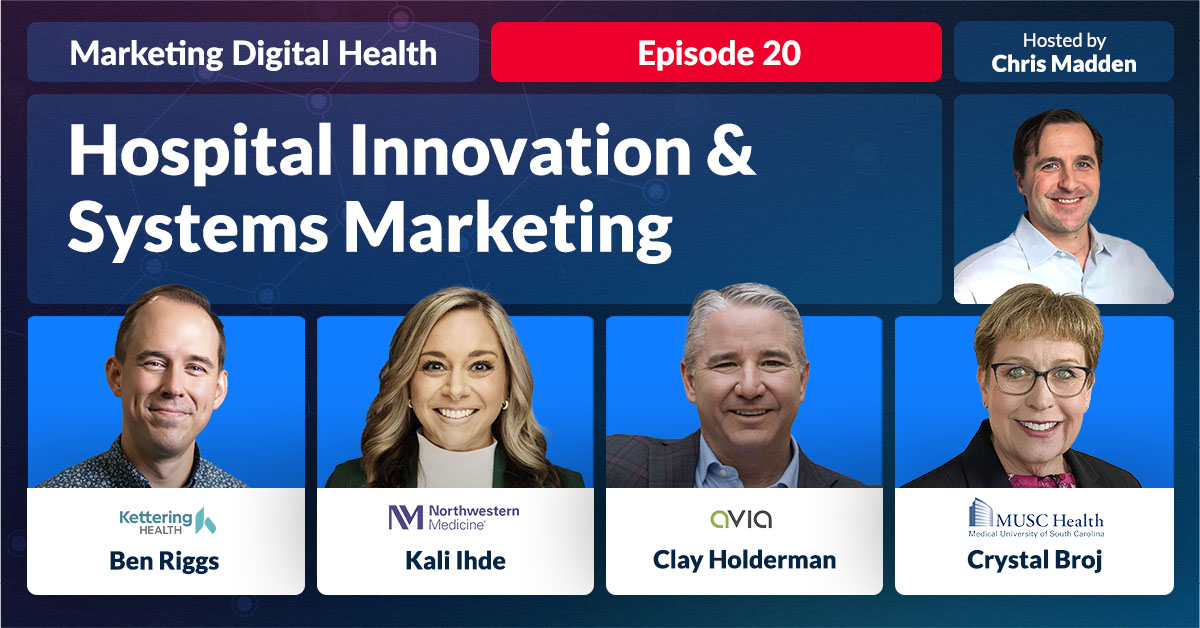
Marketing Digital Health: Hospital Innovation and Systems Marketing


Summary
Hospital innovation and systems marketing meet in the same place: access. This episode looks at how health systems are changing what they build and how they tell the story. Start with pilots that reduce burden and wait times. When scheduling gets faster and referrals route cleanly, both patients and clinicians feel the difference. That is when innovation sticks. Content matters just as much. Plain language and clear service pages lower anxiety and help people choose care with confidence. Bring clinicians into the process so claims are accurate and useful. Crystal Broj walks through access tech that delivers ROI, from smarter scheduling to referral tools that cut leakage. Clay Holderman focuses on the discipline of change management, training, adoption, and funding based on proof. Kali Arduini Ihde shares how to pick and scale the right pilots inside a large system. Ben Riggs covers the editorial patterns that make hospital content feel like part of care, not advertising. Measure what the clinic cares about. Time to appointment, show rate, service line volume, and outcomes are the score. Build privacy aware data flows with consent and server side events. Done well, the system becomes easier to use and the story becomes easier to believe.
Takeaway
Examine how hospitals and traditional health systems are adopting new marketing strategies to stay competitive and attract modern patients.
About the Guests
This panel brings leaders across innovation, content, digital transformation, and system change to show how hospitals compete today.
We’re looking at how to interact with patients without even making them schedule a visit… via the portal, questionnaires, asynchronous messaging. That’s care without disruption.
Kali Arduini Ihde
The Director of Ventures & Innovation at Northwestern Medicine, where she leads system-wide efforts to find, evaluate, pilot, and prove the value of emerging technologies in clinical and operational settings. From AI tools to drones & robots, Kali’s team plays a critical role in shaping how a major hospital system embraces innovation while maintaining patient safety, clinical alignment, and scalability.
We work hard with our vendors and marketing team to make sure it looks like us. It doesn’t look like you’re jumping out of the experience—patients want it to feel like one system.
Crystal Broj
The Chief Digital Transformation Officer at MUSC Health, where she builds, tests, and scales technologies that redefine how patients access care. From AI-driven appointment scheduling to tech-enabled referral management, Crystal is leading one of the most forward-thinking digital transformations inside a hospital system—and translating innovation into measurable ROI and improved patient experience.
Our members love to come together and compare notes—what’s emerging, what’s working. That collaboration is core to our model and accelerates adoption.
Clay Holderman
CEO of Avia, a digital transformation and innovation partner to health systems across the U.S. With deep experience in health system leadership, Clay now helps guide systems through the complexities of change management, applied AI, and operational transformation—especially at a time when economic pressures, demographic shifts, and emerging technologies are forcing an inflection point in the industry.
I’m still not even close to impressed with what AI can do from a writing perspective… but for transcribing, analyzing interviews, or rewriting a long sentence—it’s useful.
Ben Riggs
A writer and is the content manager at Kettering Health, where he leads content development for a large, multi-hospital healthcare system. With deep experience in health storytelling, team leadership, and editorial strategy, Ben brings a thoughtful lens to how hospitals can build trust, clarity, and patient connection through content—while navigating complexity, AI disruption, and cross-departmental coordination.
Full Episode Transcript
Marketing Digital Health: Hospital Innovation and Systems Marketing
Chris Madden:
Hospitals are facing a new kind of competition. Patients want convenience, they want digital first access, and they’re willing to switch providers to get it. This is Marketing Digital Health, and I’m your host, Chris Madden. The hospital systems that win today are not just delivering great care, they are building modern marketing engines around it.
Everything from telemedicine to patient portals to branded digital experiences becomes part of how you show up in the market, and that is what we are digging into in this episode. How traditional health systems are rethinking their strategies, embracing new tools, and meeting patients where they are, not where the industry used to expect them to be, which was in their office.
Kali Arduini Iday is the Director of Ventures and Innovation at Northwestern Medicine. We introduced Kali in episode one around why marketing digital health matters. Northwestern showcases how digital tools can expand access. Patient portals, telemedicine, virtual first, giving patients easy, instant access is a great way for hospitals to market their service.
Kali Arduini Ihde:
The neat thing about digital is it is everybody’s responsibilities. So our primary care leadership has really taken the charge of thinking through, there are so many different types and different needs of our patients in terms of their kind of core primary care. We have patients who are pretty healthy, they do not need much.
Occasionally they are gonna want to get lab work done and checked in on just their overall wellness. Occasionally they may come down with a bug or a virus, and so they are gonna need some kind of quick immediate care. But then you are also gonna have individuals who have multiple chronic problems, are on many medications, need a lot of assistance because they are just battling a lot of healthcare needs.
And so we are looking at both kind of simplified digital first offerings to help those patients that do not need a lot, they just need access occasionally when they need it, but also much more kind of what we call complex care clinics that can be focused on those patients who maybe have diabetes and high blood pressure and maybe cardiac issues as well, so that we can really cater the experience to them and have physicians who specialize in those multiple conditions and how to treat them and how to build a care program and a pathway that works for them.
And so when we think of the digital first, both of those environments can benefit from digital tools. And so when we think of digital first on the easy, most of those patients just need a quick telehealth visit. They have a condition that is pretty easy to check in on without extensive examination, although maybe occasionally they will need to come in.
So we have very much adopted telehealth. In some areas we are looking at remote patient monitoring where we can provide patients with devices. We also look at how can we interact with our patients without even making them schedule a telehealth or other visit. Are there ways we can do it just via the portal, so patients with conditions that I can just ask questions, have them fill out a questionnaire as a physician, have them respond back, and then I can tell them what the next step was going to be.
Fortunately, our insurance companies now offer payment for that, and that is covered through the services they offer patients. And so then these sort of asynchronous methods of getting care can be done as well. So then again, we are not making people drive to downtown Chicago. We are not making people get away from work and get their day disrupted.
And then on the complex side, we have really thought through how do we have a pre visit, during visit, and post visit complete digital experience. And so pre visit, it is making sure that if there are questions we want to ask you or you have questions, how can we get those in advance via a portal, via questionnaire, via a digital interaction during the visit.
Tools like this ambient tool are critical, because these patients, these conversations can go in many different directions. There is a lot going on. There is going to be a lot of follow up. How do we make that time in the room more enabled as well. And then post visit, are there tools, and we are looking at some of these, where it actually engages the patient after the visit without the physician and or a nurse or others having to stop their in person work and reach out.
There are patient engagement tools that allow for check ins periodically, they can upload information, it puts reminders out there and education periodically before their next visit, based on the decisions that were made during an in person appointment.
Chris Madden:
Crystal Broy is the Chief Digital Transformation Officer at MUSC Health. We introduced Crystal in episode 18 around AI’s impact on health marketing. A smart health system pulls its marketing team into every stage of the patient journey. It is not an afterthought, it is part of the build. Crystal shares how MUSC partners deeply with marketing to make sure each digital tool feels unified, on brand, and seamless to patients.
Because the truth is patients do not care how many vendors you are using, they just care whether the experience feels like one cohesive system.
Crystal Broj:
I am really good friends with our marketing team and we run a lot of things by them, and they are very gracious to give us their time. And we partner on some projects like our website with Dex Care.
Our marketing team was there one hundred percent of the way, making sure look, feel, brand voice was in our, we call it one MUSC for across all three organizations, research, health, and academic. But also, when you think about it, if I go online, in Dex Care, I make an appointment and then I need to change it.
So I might call the patient access center. And then I might get my notification from Notable that says, hey, it is time for me to come in, and then maybe it is for a colonoscopy. So I get a follow up educational path from Andor, four different systems. Plus then I am gonna go in and look at my after visit summary in MyChart.
But we want that to feel like one system. We do not want to feel like you are bouncing in and out of all these experiences. So we work very hard with our vendors and the marketing team to make sure that it looks like us. It does not look like you are jumping out of the experience, and I think that is another thing that vendors have to, you know, that white labeling thing to make it look like my tool and not their tool is super important.
Chris Madden:
I talked with Clay Holderman about Avia’s collaborative model. Clay Holderman is the CEO of Avia. We introduced Clay in episode 13 around partnerships for growth. Marketing plays a bigger role than people might realize. When health systems compare notes, learn together, and share what is working, they adapt faster.
And in a market where patient expectations shift by the month, that speed becomes a competitive advantage.
Clay Holderman:
Avia’s collaboration model is, it is core to our DNA and it is core to our differentiation. At its core, we are a membership organization and our members love to come together and compare notes on what is emerging as trends.
What are the most important problems, what are the most promising solutions, and just sharing experience and information. So we create multiple channels for innovation leaders, digital leaders, IT leaders, for operational leaders, recently for governmental relations leaders in the governmental transition and deregulation.
For marketing leaders, we have an entire generative AI community of adoption for marketing leaders and how to improve patient communications and how to automate and personalize patient communications in a way that it will actually activate patients, meeting people where they are. For a one time membership, but allowing them to enjoy multiple channels in multiple forums is the first part of Avia’s collaboration.
That is magic. I think the second part is when we do identify something that is of great interest to multiple members, usually eight to twelve at a time. The extreme example of this was when generative ai, when open ai released chat GPT in 2023. We instantly pulled together twenty nine health systems at once, and we were able to hire and bring in leading technology experts, leading governmental policy experts, international experts in AI ethics and regulation.
And we were able to instantly upskill C suite leaders in how to think about what was coming on the horizon. We helped them put together eleven frameworks for evaluation of ai, put together market leading AI governance models, and how you get your organization ready. That community was so successful that about twenty of those health systems wanted to go on to 2.0, which focused on use case identification.
And again, we were able to bring in solution companies and share what they are doing in the space. And we had executives from health systems ranking use cases, we were able to then publish to them the sequence of use cases that were in the sequence of implementation, but also in return on investment and readiness for prime time.
And that was 2.0. And then 3.0 we moved to communities of adoption. When we do that, you know, that cost of global and national expertise is split among many, many health systems and sometimes offset by a solution company sponsor. And yet our customer success managers come alongside, who know each health system well as their member, and make sure that each health system gets a unique implementation plan and action plan and follow up plan that is tailored to their unique environment.
Whether they are Stanford in a rural environment or they are Northwestern in Chicago, they all have a different set of implementation issues to think about, and we help them sequence that coming away. So, fractional expense for global and national expertise, and we think a multiplied impact from hearing from real world experiences of peers during the collaborative.
Chris Madden:
You have heard me say this on past episodes, traditional referral based marketing is massive in healthcare, and now we are watching AI reshape it.
Crystal explains how modernizing something as old fashioned as a faxed referral can dramatically improve patient conversion. This is what marketing can look like in healthcare today, fixing the operational bottlenecks that actually cost you patients.
Crystal Broj:
The most interesting thing about referrals is that if Chris, you refer me to go see Dr. Smith, the person at the front desk schedules that right away for you. Then it goes into an order. That order gets faxed to our patient access center. Yes, in this day and age we still do faxes, and that sits in a queue, and then somebody pulls that and has to type it into Epic, and then it goes into another queue where somebody calls and says, hey Crystal, we are ready to have you schedule, a lot of labor intensive stuff.
And as you can imagine, it takes a long time to get through. So my referral could sit for several days before it actually gets processed. Again, if we can take that, and we do right now, we have started with two service lines that take that fax automatically, OCR it and pull all the important information off and then put it into a queue that then could be processed by a person, saving a lot of time there.
But once we get that process really well defined, and I think you will see a theme that we start small and increase, then we will be able to have AI agent that goes through that, and for those things that you can automatically schedule, then I will send you a note and say, here you go, you can now schedule your MRI, click here to schedule, pick the date and time that you want, and if you do not, then someone would call you. We are working on voice agents outbound so that we could call instead if you do not answer a text.
But then think about things that are a little bit more difficult, and as we work on prior authorizations, that is one piece of the pie. So if you had a referral that needed a prior authorization before you could schedule, we would insert that prior authorization logic in there. Then you would know your prior authorization has been approved.
You can now schedule. We have also had some requests from doctors to let them know when their referral is scheduled, because right now they have no insight into that. That is a very easy AI agent thing, to say prior auth has been approved, here you go doctor, this is it that Crystal went to her appointment, here you go doctor, just so you know that she followed through. And so I think with AI agents, we are really gonna be able to close the loop on a lot of things and make it easier for the doctors, make it easier for patients, and really get them care faster.
Chris Madden:
Is AI saving time and money. Kali has been around this tech since the early pilot days, back when AI meant humans double checking outputs behind the scenes.
Her perspective gives a real look at how these tools evolve and what it takes to prove value inside a traditional healthcare system. And that proof is what unlocks executive buy in for future innovation.
Kali Arduini Ihde:
We were a fairly early adopter of the technology. We were working with some of the players before it truly was automatic and ai, and we were working with our partner back when they had a four hour delay because they wanted to have a quality specialist review it quickly before it got into the hands of the physicians. And so we have been on this journey for a number of years. So for us, it followed that same pilot process, because we wanted to be able to build that true value proposition and that true case for why this was not just good because it generated some positive survey feedback, but that we could actually quantify with our physicians, is it actually saving you time.
Many of our physicians wanted to see that too. They had heard from others that people liked it, but liking something and actually it providing the value that you hoped it would in saving you time are two different things.
So our pilot was really focused on quantifying all the positives that we had heard about this tool. So we spent four months doing that, absolutely generated that business case, plus all the positive end patient experience. Saw that our physicians were giving that time back to our patients in additional visits.
So we were even opening up access, which is so key these days when many of our specialties and all of our physicians are in high demand, and sometimes wait times to get an appointment can be pretty far out there.
Chris Madden:
As Kali digs into early findings from their latest pilot, you can feel the momentum. They are seeing better patient experiences, more physician time, and ultimately more accessible care.
That is the kind of outcome every health system is trying to market, faster access, clearer communication, and patients who feel supported at every step.
Kali Arduini Ihde:
We are quite early, so we met the company last year, did our vetting diligence, got them connected with our folks in our GI space, who also were part of course of the vetting. Our procedural surgeons are part of that.
Our administrators, those nurses who are making those calls today, were part of that process and really got through that in the fall and kicked off our planning for the pilot here at the start of the year. So we just activated this last week. We are excited about what we have seen so far. Naturally with any technology, we are dipping our toe versus diving in, especially again since this is AI making a phone call directly to our patients.
We are starting with supervised phone calls, so we are letting the AI take the lead, but we do have a nurse on those calls to be able to step in if for one reason or another something is not said correctly, we need to tweak the ai, things like that. And so we are gonna do a number of those phone calls before we move forward with the truly AI only kind making these calls.
We are also recognizing that unlike sometimes with technology where you turn it on and you work through the issues while it is still going, we are also finding that it is better to just pause, have our nurses continue making those calls, and then update the technology and then try again.
So really going step by step through this process so that the experience on the patient side is as optimal as we can make it as we work through this. But the potential is so incredible, the AI that is out there and what it is capable of doing, and in the moment able to shift based on what patients say and pulling information both from Northwestern Medicine’s protocols and pathways and the rules we use to work with our patients.
But also more broadly, if a patient has a question about, hey, I am going out to an Indian dinner two days before this, what should I eat so that I am not setting myself up for discomfort during this procedure. It can say, hey, you live in this area, here are the local restaurants, here are a couple items on the menu that are probably gonna be better for you than others.
And so it is incredible how it can pull so much information together to really have a meaningful conversation with that patient. And it can do as many at the same time as it can. So it can be making ten concurrent phone calls, it can be making twenty, it can stay on that call with the patient five minutes, fifteen, twenty, whatever that patient needs. That patient will never feel like the person on the other side of that call is trying to wrap up or trying to move on because they have a list of additional patients that need to be connected with.
Chris Madden:
There is always that moment when a pilot stops being a pilot and becomes the new normal. Kelly walks us through how Northwestern is scaling their AI tools across hundreds of physicians, and this is where the real marketing advantage shows up, consistency. When every clinic delivers the same strong digital forward experience, your brand is not just a logo, it is a lived patient reality.
Kali Arduini Ihde:
We are on that journey right now from transitioning from pilot to, it is just part of what we do. So we are currently activating anywhere from one hundred to one hundred fifty physicians every month on this tool across our medical groups. So that is fantastic. It means that we have a targeted focus, and that is still staying within innovation for now, because we did not wanna be the team that just piloted and then said, okay, figure out how to get it to everybody.
We also wanted to be the group that helped enable those outcomes everywhere, across all the potential folks who could get the benefit from them. And so right now, my team is still owning that. We do these monthly activations. The onboarding process we found is incredibly important to truly, physicians feeling the burden lessen, as well as being able to really get all of those different benefits from the tool.
And so we have a little bit of a choose your own journey approach, where physicians can do self learning through e learnings and videos. They can join webinars and town halls with peers to hear how others are using it and just get more hands on training. We even have onsite assistance, a combination of folks from our vendor as well as from Northwestern, even peers.
So we have a few physicians who are so bought into this tool that they are volunteering their time to go help their peers get onboarded because they know that if you can really get it embedded into the work that you do every day, it can truly make the physician career experience more enjoyable.
Chris Madden:
Ben Riggs is a writer and content manager at Kettering Health. We introduced Ben in episode four around storytelling and trust. Content has become one of the most important ways to grow and differentiate a healthcare brand. Ben talks about how AI fits into that process, and just as importantly, where he is cautious.
There is still a human touch that matters in storytelling, especially when you are trying to connect with patients and build trust on behalf of a healthcare system. And the systems that balance AI efficiency with human authenticity are the ones that will cut through the noise.
Ben Riggs:
So using AI and content, that is the big sticky wicket these days for sure. I think we are still learning how to use it. I am someone who went from the tinfoil hat member of 22, I think that is when Chad GPT first came on the scene, to I very much view it like a frenemy now because I understand it more, and I have understood it more by way of using it more.
And I think there are things that are categorically impressive about it, just the fact that it can do what it can do from an analysis perspective, from a search perspective, from sifting through things. I do not wanna sound bougie, but I am still not even close to impressed with what it can do from a written perspective in terms of this feels like the quality of content that we would publish, and there are a few low hanging fruit ways that we can use it.
A lot of this comes with making sure the people we are talking with know we are using it this way. But I think AI can be great for transcribing interviews as well as helping analyze and evaluate them. And I think this is particularly true for conversations with subject matter experts on information that you would probably already find published somewhere else.
I do not have in view like a patient story or a physician profile, anything that would maybe risk either a HIPAA violation or just the common decency of, if I interview a patient or a physician, if they have shared their story with me, I am not gonna go just start telling it to other people that I do not know. So I would not do the same thing with a large language model, I would not just share that story there.
Using it for analyzing interviews, sifting through that, transcribing of sorts. I think too, obviously doing some contextual research is always helpful, but note there still, and probably will always be, ironically, you need to do some fact checking on the research and make sure there is no hallucinations or anything fabricated or whatnot.
I really like to use it on the front end of the writing process. I think between kind of ideation through that research reporting phase, I have used it a little bit with helping me think through some structures or some outlines for things. And just to be frank, it is not like I am ever trying to write the next Great American novel as a content marketer within healthcare. Most of the time those outlines are not gonna be, there is not gonna be anything brand new I am gonna come up with.
And so what it feeds me can be helpful, even if it is just to get the ball started rolling down the hill. So on the front end, I think it is helpful, and it can be helpful on the back end as well. There have been times where I have written something and I have just known this can be cut half a word count. This forty word sentence can be definitely condensed and made more brief, but I have spent so much time with it, I do not know how to do it.
So I will feed that line to LLM and just give it the prompt of brevity and just ask for five versions and see what it comes up with. And somewhere in between one or three, I can see the sentence I am aiming for. So front end, back end, when it comes to drafting and revising, I am still leery. I still think too, there is a lot to be had about creating content that is written from a human, for a human, which AI and search actually rewards more than stuff written by ai.
And so I think that, but two, I think I am just not ready to delegate that away just yet, because one, I just have not seen anything that feels commensurate with what we want to produce and publish, but also I think I am starting to see stuff, and I think we all knew it was gonna start to happen, not just AI slop, but the AI rot sort of idea of giving up some of our critical faculties in a slow way as we are delegating whole projects to it.
That is where we are applying AI from a content production perspective.
Chris Madden:
What we heard today shows a clear truth. Modern healthcare marketing is no longer just about campaigns, it is about experience. Every digital tool, every AI workflow, every branded touchpoint, every seamless appointment becomes a message to the market about who you are and how you care.
Hospitals that embrace these strategies are not just keeping up, they are standing out. They are showing patients that access can be simple, communication can be thoughtful, and care can meet them exactly where they are. That is how traditional systems stay competitive. In a world where consumer expectations are rising fast, patients themselves are evolving just as fast.
Our next episode, episode 21, dives into emerging expectations, new behaviors, new demands, and how marketers must adapt.
Related Episodes
- 42.57
Marketing Digital Health: Building and Leading Marketing Teams
Marketing Digital Health: Founder Stories in Digital Health
- 30.49