
- Blog & Podcasts, Marketing Digital Health, Podcasts
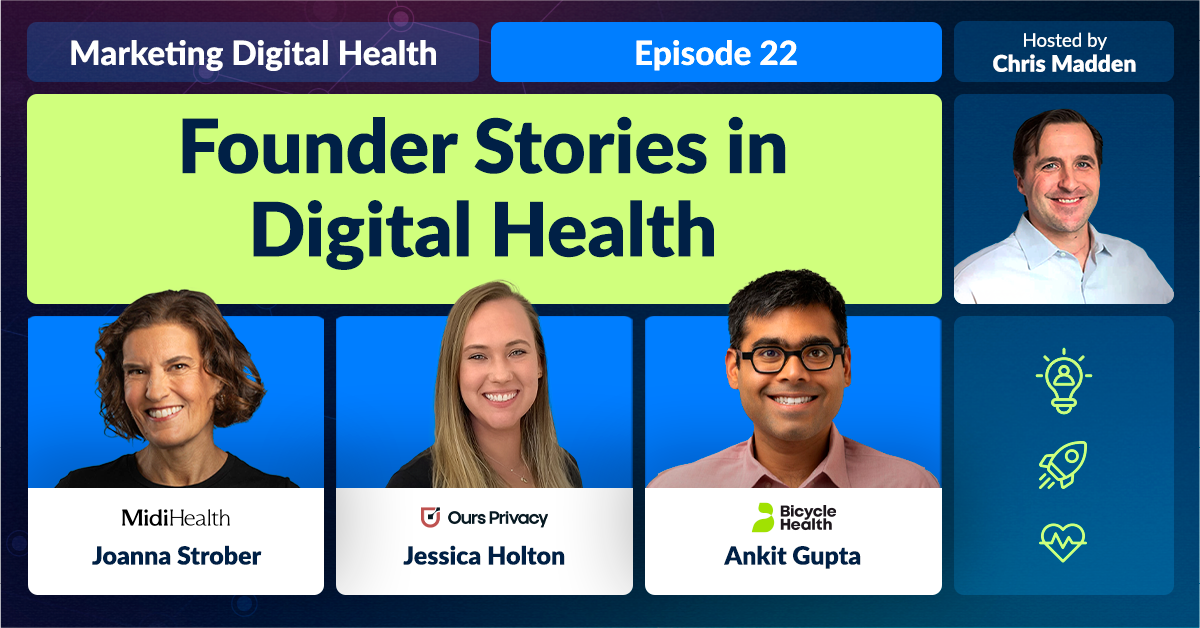
Marketing Digital Health: Founder Stories in Digital Health


Summary
Founder stories in digital health show how clarity and curiosity turn into access and outcomes. This episode traces three arcs. Ankit Gupta shares how a small addiction medicine clinic and the shock of statewide telehealth demand shaped Bicycle Health’s focus on a single, urgent problem and a model that could scale responsibly. Joanna Strober explains how a personal search for care sparked a national clinic for women’s midlife health, and how real patient needs pushed the brand beyond a narrow menopause label into a broader expert layer that bridges primary care and specialists. Jessica Holton walks through a pivot from a consumer relationship app to a HIPAA compliant privacy platform after living the pain of pixels, consent, and the need to control what leaves your site.
Across these paths, a few patterns repeat. Coverage and payer alignment make or break scale. Privacy and trust belong in the product and marketing brief. Brands evolve with the care model as you learn. The early pilots that remove friction are the ones that stick, whether that is faster scheduling, confidential access, or simpler onboarding. Measure what people feel and what care delivers, time to appointment, show rate, care started, and outcomes. The lesson is simple. Build around the mission and the patient, then let the stack and the story follow.
Takeaway
Gain insights from founders on the front lines of digital health, including hard-won lessons, pivotal decisions, and branding from day zero.
About the Guests
This episode brings three founder operators whose companies grew from lived problems to scaled solutions.
It's so important to have a North star when you're doing these things that it's, but a new customer or, or some new impact that you had on the data, et cetera.
Ankit Gupta
Co-Founder and CEO of Bicycle Health, a leading virtual care provider for opioid use disorder treatment. With a background in engineering, product, and mission-driven entrepreneurship, Ankit built Bicycle to address one of the most urgent—and complex—public health challenges in America. His perspective sits at the intersection of access, growth, and care delivery, with a strong belief in technology’s ability to scale compassion and measurable health outcomes.
I feel extraordinarily motivated because we are having a large scale impact on an incredibly important, if not the most important part of people's lives, which is their healthcare.
Jessica Holton
Co-Founder of Ours Privacy, a HIPAA-compliant customer data platform and third-party pixel replacement for healthcare marketers. Ours Privacy acts as a privacy-first buffer - removing PHI from data flows while still enabling ad and analytics optimization across the funnel - and also provides consent management, giving organizations control over how user data is collected, stored, and shared. Jessica and team work with leading digital telehealth companies, hospitals & health systems, and wellness brands to make privacy infrastructure both compliant and growth-ready.
Women make most of the healthcare decisions for their families and women spend money to take care of themselves. The economic argument for investing in women's health is actually very strong. And so once you are able to make that argument, and there's people who have capital who can invest in that, that's really when things change.
Joanna Strober
The CEO and Co-Founder of Midi Health, a virtual care platform for women navigating midlife hormonal changes and other underserved health journeys. A serial entrepreneur and investor turned founder, Joanna has built Midi to address the clinical, emotional, and structural gaps in women’s health—reaching millions often through what she calls the “side door” of healthcare. Midi was named TOP 100 Most Influential company in 2025.
Full Episode Transcript
Marketing Digital Health: Founder Stories in Digital Health
Chris Madden:
Founders in digital health all have two things in common. First, they care deeply and second, they jump in before the map is fully drawn. They’re building companies while navigating uncertainty, changing regulations, shifting patient needs, and a whole lot of trial and error. This is Marketing Digital Health, and I’m your host, Chris Madden.
Today we’re bringing together three founders who didn’t just build companies, they built solutions to problems that they lived or witnessed firsthand. You’ll hear the early decisions, the “we had no idea what we were doing” moments, and the pivots that shaped everything after. Ankit Gupta, Joanna Strober and Jessica Holton each take us back to day zero, how their ideas formed, why they pushed forward, and what they learned along the way.
Let’s get into it. We introduced Ankit Gupta in episode 16 on navigating state level fragmentation.
Ankit Gupta:
We are a national virtual treatment provider for opioid addiction, so we help people who are addicted to opioids who are looking to get off opioids and really enter recovery and make a long term change in their life. We provide a comprehensive treatment model, which includes medications, therapy, recovery coaching, case management, really a holistic kind of wraparound model that patient can engage in slowly through the app on the phone, across almost all 50 states across the country.
Chris Madden:
Behind every great founder is a moment, sometimes more than one moment, sometimes a string of them, that pushes them to solve a problem that they can no longer ignore. For Ankit, that spark started long before Bicycle Health existed, and it came from seeing the gaps up close. He’s one of those founders who mixes technical talent with curiosity, and that combination led him somewhere he didn’t expect.
Ankit Gupta:
What drove me to even think about healthcare and what I want to do next. I come from the tech world. I’m a software engineer by training. My last company was a mobile app called Pulse News, which we ran for a few years and it got acquired by LinkedIn and is now called the LinkedIn newsfeed.
And so as I was transitioning out of LinkedIn and I wanted to think about what I want to do next, where I want to spend my time, I knew I wanted to do something that’s a lot more impact oriented. I wanted to help people in some way. And I happened to get married to a doctor during that journey, just knowing or noting the patients she’s seeing and how many people with addiction and behavioral health issues walked through the hospital.
And she’s not someone who has any particular training in this field, but it’s just so highly pervasive. And so that led me to start talking to people in recovery, start hearing the story, and I was just blown away by how many people I knew and I didn’t know that they were in recovery or had these journeys or had close friends and family members having gone through these journeys, and all of those stories kept coming up for me and it was clear that our healthcare system is all obviously super fragmented in the US, but especially when it comes to addiction and recovery and behavioral health, it’s even worse.
And so many issues that people brought up around not being able to access treatment, doctors not being available nearby, insurance is really hard to navigate. It’s hard to take both treatment and work and family responsibilities all together. It was just one barrier after another, and in my brain, it seemed like technology can really help overcome a lot of those and make treatment really streamlined, really accessible, really pure, confidential, really convenient, user friendly.
And that’s something that really excited me to explore more.
Chris Madden:
One trait I see again and again with founders, they’re willing to explore and be curious. They’re willing to chase a question before they know what the answer might be.
Ankit Gupta:
I am not a healthcare person, I guess, or have no understanding of healthcare or really understanding of how services work, and so I stumbled a lot along the way, but one of the very first things in hindsight I was just so fortunate is, I had a friend who knew someone who was retiring and they had a small addiction practice here in Redwood City in California.
They just needed someone to run for, and it was one provider, a few hundred patients. It was pretty small, a small office, and for me that seemed like a great opportunity to dip my foot into healthcare and so I ended up acquiring the practice. I was living in Boston at the time, and the practice was here in California.
And so it naturally made it necessary for us to use a lot of technology to both run our operations as well as for me to really run the practice. Through that, I started learning more about the patient population, talking to patient, learning more about clinical practice, the technology challenges, and starting to improve things.
I also learned a lot about how do you really reach patients in the community, how do you actually work with insurance, get treatment reimbursed. And over about 12 to 18 months, we got the practice to be cash flow positive, sustainable, got insurance contracts, really deployed a lot of kind of modern technology into the medical operation.
And that was a nice hobby just for me to try some ideas out. And then COVID hit and it forced us to move everything remote. So move away from brick and mortar, have our provider work from home, have patients be seen online. And we didn’t have any apps or any fancy technology back then, but we basically cobbled together all the tools that a small operation that not a lot of money could buy.
And just started trying out what a purely telehealth model. And we also opened our doors up to the entire state of California because we could, because of the regulations. And that’s when it really struck me in like a visceral way. The demand for our service almost melted down our servers. The demand was so overwhelming as we opened ourselves up to the entire state of California, and even the patient and provider experience was so much better by everything being on telemedicine, providers work from home, and so just felt like we had unlocked a new model that really could be furthered and expanded upon in this unique environment, everyone was locked in home in a unique setting.
And so I think having had that background of raising money, having a purely technology company that I did before, it felt very familiar to me that this is now a technology solution that we can really raise venture capital for and really grow and expand nationally in the same way that I would for any other tech business, even though it was a clinic initially that we were running.
Chris Madden:
Joanna Strober is the founder and CEO of Midi Health. We introduced Joanna in episode 1 around why marketing digital health matters. For her, the story started somewhere deeply personal. It wasn’t a market analysis or a pitch deck, it was her own health journey and the feelings so many people can relate to. Why did it take this long to find the right care?
Joanna Strober:
Founding stories are complicated, right, because they’re never quite the straight line that you might read. But for Midi, it really did start with my perimenopause symptoms I was experiencing. All the symptoms of perimenopause: brain fog, lots of lack of sleep, the waking up in the middle of the night, I was having hot flashes throughout the day, really a lot of mood issues, and because I was still having my period, no one diagnosed this as perimenopause.
So I went to a sleep specialist to figure out why I was waking up in the middle of the night and not sleeping. I went to a primary care doctor to figure out anxiety. They gave me SSRIs medication and told me to go to therapy. So for about a year, I was really given the wrong care. Eventually, I was told, maybe this is a hormone issue.
When I drove to San Francisco, when I paid a thousand dollars to a hormone specialist and she gave me new medications. Literally within weeks, all of my issues had gone away. I was back to me, I was back to my old self. And my family noticed. My spouse noticed, and it made a big impact at work. And I have a lot of sadness about how long it took me for me to get this right care.
So I started thinking why that is and is there a way to fix that? And eventually what I realized was that because the COVID laws had changed healthcare, you now for the first time could create a national menopause clinic with care covered by insurance. So we could take that expertise of the woman that I went to in San Francisco who really knew how to take care of women in perimenopause and menopause, and we could extend her care to women nationwide and get that covered by insurance.
That’s when the light bulb went off and I was like, ah, this should be a company.
Chris Madden:
Midi Health wasn’t the first company Joanna started. One of her greatest strengths is seeing a problem and then taking action. Kurbo, an app based weight management program for children and teens, was built on that instinct.
Joanna Strober:
We started Kurbo in 2014 because we saw a number of adult weight loss companies getting started, and it was pretty clear that technology was gonna be a big help in helping adults lose weight, whether with apps to track your calories, with online coaching. And no one was doing the same thing for children.
And childhood obesity is a huge problem in this country. 40 percent of children are overweight or obese, and the idea was to build something to help them. So we actually did, and I was insanely proud of that. We were able to build an app that was safe for kids, that helped them to learn healthy habits, and we were able to get Medicaid to actually cover it in a number of states.
What was super hard is that Medicaid would pay for it, but it was actually hard to reach those children for a lot of reasons that maybe as technology gets better would get solved. But we found that Medicaid kids were the most needy of this, but it was very hard to reach them, and commercial plans were not willing to pay for it because, again, this is before COVID and before telehealth was covered as something that was insurance covered, so we couldn’t get commercial plans to pay for it.
So we ended up selling to Weight Watchers. I was really happy with the outcome, but the learnings that I had were number one: insurance has gotta pay for care. There’s no track for care that is not covered by insurance, and Medicaid is a very hard population to work with. It is very important, and I wish we had cracked that code.
But we didn’t. It’s hard because so many of those overweight and obese children are poor and need this help, and I’m hopeful that someone can crack that code, but we didn’t.
Chris Madden:
Branding is not static, especially in health. Joanna and her team started with menopause care, but quickly realized women’s health can’t be neatly segmented the way the healthcare system often tries to do. And that learning shaped Midi’s evolution in a big way.
Joanna Strober:
When we started, we did think of ourselves as a menopause / perimenopause company. But what is perimenopause? It actually turns out that it’s most aspects of women’s health and you can’t take it apart.
So we found that women would come to us, we would give them a blood test, and we would find out that they had pre diabetes, and then where do you send them? You need to take care of them. You can’t just say, oh, we don’t take care of that, go elsewhere. I think that it’s a fallacy to think that health is segmented really narrowly. Women are complicated. We’re all complicated. Forget about women, right? You have a lot of different things going on in your body, and we found that we needed to take care of those things. We couldn’t just send them elsewhere.
And so if you think of it that we have this idea that, okay, I have a head problem, I’m gonna have a neurology issue, but honestly, maybe it’s neurology, maybe it’s a migraine, maybe it’s a hormone issue. Like what is it? And instead what we’ve had is we’ve had primary care and then we’ve had specialists.
But there’s this huge thing in the middle. And so our job is to be that thing in the middle, the women’s health experts, and to look at you and say, okay, I’m sorry you’re having migraines. Is this because of hormones? Let’s try that first, and then if it’s not, then we’ll send you an expert. And what we’ve been doing is making relationships with experts all over the country so that if we can’t take care of you, we can send you to the right place.
But I would say that for us, it really is around taking care of women’s bodies and understand women’s bodies. And perimenopause and menopause is a big part of that. It’s not as fragmented as you might think from an ad.
Chris Madden:
Jessica Holton is the co-founder of Ours Privacy. We introduced Jessica in episode 16 around navigating state level fragmentation. Ours Privacy was born from pivoting while solving a problem. HIPAA compliance is mandatory, whether the context is digital or not. Going back, it all began with the expansion of the first company Jessica started, which was called Ours.
Jessica Holton:
We started Ours several years ago as a couples relationship building program. So we started out as couples coaching, and we helped couples through the big conversations that they needed to have before getting married. So we became the largest premarital counseling provider in the country outside of the Catholic Church.
And we were building content and hosting live sessions for couples to work on their relationship at the time. And I still to this day feel that relationships are so incredibly important, if not the most important part of our human lives and human experience. And so me personally, I felt so drawn to that mission and the impacts that we could have for couples, and that was extremely motivating day to day, knowing that everything we were building was going towards the most important part of couples’ lives.
How we got into Ours Privacy was a couple of years ago, we shifted from coaching into couples therapy and we built out a HIPAA compliant therapy platform that matched couples with therapists. Now going beyond premarital counseling into all types of challenges, opportunities that couples had to work on with a therapist.
Part of becoming HIPAA compliant meant that we needed to review our marketing stack and how we were growing. And at the time, our acquisition channels that were most fruitful were Google Ads and Facebook Ads. And because we were not in the medical space beforehand, we had those pixels on our site.
Becoming a therapy platform meant we needed to take those down and we made the decision to take those down to absolutely comply with HIPAA and regulations and laws, but also because we cared and still care, of course, a lot about honoring our users’ privacy. We felt like being in the relationship space meant that we were serving people in their most vulnerable times in life sometimes, and such an intimate time of their life, that it started to feel like if we were to send that data back to Google and Facebook, it just didn’t feel right.
And so we wanted to make sure that we were having full control over what actually got sent out to Google and Facebook. We built a tool for ourselves to track the conversions that we needed to track on our site and anonymize them before sending them back to Google and Facebook. We also removed any potential health information, so made it a very generic event that we sent over to Google and Facebook.
And so with this in place, we felt comfortable continuing to use Google Ads and Facebook, and we were able to optimize, but knowing that we’re not sending anything identifiable and no health information over to these platforms.
And so we started building that out and building more deeply, adding multi touch attribution, cross domain tracking and making it really powerful for our use case. So much so that we started having partners reach out to us and founders reach out to us asking, hey, how do I set this up in my org, and can you help me set this up?
We had this moment realizing that we could have a huge impact on other healthcare organizations that need to solve this same exact problem. And so we shifted completely into focusing on Ours Privacy.
And in terms of motivation, I thought about this so much because several years ago I was waking up every day feeling very motivated by having an impact on the most important part of people’s lives. And today I feel extraordinarily motivated because we are having a large scale impact on an incredibly important, if not the most important part of people’s lives, which is their healthcare.
And we get to work with healthcare companies that span an entire spectrum of pre launch startups who are in digital health and haven’t started yet and are working on building out their marketing campaigns and reaching customers who need them and need their novel solutions, all the way through some of the nation’s largest health systems and big medical brand names.
And in those cases, we are helping healthcare companies across so many different verticals reach more patients and be known to more patients who need them, and helping those patients get solutions for their healthcare that actually works for them. And it’s a much bigger impact that we can have when we’re helping all of these different companies reach their hundreds of thousands, their millions of patients, compared to when we were navigating a direct to consumer business.
The scale is just so different. The mission orientation is certainly different, but as I’ve evolved in my thinking around and my understanding of how scary it is, how much these pixels can track about us and know about us, we’ve all Googled something and then had that follow us for weeks and months and we’ve all said something out loud, and then all of a sudden we get an ad for it.
It’s a scary thing when we’re dealing with our healthcare and such a personal part of our lives. And so being able to help healthcare companies not only grow, but do so while honoring their patients’ dignity is extremely motivating because we’re part of an overall solution that helps healthcare become more responsible and more honoring of consumers’ privacy.
Chris Madden:
There’s a thread that runs through all these founder stories, this sense of mission that keeps people grounded when the decisions get tough, and Ankit captures that perfectly with how he talks about Bicycle Health’s purpose. For him, having a clear North Star wasn’t optional. It’s what keeps the team focused when everything around you is shifting.
Ankit Gupta:
It’s so important to have a North star when you’re doing these things, that it’s both a new customer or some new impact that you had on the data, et cetera. For us, it was very clear from the beginning and even articulated our mission early on: increasing access to high quality, convenient, and confidential opioid use disorder treatment for all.
And the words are very intentional for us. We are an opioid use disorder treatment provider. That’s how we started. That’s what we stuck with. I can see us doing that for a long time. This is a huge problem and it only got worse during COVID. And so that focus on opioid use disorder allowed us to really build a best in class care model, build the partnerships, health plan, and now more so we’re building partnerships with referral providers.
We were intentional about being an opioid use disorder treatment provider. We were also intentional about we do want to be an opioid use treatment provider for all, or at least increase access to opioid use disorder treatment for all. That doesn’t mean we have to be providing all of the treatment, but we want to make sure if there’s a patient in any stage, in any health plan, with any acuity or opioid use disorder and co current condition, we’re able to help them get the right treatment, and some of that might be Bicycle Health providing that treatment, some of that might be partnerships.
But we want to make sure if for whatever reason something happens in my family, there’s a treatment pathway I can confidently help them get to so that they’ll get the help they need.
Chris Madden:
What I love about episodes like this is how honest the founders are about the messy middle, the early mistakes, the pivots and the choices that shaped what their companies became. These aren’t polished origin stories. They’re real lessons from people building solutions in a space where the stakes are unbelievably high.
If there’s one takeaway here, it’s this: the future of digital health will be shaped by people who are willing to explore, to question and to stay grounded in the mission of helping others. That combination, the curiosity with purpose and a bias towards taking action, is what creates real change.
But no founder builds alone. Our next episode, episode 23, is about building and leading marketing teams, how to scale culture, structure, and performance.
Related Episodes
- 42.57
Marketing Digital Health: Building and Leading Marketing Teams
- 30.49
Marketing Digital Health: Emerging Patient Expectations
- 29.28