

Digital health future outlook is not a prediction, it is a report from the front lines. This season ends by connecting the dots across access, business models, regulation, and what patients actually need. Ankit Gupta describes how virtual care can restore dignity and confidentiality for people with opioid use disorder, and how a care model that combines medication, peers, therapy partners, and administrative support removes barriers that trigger relapse. He reframes marketing as availability, being present in the pocket, the feed, the search result, and even in physical locations like jails or Medicaid offices when someone is ready to change.
Joanna Strober brings the scale lens. Telehealth is not just for younger patients, many women in their fifties and sixties are choosing virtual care because most care is conversation. The future is virtual first with clear pathways into in-person care through health system partnerships. Dr. Aabed Meer zooms out to the market cycle. The industry moved from growth at all costs to profitability and operational excellence, with investors favoring clear ROI for patients, providers, payers, and employers. He also explains the arc from point solution to platform, and why successful companies integrate into a $4 trillion ecosystem.
The thread is simple. Use technology to remove friction and expand access, but keep empathy and human connection at the center.
Zoom out and connect the dots across the season, understanding how digital health is reshaping access, care delivery, and business models, and what it will take to build trusted, scalable companies for the future.
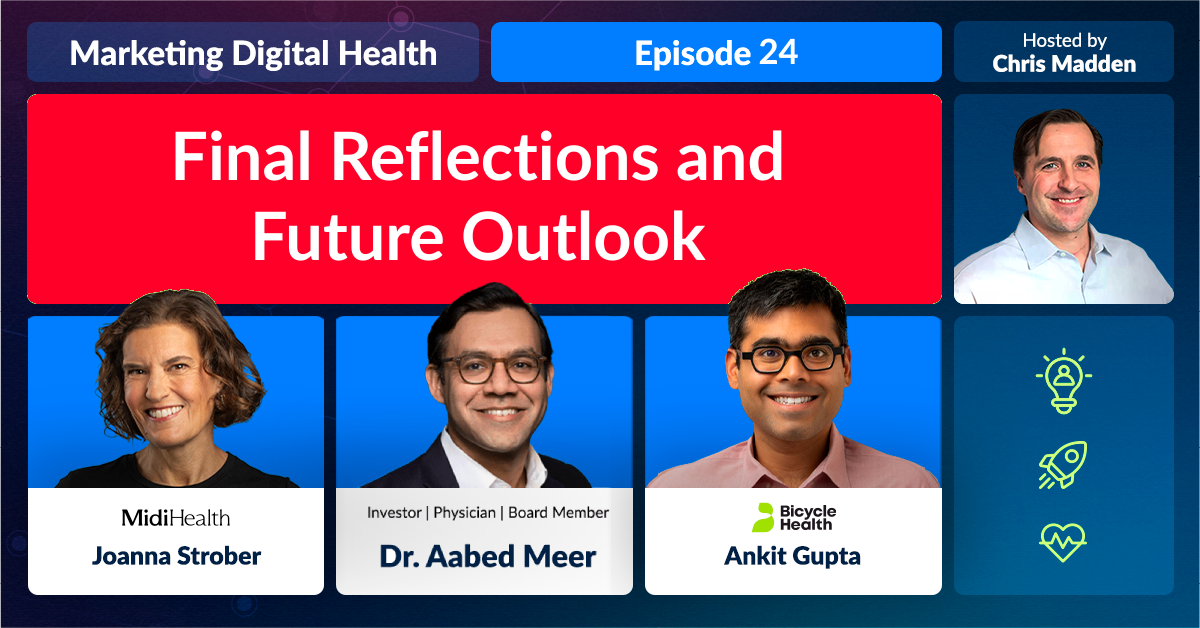
This final conversation brings three leaders with different vantage points, founder operator, founder CEO, and physician investor, to reflect on what it will take to build trusted, scalable digital health companies.
90 to 95% of care can be done on telehealth… most care is a conversation. You don’t need to look at your body for most care.
Joana Strober
CEO and Co-Founder of Midi Health, a virtual care platform for women navigating midlife hormonal changes and other underserved health journeys. A serial entrepreneur and investor turned founder, Joanna has built Midi to address the clinical, emotional, and structural gaps in women’s health—reaching millions often through what she calls the “side door” of healthcare. Midi was named TOP 100 Most Influential company in 2025.
It’s inevitable that you start with a point solution, but in order to be a scaled company, it’s important to build toward a platform solution.
Dr. Aabed Meer
He brings a rare blend of clinical training and hands-on operating experience to healthcare investing. A physician by background, he’s spent the last 15 years backing and building companies across the healthcare landscape. Throughout his career, Dr. Meer has rolled up his sleeves alongside founders and management teams—helping shape strategy, hire leadership, navigate complex payor dynamics, and scale operations. He’s also known for his ability to spot emerging themes early and back companies with a real mission.
Digital marketing is a great way to be available for that person when they need us the most… to be next to a person in their pocket when they’re ready for change.
Ankit Gupta
Co-Founder and CEO of Bicycle Health, a leading virtual care provider for opioid use disorder treatment. With a background in engineering, product, and mission-driven entrepreneurship, Ankit built Bicycle to address one of the most urgent—and complex—public health challenges in America. His perspective sits at the intersection of access, growth, and care delivery, with a strong belief in technology’s ability to scale compassion and measurable health outcomes.
Chris Madden:
This is our final episode of the season. When I look back at everything we’ve covered, one thing stands out. Digital health isn’t just changing how care happens, it’s expanding who gets access to it, making it specific to your precise needs, and providing great care to people who may have been shut out of it for years.
This is Marketing Digital Health, and I’m your host, Chris Madden. Today we’re zooming all the way out, not just a single topic about a single channel, but the bigger picture, the impact digital health is having on patients, providers, payers, and all of us as humans navigating our own health journeys.
And to bring this home, we’re bringing back three incredible voices. Ankit Gupta, Joanna Strober, and Dr. Aabed Meer. They each bring a different angle, but they overlap in the same mission, using innovation to reach people who need care the most.
Let’s close out this season the same way we started it, focused on people, access, and the future we’re building together. Digital healthcare helps remove critical barriers and is changing the way patients are treated.
For example, patients with opioid use disorder, which can carry a stigma. We introduced Ankit Gupta in episode 16 on navigating state level fragmentation.
Ankit Gupta:
Yeah, I’ve been horrified as I was starting to work on Bicycle Health and seeing how treatment gets delivered in other places. I’ve even seen cases where patients were literally in handcuffs in the clinic as they were going through treatment, supervised drug testing, someone would literally see them pee in a cup.
So we wanted to create something that is highly friendly, accessible, convenient, confidential, while at the same time works really well, provides great outcomes, and proud of the work that we’ve done to be able to do that.
So our treatment model is still based on top of the evidence base that exists for opioid use disorder, but we have really evolved it and adapted it for the telehealth and digital health setting.
Core aspect of our treatment model is medication management. We prescribe buprenorphine based medications that are highly effective, that have a strong evidence base to overcome withdrawals, overcome cravings, and really help people get into recovery and stay in long-term recovery.
One of the first things that patients receive is an appointment with one of our medical providers. They’re trained in addiction medicine. They’re trained in our protocols, and they help patients obviously assess their condition, but then start a treatment program that includes getting off of their opioids, going into trial, and then tapering up the dose of buprenorphine little by little to get to a point where they don’t have withdrawals anymore and don’t have cravings anymore.
Once patients are fairly stable on the medication, and that takes about a week or sometimes more, then patients start engaging in a lot of other aspects of the program. For example, if the patients need some sort of behavioral health intervention, we have a therapy program in-house, or we have partners that provide therapy for our patients.
Often patients might need behavioral health support, but maybe don’t want therapy or don’t need therapy. We have a large team of recovery coaches or peers who have lived experience of addiction, whether that’s their own or whether that’s through friends and family members, and so they run thousands of support groups at this point across the day, across the week, 150 different types of support groups.
And in addition to that, they also provide a lot of one-on-one counseling and support for our patients. And so this is a highly engaging program that’s based in-house. We’re really proud of that and it really helps engage patients in between those medical appointments where lots of ups and downs happen and we want to make sure we can prevent relapse as much as we can.
We also allow patients or engage patients in a lot of the wraparound administrative support that often in clinics they think of it as overhead or they think of it as just operations. We actually think of it as critical to remove barriers to staying in treatment or prevent relapse.
So we have staff members who help patients locate pharmacies to fill prescriptions because unfortunately there’s a lot of stigma about this and a lot of pharmacies either don’t want people entering treatment to be filling the prescription at the pharmacy or just don’t stock this medication enough.
And so we built a proprietary tool to locate pharmacies that will actually have the medication on the shelf, and our staff helps patients. They go through lots of hoops to help the patient actually fill their prescription.
Similarly, we have a team of financial coordinators that help the patient really understand the bills and work with them to make sure that the patients can actually stay in treatment and afford the treatment as much as we can.
And so a lot of the support services that the patients need to, again, remove those barriers in treatment.
Chris Madden:
The ability to put yourself in the shoes of your patient is one of the biggest differentiators I’ve seen between ordinary founders and truly transformational ones. And you can hear that in the way Ankit talks about treatment, not just the clinical steps, but the dignity, privacy, and respect that patients deserve.
Ankit Gupta:
90% of patients with opioid disorder don’t have access to treatment. Studies have also shown consistently 90% of people with addiction don’t want treatment.
If you put those two together, to me, what that signals is that if I ask you a day, any day, whatever, 10% chance you want treatment. But over the course of a few weeks, or over the course of a few months, there’s probably a time that comes when you really want treatment, and if in that moment you don’t get the help you need, it’s so easy to go back to the usual habits and that moment might not come for a long time.
So for a lot of our patients, when there’s a significant life event happens, maybe the birth of a child, maybe some acute event, maybe an overdose, or maybe just something that makes you realize, hey, there is a different way that I can do this. Maybe a friend or a loved one is doing really well.
And so when I think about marketing, I actually think about putting myself in the patient’s shoes and thinking, how do I actually be available for this person when they need us the most? And for me, digital marketing is a great way to do that.
For a lot of people in a new way that we have to offer. And so if we run ads on Google, as patients are searching for things, if we show up on their Meta feeds or their Instagram feeds, often what we hear is, oh my God, I didn’t even, I wasn’t even looking for Bicycle, but I’m so glad that I found you, because I was able to turn my life around.
And so I think in that sense, digital marketing is a really amazing tool to be able to be next to a person in their pocket, available when they need it. And we’ve really optimized our operation to be able to really engage those patients in those times.
So we make sure that same day, next day appointments are available. We make sure that our providers are cross-licensed across multiple states, across multiple health plans or credentialed so that they’re able to take a wide variety of patients as they’re coming through the door.
And so many more enrollment operations that help us really make sure that we’re available for the patient when they’re ready for help.
And you can really take that to the next level through thinking about B2B, where how can Bicycle be in the lobby of the jail when the patient is leaving the jail and they now are gonna go back into their community setting, but they’re actually in treatment now, whereas maybe when they got in earlier, they might be in active addiction.
And so how are you there? How are you in the lobby of yours*? How are you actually in the state Medicaid offices when someone is ready to enroll in Medicaid so that they can engage in treatment?
And so how can Bicycle be where the patient is with the street team as they’re going around and engaging patients overnight, trying to get them help. And so in my mind, marketing is more than marketing. It is being there where the person is in the moment that they are ready to change their life.
Chris Madden:
Finding new ways to reach patients can’t just be a passion project. It has to be backed by a model that works. That’s where Joanna’s perspective is so important. She brings the business reality. To help people at scale, the company has to be sustainable.
But what I love is that even though Joanna and Ankit approach the problem from different sides, the end goal is identical: access for people who were never served before.
Joanna Strober is the founder and CEO of Midi Health. We introduced Joanna in episode one around why marketing digital health matters.
Joanna Strober:
I recently was talking to the head of Google Ventures, and they’re one of our largest investors, and there’s a woman partner there named Frederic*, and Frederic pitched us the first time and she got turned down by the partnership.
And she pitched us again and she got turned down and she pitched us a third time and she got the funding.
And what the head of Google Ventures said was, she wouldn’t give up. She really believed in your company and she was persistent and not giving up, trying to get the company funded.
Not because she was trying to do the right thing, but because she believed that our company could be a really big company and we need women like her out there who are pushing their partnerships and saying women’s health is a big opportunity.
There is a lot of money to be made in serving women’s health, and therefore we should be making investments there, and that is what’s gonna drive the opportunity. It’s not done for the benefit of humanity, although it is for the benefit of humanity. It’s done because money can be made.
Chris Madden:
Joanna and Ankit share the same theme we’ve heard all season. Large groups of people who were once invisible to the healthcare system are finally being reached.
And telehealth isn’t just for younger tech savvy patients. It’s become the default for anyone who wants care that feels personal, efficient, and accessible. It’s a reminder that digital health isn’t replacing human connection. It’s enhancing it.
Joanna Strober:
What we found is that lots of women haven’t had blood tests. They haven’t had cancer screenings. They don’t really know what’s going on with their bodies. And so they’ve been lost to care after having their children and they’ve stopped taking care of themselves.
So we launched this visit and what has been interesting is how many older, and I’m gonna put myself in the older category, women are coming to us. We thought it was gonna be more women in their thirties and forties. That’s who assume, presumably is using telehealth.
And we found that actually it’s lots of women in their fifties and sixties who are coming to us who are very interested in getting up to date care.
So what that tells me is that telehealth is a pretty broad range of age categories. I think there’s a belief it might be younger people, but it’s not. It’s a very broad range of people.
The way I see healthcare going is that 90 to 95% of care can be done on telehealth. Sometimes you need to go to see a person.
I had a woman ask me the other day and she said, I was really surprised. I went to my primary care doctor for my annual visit, and she didn’t do one thing that you couldn’t do on telehealth. She said, so why did I drive there? Like, why did I go sit in the office and why did I drive there and why did I take off all my clothes and go sit on this chair when in the end all we did was have a conversation?
Most care is a conversation. You don’t need to look at your body for that, for most care.
So I think that most care will be delivered like this. It will be you and I talking, and it’s a very efficient way of providing care. You don’t have to drive, you don’t have to waste the time.
And then when you need in-person care, there will be pathways for that. And so the hospital systems will be much more set up to partner with digital health companies. And if you need an in-person visit, they will take you for that in-person visit.
So I’m actually very excited by that future. It may be instead of having to wait six months to get into an in-person visit, you’ll have to wait less because it will only be in-person visits that really need it.
So I think the care pathways are really important. I think digital health companies need to set up these care pathways like we’re doing to get you in when appropriate.
So we have a system set up now with a number of hospital systems, including Mount Sinai, Memorial Hermann, MultiCare, USC, where if you see Midi and then you need in-person care, we get you in quick.
And I think that is the most important thing, is those connections so that women can get the care they need. And when they need the in-person care, they can get in very fast.
Chris Madden:
What we’re doing in digital health isn’t easy. Every company is navigating new ground, new regulations, new patient expectations, and new ways of finding people where they are.
Ankit is building new pathways to care, not just new marketing channels. And when he talks about how referral relationships evolve, you can hear how much operational discipline is required to grow responsibly.
Ankit Gupta:
And we’re learning a lot about how to engage in referral partnerships.
We started with D2C because that’s something I’m familiar with. That’s something that really does reach the person where they’re at. It’s highly scalable and you can get a really strong engine going. It’s completely opposite of what the traditional health services world does in a sense.
It was a channel that was completely unexplored for opioid disorder treatment providers, especially at the national scale that we’re at, and especially for patients with commercial insurance.
And I think that Bicycle, we’ve really grown into that channel and optimize that channel. Thanks to your help, obviously, to help us get started on that. And that’s something I’m really proud of because of that work.
We’ve now seen, obviously, thousands of patients. We’ve seen close to 50,000 patients across all 50 states. We have been doing this work for several years now, so we understand our patient base really well.
We started off as a self-pay provider, and then we started building insurance contracts. It takes a long time to develop significant insurance coverage in a market such that a referral partner can actually take you seriously, because for them, they don’t wanna choose, oh, I’ll only send you Blue Cross patients, or I’ll only send you Medicaid patients.
For them, it’s like, I’ll send you all the patients as long as you can actually take care of them.
And so necessarily referral based acquisition had to come much later because we needed the patient base in order to get insurance reimbursed, in order to then actually engage referrals.
So now is the right time for Bicycle, where we’ve built a brand, we’ve built a patient base, we’ve built a really strong channel that can be a core channel for us, the D2C channel.
And now we’re in markets and we’re only in a handful of markets where we have pretty much 100% insurance coverage.
And so when we go to a jail and talk about how they can refer our patients to us as they’re reentering into the community, or we go to, let’s say an agency that has peers and those peers are embedded in emergency rooms, those peers now have a telehealth option that they can refer our patients to because we accept all insurance in that community.
And so it’s really, the value proposition is really resonating now where we’re having those conversations and we’re partners that are on the ground to refer patients to us.
And as we build more sort of robust insurance coverage, especially on the Medicaid side, that opens up more markets for us to go and build those kinds of referral partnerships.
Chris Madden:
And what started this surge in telehealth? The COVID-19 pandemic. That moment that pushed telehealth from a nice to have to a necessity almost overnight.
And as Dr. Meer explains, with that rapid growth came equally fast regulatory changes, all meant to keep care safe, effective, and grounded in real clinical value. It’s the biggest shift we’ve ever seen in how people access care in our country.
Dr. Aabed Meer is a physician and investor. We first introduced Dr. Meer in episode one when he contributed to our discussion around why marketing digital health matters.
Dr. Aabed Meer:
The digital health landscape was certainly gaining momentum before the pandemic and was on an upward trajectory because of a lot of secular trends. The pandemic accelerated that transition to the point where we almost had a melt up in digital health.
If you’ve looked at the number of companies that were being created, if you looked at the valuations of these companies, it definitely seemed like a peak, and many of us questioned the sustainability of that.
After 2021, the market certainly shifted from a growth at all costs market to one where the focus really was on profitability, operational excellence, and being able to have a real clinical impact.
And that’s certainly been a transition for the industry. And today, investors are largely favoring companies that demonstrate a clear ROI for all stakeholders. That includes patients, providers, payers, employers, and aren’t just focused on engagement metrics.
And in parallel, regulations have also tried to keep up with the evolution in utilization, for example, that we’re seeing.
And ultimately, these solutions have to be user-friendly. User-friendly for the patient, user-friendly for the physician, user-friendly for the payer, user-friendly for the employer.
And one way to do that is to have a robust platform solution as opposed to a point solution.
And ultimately the goal is to understand the healthcare ecosystem and integrate these solutions into the healthcare ecosystem, which is we spend north of 4 trillion today on healthcare, and regardless of how big any individual company is, it still has to figure out how to play within that ecosystem.
Chris Madden:
Turning a point solution into a platform is something we’ve seen across many companies this season. You start with a problem, a pain point, and if you do it well, you earn the right to expand.
What Dr. Meer describes is something founders struggle with. Knowing when to stay focused and when to scale. And getting that balance right is what determines whether a company stays small or becomes a category leader.
Dr. Aabed Meer:
Point solutions address very specific pain points in any workflow or process, and almost by definition, most companies start out with great point solutions.
And there’s a lot of value in developing a single solution for a single problem that really addresses that problem incredibly well.
Part of the transition any successful company that is trying to scale has to make is to turn that very, very successful point solution into something that’s more of a platform solution.
And that takes time, that takes energy, that takes process in terms of how you sequence the steps to get from a point solution to a platform solution.
And so it’s inevitable that you start out with a point solution oftentimes, but in order to be not just successful, but a scaled company, it is important to have a platform solution.
Chris Madden:
Dr. Meer shares a great example of how solutions evolve over time. When you zoom out and look at the bigger healthcare ecosystem of payers, employers, providers, and patients, you start to see the adjacencies more clearly, and that lens is what helps founders avoid common mistakes.
It’s not just about building a great product, it’s about building a product that fits into a 4 trillion dollar system.
Dr. Aabed Meer:
One of the exercises as an investor that’s important is to go through thinking about what the arc of that company could look like. Thinking about what adjacencies are there for any given solution or company, and having insight into what is more or less attractive.
And when I’m making an investment in a company, a lot of that is happening upfront. Recognizing that the path the company takes can certainly change, but it’s important to have a view.
And what I’ve benefited from is having context around what the healthcare ecosystem looks like versus working within a specific silo.
I’m thankful for my background as a physician, as a scientist prior to becoming an investor, and my ongoing involvement with the operational aspects of healthcare as a physician.
And so ultimately you want to be able to think of any solution within the broader context and figure out what are the most natural adjacencies and is this a market we would go into or not in doing that work up front as much as possible.
Chris Madden:
New technology continues to push the industry forward. Every time you remove friction, whether it’s prior authorization, scheduling, or predictive monitoring, you buy back time for providers and improve outcomes for patients, and that’s part of the real promise of digital health.
Freeing people from busy work so that they can focus on delivering great care.
Dr. Aabed Meer:
Broadly speaking, the ability to apply technology and software to workflow issues that have historically been very services oriented, the opportunity there is tremendous.
Prior authorization, as an example. That’s an area that historically has been very analog, and now you have the ability to apply software and technology to make that problem not completely go away, but at least make it easier to deal with.
If you think about predictive analytics that anticipate when a patient is gonna deteriorate before the patient actually deteriorates, there’s tremendous value in that, and you can use predictive analytics to then tailor treatment plans for patients.
Chris Madden:
We’ve talked about AI a lot this season, and the thread across all our experts is the same. AI is here to stay. It’s powerful. It’s fast. And it’s evolving at an incredible pace.
Dr. Aabed Meer:
We’re certainly hearing a lot about artificial intelligence and like any other sector within the economy, healthcare is also seeing the impact of AI.
And I spent a lot of my time thinking about the applications of AI to healthcare and trying to understand what are the most urgent problems to be solved and what are the most urgent problems that are the best fit for the technologies of today.
And we will continue to do that for the foreseeable future. I think that’s unavoidable.
So those are some of the areas I’m excited about and looking forward to seeing how they change the future of healthcare.
Chris Madden:
But AI is not a replacement for compassion, intuition, or human connection. The teams that succeed will be the ones who balance innovation with empathy.
I like how Joanna understood the difference of utilizing AI to help ease work burdens, but still keeping that human connection.
Joanna Strober:
We will always be a care company and we will always have NPs listening to you.
We are not trying to take away the people and replace them with AI. We’re only interested in supplementing them with AI, and that is, that’s really important.
That is, I don’t believe you can take away the human connection, and I don’t believe that AI is going to do that. But it can make sure that we provide incredibly high quality care and that I am delighted to be using for that purpose.
Chris Madden:
One of my favorite talking points from this season, Ankit’s North Star. Successful companies are pulled forward by something bigger than revenue. That clarity is what helps companies make the right decisions when things get messy, complicated, or uncertain.
Ankit Gupta:
We’re really motivated by our North Star, which is opioid use disorder for all.
So I see us in the next few years being able to really step into that wholeheartedly. Any state, any health plan, any acuity level, Bicycle Health should be able to help you get treatment.
We’re really expanding our Medicaid coverage and working with Medicaid managed care plans across the country to be able to do that.
We’re building a lot of partnerships with local providers of opioid use disorder treatment, especially in states where a purely telehealth model might not be feasible.
We are really investing in the criminal justice part of the business and really building those partnerships with jails and prisons and departments of corrections and parole and the entire ecosystem, along with counties and EMS.
And so really bringing these parties together to be able to get to a point where if someone has an opioid use disorder, they can get treatment maybe through the providers that Bicycle Health has, or maybe through partners in the community.
I think in the long term, this could definitely grow into a larger behavioral health platform because of a lot of the stuff we have figured out reaching patients, engaging health plans, operations to actually provide care.
I think we can go beyond opioid use disorder to a broader behavioral health platform, not for everyone, but for a specific kind of patient population that is highly underserved and that’s the ultimate vision.
But for now, we’re really focused on how do we get to a place where we can provide opioid use disorder for all.
Chris Madden:
Digital health and telehealth specifically is reshaping what’s possible. Not just in clinics, but in criminal justice, behavioral health, and recovery support.
The way Ankit talks about innovation inside prisons and correctional settings is something that most people don’t think about, but that’s where digital health can create a life-changing impact.
Everybody deserves someone fighting for their care, and technology can finally make that a reality.
Ankit Gupta:
So I’m actually really excited about, it’s funny to say, innovation in the criminal justice context, but innovation that is happening in the criminal justice system.
There’s a realization that opioid addiction and broadly behavioral health is a huge need, and especially when it comes to MOUD treatment.
I’m seeing lots of facilities actually find the funding, either through grants or through state budgets to start new patients into treatment, to start initiating patients into treatment inside the jails.
And why that is really powerful is because almost 2 million people go through the criminal justice system who have opioid use disorder, and that’s a perfect time for them to be in the mindset of making a change.
And so if we are able to start treatment inside the walls, continue that seamlessly outside the walls, and telehealth to do that, then we actually have an engine that can help us turn around the opioid epidemic and have a pretty big lever to pull to be able to do that.
So I’m really excited about that. I’m also really excited about GLP-1 and the impact they could have on addiction, although the studies are ongoing. But yeah, there’s a lot to look forward to.
Chris Madden:
Thank you so much for following along our journey this season. We’ve covered marketing tactics, compliance, creative testing, team building, AI, patient behavior, and now the impact digital health is having at scale.
So I’ll leave you with one question. How has digital health impacted your life? Whether booking a virtual doctor’s appointment, to seeing an ad that nudges you toward care you’ve been putting off, to finally getting the support you deserve.
Digital health isn’t the future. It’s the present, and I hope this season helped you understand it, navigate it, and feel empowered by it.
Here’s to our health.