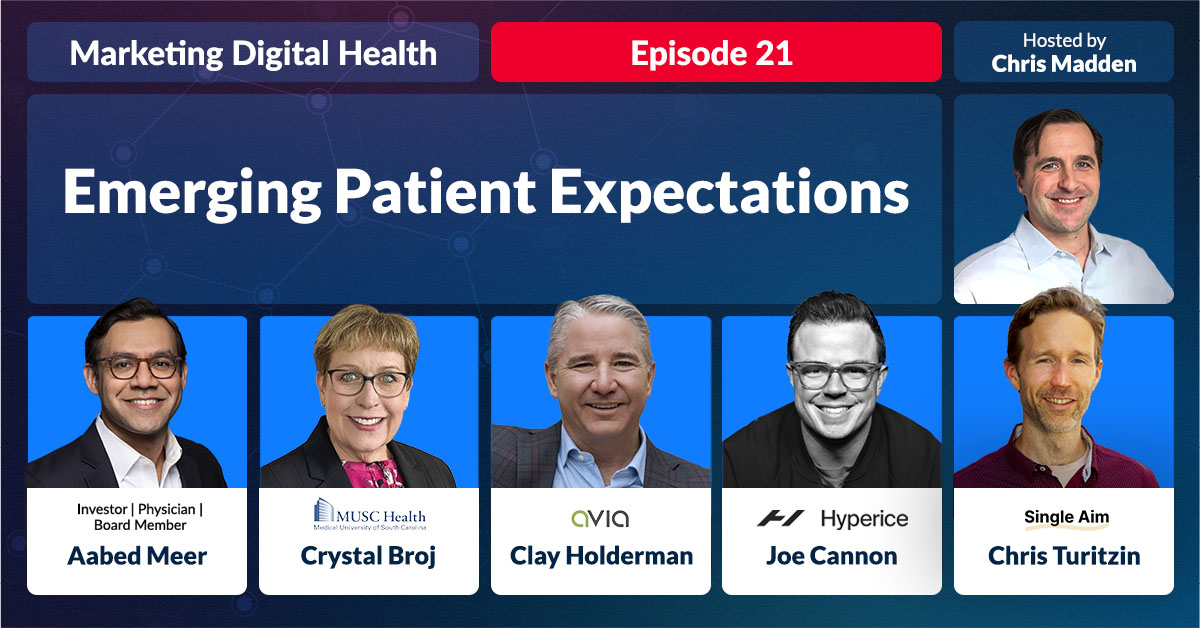


Emerging patient expectations are simple to say and hard to meet: faster access, fewer steps, and experiences that feel personal. In this episode, leaders across systems and growth share what is working. Start at the front door. Make the call to action obvious and let people self‑serve. Natural language search, visible appointment times, and pre‑registration reduce friction and build trust before the visit. Voice and chat assistants now handle routine tasks with plain English, cutting hold times and freeing up teams for higher value work. Done right, these tools lift the patient experience and the staff experience at the same time.
Channel choice matters. Virtual care expands access and speed, while in‑person visits remain essential for many needs. Match the channel to the moment and the condition. Expect strong digital uptake from seniors when the UX is clear and support exists. Outside the clinic, wellness and diagnostics are raising the bar. People want to manage health every day, not just at appointments. That means proactive education, reminders, and personalized nudges that connect to care paths. Measure what patients feel: time to appointment, no‑shows, ease of scheduling, and outcomes. The future looks less like isolated portals and more like orchestrated journeys that are personalized, proactive, and predictable.
Stay ahead of shifting patient behaviors and preferences—from decentralized care to digital-first interactions—shaping the future of health engagement.
This roundtable blends growth systems, investing and clinical perspective, hospital innovation, and consumer wellness to map what patients expect next.
We're seeing tons of growth in the diagnostic space… People want to understand what’s happening inside their body more than they are having that conversation with their general practitioner.
Joe Cannon
The SVP of Global Partnerships at Hyperice, where he’s helped transform recovery tech from a niche product into a consumer wellness category. From Equinox to the US military to major sports leagues, Joe has helped position Hyperice as a vital part of movement health—while also challenging the healthcare system to rethink MSK care, wellness access, and preventive innovation.
We’re seeing members prioritize moving from a transactional experience to one that is proactive, predictive, and engaging in a continual way.
Clay Holderman
The CEO of Avia, a digital transformation and innovation partner to health systems across the U.S. With deep experience in health system leadership, Clay now helps guide systems through the complexities of change management, applied AI, and operational transformation—especially at a time when economic pressures, demographic shifts, and emerging technologies are forcing an inflection point in the industry.
Our registration rate was doubled. When it was just Epic, it was about 24%. We’re now well over 50% doing it in digital format.
Crystal Broj
The Chief Digital Transformation Officer at MUSC Health, where she builds, tests, and scales technologies that redefine how patients access care. From AI-driven appointment scheduling to tech-enabled referral management, Crystal is leading one of the most forward-thinking digital transformations inside a hospital system—and translating innovation into measurable ROI and improved patient experience.
It took a pandemic for stakeholders—whether government or private—to recognize that telehealth was worth reimbursing for.
Dr. Aabed Meer
He brings a rare blend of clinical training and hands-on operating experience to healthcare investing. A physician by background, he’s spent the last 15 years backing and building companies across the healthcare landscape. Throughout his career, Dr. Meer has rolled up his sleeves alongside founders and management teams—helping shape strategy, hire leadership, navigate complex payor dynamics, and scale operations. He’s also known for his ability to spot emerging themes early and back companies with a real mission.
The next frontier is in areas with in-person treatment or regulation… We’re seeing growth in Med Spa, Direct Primary Care, fertility, ophthalmology, and wound care.
Chris Turitzin
A growth advisor and founder of Single Aim known for bringing rigorous product and marketing discipline to the world of digital health. After years of leadership at Meta and digital health companies, he now advises companies like Bicycle Health, Ours Privacy, and other healthcare leaders on how to architect scalable growth systems tailored to diverse business models, from DTC to payor-aligned care.
Chris Madden:
Healthcare is transforming fast from decentralized care to digital first interactions. The goal remains the same, which is improving the patient experience. This is Marketing Digital Health, and I’m your host, Chris Madden. This episode explores how health systems are adapting to new behaviors and expectations, creating more connected and personalized patient journeys.
Our first guest is Crystal Broj. Crystal has been working on a pilot program with Notable, an AI platform for healthcare operations that automates repetitive administrative workflows. They started small just with simple appointment reminders, and then expanded with the ability to confirm or cancel appointments, which led to patients getting to do the entire pre registration process if they select it before they even stepped into the office. Since then, the program has been able to take on more and more work, taking on the menial tasks so healthcare workers’ energy could be used elsewhere.
Crystal Broj:
As you talk about AI or AI agents taking work out of the system, think about how when you go to the doctor’s office, they give you a clipboard.
Well, in this case, when we have this preregistration, everything you would do on the clipboard, including giving your driver’s license, insurance, stuff like that, happens with a text message, and then it automatically goes into the EHR. So we started there and then we started adding onto it, adding more offices across, and now it’s across all of our offices in South Carolina.
But then we also added not only confirm cancel, but the ability to copay before you get there and to pay prior balances. Wildly successful, our registration rate was doubled by that product. So when it was just Epic, it was about 24 percent of the people did their preregistration. We’re well over 50 percent doing it now in electronic digital format.
We also dropped no shows by about 11 percent. And since we had Epic FastPass that was able to open those slots up and let people get in faster, access being the name of the game for most hospital systems today, and trying to find ways to either make more appointments or make them more efficient. And we also had a big uptick in copays.
So that’s where we started the journey. So then we wanted to look for how do we update our website. We knew we were having a big website redesign, but it was gonna take 18 months before our total overhaul. So we wanted to just make better calls to action much more clear. And so if you go on MUSCHealth.org right now, you’ll see there are four main buttons.
Find a doctor, find a location, get care now, and then very clear for the patient to be able to find it. We just launched this spring. DexCare is our front end for our find a provider, which is a wonderful tool. It lets people search using natural language processing. You can say you have elbow pain and it’ll show you doctors that just orthopedics, that just do elbows, and not only does it do that, but has a map on the side.
And it shows you the times the doctors are available, which is total transparency. You don’t have to log into MyChart, you don’t have to do anything else. It’s right there on our website. So if you need to find an appointment for one of your kids tomorrow, you can sort by first available, because sometimes you have your doctor, but it doesn’t matter. Sometimes you are sick and you wanna see somebody right away.
Chris Madden:
Crystal describes even more programs they’ve enlisted into their telehealth, all to better patient experiences. The use of AI chatbots is making it easier for patients to manage their care while giving healthcare teams valuable time back.
Crystal Broj:
We also tie that into our telehealth, so along that list you’ll see Get Care Now. If you click on that, you can actually get a telehealth appointment right away, either via text or on screen, or you can do a video visit. Those were some of the things for front door, and then we started working with our patient access center and we launched with a product called Amelia, which is a voice bot chatbot.
And we started again with very small, four lines. And she answers the phone, but she’s not “press one for more options, press two for things,” but instead it’s, “Hi, I am Emily, your digital assistant. How can I help you today?”
And with plain English, you can talk to Emily and say, “Oh, I wanna confirm my appointment for Tuesday and cancel the one for Thursday.” And she understands all of that. She’ll verify you with our EHR and go, “Oh, okay. You’re Crystal. So you have an appointment Tuesday at one o’clock, did you wanna talk about that one, and Thursday with Dr. Brown at five?”
So I’m like, “No, I need to cancel Dr. Brown and I wanna find the address I need to go to for Dr. Smith on Tuesday.” She can handle that entire conversation. So after we did that on four lines, being an NLP model, we had to tweak that a little bit, get it right, make sure there were words that she could not say like “mammogram” first. It was a very strange reason.
So we had to train the model, which is what you have to do in all AI cases, and she didn’t understand last names. And being in the South, we have a lot of interesting last names. I have an interesting last name. It’s Broj, but it’s spelled BROJ. When I tested the bot and I said, “Who are you?” “I’m Broj.” And she goes, “Oh, Broy, B R O Y.”
And I said, “No, no, no, no, BROJ.” And she goes, “Oh, your last name is…” “No, no, no, no, BROJ.” And it was so frustrating. And so then you think, okay, well how do we train this bot so we could use the NATO alphabet, alpha, bravo, blah, blah, blah, you know, those. But not everybody does that. We’re in the South, people could be saying B for bourbon, something like that.
And so there was no way to train even when we added the top 10,000 names in South Carolina. So we found a different way to authenticate so that our users wouldn’t get frustrated. That is now on all 40 lines in our patient access center.
Amazing results, our wait times have gone down in half because Emily can answer all the calls and then route them to the appropriate agents to do the higher level volume. And our patient satisfaction scores have gone up, I think 11 notches for being able to contact the office. So patients love it.
It’s in Spanish on a couple of lines as well, on our lines where we have Spanish speakers calling into those offices. So we are now expanding that into our revenue cycle, and we just launched that last week. And so it’s answering billing questions, how to pay my balance. And we’ve seen really good results with that.
We get about 1,200 calls in our revenue cycle call center a day, and Amelia, on the first week, answered 25 percent of them without ever having to go to a human. So we’re seeing some really good results with transformative digital tools.
Chris Madden:
The impact goes deeper than convenience. When you remove friction points, you open doors for patients who might have struggled to get care before, such as those with mobility challenges, language barriers, or limited time. As Crystal shares, automation is about helping health systems reach more people more equitably, and that’s what real innovation looks like.
Crystal Broj:
It’s really hard to navigate a health system and so however you can do it, we always keep in mind we do personas. So we have a bunch of personas. We have the busy mom with two small kids. We have an individual that’s just single that lives downtown. We have people in rural areas that have problem speaking or have problems using digital. And we have one persona, Fred, who doesn’t use digital at all.
And it’s really important for us to consider all of those things when we’re building out digital tools because Iris in Orangeburg probably will need her daughter to help her unless we can get a Spanish speaking line for her, and Fred‘s not gonna use anything. So we have to think about when he comes in the office, if he hasn’t preregistered, how that’ll work.
But really the whole point of a lot of the work that we were doing is access. If we can do prior authorizations, which is another tool that we’ve launched this year in our revenue cycle area. So we use an AI agent to go actually out to the payer site and type in all the information from the records, say for an MRI, for example, and it does it automatically and then it brings back the result.
That can take 15 to 30 minutes when a person does it and the agent does it in 30 seconds, saving a ton of time, and about 40 percent of them are instantly approved. So that takes a lot of work out of the system too. So that’s great for our care team members because they can work on higher level tasks. It’s great for patients because they’re getting in to see the doctor sooner.
They’re approved so they can schedule, so they can get in, so they can get the care they need. So at the end of the day, it’s really an access play for all of these different tools. Getting that to show you the appointments, letting you schedule, letting you pick the time and place that you want, and making it easy for patients.
Chris Madden:
The whole experience of telehealth is creating an incredible connection for patients. It’s giving them important reminders. It’s allowing them to pay a bill online, to schedule and see their doctor online. Healthcare workers are having their own burdens reduced so they can give more time to patients.
We’re automating the mundane phone calls and appointment reminders so we can focus on the patient in the room. Clay Holderman is the CEO of Avia. We introduced Clay in episode 13 around partnerships for growth. Clay talks about what he’s seen firsthand.
Clay Holderman:
In spite of huge financial headwinds, the interest in the consumer orchestration journey has not diminished. And so we still have many of our members, probably fully half of our members, that are prioritizing getting away from a transactional web based or phone based “I can make a schedule, I can book an appointment, I can pay a bill, I can fill out forms” to an actual engagement where it’s been personalized and it is proactive and it’s predictive about my needs, and it’s engaging me in a continual way.
So that orchestrated experience is a big theme. Another one is connected care everywhere. Through COVID, everyone accelerated what they were doing in at home programs, at home monitoring, virtual nursing, virtual urgent care, virtual physician visits, behavioral visits, all kinds of virtual cares.
How do you take these connected care programs and put them into a single care model? Because often they were fragmented. They were often bought or created through different solutions. They weren’t integrated into the electronic health record and they weren’t generating a note that became part of the EMR. They often were not reimbursable or reimbursable only under a value based care contract, only under an emergency use authorization.
Helping people to now create a care model and a business model around their connected care devices, including wearables in some cases, depending on the market. Those are two big trends. The third is all things telephonic and outreach. And the easiest is SMS text, which is old technology, easy to implement, cheap to program, but we find that it has a response rate that’s much, much more effective than a phone call.
And so using SMS text for everything from appointment reminders, to post follow up care reminder, to billing processes, to helping people with chronic conditions to remember to take their daily weight check in and record their glucose. Now being able to automate those tasks, you can talk to a lonely senior as long as she wants to talk, and you can answer questions about the discharge instructions, about the home medications, and the AI agent can take action to ping the pharmacy and see if the medication’s ready, have it delivered to the home, change the delivery address, set the follow up appointment, all without a human touching that process unless the agent escalates it out.
Chris Madden:
Automation is driving massive ROI across healthcare, but it’s not just about saving dollars, it’s about saving energy. When staff no longer spends hours chasing forms or rescheduling appointments, they can reinvest that time into patients.
Krystal‘s team has found real measurable wins here. The kind that prove automation isn’t replacing people. Instead it’s empowering them.
Crystal Broj:
There’s a certain cost to putting in that voice technology and we first went through it, it was like, “Oh, this is a great idea, it’s gonna save time.” And the first thing you know, any finance department’s gonna go, “Okay, you’re saving time. How much time are we gonna be able to reduce headcounts?” And the answer is no.
But we couldn’t hire enough people for the patient access center. We really had 30 open reqs and we had long wait times, which we talked about before. We had people getting frustrated, hanging up because they were waiting. But we couldn’t meet the standards that we had anticipated or wanted to set for ourselves for that.
We watched how many calls are deflected. We watched how many calls are confirmed, canceled, and taking the industry average of six minutes per call, and then say, well, we know that we’re saving at least three to five minutes. We deflected 275,000 calls that did not have to go to a person in fiscal year 25.
And if you take that three to five minutes, that comes out to about 32,000 hours of savings when you then don’t have to hire someone else to keep up with that load. And we’ve been in a system that’s growing, so we can just keep getting people into our system that wanna call. And you don’t have to do that, and you can cut your wait times down so your staff’s being more efficient.
They don’t feel as burned out because they actually can breathe in between a phone call before they gotta grab another one again. So that’s the soft ROI. You can’t count people feeling better, but you can count the amount of work that they can do and the metrics that you have around it, reduced wait times and things like that.
Is there a financial savings? In a way, because we didn’t have to hire the extra people, but also because we can then expand because we have technology and we can expand to cover other patient access centers too, which is great then because we can train our agents to answer any call across the network with AI helping at the front end to direct it to the right person.
Chris Madden:
Dr. Aabed Meer sees this evolution from the physician side. Dr. Aabed Meer is a physician and investor. We first introduced Dr. Aabed Meer in episode one when he contributed to our discussion around why marketing digital health matters. He knows firsthand how new tools can make care more efficient without sacrificing empathy.
His approach to innovation is simple. If it helps patients and makes doctors’ lives easier, it’s worth doing. It’s that balance between clinical precision and compassionate care that defines where healthcare is heading.
Dr. Aabed Meer:
If you look at the last 20, 30, 40 years, the ratio of time spent with the patient to the ratio of time spent on administrative tasks has only decreased, i.e., we spend less time with patients today than we used to, and we spend more time on administrative tasks today than we used to.
And that’s not the direction in which physicians want to go. That’s not the direction in which patients want to go either. And the types of innovations, including scribes or ambient scribes, are exactly the type of innovation that we need in healthcare because it helps that physician, that provider, to shift their attention from these administrative tasks to what really matters, which is patient care.
Chris Madden:
Dr. Aabed Meer also highlights something many overlook, which is that telehealth isn’t meant to replace in person care. It’s about giving patients the right care at the right time through the right channel. Sometimes that’s a virtual visit, sometimes that’s face to face.
The key is flexibility. And that flexibility is what today’s patients have come to expect.
Dr. Aabed Meer:
There’s certainly a difference between where virtual care is relevant and is the best way of delivering care versus where in person care is most relevant and the best way of delivering care. And the analogy I would use here is when folks buy clothes.
There are folks that love the convenience of online shopping and buy clothes there, and there’s some folks who may still want to go in person to a store and buy clothes in person. And in healthcare, similarly, a virtual care visit or a telehealth visit certainly has the convenience and the urgency that an in person visit may not have.
But depending on what an individual is dealing with from a medical perspective, it’s really about what is most relevant to the individual with a given condition in that moment. And so broadly speaking, telehealth and virtual care have expanded access to care, which is fantastic, particularly in parts of this country that don’t otherwise have access to care.
Rural America, unfortunately, doesn’t have as much access to care, and we’re seeing organizations that are able to deliver virtual care actually reach these parts of the country, which is great. Now, at the same time, virtual care may not be perfect for certain types of care, right. So it depends. It certainly depends on the acuity of what the patient or the individual is experiencing.
Chris Madden:
The government and private stakeholders didn’t always see the benefits of telehealth. While the technology has been around, what’s new is the recognition, reimbursement, and adoption behind it. The pandemic didn’t invent virtual care. It simply forced the system to embrace it.
Dr. Aabed Meer:
The technology to enable telehealth or virtual care has been around for a long time, and there was this first generation of companies that came into being sometime between a decade and a decade and a half when these technologies were available.
However, it took a pandemic to help us recognize that these were viable forms of delivering care, and it also took a pandemic for stakeholders, whether government or private payers, to recognize that telehealth was worth reimbursing for. We can’t get away from the fact that healthcare is a regulated industry for good reason, and therefore adoption of technologies like virtual care or telehealth is dependent on whether there are billing codes, for example, that allow a physician to bill for a telehealth visit.
And so in the last few years, we’ve seen that transition happen, and that’s been a catalyst for the increase in telehealth that we’re seeing today versus the prevalence of telehealth even just five years ago.
Chris Madden:
Crystal adds another layer here. The idea that digital adoption isn’t just for the tech savvy or the young. We’re seeing seniors, parents, caregivers, and patients across every age bracket embracing digital tools when they’re built intuitively.
That’s the future of engagement. Meet people where they are, but design for everyone.
Crystal Broj:
There’s an assumption that age makes a difference in tech adoption. And from what we’ve seen, it’s not the case. Our 65 plus generation, although you would think that they wanna call all the time, they’re adopting technology and doing online scheduling, for example, or things like that, at a rate that’s very similar to a millennial, for example.
And so that stereotypical thing that they won’t use it is something that actually is not true. And I think while you think tools are easy enough to use, and it should be really simple, you still have to be willing to train your staff and spend some time so they feel confident, especially when you’re introducing a new process.
So if I’m doing it this way, I’ve done it this way for three, five years, and then I give them a new tool and they’re trained well and they aren’t comfortable, they’re certainly not gonna wanna use that tool in front of the patient because they were efficient before, so they don’t wanna look dumb doing their job. And then you’ll have non adoption as well.
So you really have to work with whoever your customer is at that point to make sure that they feel comfortable enough to use it.
Chris Madden:
Joe Cannon is the SVP of Global Partnerships at Hyperice. We introduced Joe in episode four around storytelling and trust. He’s been watching how wellness and longevity tech are redefining what healthcare even means.
Patients aren’t just waiting for care, they’re tracking, testing, and optimizing their health every day. It’s a total mindset shift from reactive medicine to proactive wellness.
Joe Cannon:
That’s the future of where we’re going and what we’re doing is trying to increase those conversations. We’re seeing tons of growth in the diagnostic space with like Lifeforce and Function and Superpower. People want to understand what’s happening inside their body more than they are having that conversation with their general practitioner.
The rise in functional medicine is at an all time high, and I think will continue to grow. I think it’s that conversation where it’s like they’re starting to take what we’re putting into our bodies into account. We’re starting to take what our biometrics are doing.
The next level of longevity is obviously having a just an unbelievable moment with Huberman and Attia and Sinclair and those guys. They’re doing incredible work and really bringing the forefront of a lot of the studies that we’ve been building on for years to the masses and where we’re going.
So it is this wonderful wrap of all these wonderful spaces coming together. It’s health, it’s wellness, it’s fitness, it’s spa, it’s body care, it’s MSK. It’s all of these things telling a story on how we’re gonna feel and move better.
Chris Madden:
Since the pandemic, patients have become more empowered and more self aware. Joe points out that people now expect healthcare to fit into their lifestyles, not the other way around. They want insights, personalization, and the ability to act on their data in real time.
It’s a powerful shift from patients receiving care to people managing their health.
Joe Cannon:
Consumer expectations post COVID and during COVID have changed dramatically around people’s worry that, oh, like, damn, we might not live forever and we might not live that well. And I think a lot of millennials have seen their parents, a lot of boomers have seen their parents’ bodies deteriorate. And when you stop moving, you start dying very, very quickly.
And you see those people in the gym that are 80 and they’re in great shape and they’re crushing it and they are the exception to the rule. It’s how do we build these bodies for that not to be the exception by the time we get there. And I think the expectation now is you wanna live a long time, but you wanna live a great life.
You don’t wanna just be hurt or broken or whatever. And I think so many, even millennials, might not be saveable in the sense of a lot of the MSK issues. I have numerous friends who are 40 and below that have had hip replacements or knee replacements at this age. And when you think about that, that’s crazy.
Where that’s coming from, repetitive strain, sitting, biking, whatever it’s been that has caused these issues. How do we prevent that? And I think people don’t want to see this happening and see this happen to their parents, or back issues or whatnot, and they want to fix it now.
That’s really exciting about the space, that people don’t want to be hurt, and people are looking for alternative medicine resources now to help them achieve those health outcomes, which is pretty cool. A lot of people are going to doctors, they’re going to chiropractors, they’re going to physical therapists on their own.
Chris Madden:
Chris Turitzin is a growth advisor for digital health companies and is the founder of Single Aim Marketing. We introduced Chris in episode one around why marketing digital health matters.
Chris jumps in to look at this from the marketing side. He’s seen how COVID accelerated the digital curve, pushing health systems to modernize fast. What used to take years of planning now happens in months. That urgency created new habits that stuck and opened the door for healthcare to finally compete on experience.
Chris Turitzin:
Basically because of the pandemic, some regulations opened up and generally companies that gatekeep in healthcare became more telemedicine friendly. I’m talking about insurers, for example. They started accepting telemedicine companies, and what that meant was there’s this huge cohort of companies that showed up in that time and essentially I would say saturated all of the verticals.
So if you look at all the mental health verticals, dietician verticals, men’s, women’s health, weight loss, GLP-1s, addiction, various metabolic health, there’s a lot of players in all of those.
I think the next frontier is in areas that have some form of in person treatment or some form of regulation requiring in person service. So that could be like the prescription of controlled medications, it could be running procedures. And I think we’re already seeing that the telemedicine markets are relatively saturated, in person markets are very much not saturated.
Just the experience of a consumer trying to get an ophthalmology appointment and you have to wait six months. It’s obviously not saturated from a supply perspective. So what we’re seeing is a lot of movement starting in these consumer in person markets. So med spa being the prime example here.
There’s just been a lot of growth there over the last few years, but others like direct primary care, optometry, dental, longevity, fertility, a lot of expansion of in person clinics.
And what’s next after that is moving to less consumer markets, but still very high demand and supply constrained. These are just examples that I’ve talked to physicians about, like ophthalmology, urology, primary care, wound care.
The model that we’ll likely see is like a physician pod model where a physician is kind of at the center and they’re managing a team of NPs and PAs who basically are these business managers running clinics wherever in the country. So that’s generally what I think we’re gonna see next.
One reason I go into healthcare and one reason I maintain healthcare is I think competition is good and we need more competition. And you kind of have to come in from these peripheral markets, these consumer healthcare markets, and slowly eat into these more core healthcare markets. And as you do that, you start to compete with the more traditional healthcare options. You’re basically just offering more good options.
So I think it’s generally all a good thing. It’s happening slowly. That’s what I see in terms of maybe the next five to ten years. There’s just gonna be, so much healthcare is gonna be provided by advanced practice practitioners. That’s just the future. It’s just purely a numbers game.
So the question is, will the world be set up, in which way will they be employed by large organizations like health systems or will they be more in some sort of autonomous model, either fully independent or in that kind of pod structure with the physician as I was talking about.
Chris Madden:
Clay wraps it up by zooming back out to the system level. Workforce shortages, rising demand, higher expectations. Healthcare’s next chapter depends on automation and smart technology to close those gaps.
As he puts it, this isn’t about replacing people, it’s about redesigning the system so care teams can focus on what matters most: connection.
Clay Holderman:
So there’s not a silver bullet. There’s not just one solution. We have the most complex health system of the world. It’s made up of at least five or six sub health systems based on reimbursement category. We have one health system for our veterans. We have one health system for our Medicare population and retirees.
We have another population for the poor and for women undergoing pregnancy and children in the Medicaid system. We have the indigent and undocumented that largely come into indigent care and EMTALA required care inside of health systems. We have the commercially insured, which breaks down into multiple different health systems.
All of those are billed differently. All of those have different prior authorization requirements. They all have different formularies. They all have different workflows associated. That complexity doesn’t have just one solution.
However, the combination of the 2030 problem, diminishing workforce, increasing patient demand, increasing patient complexity, and diminishing revenue from the shift to government payers, I think the adoption of automated technologies to replace what workforce used to be able to do is now critical, more critical than ever.
And it doesn’t matter if this is going back to 20 years ago and it’s just simple robotic process automation and task automation, or whether it’s going to some actual intelligent automation, or we’re getting into real autonomous decision making and AI enabled workflows, or we’re working upstream into really context aware AI agents, or really a composable system of multi agent autonomous operations and composable intelligence, that entire continuum is available to us.
But what really got interesting, we had OpenAI come out in 2023 and change the market on intelligence approaching AI, but it was still populating workflows for humans. Now, agentic and autonomous workflows are doing something different. Instead of populating a workflow for a human to complete, it can complete an administrative task.
It can complete a clinical task if we decide it’s ethical and safe. And so with those in front of us, a huge part of the solutions of the 2030 problem has got to be scale adoption of autonomous workflows and innovation.
Chris Madden:
If there’s one takeaway from today, it’s that patient expectations are rewriting the rules of engagement. Healthcare isn’t just about appointments and outcomes anymore. It’s about experience, empowerment, and access.
From automated workflows to virtual visits and personalized communication, the organizations that thrive will be the ones that stay curious, stay flexible, and stay human, because the future of healthcare isn’t digital instead of personal. It’s digital so it can be personal.
Behind every movement are the founders who built it. Episode 22 brings raw stories from digital health entrepreneurs and the lessons they learned the hard way.