

Healthcare ad creative testing works when teams run a tight loop, not a one time campaign. Start with a simple hypothesis that ties to a real patient problem. Build two to four variations that focus on one variable at a time, for example hook or value prop. Launch small, learn fast, then double down on what moves qualified sessions and conversions. The first second matters the most. Put the problem, the person, and the proof up front. Show a patient or clinician, speak to the pain point, and add a quick proof cue, for example doctor reviewed, outcome data, or a short testimonial. Choose formats that fit the platform. Use square for feeds, vertical for Reels and Shorts, and horizontal for YouTube, with captions and safe text areas. Plan creative sets around concept buckets, problem led for empathy, outcome led for motivation, proof led for credibility, and education led for clarity. Keep reading level friendly, avoid scare tactics, and bring in clinician voices where claims require it. Compliance is not a speed bump, it belongs in the brief. Write claims you can prove, include disclosures, and design privacy safe tracking from day one. Measure beyond click rate. Look for engaged reads, form progress, booked appointments, and assisted conversions. Rotate winners before fatigue and share learnings back into the next hypothesis. That is how creative compounds.
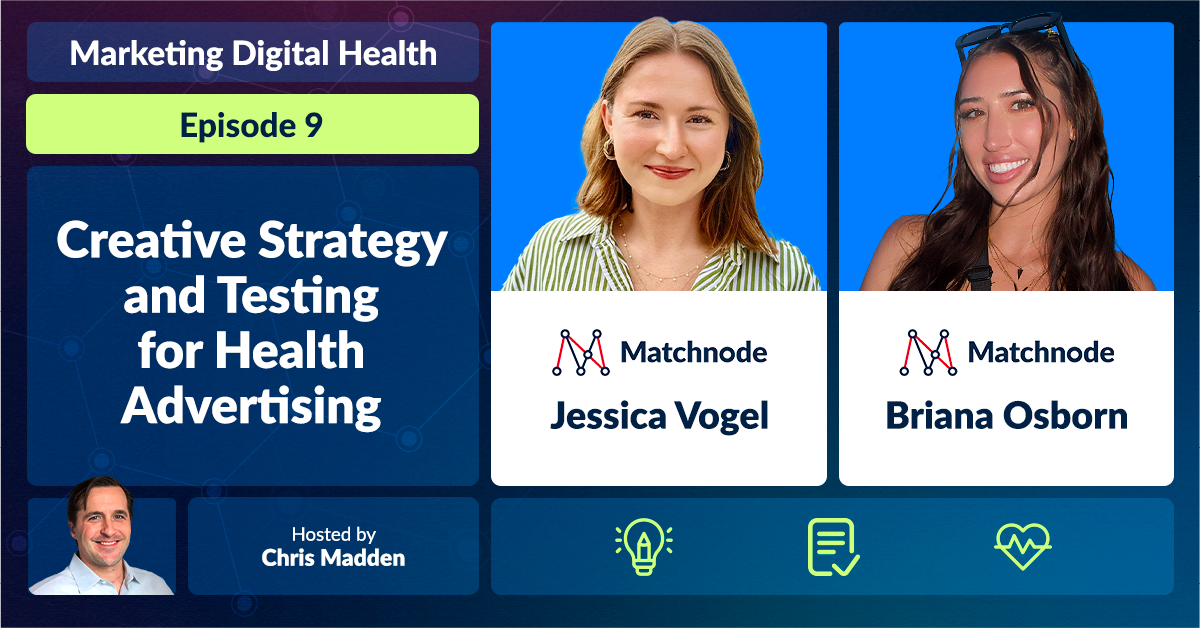
Master creative testing techniques to identify high-performing content that resonates with your audience and drives conversions.
This episode pairs a creative director who stress tests ideas at speed with a UGC strategist who translates clinical nuance into authentic, platform-native content.
The top metrics that I'm generally looking at are CTR link, click through. When it comes to videos, I'm looking at the hook rate…
Jessica Vogel
Matchnode's creative director with deep expertise in digital health marketing, helping brands craft campaigns that drive real impact. From testing messaging to balancing creative strategy with rapid iteration, she understands what it takes to make creative work in patient acquisition.
You don't wanna just start jumping into product features without really identifying who they're talking to or what angle matters most.
Briana Osborn
A UGC strategist and creative director who specializes in helping healthcare and wellness brands create high-performing, authentic content. With a background in nursing and over three years in full-time content creation, she brings a rare blend of clinical understanding and marketing insight. Through her work with brands like Credo Health, Briana coaches creators, shapes platform-specific content strategies, and leads campaigns that deliver real results in highly regulated categories.
Chris Madden:
How do you make your ads stand out among the endless feeds and doom scrolling? You need thumb stopping creative. This is Marketing Digital Health, and I’m your host, Chris Madden.
Today we’re digging into one of the most important skills in digital marketing, mastering creative strategy and testing. How do you figure out what content, messaging, and ads really connect with your audience?
How do you spot the winners, double down, and keep improving until you’ve got ads and messages that are driving real conversions at volume, at an efficiency that you can live with? That’s what this episode is all about. Jessica Vogel and Briana Osborn work every day helping Matchnode’s digital health clients stand out online.
They’re taking us through their strategies, ensuring we follow health privacy guidelines while reminding us to stay true to authenticity. Jessica Vogel is the Creative Director at Matchnode. We introduced Jess in episode seven when we provided an overview of the paid acquisition funnel in digital health.
Jess starts us off at the early stages of working with a new client.
Jessica Vogel:
So my role as a Creative Director, I always tell clients that my job is to understand, research, and drive creative strategy based off top performers and trends, and marrying that with our client’s brand. So it’s honoring their brand and applying our best top performing strategies along with best practices.
We have a weekly status call with our clients, talking through all of the data. My job is to understand how creative is performing, so I’m looking at captions, headlines, actual ad creative when it comes to video. Is the hook resonating? How long are people staying on a video?
So I take that all into account and watch what has been performing best. Also looking at what are lower performers that have too high of a CPA or aren’t spending. And I discuss with the accounts team and also the client what are the needs, what are some upcoming campaigns they want to work on, or things that they’d like to focus on.
After those client calls, I get into either research mode and creating briefs, or creating tasks for iterations. A lot of my day to day also comes from creative direction, so I’m working with a talented team of graphic designers, reviewing the ads, presenting the briefs to them with my ideas, my inspiration, and how to make these ads come to life.
They will then execute, and I am in rounds and rounds of feedback, making sure that this is aligning with our client’s brand, but also our idea for the new design.
Chris Madden:
Having a high performing creative team is now a must have in digital health marketing. Jess and her team are putting in the work to make sure that the client’s goals are met while pushing the brand forward with research and care.
Jessica Vogel:
Once we have our kickoff call and I have a better understanding of what the client needs and who they are, I jump right into brand assets. I need to know where I’m starting, because a big part of the creative brief is also understanding what the brand’s capabilities are. If we have no brand assets or no imagery, then I’m not starting at zero, but I’m definitely not starting at the best case.
So having a whole folder of their brand assets, and also video and imagery that either they have produced or content creators that they have permission to use, that’s also a great starting point for me to get into a brief and understand what their past creative looks like and how I can iterate on top of even just their past top performers.
I think the first round would be a mix of iterations off of their past top performers to see if we can enhance what they’ve been doing, and also going into a creative brief on just starting a completely new perspective and fresh start on how we can provide a diversity of ad creative and market to all of these potential patients and see what messaging resonates.
Chris Madden:
Briana Osborn is a UGC strategist and Creative Director who specializes in helping healthcare and wellness brands create high performing, authentic content. With a background in nursing before years in full time content creation and creator management, she brings a rare blend of clinical understanding and marketing insight.
Through her work with brands like Credo Health, Briana coaches creators, shapes platform specific content strategies, and leads campaigns that deliver real results in highly regulated categories.
Briana specializes in UGC ads. UGC stands for user generated content and refers to ads that are made to look more like organic content. They’re a hot approach to digital ads and the “it thing” for consumers. If you want your company to be relevant, it’s going to be part of your repertoire.
Where do you start?
Briana Osborn:
With especially health, wellness, digital health fields, anything like that, it really is about building the trust and authenticity in the UGC ads that we create. I feel like it is really important, and I try and tell all my creators this, but before you start actually filming, you really do want to strategize and you really do want to ask yourself two possible questions.
And this is what I always ask all my creators to answer. You want to ask yourself and this client, who am I actually talking to? I always ask my creators to really be specific in who they’re talking to. So it’s like, okay, I’m not just talking to busy moms, but I’m talking to busy moms who have low time, that are ages 30 to 40, and who want simple routines.
After that, you do want to always ask the question of what is the angle that makes them care. So you do want to always have that be a specific angle. Is it going to be emotional or is it going to be functional? So it could be convenience, it could be confidence, it could be time saved, money saved, stress reduction, or even credibility.
I feel like for moms, it’s really convenience, making sure that their hook is, “How I cut my morning routine as a busy mom from an hour to 20 minutes,” and it’s something as super specific as that that’s really going to make content convert. So I always try to make creators realize that it’s not just really obtuse observations, but really specific observations that are going to make content convert and make people really relate to that content.
Chris Madden:
There can be a lot to juggle. Briana simplifies the creative brief. She tells us her strategy of finding the right creators to fit the project. She uses Matchnode and digital health specific examples which translate to most of your needs.
Briana Osborn:
For the creative brief, I always brief on specific outlines that the brand is looking for.
I want the creators to really emphasize what they do best. So I do maybe provide some specific hooks or some specific really good intro lines that are actually performing really well on different platforms, but also just making sure that they know that they have full creative freedom to do that.
I have been specifically providing or sourcing creators from X and also through Meta opportunities. I have a really good platform on X where I just know a lot of really good, high quality creators. So if we’re sourcing for Matchnode, then I definitely want to make sure I do the posts about what specifically that brand is needing.
It’s going to be age range, it could be profession, if they needed to be a prior nurse or things like that. And then after that, we go ahead and I touch base with Jess and make sure everything aligns in that space and she’s happy with all of the creators I’ve sourced. After that, I reach out to them and it’s pretty straightforward, which I really like, especially with the creators who respond within the 24 hour timeframe or things like that.
Chris Madden:
With content creators, especially for UGC, pre planning is the most important part, even if it’s often rushed through or overlooked.
Briana Osborn:
People really do focus on the filming part of it, but you really do want to understand the brand, understand their specific struggles, what someone who would actually want to hop on the brand and actually hop on the service would be interested in and why.
And that’s what’s actually going to convert and create the converting content that you want and brands want, agencies want. And that’s the most important part. I feel like a lot of creators skip over that because they’re so excited about, “Oh, creating this content that I saw,” or “I have this one problem and I think this is going to be great for this brand.”
But you really do want to do the research.
Chris Madden:
In all the excitement, Briana feels UGC creators also focus too much on all the features and unique selling points of each product, and often miss the focus on their audience. Who are they talking to specifically and what are that person’s needs?
Briana Osborn:
You don’t want to just start jumping into product features without really identifying who they’re talking to or what angle matters most.
So you really do want to have that framework of, it’s the audience plus the angle. Let’s say I had a script for a 25 year old starting Pilates. It’s going to look a lot different from a mom who is juggling three kids and has a lot of work stress, even if it is the same products.
So the creators really do focus on having that relevance, having that relatability, having that in person connection, like, “Oh, this is where I found this problem, and this is the turning point,” and the creators who really do focus on their relevance rather than the cleverness really do make a converting piece of content.
Chris Madden:
Ultimately, authenticity matters the most. It is necessary but not sufficient with health marketing. You should also have a very high bar for sensitivity in clinical efficacy data when making health claims. It is important not to make general or unsubstantiated claims.
Briana Osborn:
A lot of people, especially new UGC creators, really do like to focus on creating something aesthetic and cute, but that’s not anything that sells today.
People are getting so smart in how they actually spot ads and things like that. So no matter what platform you’re on, it could be TikTok, could be Meta, it could be any other platform, Pinterest, whatever it is. It is all on the authenticity versus just creating something aesthetic that’s aesthetically pleasing.
And so that’s something I feel like is really important in teaching these creators, especially new creators in the health and wellness field. That it’s really about bridging that connection between what it does and actually relating it to real life problems that you actually have.
You always want to make personalized statements. You never want to make full medical claims. It’s always something along the lines of, “This helped me manage my stress during long work days.” Or you can add your experience in it, you’ve worked with patients and this is how you keep their roles within your line of expertise, or really just making sure that you balance compliance with the authenticity and the health content.
So not ever full general claims. You really do want to make it authentic to you. I feel like the relatability really does come from having a smaller audience and again being really niche specific in what you’re asking your creator, or even just when you’re creating a video as a UGC creator, what you’re asking your audience.
And just really gaining that smaller audience and that smaller and higher trust, and really treating the pain points and the raw problems as something that is the main point of the video. I do feel like focusing on solving real problems and not necessarily selling, really focusing on solving what could be the issue, the brand results really do follow after that.
Chris Madden:
For conversion, actually driving the business results, you want to have a great hook. Briana shares what she calls her hook trifecta.
Briana Osborn:
This is for any platform, any platform at all. It could be TikTok, it could be Meta, Facebook, especially with how short attention spans are nowadays. So it is really all about grabbing the audience in the first three seconds.
So I like to teach my creators what I call the hook trifecta. So that is, one, a visual hook, what’s happening on screen, really what makes someone stop scrolling. So think of a pattern interrupt, things like that. This could be something as easy as an unexpected shot, a transformation, a fast movement, something that’s really just moving and grabbing that visual attention.
The verbal hook is going to be something completely different. So that can be something said out loud, like your actual verbal hook. It could be something that you actually put into your editing, like a sparkle sound while your onscreen text is coming on screen, so it’s something that actually grabs that kind of verbal attention, or it could be something that you’re actually saying.
And then of course, you do want to have that onscreen text. And this is going to be different from what you’re actually saying. You do not want it to be the same, but it does really reinforce the message that you are visually showing people. And that could be without sound, but it is also grabbing that attention with the onscreen hook that tells what the viewers are going to watch and see before the verbal hook actually tells them.
Chris Madden:
And sometimes, of course, viewers just read the captions or text, but they don’t have the volume on. I was curious why it matters that all three are different, with that being the case.
Briana Osborn:
Those three things should be different specifically because it keeps the viewer on the screen for longer, especially on Reels or whatever is playing, because they’re taking in so much information at one time.
They’re taking in a different onscreen text, which they’re reading. They’re actually intaking something else with a verbal onscreen hook, and then the visual hook is going to be something that’s moving. People read faster than they actually hear. You can have a super out of the box onscreen text while you’re saying something else, and it just really does keep them more engaged for a longer period of time.
If you wanted to put that ad onto a lot of different platforms, the hook trifecta really does make it easier for you to be able to monetize that way, and the fact that you’re not just relying on a visual hook, you’re not just relying on a verbal hook, but you’re also relying on an onscreen text hook.
Like with TikTok, I know that it does mute a lot of videos before you actually click to unmute it, so that onscreen text hook will be a really good variable to help people stay on your screen for longer, especially for Instagram, and they’ll be able to actually be on your video for longer, and you’ll be able to see what is making them stay or what’s making them go.
Chris Madden:
One of Jessica’s important strategies is never settling, even if you’ve isolated what works. It’s about always pushing the envelope. Keep creating, keep diversifying. You’ll hear her refer to a campaign for a weight loss drug.
Jessica Vogel:
When they’re scaled so much that we know their messaging, that’s when we really, really need to work on creative diversity.
So when we’re creating that much, my strategy is, what can we try? What else haven’t we tried? And really looking at what’s out in the industry. And because it’s also a really crowded industry, specifically when we’re talking about weight loss for women, semaglutide, GLP-1s are everywhere, and so trying to create creative that stands out when everybody is price checking how much they can get GLP-1s for, how much they can get semaglutide for, creating a really diverse, wide array of creative is our sole focus.
So in my strategy, I’m really changing all briefs to different layouts, different looks, and really trying messaging, changing the colors. For the longest time, blue ads worked well for us, and then all of a sudden, all of the yellow ads are happening and being top performers. So it’s a lot of iterations, and when we come to create a brief, I’m really trying to throw a lot of different ideas out there, because we have the bandwidth to put them out there.
Chris Madden:
Sometimes things fall short. Even your best ideas may not land. With today’s technology, Briana is able to analyze the data so she knows what to adjust.
Briana Osborn:
It’s platform specific. So I’m going to go to TikTok, where they can actually tell what specific second viewers are scrolling on, and you can actually see where they were losing interest.
It does help you see, okay, was it the onscreen text, was it the verbal hook, was it the visual hook, was it the video idea in general? Where were people actually scrolling that they weren’t interested anymore? And I feel like that will be a huge indication on where you actually need to iterate and where things could be different a little bit, especially with health platforms.
Because I do feel like health platforms specifically, you are really leaning into that authenticity. You really do need to build that trust, and you’re hitting on the real pain points that they’re actually experiencing, and it’s not just something that you think the company or the product is going to sell, but something that the actual consumer is dealing with as an issue and something that they can connect with on that basis.
Chris Madden:
Jess shares an example of how she also analyzes the hook rate and applies those results to the next project.
Jessica Vogel:
The top metrics that I’m generally looking at are CTR link click-through. When it comes to videos, I’m looking at the hook rate, so it’s when someone has watched the video in the first three seconds.
And even better if they keep watching the video, that means that the video has hooked them in. So especially for videos, I’ll rewatch the video and understand what hook is capturing people and see if we can apply that to future videos, either that iteration or if that’s something that we need to go into a research and apply a similar type hook.
One hook that has worked really well for us for our perimenopause ads is, “I was 41 and I didn’t know I was in perimenopause.” It hooks people because a lot of people don’t know about perimenopause and how early it can start, and so that’s what’s hooking people in.
And also looking at copy when it comes to looking at headlines and captions. When I’m looking in those platforms, I’m looking at, okay, is there some type of template of why these specific short headlines are working? And I’ve actually, from these platforms, seen my copy become almost like a templated format that I can keep reapplying.
Chris Madden:
Testing various captions and headlines is also part of the process.
Jessica Vogel:
I’m always testing five captions and five headlines. That’s a good starting place where I’m always using different formats of captions and headlines. Headlines being a max of 40 characters so you can get a really tight message in there. Captions can be a little bit longer.
So I have a few go to formats, one being testimonials. People want to hear from other people and they want to know that this is a good experience and it’s not just feeling salesy like a car salesman. And so it’s really validating to hear other people’s experiences when they’re going through a health journey.
The second one does seem a little bit more salesy, and that’s like a bullet point list of value propositions from the company. What can they offer? Is it covered by insurance? Is it completely virtual? How fast can I get a prescription? And I love emojis, so of course those bullet points are prefaced with a different emoji for each. Or you can use the point emoji, check mark emojis, there’s so many out there.
And then the last one is an informational type of caption. So I have an example here that we use that works really well for perimenopause type ads. “Did you know perimenopause often starts for women in their mid forties, but can begin in some women in their thirties?”
It’s a really shocking stat, and myself in my thirties, that freaks me out a little bit. So that can place a little bit of fear, but it also can get women thinking about, okay, how can I get ahead of this? How can I figure out that I don’t gain extra weight in perimenopause or menopause? Or how can I get ahead of osteoporosis strength training for that one?
So those testimonials, bullet points of value propositions, and then informational captions are my go to. What I do from those is, if I see ones that are top performing in captions, I may add those into ad creative, or top performing headlines. And because of seeing what performs in headlines and captions, that’s where I find my winning copy templates, and then I apply them to ad creative.
So I have kind of a little bit of a case study here for a winning copy template that I’ve used for our client Midi Health. It’s a very short sentence. It’s direct and to the point that I’ve added in ad creative, and it continues to win.
Chris Madden:
There are so many AI tools out there now. The possibilities can seem endless. Ultimately AI is here to support the workflow, not yet to take it over.
While she says she doesn’t rely on it solely, Jess knows how to use AI in a smart way and understands what it can do, what it can’t do, and then builds off of what’s working. How she’s using it to optimize video testimonials makes her life easier.
Jessica Vogel:
I use AI from the copywriting standpoint to brainstorming creative briefs to the actual execution of design. So it’s integrated everywhere, which I could not say two years ago.
When it comes to copywriting, I use a mix of ChatGPT, Meta AI, and Perplexity. They all kind of have a little bit different outputs. I will ask it, “Write captions for me based off of these top performers.” So I’ll supply top performing captions or lines. I’ll also say, “Provide different formats of the caption and also use Meta Ads best practices.”
That usually gets me, I’d say, 80 percent of the way there. Sometimes I will use the same prompt in all of these different platforms and see what they spit out. I’ve been working in AI enough now that I can see when it feels a little bit cheesy, a little bit overdone. You kind of just get the vibe it’s AI, so I always will tweak or add a little bit more of my human element when it comes so it feels more personal and relevant.
That is also really great for, like I’ve mentioned, writing scripts for videos. Video testimonials that we’ve gotten from a client, so we’ll get these video testimonials. They generally are really long, and we need to have quick clips for Facebook Reels or even TikTok videos.
So I will copy and paste the transcript into GPT, Meta AI, or Perplexity and ask, “Can you pull out the most valuable quotes that would convert another patient from this testimonial?”
It will then pull out, “Okay, here are the best quotes,” and then I’ll ask, “Okay, can you reorder those clips in a way that would be an engaging video?” So then from hook to problem to solution to an example from the experience to an ending CTA. And then I have multiple blueprints of how I should edit this video and hand it off to our designers to create.
Chris Madden:
Among the various AI tools, Jessica says that Perplexity is especially effective for brainstorming. For example, you’ll hear her refer to a client she works with called Midi, which is a healthcare platform for women going through perimenopause or menopause.
Jessica Vogel:
When it comes to brainstorming, I’ve found that Perplexity is really strong. So I will, especially with new clients, ask it questions more about the industry we’re in or perimenopause or menopause, and ask, “If someone’s going through perimenopause, what are the top symptoms and what are the solutions that Midi could provide?”
And it will supply those answers, but also provide sources and pull from blog quotes that are in Midi or videos that they’ve talked about, and that also provides me more assets that I can pull from, especially if they’re created by our client.
Then lastly, when it comes to design execution, Photoshop and Adobe products have just been killing it in the game when it comes to constantly iterating on how they can make it better. There’s always a new beta version.
One of my favorite AI tools is Photoshop’s generative AI, so it’ll expand an image, make it look seamless or bigger so you have room to add text or reformat the image so that the feature is center stage in an asset.
We also like using Captions.ai, and the recent tool that I’ve been playing with is AI clones. So you can upload your own video and provide a script, and I could upload a video myself and it will create a video of my clone speaking the script. It’s not completely perfect, but it is wild and quick and fast. So creating videos that seem a little bit more authentic from the person you want to be speaking is pretty cool.
Chris Madden:
While you’re building your hooks and creating, it’s really important to monitor the guidelines for the brands.
Briana Osborn:
I feel like the quality in the brief is important when you’re sourcing any kind of creator, just making sure they’re aligned with what they need to do, as well as the brand is aligned with what they’re expecting with the creators and what kind of content they are expecting.
Especially with health and digital marketing agencies, you never want to make huge medical claims. You really do want to lean on the personal experience and lifestyle impact that the brand or product brings.
You don’t want to make, and this is really specific also for TikTok Shop and TikTok things, but also Meta as well, you just never want to put out the fact that, “Oh, this will cure anxiety.” But you do want to really personalize it and be like, “This will help me manage my stress during long work days.”
So it’s more personalized to you, and that’s where someone else can actually connect with it, and that’s where someone else can put themselves in your shoes and really say, “Oh, okay, Midi Health. I do experience hot flashes, I do experience brain fog, and that’s where I do really want to connect with this brand because they really do help with those aspects.”
So it’s all about creating that authentic personal connection, especially with marketing nowadays. That’s going to be the key.
Chris Madden:
I was interested in how the platforms differ. Will something that performs well on TikTok also succeed on Meta, or do different types of UGC content do better on specific platforms?
Briana gave me her insights on how she would adapt different health content across platforms.
Briana Osborn:
TikTok, it’s very much more raw, authentic, curiosity driven content. And especially for TikTok, they are pushing out watch time more than anything else, so it’s going to be hooks in the first three seconds and making sure people are actually watching that, relatable scenarios, things like that.
For Meta and Instagram, it’s definitely a little bit more polished. It’s going to be longer storytelling, also really good for retargeting a lot of ad campaigns and iterating on things like that.
And I really do stress this for any platform, all ad angles, authenticity is greater than anything right now. This is what we like to call the “ugly angle” in UGC. So it’s really about pattern interrupts, it’s really about breaking up what the viewer would actually see, and the authenticity is really going to win.
The biggest example I can produce for an ugly angle would be, you have a bag and you are just showing the insides of the bag and showing how you would actually use it in a real day scenario or things like that. It’s not aesthetic. It’s not like, “Oh, a cute bag with a really fancy backdrop,” it’s, you’re looking for something in the bag, you’re out and about and you’re going through your day, and you pull it out of your bag.
And it’s those ugly angles, those real life angles, that do produce the best results today.
Chris Madden:
Here’s the big takeaway. Creative testing isn’t optional. It’s the engine that powers your best ads and best results.
The faster you run smart tests, the more you learn and the closer you get to the messages that truly resonate and convert. And don’t forget authenticity. The ads that win are the ones that feel real, honest, and aligned with your brand.
Let the data guide you. Start small, scale what works, and keep experimenting. Creative wins attention, but you need the right systems underneath to make it count.
Our next episode, episode ten, digs into data and technical setup, events, attribution, and signal resilience with tools like CAPI and GA4, so you can grow with clarity and confidence.