

Digital health SEO tactics work when they serve real intent. This episode makes it practical. Start by understanding why a person is searching or what prompt led them to your site, then map that intent to a funnel stage and choose the right format, short explainer, decision aid, checklist, or video. Ahava Leibtag explains the technical side of web writing, short sentences, bullets, chunking, clear headings, and the inverted pyramid. These reduce friction and make clinical topics feel approachable. Ben Riggs connects the dots to trust, when cognitive and emotional load drop, functional literacy rises, and people can act with confidence. Noah Goldfarb ties intent to execution. Do not just target keywords, understand the job to be done, and let it guide information architecture, internal links, and calls to action. Back it up with the basics that many teams skip, schema for medical content where appropriate, reviewer bylines, citations, and last reviewed dates. Use AI to speed research and outlines, then keep a human editor in the loop to massage tone, accuracy, and structure. Finally, measure beyond traffic. Look at qualified sessions, engaged reads, assisted conversions, and downstream patient acquisition. The result is a content system that helps people, satisfies compliance, and supports growth.
Get actionable tactics for producing high-impact content that directly supports acquisition, conversion, and retention.
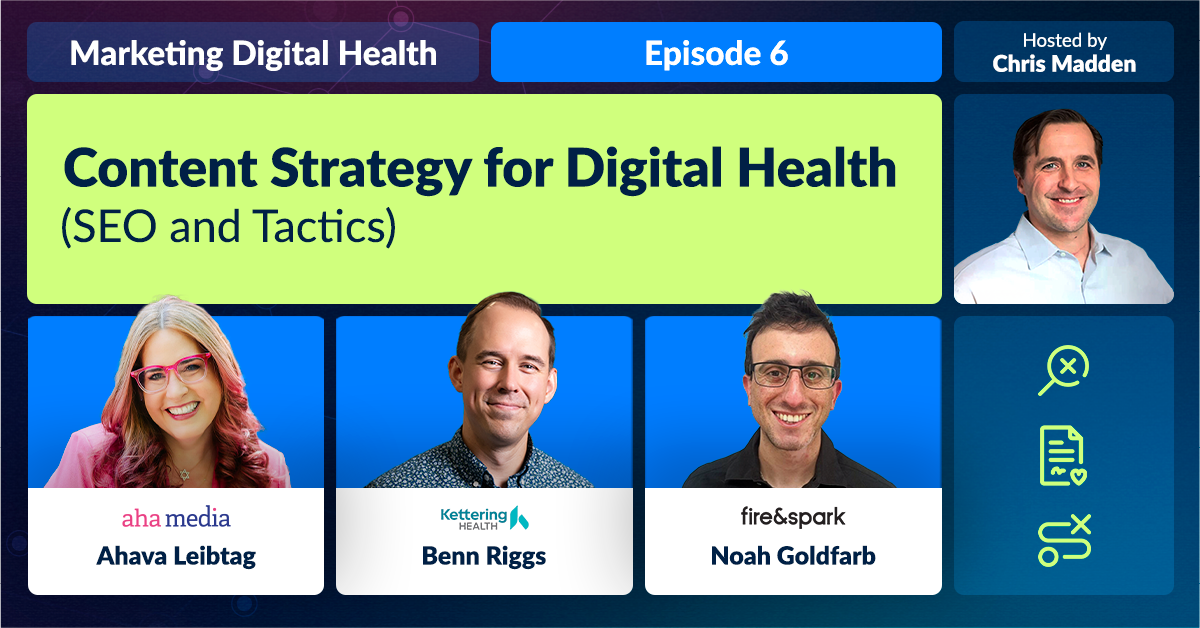
This panel blends a plain language pioneer, a hospital system content lead, and a digital health SEO strategist. Together they turn intent and readability into a playbook for growth.
The technical aspect of web writing, which is using shorter sentences, bullets, chunking links, using the inverted pyramid when writing… AI is now spitting out content that does not have those. … you still need a human writer to get in there and massage the information.
Ahava Leibtag
The founder and CEO of Aha Media Group, a 60-person content strategy agency focused on healthcare communication. A pioneer in plain language and patient-centered messaging, Ahava helps organizations simplify complex topics into powerful stories that engage and convert. She’s also leading the agency’s repositioning toward full-funnel digital marketing strategy in response to AI and evolving healthcare needs.
Studies show that cognitive emotional loads will actually decrease functional literacy… plain languages and trust are really connected at the hip, especially within healthcare marketing.
Ben Riggs
A writer and is the content manager at Kettering Health, where he leads content development for a large, multi-hospital healthcare system. With deep experience in health storytelling, team leadership, and editorial strategy, Ben brings a thoughtful lens to how hospitals can build trust, clarity, and patient connection through content—while navigating complexity, AI disruption, and cross-departmental coordination.
The way to understand what kind of content you need to put in front of a specific site user at a specific time really starts with understanding the intent behind their search or now the intent behind the prompt that led them to your website. And the prompt in a tool like chatGPT, what kind of conversation were they having with that pointed them towards your website. So it is key to understand not just what they're searching, but the why behind they're searching that. And then to be able to map that on to a particular stage in, in a funnel.
Noah Goldfarb
The Director of SEO Strategy at Fire&Spark, a digital health SEO agency, where he helps growth leaders scale organic patient acquisition in highly competitive, high-compliance environments. With a specialty in content strategy and generative AI search, Noah brings a sharp, tested perspective to what actually drives growth in search today—and where teams often go wrong.
Chris Madden:
Welcome back. In our previous episode, we explored content creation as part of your strategy for digital health marketing. In this episode, we’re looking at SEO and the organic tactics involved in a holistic strategy. This is Marketing Digital Health, and I’m your host, Chris Madden. Returning voices, Ahava Leibtag and Ben Riggs share more specific insight related to SEO. They’ll also highlight the emotional aspects of illness and how we search for answers online.
Let’s get things started with Noah Goldfarb. Noah Goldfarb is the director of SEO Strategy at Fire&Spark, a digital health SEO agency where he helps growth leaders scale organic patient acquisition in highly competitive, high compliance environments with a specialty in content strategy and generative AI search.
Noah brings a sharp, tested perspective to what actually drives growth in search today and where teams often go wrong. This episode is really all about what he does, so I knew he’d be the right person for the conversation.
What distinguishes Fire&Spark from other SEO agencies is how it focuses on conversion generative AI, and high stakes technical work for digital health. Many other SEOs are trained at the top of the marketing funnel around initial awareness, which is actually only the beginning of the journey according to Noah. It’s the concrete results at the bottom of the funnel that count.
Noah Goldfarb:
At the very baseline, what every company, what every marketer should expect out of their SEO team, whether it’s in house or at an agency, is reporting on actual business growth. Whether that’s leads, signing up through a form, whether that’s phone calls, however you can measure conversions, especially in a HIPAA compliant environment.
That’s what you should be holding your SEO accountable to. SEO is a long term game. It’s gonna take a while. It’s a cliche, and it takes six to 12 months in a lot of cases before you see a notable traction. But where I think a lot of marketers make a mistake is hearing from their SEO, from the marketing community writ large, that what SEO does is it drives traffic and it improves your rankings.
Sure, those are leading indicators, but what we really need to hold ourselves accountable to is acquiring patients, customers, or leads, whatever it might be for your business.
Chris Madden:
From the very start, accountability and tracking are key. Noah highlights how success is actually measured, which numbers are important and why SEO truly matters.
Noah Goldfarb:
You’re reporting success not against the number of keywords you’re ranking for, but the number of people that you’re converting in are becoming paying customers in one way or another.
Beyond that, technical SEO does matter. Your site needs to be findable, crawlable, understandable by Google, and now large language models as well.
The fact of the matter is that most companies’ websites in 2025, whether they’re built on a standard platform or even custom coded, they usually have their ducks in a row. For the most part, if you have a very complex site, a very large site, a very old site, then there might be some more technical hurdles that you need to remain aware of and address.
But for the most part, Google’s gonna be able to understand what you have on your website, what the solution then becomes from a patient acquisition perspective or a customer acquisition perspective is you need to be able to not only bring someone onto your site, but provide them with the experience that they’re looking for.
Chris Madden:
Noah says that he uses what he calls confidence building content.
Noah Goldfarb:
What that really means is from the moment they land on your website, you understand how they got there. If they landed there through SEO, you understand the search term that brought them there. Through organic search, you understand where in their conversion decision they might be.
You understand whether they’re searching for information for themselves or maybe a loved one. And then you’re understanding where they’re likely to want to go from there, what other questions are they likely to have? What questions might be the piece of content that they’re landing on, provoking them?
And then how can you provide those answers to them in an intuitive way, in a valuable way that nobody else on the web is doing, including now, AI models and ChatGPT and Google’s AI overviews and all those sorts of things.
So the short answer to your question is SEO that drives conversion focuses on tracking the right metrics, holding yourself accountable to those metrics, and providing a site visitor experience that doesn’t stop at bringing them onto your site, but gives them the information they need and the experience they need to feel confident in their conversion decision.
Chris Madden:
Noah introduced me to what I think is a very cool and very important distinction. Where someone is in the funnel and what their level of intent is are two different and sometimes unrelated dimensions. High versus low intent and higher low funnel are two different axes. It’s possible to be high intent at the top of the funnel and low intent at the bottom.
Noah says building different content for the various points in the funnel is key in their strategy.
Noah Goldfarb:
The way to understand what kind of content you need to put in front of a specific site user at a specific time really starts with understanding the intent behind their search for now, like the intent behind the prompt that led them to your website in the prompt, meaning in a tool like ChatGPT.
What kind of conversation were they having with that bot that pointed them towards your website? So it’s key to understand not just what they’re searching, but the why behind they’re searching that, and then to be able to map that on to a particular stage in a funnel.
One mistake we see a lot of SEOs making or a lot of marketers who have invested in SEO is that they produce SEO content. And what SEO content usually means to them is blog articles. Either the 750 to a thousand to maybe 1200 word blog article, maybe longer with a keyword in the header and two times in the body, and it’s the keyword optimized, and sometimes that’s going to get you in front of the right person. Usually those are going to be people at the top of the conversion funnel.
I think there’s a mistake that people make where they conflate being top of funnel with being low conversion intent, and I think those are actually kind of separate axes. Someone can be searching something informational at the very top of the funnel, and they might have a lot more questions they need to answer before they’re ready to convert. They still have conversion intent though, but there’s also other people that are searching at the top of the funnel on their informational terms that are just not valuable at all.
For an example of this, if you run a telehealth brand and you tend to prescribe a particular medicine, if someone is searching a term like, why does this medicine make my burps taste funny, that person is probably already on that medication and you might be able to convert them, convince them to maybe leave their existing provider and come with you, but that’s someone who’s probably already on this and receiving the treatment that you provide, unlikely to be someone who is starting out in their conversion journey.
Meanwhile, someone might have heard that this medication can cause funny tasting burps. And they might be concerned, maybe they’ve heard that maybe this is the right thing for them, but they’re not sure and they really don’t want those weird burps. So they’re searching about that. And that could be someone that’s actually at the top of the funnel searching an informational term, but is essentially in the market. They might convert eventually if you can provide them with the confidence that your solution is right for them, if it is right for them.
Chris Madden:
Once you have a better understanding of where they’re on the funnel, Noah says, the next step is to simply search for the topic you wanna rank for and see the results. Try this on Google, ChatGPT and other LLMs.
Noah Goldfarb:
The best way to do that is just plugging that search term or that prompt into Google or into an LLM and seeing what it shows.
Often what you’ll see is some big names, your competitors, if you’re in healthcare might be Cleveland Clinic. All sorts of different kinds of information that Google or LLMs are essentially telling you this is what we think people who are searching these terms want to see. This is what we think will satisfy their intent.
And then the challenge becomes, how do we create something that satisfies that intent even better than everything else that’s being shown here? And sometimes the competition’s gonna be too stiff. Sometimes there’s going to be an opening for you, especially if you have something unique to say, if you have expertise that others don’t. If you can provide a better experience on your site, those are your advantages in that case.
Chris Madden:
Noah says that once you have an understanding of the intent behind your searcher and you know where they are in the funnel, you can start to plan specific content to satisfy them. That’s where the brainstorming comes in.
What language belongs on that page? What format should it be? What
Noah Goldfarb:
visuals. Should this be a blog article? Sometimes it should be, but we recommend not just defaulting to that. Should this be a landing page that’s more of a marketing style landing page, less text, more visuals? Should this be just like a short FAQ?
‘Cause you can really give them the answer in a hundred words and that’s all anybody would want, because they don’t wanna read a dissertation to get a simple answer.
Once you get them onto this site, no matter what kind of content you’re using to do that, you then provide them with the opportunities to continue to explore and to get educated, to build their confidence directly on your site.
So from a blog post that might be links to related blog posts, it’s gonna be calls to action to more conversion oriented pages. If it’s a traditional marketing landing page where they’re searching a conversion oriented term that would suggest they’re near the bottom of the funnel, then great, you brought them onto your site ’cause they were looking for the treatment you provide, but they’re gonna wanna know how do you provide it?
Do you take their insurance? How much does it cost? How often do they need to meet with a provider? How long is it gonna take to work? Do you treat people in the area where they live? These are the kinds of questions that you can continue to provide answers to in a really straightforward way, and help them move to the very bottom of their funnel and ultimately convert.
Chris Madden:
It is interesting to think about the different types of content for different depths in the funnel and tailoring what you put out there to take people to the finish line. Doing that well takes more than a bit of strategic thinking and purposeful actions when it comes to content.
However, some digital health companies think that they know what they need to do or accomplish right from the start, but they may be on the wrong track.
Ahava Leibtag is the founder and CEO of Aha Media Group. We introduced Ahava in episode four around storytelling and trust. She likes to perform a diagnostic with clients to help them figure out what they really need. She asks them big picture questions to pinpoint that and to figure out how her content consultancy can help make that happen.
Ahava Leibtag:
Any really great content strategy engagement or digital strategy engagement is really kind of like therapy. Clients come to you and they say, this is our problem, and I know because I’ve done this for a really long time that’s not their problem.
They think that’s their problem because they’re doing it every day with an up against their face like that and it’s hard to see the forest for the trees.
And I just use my experience to try to uncover what’s really happening for them. So I’ll give you a recent example. Somebody came to us and they wanted a website rewritten, and I started to ask them about their overall channel strategy. You know, do you have an email newsletter? Like they have very specific business goals driving leads.
We do a ton of lead gen work, but we do it obviously a little bit differently than like a landing page. So we try to build something a little bit deeper and a little bit more holistic and including their audience’s true needs. I started asking him questions about what he was really trying to accomplish as a business, and we came to the conclusion that he doesn’t need the website rewritten. He really needs to understand his overall audience and what they’re looking for from the messaging and educating them about what it is that they do.
And through the questions he said to me, you know, I really just thought I needed writing, but I really see that I need a lot more than that. And so I think that when people first start with us, they can come to us and say, we need an ebook written.
And we can listen to them and we can say, okay, let’s figure that out and let’s write that ebook. Or we can be smarter and say, okay, well what’s the ebook designed to do? Where are the leads gonna go? Who’s keeping track of them? How are you nurturing them? What’s the ebook gonna do when it’s on LinkedIn?
Are you gonna throw ads behind it? And when you start to delve into what they’re really trying to accomplish, what you realize is that they don’t need an ebook. They need to do some discovery work first to understand what they’re trying to truly accomplish, because very often the stated business goal doesn’t match the content activity that they think it should be.
So that’s where I really do try to ask a lot of questions. One of our values at Aha Media Group is stay curious longer, ’cause it’s so easy for me to just listen and be like, oh, I know the answer to that question, but I don’t know the answer to that question. I literally just met this person 10 minutes ago.
So I really do try to see these conversations as, you know, let me get to know you, you can get to know us a little bit, and if we don’t go out on the second date, no problem. But at least I added value by listening to their problem and telling them, I think our expertise can match to this. Or maybe it can.
Chris Madden:
Starting with questions and really listening does open the door to a strategy that succeeds for clients in the health marketing space.
Ahava is also quick to emphasize the importance of writing for the web when it comes to digital health marketing. Health information online, she contends, can be complicated and full of jargon. She suggests using plain language as much as possible.
Ahava Leibtag:
Very few organizations start in the right place. Well just gimme the basics here. Just start from, what are we trying to say? And then you can build the appropriate content formats based on the audience, and then appropriate distribution channels based on the audience.
So there’s the technical aspect of web writing, which is using shorter sentences, bullets, chunking links, using the inverted pyramid when writing. And that’s really important as we move into AI as well, to continue to use those technical best practices because AI is now spitting out content that does not have those, and so it’s taken too long for people to read and they’re not interested in what they’re reading, so you kind of need a human writer to get in and massage the information.
Chris Madden:
Again, use the simplest words possible to provide the maximum amount of clarity.
Ahava Leibtag:
People hear that and they think it’s dumbing it down, but that’s not what it is at all. It’s just helping people find the information that they’re looking for, understand the information that they’re looking for, and then use it to make the next best decision.
When we think about people finding what they’re looking for, that’s search and using search terms that they use about their own conditions in their own health, and then it’s about helping them understand it. So taking out jargon doesn’t help them.
Now jargon isn’t using the technical terms of the diseases and conditions that they may have. If you have supraventricular tachycardia, you need to know what it’s called ’cause that makes you a more educated patient. But taking out jargon that sort of many writing communities use to sound more educated, that’s not what patients need at that moment. They need to understand what they need to do next.
And so I think, you know, those two things, the plain language plus the technical web writing is really where you can find that synthesis between making sure that the robots and the spiders can find your content, and also making sure that humans can understand it and use it.
Chris Madden:
Speaking of robots, keywords are a fundamental way for companies to improve their SEO and bring consumers to their site. As technology is advancing, consumers aren’t just using Google anymore. ChatGPT, TikTok and YouTube are some of the top places people search for health information now, and that means more to think about in terms of catering to the consumers on those platforms.
Noah Goldfarb takes us behind the scenes of a comprehensive keyword research process.
Noah Goldfarb:
It’s looking at the keywords that you’re already ranking for. You can get that from SEO tools. We can get that from the search console.
It’s looking at the keyword that your competitors are ranking for, that you may be ranking for as well or may not be ranking for, but more and more, it really is going to come down to the understanding that you have of your target audience, and the reason for that is people are just searching in more ways than they ever have before.
That includes LLMs and tools like ChatGPT. People are also searching on YouTube. They’re searching even on TikTok and all these other sorts of platforms, and they’re still searching in Google, but they might be doing it in different ways, or when they’re searching the same thing, they’re looking for a different result.
What that would look like is someone who’s searching informational terms, and a year ago they might’ve expected to click through on a website, but now they’re just gonna read the overview that’s there.
So yes, to start out the project, we do a very thorough analysis of the keyword space. That usually ends up with, depending on the space, 20 to 50,000 keywords that we’re looking at in total. Then it’s assessing those keywords, starting to categorize them and identifying the opportunities for you.
Sometimes you’re already ranking well for high value keywords, and there’s something we can do to improve those further. That’s likely going to be overhauling or improving the existing content on the site to match search intent even better, most likely.
There’s also going to be tons of opportunities for new keyword targeting. By far, the most common problem that we see is people defaulting to the blog, which means you’re generally going to have a very high ratio of informational, top of funnel traffic to bottom of funnel traffic that’s ready to convert, which is fine.
The reason people tend to do that is the competition is lower. It’s generally easier to rank for the many more informational related terms, each with generally more search volume than those lower conversion terms. So what we often find is companies where they’ve invested significantly in bringing people in at the top of the funnel and have really neglected the middle and the bottom of the funnel.
What that will look like is a telehealth company that’s not going after any local terms, for example. They’re not even trying to rank for a keyword like “blank treatment type in Boston” and doing that across all of the different areas that they service.
Same thing for insurances, “blank treatment type covered by Aetna,” “covered by Medicaid,” whatever it might be. Those are higher conversion terms. Yes, they tend to be competitive, but if you can get in front of those people, you are the perfect match to provide the solution that they’re looking for.
So it comes down to assessing the total keyword space, seeing what your unique opportunity is, getting a bit longer tail, getting a bit more conversion focused, and really just deciding to not necessarily default to quote unquote easier informational content when there’s more opportunity lower down in the funnel.
Chris Madden:
Organic search and optimized keywords are one thing. Social media queries are another.
Ahava Leibtag observes that social media undergoes almost constant change. For example, in 2018, Meta’s ad engine started to switch to being AI driven.
In terms of SEO, Ahava addresses organic versus paid acquisition and discusses some pros and cons companies consider when balancing each. She also identifies a great channel that we will dive deeper into in future episodes, which is email.
Ahava Leibtag:
When Twitter became X. And so many people left and now they’re back. And is it still a research place or not? Like where can you reach healthcare executives and are they on LinkedIn?
Are the doctors really on Doximity? It’s so complicated, and I think that if you’re gonna do paid, you have to have a very honest expectation set around what you’re really gonna get, how qualified those leads are gonna be.
I think if you’re starting an organic content program, putting paid behind it really makes a ton of sense ’cause it’s gonna help you rise and you’re gonna get some quick, early wins.
I would prefer to see things happen organically, but I also recognize that we live in a world where they know that they can get money out of you. So why would they show your content to your intended audience?
And so for me, from my perspective, it’s really weighing the business considerations and what they’re trying to accomplish. If you want my personal feeling, your most important channel right now is email in 2025. And if you’re not working on your content and your tech and your distribution around email, you’re missing the most important channel you have, unless maybe you’re a retail institution and Instagram’s where you get a lot of your sales.
But certainly for healthcare marketers, both B2B and B2C, you should really be using your email. That’s work email.
An email newsletter needs to be designed. Now, I do think that you should follow accessibility guidelines, so you should have both versions available to people because they prefer plain text or HTML, then give it to them. If you wanna stand out, you need to look sharp.
Chris Madden:
Similar to what Ahava said about paid versus unpaid, Noah Goldfarb mentions possible constraints that emerge and says that there are times when his content team gains perspectives by working with other marketers.
Noah Goldfarb:
When we are working on our best projects and really firing on all cylinders, we’re collaborating very closely with the paid marketing team. We wanna understand the search terms that are working for them, the collateral, the creative that’s working for them, and if they are regulated, restricted in the information that they can have.
If they don’t have a strong reporting regimen or understanding of their data or there’s limitations to what data they have access to, that makes it a bit tougher to do our job.
Chris Madden:
That holistic view that Noah mentions is key and can be unlocked with organization and communication. Some of these are common sense and fundamental basic business practices.
At the same time, each classic marketing tactic needs to be checked for safety and compliance in digital health. For example, in the case of local SEO, soliciting reviews from customers is an area to be careful of legally.
Noah Goldfarb:
So if you have any sort of local presence, if you have Google Business Profile listings and you’re trying to generate positive reviews, because that is one of the most effective ways to improve your rankings in those listings, you gotta be a bit more careful than you normally would be in soliciting those reviews due to patient privacy concerns.
If you’re not in a regulated space, you can just reach out to people and say, hey, please leave us a nice review. Within healthcare, you need to be a bit more specific in your wording. You can’t reach out to people individually. But it still remains equally, if not more important, that you do have a positive set of reviews on your public listings.
Chris Madden:
That’s Noah sharing just one example of a local SEO tactic that requires extra caution in digital health.
At our best, that extra level of caution and care is everywhere.
Ben Riggs is a writer and content manager at Kettering Health. We introduced Ben in episode four around storytelling and trust. He mentions one of the most important differences between health marketing and regular retail, for example, which is that the emotional component may be extreme, and that can deeply affect how your content is consumed and understood.
Ben Riggs:
When you add the emotional pressure of a cancer diagnosis or someone who’s just gotten a WebMD and found out their headache might be a brain tumor, but they’re also trying to look for something else out there that feels more credible, maybe people aren’t in this kind of emotional vacuum when they’re reading something from us.
We have to take that into account because the studies show that sort of cognitive emotional loads will actually decrease functional literacy. And so if you’re not prepared for that, or if you’ve interviewed a subject matter expert on, or something about for some condition or service page, and it’s incredibly accurate, but perhaps it’s in clinician speak, that already without having anyone visit has boxed a lot of people out for probably being able to access it in terms of what it means.
But then you add folks who are going through something heavy, hard, and it’s just asking a lot of readers, and it’s asking a lot more of them than should ever be asked for.
And so I think plain language and trust are really connected at the hip, especially within healthcare marketing.
Chris Madden:
Taking all that into consideration, Noah Goldfarb says it’s all about patient acquisition, which determines every choice companies make when they’re trying to grow their business. Once again, getting a holistic view as you toggle between macro and micro is crucial.
Noah Goldfarb:
When we work with a digital health company, what our strategy really revolves around is getting to measurable, impactful business growth, which we’re tracking at the conversion level on the website. And it sounds almost obvious, but when we are building a strategy, it is important that we use that as an anchor.
We’re using patient acquisition, however closely we can track that, as the guiding light for everything that we do. We kind of work backwards from there with our strategy.
Often what that means is we’re coming into a client project where they’ve invested in SEO before and the investment they’ve made is very top of funnel. It’s a lot of blog articles, maybe it’s technical SEO, maybe it’s link building.
And what they’ve likely ended up with is anywhere from a not so functional to a somewhat functional traffic acquisition engine. And in that case, our job really becomes to turn that into a patient acquisition engine. That means taking the existing traffic, taking the existing rankings and assets and content, all that work you’ve already put in and putting it to its best use.
Improving the content further, making sure it matches the intent that people have when they’re searching to land on that page. And then really taking things the rest of the way. So that’s thinking about site structure. How does our main navigation look? What are the bells and whistles we can put within a piece of content, including just straight up conversion calls to action, but also internal linking, valuable assets, whether it’s a checklist or a quiz or graphics.
Anything we can do to not just meet someone at whatever stage they are in the funnel but really to help guide that person. Again, I think of it as building their confidence. So with each and every piece of content that you have, each keyword that you’re already ranking for, how can we get them from there to a state of greater confidence in what you do as their solution if, again, you are actually their solution.
And if you’re not, that is fine and you can politely send them on their way so they can find what they do need.
In short, what we do for our clients is a very deep dive into the intent behind their audience searches. It starts with understanding their audience as well as possible, speaking to their subject matter experts, understanding the questions that their sales team or their enrollment team gets once they get somebody on the phone.
Making sure we’re answering those as thoroughly as possible on the website. Just providing the best experience that we can on the website so that when somebody lands it is an easy process and a helpful process for them to get to an actual conversion decision.
All of this is becoming complicated and also more important as generative AI comes into the fray. As tools like ChatGPT can now do the kinds of things that you used to have to go to a website for, including finding answers to questions that you have, it becomes increasingly important to think of the unique value that you and you alone, if possible, can provide to the searcher, can provide to the visitor.
Why would they stay on your site? What can you do to provide an excellent experience for them that is informative and valuable and builds their confidence all on your website to keep them there and hopefully guide them through to a conversion decision?
Chris Madden:
So effective SEO and organic health marketing tactics aren’t just about visibility or top of funnel clicks. They’re about adding trust, addressing emotional needs, and guiding individuals toward confident, informed health decisions based on the integrity of the content you provide them.
If we can gain an understanding of each patient’s journey, we can turn top of funnel traffic into genuine patient acquisition as long as we make sure that every touchpoint is valuable to those people and builds their confidence in your product or service. That sounds like a winning formula to me.
Once the content is in motion, it’s time to fuel it with ad budget. Our next episode, episode seven, opens the door to the paid acquisition funnel, how digital health brands turn investment into measurable growth.