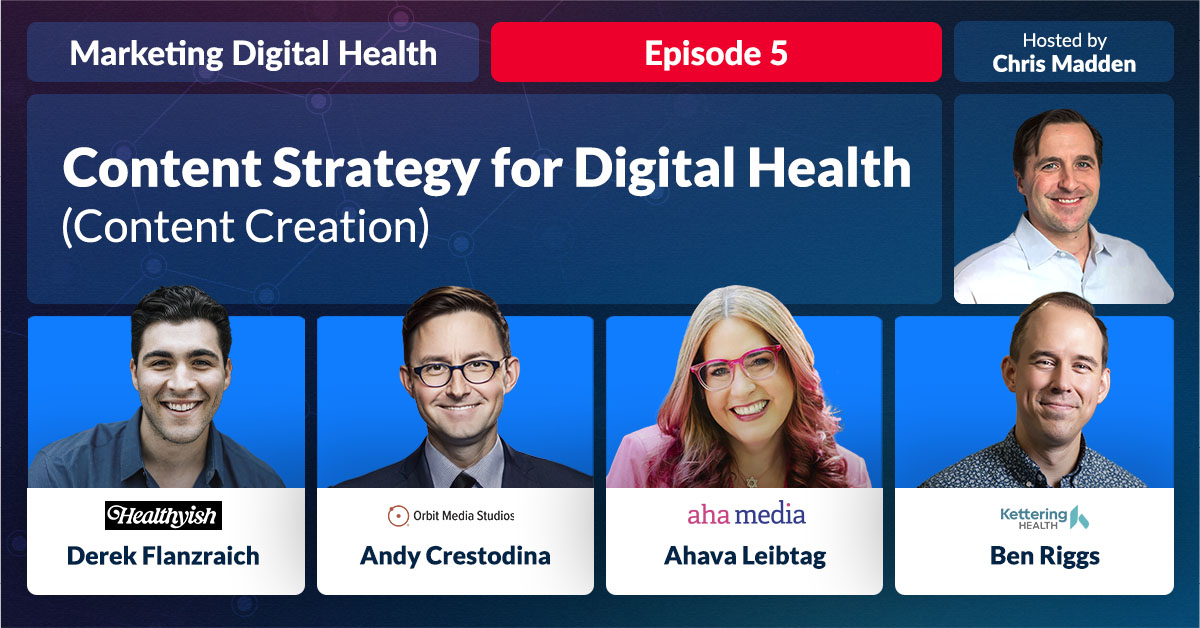


Digital health content strategy wins when it is both helpful and findable. This episode lays out a simple plan. Start with the real questions people ask when they are anxious, confused, or deciding what to do next. Pair those questions with expert review and plain language to reduce cognitive load and build trust. From there, organize your site around one or two pillar topics where you have the right to win, then support them with a cluster of specific, searchable subtopics. Andy Crestodina walks through connecting intent, internal links, and on page structure so your best content ranks and converts. Ahava Leibtag explains how patient centered editing improves comprehension and outcomes, while Derek Flanzraich shares the quality bar that earns attention in a noisy market. Ben Riggs covers editorial governance and the rhythms that keep teams shipping. AI has a place, but it should speed briefs and outlines, not replace voice or expert review. Distribution matters just as much as creation. Plan the path to readers across owned channels, earned placements, and creator partners. Finally, measure what matters. Focus on qualified sessions, engaged reads, assisted conversions, and downstream patient acquisition, not vanity metrics. The result is a repeatable system that compounds trust and demand over time.
Develop a strategic content plan tailored to digital health, leveraging education and trust-building as key elements of patient acquisition.
This roundtable blends a publisher’s quality bar, an SEO and analytics lens, a hospital system’s editorial craft, and an agency’s plain language rigor. Together they outline a content system built for trust and growth.
Writing the best answer on the internet is very easy to understand, but it takes chutzpah to actually execute. It takes resources, it takes time, it takes patience. And so a lot of companies don't end up following through on that. They cut corners. They want something cheaper. They work with SEO-first solutions as opposed to content-first solutions. And they end up with something that's in the middle....most people will tell you that's a science. And I believe that it is equally art and science.
Derek Flanzraich
An entrepreneur working to make health more accessible. He previously founded Greatist, which became the largest health and wellness site for millennials (acquired by Healthline), and launched Ness, a venture-backed health-first credit card startup. Today, he runs Healthyish, a personal holding company across content, investing, and advisory work. His agency, Healthyish Content, creates content for brands like LMNT, Ro, Allara, and Midi. He also writes 5HT, a weekly newsletter with 100,000+ subscribers, where he shares the most interesting and useful health ideas he’s come across that week.
You go to the internet and you search for the doctor's name. … And now that page will. It either sparkle with credibility or not. … If it has those things, especially if it has them as video. … to put in all the, the image related trust signals, accreditation, certification, association memberships, but then also I think really it's worth it to, put some video content there also, that's social content as well. … for credibility building on the internet.
Andy Crestodina
The co-founder and CMO of Orbit Media, a web development and website optimization agency. Andy is also an author and speaker, known for distilling complex SEO and content strategy concepts into practical, actionable tactics. As a leader at the intersection of content and technology, Andy’s insights are especially relevant as AI transforms how we think about visibility and value in marketing.
Nine out of 10 Americans struggle with health literacy. … when you start using simple language, it helps people calm down that adrenaline reaction … and get into a place where they can be more pragmatic about their care.
Ahava Leibtag
The founder and CEO of Aha Media Group, a 60-person content strategy agency focused on healthcare communication. A pioneer in plain language and patient-centered messaging, Ahava helps organizations simplify complex topics into powerful stories that engage and convert. She’s also leading the agency’s repositioning toward full-funnel digital marketing strategy in response to AI and evolving healthcare needs.
Ben Riggs
A writer and is the content manager at Kettering Health, where he leads content development for a large, multi-hospital healthcare system. With deep experience in health storytelling, team leadership, and editorial strategy, Ben brings a thoughtful lens to how hospitals can build trust, clarity, and patient connection through content—while navigating complexity, AI disruption, and cross-departmental coordination.
Chris Madden:
Have you been reconsidering your content strategy or looking for ways to level up your organic content program? If so, you’re in the right place. Today is all about content strategy and digital health, specifically how to create content that resonates. This is Marketing Digital Health, and I’m your host, Chris Madden.
We’ve brought in just the right experts to walk you through how you can leverage educating your audience and building trust. First, you’ll hear from Ahava Leibtag. Ahava is the founder and CEO of Aha Media Group, a 60 person content strategy agency focused on healthcare communication, a pioneer in plain language and patient-centered messaging.
Ahava helps organizations simplify complex topics into powerful stories that engage and convert. She’s also leading the agency’s repositioning towards full funnel digital marketing strategy in response to AI and evolving healthcare needs. You’ll also hear from familiar voices like Derek Flanzraich, Ben Riggs, and Andy Crestodina.
Derek was featured on episode four talking about trust building. Also from episode four, Ben taught us a lot about the basics of storytelling. Last, Andy was first featured on episode one, discussing his own personal health journey. They’ll chime in with additional expertise and perspective on Ahava’s comments.
So there’s a lot of ways to reach an audience when it comes to health marketing. In my own case, I see a lot of ads online for companies that I consider or even already use as a product or service. There’s a lot of people that I talk to in my family and friends that I trust for word of mouth for how I get some of that content.
And then of course, just being online and seeing things, whether it’s a clinic itself or advertising on a billboard or TV. There’s a lot of healthcare marketing out in the world. So if you’re a content marketer, knowing your goals or desired outcomes is really important before you start to think about writing content or even thinking about what channels this content might be on. First, you start with your goals.
So while repurposing content for different channels is common, Ahava says it’s not really the best practice anymore. Ahava walks us through what she now considers the three critical factors of content, information, format, and distribution. Repurposing content might be on its way out. The question that you want to ask is, what are you trying to convey?
So in this example, let’s say you’re trying to tell your consumers to not smoke cigarettes.
Ahava Leibtag:
There’s the format that you put it in. So if you have an audience that you’re trying to tell, don’t start smoking, who are you talking to? Well, you’re talking to teenagers, you’re talking to parents, you’re talking to teachers.
You’re talking to people who might influence these teenagers never to start smoking. So you have to think about the audience and the format that’s gonna work for them. So teenagers are gonna love video. You might want to print out signs and hang them on the back of bathroom stalls. Think about the context. They might be scrolling through TikTok. They’re also in the bathroom, whereas parents are never in the school bathroom. So printing out signs for them isn’t gonna work.
But blog posts and stories about how you stop your children and you talk to them about this at dinner and you make sure that they understand the dangers of smoking, those are the kinds of things that parents are gonna respond to. So they may be more inclined to watch a video, but actually read about it.
Then a teacher, obviously there’s so many different formats that a teacher might use. Certainly research might be interesting to a teacher or a principal. So it’s just thinking about that. And then it’s the distribution of those things.
So we already talked about if you build a flyer, well then you’re gonna distribute it on the bathroom stall, but you can change that flyer so that it stops the scroll on Instagram. So when people talk about repurposing content, it’s very hard to shift and lift. Think about any book adaptation you’ve ever watched in a movie.
How many of them are as good as the book? It’s the same content. It’s the same story. It’s the same characters, and yet sometimes it really works more beautifully on the page than it does on screen. I think we could argue there are very few adaptations that really capture the magic of the book, and that’s why, because you can’t just repurpose something.
You have to find what works in that content format. Take the magic that was in the original content format and the context with which people are consuming the content, and then slide it over to the next format. And that’s again, I think where the nuance comes in.
Chris Madden:
Ahava says you should consider the various contexts in which your audience could see your content. For example, if you’re on a social media channel, your goal as a marketer or a communicator or even as an educator is to get people to stop scrolling and grab their attention.
Ahava Leibtag:
And so when we think about the different contexts that we’re meeting people in, if you’re on a social media channel, your goal as a marketer or a communicator or an educator is to stop the scroll and get people’s attention.
So the kind of content that you’re gonna use is gonna be very different than on a blog post where you’re trying to tell somebody a story or you’re trying to give somebody a point of view, or on, let’s say, a conditions or treatment page where you really are just giving people information that they need to decide what to do next.
And I think that’s where the art and the nuance of content creation is. You can tell somebody, this is what plain language is and this is what that formula is about, and just go and do that. But it’s the practice of learning the technical best practices, understanding the way that content is searched by the search engines and by these large language models, and then putting all of those different things into practice.
Understanding that human psychology itself hasn’t changed. We painted cave paintings 10,000 years ago. Content has always been king. The question is, what context is a person in in order to understand it and use it, and what are they primed to do at that moment? When you’re on a hospital webpage or you’re on Google to decide what is SVT, which is supraventricular tachycardia, you’re thinking about that information very differently than you might be if you’re on Instagram or Facebook.
And so it’s really a marketer’s job to understand, where is my audience in this moment, not only in their thinking, but in their prime to action space in their head? And then how do I then design content that gets the reaction or the action?
Chris Madden:
It’s crucial to consider the medium before implementing a strategy. Regardless of the medium, Derek Flanzraich’s focus is on setting content strategy into motion. Derek is a builder and health founder. He’s the CEO of Healthy-ish Content and writes the Five Healthy-ish Things newsletter. Derek also founded Greatist, which was a pioneer in health content.
Derek says follow through on your strategy is everything.
Derek Flanzraich:
I’ll say that writing the best answer on the internet is very easy to understand, but takes chutzpah to actually execute. It takes resources, it takes time, it takes patience. And so a lot of people, even if they intend well, a lot of companies don’t end up following through on that.
They cut corners, they want something cheaper. They work with SEO first solutions as opposed to content first solutions, and they end up with something that’s like in the middle. So the first thing to say is it’s always about, you have to be really bought into it, and frankly, you have to have the resources to commit to doing it right.
So let’s say that’s all true. What’s next and how you decide what to cover? Most people will tell you that’s a science, and I believe that it is equally art and science. The science of it is very simple and very classic SEO. It is you take a bunch of keywords that are relevant to your company. You put them into the many different platforms for SEO that exist.
You look at the list of those keywords and compare the volume of searches against the amount of competition that exists, essentially saying, do you have an entryway? Can you get in and compete with what is already existing? And ideally, you want to pick something with high volume and lower competition.
So that’s the classic thing. Our agency does that too. That’s critical data. I just think it’s never enough, and I tend to dismiss a lot of the competition if I believe that you can create better content than them, and also that your brand, your company, what you’re offering actually has more of a right to win than who’s competing.
Then also picking the keywords very carefully based on what is your business proposition. Value proposition is also a very nuanced thing. Let’s say you’re a virtual first provider that’s providing autoimmune support. There is a million different things in autoimmunity that you can be writing about. You can be writing about symptoms, you can be writing about disorders, you can be writing about explaining the different things that go into it, the care that you can receive for it.
So how do you whittle that down into something that makes sense, I think is often the data’s not enough to make that decision.
Chris Madden:
Of all the marketing methods out there, Derek says content is still his favorite.
Derek Flanzraich:
I believe it is the most cost effective way to start a relationship with the target customer and the most cost effective way to deepen that relationship.
It is not always the most cost effective way to convert a customer, but I think people heavily underrate the potential for content to lead to conversion. And in almost every company I’ve ever been, when they turn multi-touch attribution on, they realize that nearly every conversion at some point interacted with content from that brand in some way if they have a robust content offering.
So I think it’s a much bigger part of the sales process than a lot of people give it credit for. Most people think of content as education, as awareness building. Maybe you get some traffic. I tend to think it’s a marketing channel and the way that you measure success from it has to ultimately be conversions.
Chris Madden:
Derek says that getting those conversions is about driving as much high quality traffic as possible, then working the funnel over time to improve your conversion rate such that the traffic you’re driving delivers more and more of the business outcome that you want, or what we call conversions.
Derek Flanzraich:
And so to accomplish conversions, we tend to try to drive as much traffic as possible and then work really hard to convert the traffic that does come down the funnel.
The primary way we do that is through conversion rate optimization, CRO. That means putting a bunch of buttons, putting a bunch of organic, authentic modules. Think in the healthcare world, putting pictures of the doctors or clinicians you can see with a button that says, “Book an appointment.” Think patient testimonials, a carousel of patient testimonials to capture someone with the stories of patients who’ve gotten better, whether that is a module that shows you what insurance plans are accepted.
Each of these modules are A/B tested and ultimately the ones that are the most effective get placed into each piece of the content alongside buttons with also A/B tested kind of copy on the buttons. Then if someone is not ready to convert, you don’t want to lose that person.
And so a lot of the attention next is placed on capturing sort of this, what I call latent demand. People have been exposed to your brand, they’re interested in what you’re doing. They’re clearly interested enough to read and engage with some piece of content you wrote. What you want to do is do everything you can to get them to sign up for an email.
They’re not gonna sign up for your product and service right now. Let’s get them into an email. And the way to do that, besides your kind of traditional popups and box at the bottom telling people about a newsletter, is often through some type of a lead gen download. So think of it as, get a free cookbook by entering your email, a quiz, or a symptom checker.
Those tend to be very effective in health and healthcare. You have to enter your information to start, and then that means you’ve captured the email. And then the last kind of key part of this is actually sending to those subscribers something worth them subscribing for. And usually, in my experience, that’s a best in class weekly newsletter, as you create a flywheel essentially of content.
The content you write on your blog, you can then bring into your email. You can, in your email, promote popular blog posts, and you create a new sort of diversified marketing channel that drives, yes, retention, engagement, awareness, kind of brand educational value, but ultimately plays a very important role in your funnel towards conversion.
One other piece to consider when it comes to articles and their role in the funnel is what the topic is. Often top of funnel content is going to be more broader based. So let’s say you’ve got some product that you offer, but a lot of other people offer. Can you get to the top of that in a keyword that might not necessarily immediately drive people to purchase your solution?
Then you need another piece of content that is going to be more mid funnel, explaining kind of your solution or how your solution compares to others. And then ideally, you actually have an even further, even more low funnel solution, which explains how to sign up for your service. And so even the articles themselves can work together to drive someone down through to conversion.
Chris Madden:
A good strategy starts with truly working to learn and understand how your audience behaves online. Andy Crestodina is the co-founder and chief marketing officer of Orbit Media. Andy walks us through a word of mouth moment when online content seals the deal with credibility.
Andy Crestodina:
You go to the internet and you search for the doctor’s name, so this is called a navigational query.
You’re looking for a specific person. You click, you land on a website, like a hospital site, for example, or their medical group. Now, that page will either sparkle with credibility or not. That page will either explain their passion and history and origin story or not. If it has those things, especially if it has them as video, that was a very short funnel. You were recommended.
So you looked at it, the page builds trust, and it was mostly validation. The page was sort of doing a confirmational job. But if I’m not yet brand aware, maybe I don’t have a doctor’s name yet. What I think all these healthcare systems can do is build search optimized procedure pages and then on those pages, show video that conveys the passion of the docs themselves.
That’s cheese and mousetrap. Search optimized pages describing procedures, and maybe mentioning the geography or the related conditions that are being addressed, but then on that page, to put in all the image-related trust signals, accreditation, certification, association memberships, but then also I think really it’s worth it to put some video content there.
Also, that’s social content as well. Share that, post that, cut that up. Use it in different ways. Put it into streams, because you can easily build the brand of the hospital once you have these videos. It’s catnip for credibility building on the internet. And then also make sure that your referring doctors have access to that and that you inform them that, hey, if you’re referring this doctor, by the way, here’s their page.
This page has their story, and that story is highly credible. So I think that you’ll have a higher conversion rate from the word of mouth and referral. So all of the little digital marketing elements are totally relevant. It’s really in many ways higher stakes, sure, but not so different than marketing for sort of anything else.
Chris Madden:
In healthcare, credibility isn’t optional. Ben Riggs is a writer and content manager at Kettering Health. Ben says real stories from real people are what make content relatable and trusted.
Ben Riggs:
To tell stories, you need stories, and so we want to make sure that we’re aligned with our folks in marketing. They have the relationships with the different facilities, service lines, where the stories are taking place, where these patient interactions are happening.
And we really want to create sort of a low clearance bar in the sense of we know that these folks are busy, whether it’s clinicians, whether it’s frontline staff, whether it’s service line leaders. We don’t want them to have to feel like they have to be content experts. They’ve got jobs that keep them busy.
We want to make sure that they’re on the same page with some of those baseline things that we’re looking for in terms of someone who had a positive experience with us, which thankfully there are countless ones of those.
Chris Madden:
Ben says that Kettering has a process for the marketing team to be able to collect stories and ideas for content from the frontline health workers who are actually providing the care.
Ben Riggs:
We have an intake system where, through our marketing team, these folks can kind of let us know about story leads that happen, patient encounters, and these really have a spectrum on their own, whether it’s what might feel like a sort of everyday patient experience, but that patient said something in that interaction or just the clinician is privy to the fact.
Because a lot of people are having these everyday experiences, it’s important to capture those too. You don’t want to just tell the big dramatic ones because most people aren’t having them. A lot of people, their healthcare experience is trying to figure out what’s going on with their stuffy nose, scheduling an appointment, seeing their primary care doctor, and maybe being prescribed something.
You want to tell stories that mimic that sort of everyday quality too. That may not require the resources of a whole video team or a writer shadowing a primary care doc all day, but it might warrant us reaching out just to talk to a patient that we’ve heard about. Maybe if they said something to a provider that just made that provider or service line leader think, oh, this could be a great story.
With Facebook and Instagram and LinkedIn, places where the real estate, there isn’t a lot, smaller experiences are great there. You can also tell these stories by way of your PR teams, and I think too, just knowing that they were there. You may not have moved on them right away, but keeping them around in your back pocket as other things come up.
Or maybe media reaches out and they have a question or they’d like to talk to a patient about X, you’ve got those folks you can reach back out to and inquire about their interest. But I think too, we’re always interested in those stories that do present complex patient cases and also provide a backdrop to be able to really delve into the complexity of certain kinds of patient care.
Chris Madden:
I love how Leibtag’s approach is rooted in experience. She once faced a life-threatening illness herself and found that what she needed online was clarity and compassion.
Ahava Leibtag:
I had a life-threatening illness when I was in my early thirties that made me realize how hard it was to find empathetic content online.
Most of it was very clinical. It didn’t really answer my questions. There wasn’t clarity about what to do next. I became very passionate about trying to solve that problem for the millions of Americans who deal with that on a regular basis and, quite frankly, across the world. And I learned a lot about Web 2.0 when I was working as a federal government employee.
And so I was able to take Gerry McGovern’s principles of web writing, and I learned from her and applied them to healthcare. And then as the digital marketing space grew and evolved quite rapidly, I tried to really become an expert in what made the most sense for people in healthcare and in content. So I wrote a book about it called The Digital Crown, and I just continued to preach what I thought was the most important thing, which is that we need to speak to people, meet them where they are, speak to them with empathy, give them hope, even when it doesn’t seem like there is any, but the goal is to help them understand where they can go for the help that they need, and then deal with it from that.
So a lot of people always ask me, how are you now? I unfortunately have a chronic GI condition that I manage every day, but I’m a patient every day. So I really feel for people who are looking for that healthcare, whether it’s for themselves or a loved one. It’s really important that when you go through a crisis, you feel like you can depend on the community that you have.
And sometimes a lot of people find that community online.
Chris Madden:
Personal struggle can shape perspective, especially in health marketing. Ahava gets what it’s like to be overwhelmed. She reminds us that for most Americans, health information is hard to access and even harder to absorb.
Ahava Leibtag:
In healthcare, when we talk about somebody feeling scared or frightened, what happens in our bodies is that our adrenal glands start to pump out cortisol, and that sends a message to our brain to leave our frontal cortex, which is our executive functioning.
So if you’re faced with a very scary diagnosis, or you’re in pain just from the cut on your thumb, and anybody who’s had that knows it’s throbbing, your executive functioning is really not as high as it would be if you’re feeling a hundred percent healthy. So when people are trying to consume healthcare language and they’re trying to understand what to do next, we already know that their literacy has fallen down.
Then you also look at studies that HHS, the Department of Health and Human Services, did, and nine out of ten Americans struggle with health literacy. Just understanding basic prescription directions or understanding even a map to how to get to a doctor’s office. Literacy in this country has fallen tremendously over the last 40 years, and so you can imagine what’s happening in healthcare in general.
So when you take these highly complex topics, like your heart is speeding up, why is it doing that? Well, then you have to sort of break things down for people in really simple concrete ways. Your heart runs on an electrical system just like your house, and it’s a pump and it moves the blood around your body.
And so when you start talking in those more simple terms, it helps people sort of to calm down that adrenaline reaction of, oh my God, I’m so scared about what’s happening to me right now. And it’s just sort of basic facts. We have doctors who can help you. Here’s what they’re gonna do. Step by step is very important for people when they’re feeling flooded and sort of just getting them off that emotional response and into a place where they can be more pragmatic about their care.
That’s where thinking about plain language is not necessarily about jargon, taking out overly complex ways to describe things. I also think it’s about choosing words that are real words that real people use all the time.
Chris Madden:
This is such an underrated advancement compared to the days of annual checkups and static brochures as the sole sources of health information. Ahava and experts like her are going deep to make sure that the message is as clear and understandable as possible. Content marketing for the health sector is not only about simplicity.
Ahava Leibtag:
It’s not always about taking out words. It’s sometimes actually about putting words in to make things easier to understand, because you have to move step by step.
The question we have to ask ourselves anytime we’re creating content that’s designed to educate people is, do we want them to understand, or do we want them to walk away and think we’re smart? Because they’re not gonna walk away and think we’re smart. They’re gonna walk away and think, this is useless and I’m gonna move on to the next brand who can actually help me.
So a lot of content creators talk about, in writing, really getting inside the hearts and minds and shoes of the people that are going through this and leaving your ego at the door. It’s really about trying to help people. You can write great content, but you have to be aware of who it’s for and when it’s for them.
And if it’s not a moment that they’re really looking to connect, but they’re just trying to solve a problem, just get to the point faster.
Chris Madden:
Empathy means putting yourself in other shoes. And in an ideal case, marketing can give people exactly what they need at the moment they need it. Ahava’s content instincts come from years as a journalist, and it shows.
Ahava Leibtag:
If you think about a headline, a headline tries to summarize exactly what the news is. “The Dow dropped X number of points, investors concerned about tariffs.” So that’s the top. You want to get the top facts. What happened? When did it happen? Why did the stocks drop? Why did the Dow tumble? Then you get into the things that people might not want to know as much about if they already know the background of the story.
One of the content strategy elements that I espoused was putting on the top of an article “what you need to know” in three or four bullets. So for healthcare, this was this study that was done by HHS. This is what they found on low literacy readers. If you just summarize the article for them at the top and told them the top most important things that they had to do.
Don’t start smoking. If you smoke, try to stop smoking. Here are resources with a link to help you stop smoking, instead of giving them this long article that they could read that, quite frankly, is just telling them what those three bullets say. Now, the counter argument to that is, well, why don’t you just do that for everything?
Well, because we have to make a case for people and we have to help them understand. But certainly for low literacy readers, they’re probably not gonna read the whole article. For people who are more comfortable, we want them to understand the background and the basics behind it. I don’t think there’s an American that hasn’t heard the idea, don’t start smoking, stop smoking if you smoke. But giving people really important facts and reasons why they shouldn’t do these things, I think has to be included so that people can choose what they consume or what they don’t consume.
Chris Madden:
That mindset drives Ahava’s whole approach. Health orgs turn to her when messaging falls flat, whether it’s launching new leadership or chasing a business milestone. She knows the right digital marketing can close that gap.
Ahava Leibtag:
The way that we approach these conversations is in a consultative way, so if an organization comes in and wants to talk to us, I’m the one who has the conversation first. Because first of all, I learn more on those calls than I do almost anything else, because it’s just so interesting to hear people’s challenges, how their organizations are organized in terms of which departments are responsible for which communication activities.
I listen to what they have to say. I ask very specific questions. I’m trained as a content strategist, so I’m always thinking about how am I gonna move the needle for the business and how am I gonna move the needle for the audience, because if that Venn diagram, if there’s not an intersection between those two things, that’s where your content is usually falling flat.
And then we have a conversation about what we might be able to do for them, whether it’s content creation or it’s auditing and discovery, or it’s figuring out a content marketing campaign, or it’s a huge website redesign and rewrite. It just depends on what the needs are and what they’re really trying to accomplish.
And I’ve often been told that one of the reasons that people choose to go with us is because we come at it from a very strategic point of view. And I think that’s because I’m the business owner. And so in the same way that I’m thinking about how am I gonna grow Aha Media Group and make it a thriving place to work and a thriving organization, I’m also thinking about how am I gonna help these businesses, which they are. I don’t care what kind of healthcare institution you’re a part of, every business needs revenue. Their goal may not be profit, but they need revenue.
So I’m always thinking about how are we gonna use messaging and branding and content and storytelling, and then all the tools that are in our toolbox, like SEM and search and writing and video. How are we gonna use all those things to get them closer to what they’re trying to accomplish as a business?
Chris Madden:
Then she says it’s about figuring out exactly what it is that’s going to help the business achieve its objective.
Ahava Leibtag:
When we do lead gen, people feel like, ugh, this is rapid or chasing the dollar or whatever. But you know what? When I had that life threatening illness, if that doctor didn’t get research dollars and revenue to progress the treatment of what I had, I wouldn’t have been able to have a life.
But that revenue went into his lab and went into his inventing a stent that was in my body and helped me. And so I think about that all the time, that unfortunately we have this very cynical view towards revenue. In healthcare, revenue is what drives the purchase and innovation behind new technology, behind training doctors, behind clinical trials, behind moving ahead. They cured cystic fibrosis in our lifetime.
That didn’t happen with no money. That happened because people gave a lot of money to try to make that happen. When people say, “Oh, marketing is vapid,” I’m like, growing a company is vapid? No, it’s not. Growing a company is incredibly important because it’s helping people for the most part. Remembering that those dollars fuel that innovation and that technology and that research that really gets us closer to solving a lot of these problems.
That’s what makes the work also meaningful to me. We try to be fun. Healthcare is a serious business. But you know, I have bright pink hair and hot pink glasses and I’m a huge fan of Taylor Swift and I use her lyrics in my email marketing. I think we try to have as good a time as we can about it because we do feel like we’re helping people, and I think that when you help people in good cheer, you get a better product at the end.
Chris Madden:
Ahava drives home the power of relatable, informative content. And Derek shows us how even details like adding a doctor’s photo add credibility to a piece of content and help build trust, because empathetic content that continually puts your audience first drives real long-term results. A strategy is only as strong as its execution.
Episode six, our next episode, gets tactical, breaking down the technical details of high stakes and high impact SEO that supports acquisition, conversion, and retention. Now including GEO, or generative engine optimization, to optimize for LLMs.