
- Blog & Podcasts, Marketing Digital Health, Podcasts
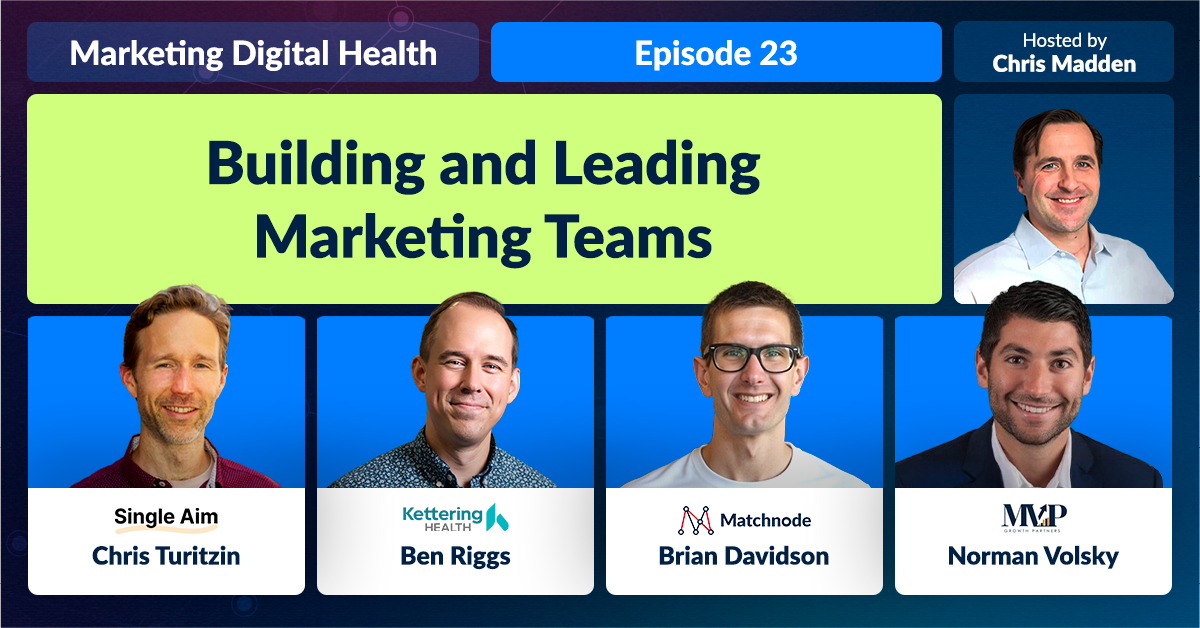
Marketing Digital Health: Building and Leading Marketing Teams


Summary
Digital health marketing team building is not like hiring in other industries. You are operating in a regulated environment, under revenue pressure, while the work touches patient outcomes. This episode breaks down what it takes to build teams that can scale execution without losing quality. Norm Volsky explains why top talent chases momentum and mission, and why the CEO’s lived understanding of the problem matters. Mission is not a tagline. It shows up in whether leaders keep investing in top performers after early wins, or decide average talent is “good enough.”
From there, the conversation gets practical about stage appropriate org design. Growth stage companies need leaders who are accomplished but still willing to do the work. Norm calls it high confidence with low ego, the kind of person who will take out the trash when needed. The way you prevent misalignment is simple: set expectations early. If you hire junior with intent to promote, define milestones. If you hire senior leaders, define when they can add headcount and what progress unlocks that.
Chris Turitzin adds the lens of bridging consumer growth rigor with healthcare constraints, and Ben Riggs shares how mission and patient stories create meaning that sustains teams. The throughline is clear: hire for empathy and communication, build systems that support B2B and B2B2C utilization, and use AI to speed the admin so the human work stays human.
Takeaway
Learn how high-performing digital health marketing teams are built—from org design and hiring to culture, process, and scaling execution.
About the Guests
This episode blends executive recruiting, growth systems, performance marketing, and health system storytelling to explain how great teams get built and retained.
If you don’t have people’s trust, you have nothing.
Norman Volsky
In addition to his role at Direct Recruiters, Norm is a Founding Partner at MVP Growth Partners, an investment and advisory group that empowers visionary entrepreneurs and innovators to bend the cost curve of U.S. healthcare. MVP Growth Partners provides strategic investment, operational guidance, and a collaborative network focused on measurable clinical and financial outcomes. The firm is grounded in integrity, collective intelligence, and founder collaboration driving sustainable growth through disciplined evaluation, hands-on support, and aligned incentives. Norm is also host of The Digital Health Heavyweights Podcast, where he interviews leading founders, investors, and executives shaping the future of healthcare technology.
I’ve always had this life of one foot in the consumer growth world and one foot in a highly regulated healthcare world… and I think that’s a really interesting niche to be in.
Chris Turitzin
A growth advisor and founder of Single Aim known for bringing rigorous product and marketing discipline to the world of digital health. After years of leadership at Meta and digital health companies, he now advises companies like Bicycle Health, Ours Privacy, and other healthcare leaders on how to architect scalable growth systems tailored to diverse business models, from DTC to payor-aligned care.
There have been moments where, because of patient stories in my personal life, I’ve gotten to know that I feel really good about working here… because I know we are following through on our mission.
Ben Riggs
A writer and is the content manager at Kettering Health, where he leads content development for a large, multi-hospital healthcare system. With deep experience in health storytelling, team leadership, and editorial strategy, Ben brings a thoughtful lens to how hospitals can build trust, clarity, and patient connection through content—while navigating complexity, AI disruption, and cross-departmental coordination.
Usually businesses come to us when they’re looking at scale… they’ve proven out that their offering is working, and they want to scale using paid channels.
Brian Davidson
Co-founder of Matchnode, Brian has helped redefine marketing for digital health companies by focusing on performance-driven strategies that deliver real results. With deep expertise in strategy, advertising, and digital health, he’s worked with brands to optimize campaigns, scale patient acquisition, and navigate the evolving digital ad landscape.
Full Episode Transcript
Marketing Digital Health: Building and Leading Marketing Teams
Chris Madden:
If you’ve ever tried to build a marketing team in digital health, you know it’s not like hiring for any other industry. You’re building in a regulated environment. You’re juggling revenue pressure, patient outcomes, compliance constraints, and a buyer that’s historically slow to move. And yet the teams that crack this code, they can unlock growth fast.
This is Marketing Digital Health, and I’m your host, Chris Madden. Today’s episode is all about understanding what that actually takes, the talent, the structure, the culture, and the process behind high performing digital health marketing teams. We’re talking with people who live this every day. Leaders who’ve built teams from scratch, navigated hypergrowth and figured out how to scale execution without losing quality.
And we’re starting with someone who’s had a front row seat to all of it. Norm Volsky leads the digital health practice at Direct Recruiters, hiring senior leaders and full marketing organizations for payers, providers, virtual first care, health tech, and life sciences. He specializes in org design, executive search, and go to market hiring in regulated high growth environments, helping companies match stage appropriate talent with the realities of healthcare.
In addition to his role at Direct Recruiters, Norm is a founding partner at MVP Growth Partners, an investment and advisory group that empowers visionary entrepreneurs and innovators to bend the cost curve of US healthcare. MVP Growth Partners provides strategic investment, operational guidance, and a collaborative network focused on measurable clinical and financial outcomes.
The firm is grounded in integrity, collective intelligence, and founder collaboration, driving sustainable growth through disciplined evaluation, hands on support and aligned incentives. Norm is also the host of the Digital Health Heavyweights podcast, where he interviews leading founders, investors, and executives shaping the health of healthcare technology.
Norm Volsky:
Success is addicting, and I think when people experience success and achievement in their career, they just want more of it, and they wanna feel that again. And when the best talent feels like they’re stagnant, they’re not growing, their company’s not growing, they’re not winning. They wanna get that feeling of winning again.
So I would say in general, that is like the core of all things motivation. When great talent feels like they’re not winning anymore, that’s usually when they’re open at picking their head up and considering getting themselves in a situation where they’re set up to win better.
I hate to say it as a Cleveland fan. When LeBron went to Miami, he made the move because essentially he wasn’t winning up to his expectation. Maybe he didn’t handle it the perfect way and making the whole world know that Cleveland wasn’t cutting it for him at the time. But same thing that motivated him to go pursue titles in Miami mid career is the same thing that motivates top talent in every market to move on and go to what they perceive as greener pastures.
Chris Madden:
From a digital health standpoint, Norm gives us such a clear view into what candidates actually want and what companies need in order to attract them. Modern talent doesn’t want stagnation. They want momentum. They wanna feel the company is moving with purpose.
In my experience, the people who thrive in this space are the ones energized by growth and Norm’s seeing the same patterns across the market.
Norm Volsky:
What I look for and what a lot of talent looks for is mission driven. It’s number one. If a company is not mission driven and in the business for the right reasons, it becomes very clear pretty quickly that incentives are misaligned.
Another thing that is incredibly crucial in our market is that the CEO of the company has a direct experience with whatever problem they’re solving. I would argue they probably have to be a world renowned expert in that specific category to have any amount of success. If you don’t come into a room of educated people and are able to become an authority on that subject, you’re most likely not gonna have a ton of success.
Mission driven and the CEO being an expert and a true authority on that topic is gonna be a really important thing to start. But what else needs to be in place for it to truly become a destination and beacon for talent?
First, they have to be solving a real problem that customers are experiencing issues in. So I think there has to be product market fit, and not only that it’s an issue, but it’s measurable and there’s a measurable impact post implementation. A hard ROI, a cost savings component, specifically in the employee benefits space is an extremely important characteristic.
Now I know plenty of top sellers that say, hey, I don’t care who the company is, if they don’t have a hard ROI and they can’t prove cost savings, could be the best company since sliced bread, I don’t think they’re gonna have as much success as they’re capable of without those components. So I would say those are the biggies.
Another thing is, are they not only a destination for talent, but can they keep that talent happy? A lot of companies at the early onset, when they’re trying to establish themselves, when they’re trying to build a brand, they may recruit the best of the best and be willing to pay the best of the best and really do what it takes to get them into the organization.
But what does that company do a year, two years, three years later, after they’ve experienced tremendous success? Does that success get to the executives, the founders, even the investors’ head and say, well, we don’t need top talent. We’re Walmart, we’re Coca-Cola. We’re like the name brand in our space. Now we just need average talent. And why pay these people an arm and a leg going forward?
Because now it’s easy to sell or it’s easy to market the solution, or it’s easy to whatever the company is doing and whatever they potentially need from a talent standpoint.
But I think the smart companies are the ones that say, hey, we don’t get here without the talent and we’re not gonna get to the next level if we don’t keep that talent happy and continue to promote that group of people that helped us get here, give them more equity, give them more career upside, because again, as soon as that talent feels, hey, I’m stagnant, I’m not growing, that’s the exact moment at which they start to open their eyes and see what their alternatives are.
Chris Madden:
There are a few roles in digital health that always stay in high demand, and Norm breaks down something I hear from founders continuously. They want people who can either save money or make money.
It’s a reminder that as teams scale, the early hires aren’t just filling seats, they’re driving the entire direction of the business.
Norm Volsky:
Financial leadership has been very in vogue. The person on our team that does all finance search, career year after career year.
Sales as well. Top sellers are always in demand and commercial leaders always in demand.
What I’m starting to see open up more than has been in the last couple years is some of the other things we used to do a ton of that were a little lighter in the last couple years. We’re seeing product management come back in full swing. We’re seeing marketing come back. We’re seeing customer success being emphasized more than it’s been emphasized in the last couple of years.
Engineering and tech talent, although always in demand, I’m starting to see even more demand there than there’s been in the past.
So important for you to know when I’m talking about talent. Our team does everything from sales to partnerships and business development and corp dev, marketing, product, ops, account management, customer success, client services, product, tech, engineering, finance and legal.
Our core competencies might have missed a position type here or there, but usually it kind of funnels into those major areas of expertise. And we probably do about 80 to 90 percent of what most of our clients need. And then if something’s out of scope, we usually get others involved because again, in our business, I would argue niche specialty can really achieve drastically different results.
So if there’s a client of ours that needs something that doesn’t fall within our niche specialty, which is health and benefits, we don’t touch it because it’s not good use of our time. It’s not a good use of their resources, for us to be learning on the job.
Chris Madden:
When you’re building a team, knowing what’s not right for you is just as important as knowing what is. A key takeaway here is honesty, being able to say no to a search because the candidate pool is not aligned.
Norm Volsky:
I talked to a CEO of a company that’s growing like a weed. And he needs several things. One of the things he needs is COO, which we place tons of COOs, but he said, interestingly, for this one, I really need someone a little bit more from direct to consumer, maybe manufacturing.
And I said, hey, that sounds like an amazing role for the right team. That’s actually not for us. That’s actually not the candidate pool we have immediate access to. And I don’t have a list of dozens, if not even over a hundred people, that we can go out and go get the best people with that skill set. So I’m gonna pass on that one because I don’t wanna set the wrong expectation. I don’t want you to evaluate us based on our ability to accomplish that search as it’s outside of scope.
Chris Madden:
Switching gears, Norm breaks down something that I also see in digital health. There are mission driven founders and then there are follow the money founders. Both exist, but only one group builds organizations that people genuinely want to work for.
It’s a helpful lens for understanding how teams form and why some teams thrive while others have turnover continuously.
Norm Volsky:
Every healthcare company is going to tell you they’re mission driven. With that being said, I think there’s two types of founders.
There are founders that experience an issue in their own personal lives that think to themselves, I’m not the only one suffering from this issue. And if I solved it at scale, not only could it be financially beneficial, but that’s what I wanna spend my life doing and that’s what I wanna spend my time fixing.
And then there’s founders that look for the problem that comes with dollar signs. This government regulation is going to mean this market is going to be very, very hot and there’s gonna be a lot of commercial traction, and I’m following the dollar signs, and I’ll figure out a way to concoct some sort of storytelling that makes me seem mission driven. And this came from the problem, not the end result being the motivation of starting this company.
That ball unravels very quickly if you not only start to dig in a little, but you also see how the company operates.
So again, I’m not picking anyone out, I’m not gonna mention any names, but a good example is the GLP-1 space. There are a lot of companies that have all gone into GLP-1s.
I think some of those founders might have personally dealt with that as a clinician, as a patient. And before it became very in vogue and very popular in pop culture and obviously dollar signs going with that, built a business prior to it being one of the most hotly discussed markets within employee health benefits.
And then there are some that just follow the dollars. Hey, GLP-1s, weight loss, and it’s gonna be an area where there’s gonna be a lot of prescriptions and a lot of care management. Oh, let me build a company because if we can even win X percent of market share, we’re gonna have a business doing X run rate in revenue, and then we can sell it for Y.
That’s a very different motivation for coming in work Monday through Friday, getting people to get excited to come and work their butts off even when you know you have some rejection or have some stumbling blocks.
It can really separate the people doing it because it’s what they wanna be doing, and it’s what their passions are, and whether it’s, hey, this is a business with the intent to make money.
Chris Madden:
Chris Ritson is a growth advisor for digital health companies and is the founder of Single Aim Marketing. We introduced Chris in episode one around why marketing digital health matters.
He’s a founder, but he’s also someone who’s navigated both high growth consumer technology and healthcare. And when you’ve worked inside those two worlds, you can see patterns differently.
He started off as an app developer on the Facebook team building viral Facebook apps back in 08 and 09. Then he sought to do something more tangible and made the move to healthcare. Chris brings a perspective that merges rigor with creativity, and that’s what makes his take on team building so valuable.
Chris Turitzin:
I was at Facebook for a handful of years on the growth team at Facebook, where I guess I grew up quickly. I had never really learned what growth meant from a rigorous perspective and trial by fire there.
I spent a handful of years at Facebook, and then in 2014 made like a hard pivot, had been in this consumer internet world, but wanted to do something that felt more tangible, felt more in a real world, but also felt like an area that I could basically spend like decades going deeper and deeper in, and healthcare fit the bill pretty well at that point.
And so I jumped into healthcare with essentially no experience, and I’ve always had this life of one foot in the kind of consumer growth world and one foot in a highly regulated, highly constrained healthcare world, which can be quite awkward at times and sometimes feel like not a great fit, but I’ve always maintained that I think that is like a really interesting niche to be in.
And it provides you a unique perspective that a lot of folks that either come from one world or the other don’t have. So in my time in the healthcare world, the last 10 years, primarily worked on three things. First was Virta Health, which is a digital provider organization focusing on diabetes reversal.
And then right at the beginning of the pandemic, I had been working with Bicycle Health. It was a very nascent organization, jumped in to help the founder grow that. We grew it from a few hundred patients to tens of thousands of patients over a handful of years, and then rolled off Bicycle about a year ago, started a company called Single Aim, which is focused on individual entrepreneurship for clinicians such as nurse practitioners and physicians assistants.
So we have a lot of interesting products in the pipeline there, and my general hypothesis right now is that this area of clinician entrepreneurship is gonna be like a next big wave. I also work with a handful of digital health companies in various parts of the marketing stack, either providers themselves or organizations that work with digital health companies on an advisor relationship.
Chris Madden:
As a successful founder, Chris is always scanning the landscape, looking at where the next wave of growth might come from. He’s seen firsthand how clinician entrepreneurship is shaping new models of care, and those trends directly influence how teams need to be built.
It’s one of those areas where the market forces and the talent pipeline move together.
Chris Turitzin:
There’s actually interesting narratives going on here, because if you look at physician entrepreneurship, it’s essentially only gone down in the last, I don’t know, 60 years. I think the numbers used to be something like 40 percent of physicians ran their own practices, now it’s down to 10 percent.
But if you look at the rates for these nurse practitioners and physicians assistants, it’s going in the opposite direction. So the rates of entrepreneurship, they’re very small numbers, but from the best data I can find, it’s going from 1 percent a few years ago are entrepreneurs to now two, three, 4 percent are entrepreneurial. So in investing, four X-ing in a matter of years, which is very quick growth, even though it is a small total.
And also the size of the population of nurse practitioners and physicians assistants is growing quite quickly. I think there’s some projections, I don’t know the year, I think I heard maybe like 2031, there’s actually gonna be more PAs and NPs than there are physicians in the country.
There’s also just generally a need for more clinicians, especially in many areas that have less access. I think also at some point clinicians are gonna reach a breaking point. I think it’s already happened where the employment model, the corporate employment model just is too difficult for people to enjoy their jobs on a daily basis. So there’s a lot of just latent pressure to get out of that and do other things.
And you see that among nurses, among NPs, also among physicians. And then you see things, for example, the burgeoning amount of people starting med spas, the amount of people going to work on platforms like Headway. So there’s just a lot of energy there.
Chris Madden:
Founders with lived experience often build teams with a stronger sense of purpose. It’s a reminder that culture isn’t something you write down. It’s something you model.
Ben Riggs is a writer and content manager at Kettering Health. We introduced Ben in episode four around storytelling and trust. Another great example of someone who’s connected their personal story to their career path, and you can hear how much that matters.
Ben Riggs:
I have the benefit of working myself and working with a team of people who are sitting down with physicians who are sharing their expertise on hydration, on heart health, on what, infinite number of topics, but also sitting with patients who have honestly really come away with powerful experiences that while they are changed for the better from a recovery standpoint, their worldview has also changed because of perhaps the extra mile, the compassion, the expertise that a care team provided.
I’ll be honest, I probably drink more water because of having worked on X number of pieces about hydration and its impacts. I actually, I won a trivia question one time with a group of friends about hydration and its impacts, or not. But two, it would be a shame for someone to work on consumer health pieces and not walk away wanting to apply some of them to their everyday life.
There have been moments where, because of patient stories in my personal life, I’ve gotten to know that I feel really good about working here, and I feel really good about contributing to content here because I know that we are following through on our mission. We are following through on our promise to patients.
And we have some really incredible people here doing some really incredible work. And so I think that personally, some of them are my friends now, some of these physicians, and so getting to know them and know that they mean business, they really take patient care, patient safety very seriously and they’re doing a really good job of it.
And so I think that just personally, I don’t have many qualms waking up and working for Kettering Health, largely because of the people I get to work with, but also the people that I know who are caring for our patients and having gotten to work with them. And that’s great for your mental health.
Chris Madden:
Norm brings us back to leadership, the cornerstone of any strong team. I’ve seen companies with great products fall apart because the executive team didn’t value talent. And I’ve seen companies win because the CEO understood how much the right team can change everything.
It really does start at the top.
Norm Volsky:
A key to companies succeeding and becoming a beacon of talent is it has to start at the top. If the CEO doesn’t feel that they need help and they need a great team around them to succeed, I would run. I would be very scared.
If a founder thinks with mediocre talent around them, they’re still gonna be able to succeed, and that is a core belief that doesn’t typically change as someone has more success, it only emboldens their thinking. As they achieve more success, like, oh, I’m the reason. I don’t need help. I don’t need support. I don’t need a team around me, like all that kind of stuff.
So I think it’s really important in a talent organization internally or externally that you understand and have a good feeling for, does the CEO and the founding team, do they value talent and at which interval they value talent and is that a moment in time or is that a philosophy long term about how they do their business, how they run business?
And same thing on the talent side. If you’re getting a great experience from the talent team, but the executives aren’t giving you the time of day, that’s probably an indication of how you’ll be treated as a full time employee.
I would also argue if you’re working with a company during an interview process and their executives are rolling out the red carpet and really being intentional about making a great impression and taking the time to take you to lunch or take you to dinner or finding extra time and maybe hanging out with you socially, getting to meet your spouse or your kids.
Those things are incredibly important and very telling of what the company culture will be. So I would just say in most things in business, it starts at the top, and if CEO and founders aren’t prioritizing something, usually that’s not gonna bode well long term for whatever that area you’re looking to prioritize is.
Chris Madden:
When it comes to building a high performing team, Norm names a critical combination, high confidence and low ego. Digital health moves fast and early stage companies need leaders who aren’t afraid to roll up their sleeves.
That combination is exactly what scaling companies need.
Norm Volsky:
When I think about growth stage hiring, I’m thinking about companies founder led, probably their founder did most of their first handful of sales, and at the point I’m meeting them, they might need to scale their company and hire people to do certain tasks in certain position verticals that they don’t necessarily have all the time in the day for anymore.
When I’m thinking about that, it’s like, all right, let’s hire a Chief Commercial, Chief Operating, Chief Financial Officer, CTO, and surround the founder with a strong team. What I think is crucial is you look for people with a lot of confidence, but low ego, and the reason for that is in a very early stage company, there are not a ton of resources. There are not a ton of employees.
So you could have a C level title, you could be getting paid extremely well. You could already have been ultra successful in other career steps and maybe even be very financially well off from some of that previous success. But when push comes to shove, something needs to get done. A lot of times you have to look in the mirror and say, okay, I’m gonna have to do that myself, because there isn’t anyone to delegate it to, or that’s not a resource I can pull on within the company right now.
So I think what’s really important for scaling companies is getting really good talent, but you have to make sure they’re willing to do the work and roll up the sleeves. So many times I see people who get hired in a situation with a growing company that is not really ready to do the work. It’s been a very long time since they were boots on the ground and like very customer facing, and within a couple months they realized I was not prepared for what I signed up for.
And when they meet with their executives and founders and investors, they start to say, well, for me to be able to accomplish this, I really need to hire this person. And all of a sudden this company’s burning money because the person they intended to hire to not only lead commercial, but also do some selling, or not only to lead technology, but also do some development and programming, or run operations, but not necessarily roll the sleeves and do any of the operations work, marketing, so on and so forth.
That’s when you start to bleed money and not make a ton of progress. So I think it’s really important when you’re hiring for growth stage companies that you’re looking for people who are very accomplished, but still willing to do the work and have a low ego level where they’re not too comfortable. You know that they’re actually willing to do some of the less desirable tasks a company needs to do, because sometimes when you’re CEO, you gotta take out the trash.
Chris Madden:
Another key takeaway, set expectations correctly at the hiring stage, whether you’re hiring junior talent with upward potential or senior leaders willing to get their hands dirty. Clarity prevents so much misalignment down the line.
It’s one of the simplest ways to protect your culture as you grow.
Norm Volsky:
There’s no one way to slice it. I’ve seen companies hire external agencies and use them for over a decade. I’ve seen people hire a very junior marketer that becomes the CMO of a company because they continue to get more and more responsibility. They consistently hit objectives and they just earn promotion after promotion.
What I do think is very important was about combination of succession planning and hiring in the right order, I think was like the general gist, and what I would say is it can be done anyway. You can hire junior with the intent to promote. You can hire a senior with the expectation that you’re rolling up the sleeves until the team and revenue’s big enough to justify you having a team.
What’s incredibly important is you set proper expectations, because what cannot happen is you hire a young person or less experienced person with the intent that they’re gonna grow into the role and not make very clear, here’s what is expected, and if you’re not accomplishing these things by this date.
Yes, the plan is to promote you all the way through the organization, and nothing’s stopping you from being eventually the Chief Marketing Officer, but you need to do this and this to get there, and if we don’t, we have the right to hire above you if at any point you’re not able to grow into the role.
Same thing with what we described earlier. You hire a Chief Marketing Officer that’s led a team of 50 people, they’re willing to roll up sleeves, but explaining like, hey, I’m glad you’re willing to roll up the sleeves, but at what time point in the future are you gonna say, hey, I’m getting a little fatigued, I need to hire a team.
Here are the things and the mile markers we have pre agreed upon, that until we accomplish X, Y, Z, you can’t hire more people. And that way people see what the light at the end of the tunnel is, and then make an informed decision of, okay, having done this before, yeah, knowing that it usually takes, let’s say, eight to 16 months for us to accomplish that, I’m willing to sign up for a year and a half or less of rolling up the sleeves until I’m able to make that hire.
So I think, again, there’s a lot of best practices that we can follow. But I think a core competency and a core value that’s really important in the recruiting is just setting proper expectations. Don’t commit to things you’re not fully willing to live by in the future, and that works on both sides.
Chris Madden:
Norm also talks about the traits he looks for in top marketing talent, creativity, communication, empathy and organizational strength.
And he’s right. Digital health marketers need to understand human behavior at a deep level. They’re not just selling a product, they’re helping people navigate their health, often during vulnerable moments.
Norm Volsky:
We like creativity, we need to see that. I do think organization is important, having a well thought out strategy and not just someone that’s creative but doesn’t know how to harness that creativity.
And I believe they have to be excellent communicators and I think they have to be very empathetic, because when it really comes down to it, what is marketing’s job? Their job is to understand the buyer and understand how to position the product to give itself the most chance, or its highest probability of being considered as a solution that buyer will buy at some point in the future.
So being really perceptive, understanding human behavior is a very, very important thing, specifically within digital health, because not only do you need to be able to market to the buyer, but a lot of these contracts are performance based. Unless they’re getting engagement, utilization, they don’t make any money.
So for example, MIDI, you know, a company in the menopause space, they can sell large health plan, they can sell Anthem tomorrow. If none of the Anthem members use it, MIDI makes zero.
So not only does a marketing leader at a company like MIDI have to market its services to its end buyer, which could be health plan, could be employer, could be health system, you name it, but they also have to have the function of not only B2B marketing, but also B2B2C, because they need to get the engagement, they need to get people to actually adopt the solution. Some companies need them to download the app or opt into a program.
So I think that’s what’s unique about digital health for these marketing leaders. They need to know B2B and B2B2C really, really well because both are crucial to having success.
Chris Madden:
Brian Davidson is my co founder at Matchnode. We first introduced Brian in episode seven when he contributed to the overview of the paid acquisition funnel in digital health.
Brian is someone who embodies what Norm is describing. A leader who uses research, creativity, and structured testing to scale companies responsibly. A strong marketing team doesn’t just guess. They listen, learn, and experiment their way into growth, always grounded in data.
Brian Davidson:
So usually businesses come to us when they’re looking at scale. They’ve already proven out to some degree that their offering is working, that there’s a marketplace for it, that they’re able to help patients or validate that their product is working or their service is working, and people come to us saying, this is great.
I’ve got these channels that are working. Some people are finding us organically. Email marketing might be working, or we’ve got something going with direct mail. Can we start to scale this using paid channels?
And generally speaking in business in general, paid channels is really where you begin to scale your business.
Chris Madden:
At Matchnode, we utilize research and ideas to help.
Brian Davidson:
Generating the idea, yeah, well generally that’s a lot of time talking to the client. That’s a lot of research on either their part or our part or a combination of both.
There’s definitely these days an AI element of just trying to get more ideas and then iterate on those AI generated ideas and really try to come up with a very large laundry list of different ideas you can test.
And sometimes I like to get some outlier ideas, those things that seem outlandish at first or seem a little bit crazy and are a big departure from what the company’s doing right now, because sometimes you need a big test to learn something really, really important.
Chris Madden:
Motivation is a huge factor in building high performing teams, and Norm shares something important. Great talent isn’t just chasing a job. They’re chasing the right environment, one that aligns with how they work and what they value.
And when you understand someone’s true motivation, you can hire better, you build better, and you retain people longer.
Norm Volsky:
Number one is listen. It is very easy in a hiring seat, whether you’re a recruiter, hiring manager, to hope that someone in front of you is everything you hope they to be, because that’s convenient, like you hope that the person you’re talking to can solve all your problems, because then you’ve saved a ton of time and effort.
So I think it’s really important that you listen really well onto why someone’s open to making a move, what motivates them, what environment they like working in, why they like working in that environment, what personality types they like working with, what type of personality types they don’t, and really understanding past experience, what baggage do they have, good and bad.
All of that context, we do not pitch clients before we understand the candidate’s experience and their motivations because number one, we don’t wanna waste our own time. Number two, we don’t wanna waste the candidate’s time.
And otherwise we end up having the same conversation dozen plus times a year of, oh, let me tell you what I’m working on. That’s new. Pitch regurgitate. Okay, what do you think? And if we don’t understand what that person’s experience is, what motivates them, what their current situation is, what a better one would look like, we’re literally just throwing darts at a dartboard with our eyes closed.
So I think it’s really important to truly listen and to understand what the perfect situation is for that person you’re talking to, and being very honest with not only them, but also yourself. Is the situation you’re describing, is it what they’re looking for or is it just your convenient situation that like they have the experience that would allow them to be successful in it, might not be exactly what they’re looking for or even be deemed enjoyable by them.
So I think it’s just always looking at it from, is it in their best interest to pursue it? And if not, just cut the cord, because credibility is the most important thing in this business. If you don’t have people’s trust, you have nothing.
Chris Madden:
AI is inescapable. So I asked Norm his thoughts when it comes to AI in the hiring process. Is it possible that AI will take over or is it just working alongside us and helping us speed up processes?
Norm Volsky:
I personally believe that persuasion is a personal task, like a human task. I don’t know if AI will be able to persuade in the same way humans can, because AI lacks empathy. It’s not a human. It’s hard for AI to screen for those types of things.
So I focus on keeping my team customer or candidate facing as much of the day as possible, and we are leveraging AI to do that. The task of writing up a candidate and presenting them to a client is a lot faster now, because you can leverage AI, you can write something up in a minute that would’ve taken 30 minutes before.
There’s plenty of AI to make sure the candidate tracking and the client communication is all done super seamlessly. But I’m not a fan of taking away the personal touch and using AI that is either customer or candidate facing.
So I think it’s made us more efficient and allowed us to spend more time building relationships, but we don’t leverage AI as a replacement for the human touch.
Chris Madden:
Something that’s always stuck with Norm is the idea of leaving your ego at the door. He learned this from founders like Glen Talman at Livongo. In addition, these successful founders have mission driven goals.
Norm Volsky:
Another thing to keep in mind when doing recruiting is you gotta have a really small ego and you’ve gotta be willing to put your ego aside in a lot of situations. And even when people initially say no, sometimes, not every time, but sometimes, with the right level of caring and information and time spent with a senior executive in the company, they can change people’s minds, because they’re willing to be rejected. They’re willing to fail. They’re willing to put themselves out there.
Another thing to think about when you’re thinking about building teams, especially in the early years, it eventually will get easier. When I started recruiting for Hinge Health or Livongo, I was educating people that they even existed. They weren’t companies that were brand names yet. As they became brand name, they were able to recruit talent at a different level and a lot easier, sometimes not even needing my services later in our relationship, less and less.
But what those founders did really, really well, and Glen in particular because he had a couple wins on his resume before starting Livongo, that, hey, you gotta bend over backwards and you gotta roll out the red carpet, even if you feel you don’t have to.
Let me explain why I think Glen at Livongo was so uber successful and why Dan and Gabriel at Hinge were ultra successful. And David Ebersman at Lira, and I can go on and on, Sammy and can then Alberta, and the list goes on and on.
But what I would say about these folks is there was a mission driven component to it, and their lives were personally touched by the conditions that they are helping manage. So Glen, whose diabetes management company, his son had diabetes. So he as a parent saw how hard and difficult it was to manage diabetes for an individual.
And he said, you know what, our family can’t be the only one going through this. And I don’t want any family to struggle with it, especially my own. So if I’m gonna solve this problem for my family, I might as well solve it for the entire country.
That’s how Glen thinks. That’s how he builds amazing businesses.
Dan Perez and Gabriel, Dan fell off his bike in, I believe, middle school, broke his arm and it really was a traumatic experience for him, and recovering from that musculoskeletal injury was something that had a deep, profound impact on his life.
His co founder Gabriel was a judo enthusiast that tore his ACL in judo and also had a PT recovery story as well. And they wanted to give people access to something they didn’t have access to, which was remote physical therapy and the ability to do it in the comfort of their own home.
David Ebersman had a family member that was going through some mental health challenges. Even he, who was at the time CFO of Facebook, had every resource imaginable at his disposal, couldn’t get one of his family members in to see the right type of therapist for months, maybe even over a year, and said, you know what, I should probably build a company that allows people to access mental healthcare in an easier way than currently exists in the healthcare market.
All of them had an issue that they dealt with personally, or someone they cared about dealt with it, and then they solved it for the masses. They didn’t say, oh, the United States is in a diabetes epidemic or mental health epidemic, let me figure out how to monetize this. It was more of, let me solve a micro issue and then do it at scale.
So I think, again, that really ties into the mission driven nature. When it’s about more than dollars and cents, it’s really easy for employees to see that.
Chris Madden:
As we’ve seen in this episode, great teams don’t happen by accident. They’re built with intention through hiring, culture, leadership, and an honest understanding of what the business needs.
The companies that win in digital health aren’t just the ones with great products. They’re the ones with great people. People who stay curious, collaborate, and stay grounded in the mission of improving care. And if you want to scale and not just grow, but truly scale, building the right team is the most strategic move you can make.
Finally, we’ll pull the threads together. Our next episode, episode 24, offers reflections as well as a forward look at what digital health marketing means for the future of care and where we can go from here.
Related Episodes
Marketing Digital Health: Founder Stories in Digital Health
- 30.49
Marketing Digital Health: Emerging Patient Expectations
- 29.28