

Digital health B2B2C growth models win when you earn coverage, then make enrollment effortless. This episode turns that into a plan. Start by aligning value with buyers, benefits leaders and plans want lower cost, better outcomes, and easier access. Show clear proof and make the pilot low risk. Once you have coverage, remember you still need the member to opt in and use the service. That requires consumer grade marketing. Build simple landing pages, plain language eligibility checks, and short paths to book or start care. Use partner channels with intention, member email and SMS, portals, on site events, and care navigators who guide the next step.
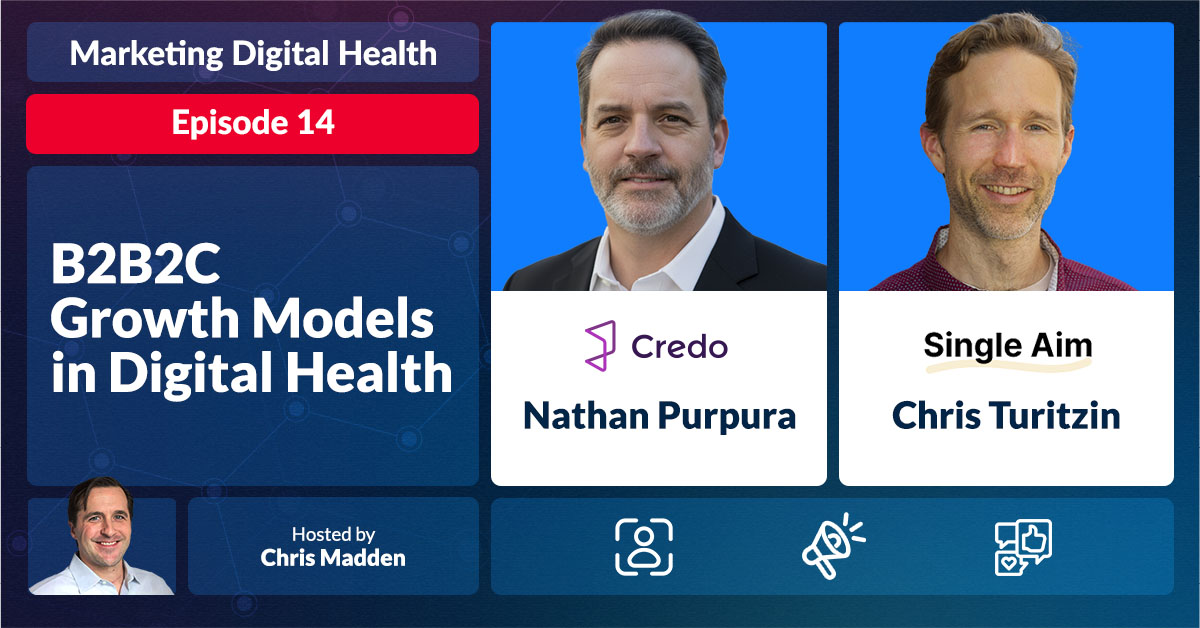
Chris Turitzin lays out systems that connect demand generation to enrollment and activation. Nathan Purpura shares how to pick the right partners and how to mix direct, partner, and pharmacy distribution. Keep data flows clean and compliant when partners touch the journey. Share only what is needed and keep consent records tight. Measure what matters. Track eligible reach, enrollment rate, activation inside the first session or seven days, show rates, adherence, and retention by cohort and by partner. Use experiments and holdouts so you can prove uplift. With the right contracts and retention, you can invest with confidence and scale without burning trust.
Discover specific tactics for acquiring and enrolling patients in a B2B2C model, where employer and payer partnerships are key.
This episode brings two growth leaders who have shipped B2B2C at scale, from winning coverage to driving enrollment and long term engagement.
SEO is a channel though that I think a lot of them do invest in.
Chris Turitzin
A growth advisor and founder of Single Aim known for bringing rigorous product and marketing discipline to the world of digital health. After years of leadership at Meta and digital health companies, he now advises companies like Bicycle Health, Ours Privacy, and other healthcare leaders on how to architect scalable growth systems tailored to diverse business models, from DTC to payor-aligned care.
It’s a smarter and more respectful way to reach people.
Nathan Purpura
A veteran growth leader in digital health, with deep experience building D2C and B2B2C and partnership-driven models at companies like eHealth and Bicycle Health. Now driving growth at Credo Health, Nate is known for his pragmatic approach to growth strategy, having scaled patient acquisition through a mix of direct-to-consumer marketing, health system and pharmacy partnerships, and employer-driven distribution. His work bridges brand-building, data rigor, and collaborative go-to-market thinking—making him one of the most experienced voices in operationalizing growth in healthcare.
Chris Madden:
One of the most powerful and misunderstood growth models in digital health is B2B two C. It is where employers, payers, and providers meet your patients. Get it right, and you can unlock massive reach and increase trust. Get it wrong, and all those contracts and partnerships just sit there doing nothing.
This is Marketing Digital Health, and I’m your host, Chris Madden. Chris Turitzin and Nate Purpura are back to guide us through it. Chris Turitzin is a growth advisor for digital health companies and is the founder of Single Aim Marketing. We introduced Chris in episode one around why marketing digital health matters.
He starts with referrals, a strategy that feels old school but still delivers. The trick is making it real and local. He talks about companies building real relationships with referring providers, not just sending a few emails and hoping for the best. I love that he highlights the difference between a referral strategy that is just an idea and one that is an actual operational motion with boots on the ground, local credibility, and data to prove that it is working.
Chris Turitzin:
You will see a company like a D two C company saying, we want to do referrals. And then they will get a few doctors to send them patients. The doctors will maybe trickle a few in, but they cannot scale it up and, or those doctors will eventually forget about them three or four months later.
The thing that is true about our referral based approach is that it is a very real endeavor and it requires a very real on the ground local relationships approach, which some may compare to like a pharma sales model, but the reason it works for local businesses is that they are literally down the street. They are in the community. It is a very tangible thing for a doctor referring to send people to.
So there are some examples. There is a company I love referencing called Ideal Option, which is in the substance use space. The reason I love it is that they publish a report every year of their referral volume and how they are doing it. So there are these yearly reports. I think they are getting like seven to ten thousand referrals a year, something along those lines, and they talk about how many people they have in the world and how many essentially bases they have around the country.
So it is just a different approach, but it is a real investment they are making to do that. I think one approach that I also want to say, we are talking about referrals, is so, either you have this local approach, or in certain cases, your treatments are so high volume and so high need that you can make more of a sort of top down referral model work.
For example, during the pandemic there was such demand for therapy that companies like Headway were able to make referral partnerships with these large health systems and they would just stream people their way. A company like Brave Health does Medicaid mental health. Again, exceedingly high demand, and they are just like flooding in referrals.
But the reason that works is it is both high volume in the sense that they offer a fairly generic product like mental health services, something that comes up in a physician or a referral coordinator’s life like every hour, every day, and very undersupplied by other options. If you have those two things, then you can make a top down telemedicine referral thing work.
Otherwise, I think a lot of people think that they are those two things. It is just not strong enough in those, so the referral thing, referral thing from a telemedicine perspective, fizzles.
Chris Madden:
Then Chris walks us through the three big growth models in digital health. You have got direct to consumer, where you are fighting for every click and conversion. You have got covered populations, the B2B two C world where employers or payers unlock access to your audience. And then there is the referral based growth, which looks a lot more like traditional healthcare.
I love how he makes this framework feel simple and actionable because too many companies try to do all three at once and end up doing none of them well.
Chris Turitzin:
Often people talk about digital health or virtual care, and everything gets bucketed together into the same bucket, even though I think there are businesses that mechanistically are very different from each other. And if you just look at the staffing of those companies, they look drastically different.
So I would bucket these generally into three groups. One is direct to consumer. And to be clear, when I say direct to consumer, I am not saying cash pay, because that is often, in my opinion, a misinterpretation. Direct to consumer is just applying to the literal meaning of direct to consumer. It is marketing direct to consumers.
So these would be companies that essentially advertise online. Think of any of these weight loss companies, or women’s health companies, or men’s health companies, or the things that you would see on a TV ad, or the things you see when you search on Google, or you would see on Instagram or TikTok, a lot of mental health companies too. So that is direct to consumer, and if you talk to those companies, probably ninety ish percent of their incoming patients are coming from some direct to consumer channel.
The second category I like calling covered populations, or sometimes it is referred to as B2B two C. These are companies where you have to unlock a population before you can market to them. So usually what that means is an employer or a health plan starts paying for your thing.
So these kinds of companies offer treatment experiences that are slightly abnormal, so they do not fit into either a cash pay basis or into an insurance pay basis, like traditional insurance. They have a new model. Companies like Omada, Virta, a lot of these employer based mental health companies like Lira and Spring. Advantages of offering slightly less traditional services are actually big advantages in the sense that you can be more flexible in the actual treatments, but you need to basically get payment permission from an employer or a health plan, and then you need to get marketing permission from that employer or health plan.
So that is the second category.
The third category is actually the category that looks the most like traditional healthcare, and interestingly, I think it is the one that people think about the least in the digital health world, and that is basically a referral based business.
If you talk to most doctors, most of their patients are coming from referrals, just like traditional, like some ophthalmologist down the street or urologist down the street. They have a local network of physicians that refer into them, and that is how healthcare works. And it is also possible on more of a scaled basis, and there are some examples of it.
I would also say though, building a company like that is very different than building a direct to consumer company, and I think many organizations try to do everything and just do not succeed. So there are examples of referral based organizations. I know some in the addiction business. But yeah, those are the three different models.
Chris Madden:
One of the most fascinating parts of this conversation was when Chris talked about trade offs in the B2B two C model. On paper, it looks like free marketing. You have got access to a defined audience, employees and plan members that already trust their health plan or their employer.
But if you do not negotiate the right permissions up front, like being able to send SMS or direct mail, all that potential reach just evaporates. I have seen companies make that mistake. They win the contract, but do not get access to the audience.
Chris Turitzin:
It is a great position, but it is also a frustrating position. It is great in the sense that most of your marketing is essentially free. There are costs, for example, with mailers and sending SMSs, but you basically have been given permission in most cases to have free advertising to this population that is an employer base or is a healthcare base.
The biggest lever, from my experience in working with those organizations, is getting that access. It is a really common pitfall that you get some employer, “Yeah, yeah, yeah, we have got a hundred thousand employees,” but then somehow in the contracting you forgot to ask for the ability to SMS them or the ability to send mail to them, and then you get no enrollments.
After that, the kind of direct to consumer channel application to a B2B two C model. There is this point in time where if you are doing it really, really well, a B2B two C becomes basically D two C, because your product is so well adopted that you can run broad based marketing and have a pretty good assumption that enough of the population will be eligible for it, that you can market in that way.
That is a pretty long way down the road, and honestly, I am not sure if any of the larger digital health companies have gotten there, maybe in certain geographies.
Because otherwise, if you do that, if you just run ads on Google or run ads on Facebook, it is going to be too expensive, because every nine out of ten people will not be eligible for your thing. So you will be burning through money and the systems do not have any good way of targeting people that would be eligible for your thing.
A lot of those companies generally feel pretty frustrated by the paid channels. Maybe there is some nominal spend. Maybe they found some way of targeting like a small geo or some signal on the platform. SEO is a channel though that I think a lot of them do invest in.
Chris Madden:
That is where Nathan comes in. His background in journalism and PR gives him a storytelling lens, and he applies that to healthcare marketing in such a powerful way. Nathan Purpura, who we first introduced in episode thirteen around partnerships for growth. Nate is the VP of Marketing at Credo Health. To Nate, it is not about choosing one channel, it is about orchestrating them all so that the message actually lands.
I started out where my career actually in journalism. Worked in TV news as a producer and field reporting and anchoring and wrote print publications.
Nate Purpura:
And then eventually made my way to public relations and did a number of different kinds of corporate PR, and that started through force. Got my way into content marketing when that was not really a thing, but you just saw the shrinking pool of journalists out there and how much help they needed in pulling stories together, pulling content together.
I did more and more of that, sort of in my later stage of my career in public relations, really packaging, building content and data to support media on stories. And then when we started to publish those things, instead of us driving search traffic on Google for SEO, it was not as much of a specialized practice like it is now, but we would publish content. We would publish reports, obviously share them with select journalists first, and then we would publish them.
We noticed that the online traffic we got off of publishing content had more long term value in terms of lead generation through publishing our own owned content. And so I fell into content marketing that way. And then that sort of led into organic social media and then obviously how I ended up working at Matchnode, and then ended up running a partnership, a business to business to consumer channel in a public company called eHealth and figured out how to drive leads through strategic partners.
And then over the last five years went back to startups again, and all those skills have come in handy. So everything from SEO and organic social to paid media and, and certainly being in healthcare has become really important in the last couple of years.
Chris Madden:
Nate’s playbook is all about iteration. Test a campaign, collect the data, optimize, and repeat. I have seen this pattern in great marketing teams everywhere. They do not just set it and forget it. They learn, document, and build a smarter approach over time.
Nate’s point about having a playbook and not just a collection of assets really hits home. That is what separates average partnerships from high performing ones.
Nate Purpura:
You can work through providers, so you can work through the medical groups, through the health systems, and you can actually educate the clinicians. That is often very difficult to do. You can do some things to educate their care staff, and you can do great traditional marcom stuff where you are building assets and you are getting them placed in the medical offices. That is a tactic that you can deploy.
I have seen that work really well, and I have seen that crash and burn. Most health systems and employer groups will deploy a combination of webinars, text messages, emails, and direct mail. So you are really building what I call plays. You are trying to build an arsenal of assets where you can plug into their program whatever they are willing to run to do member acquisition for you.
And then where it gets really effective is if you tune it. Learn from those programs that are deployed and optimize your approach. And so when you enter a partnership, you go from saying, “What are you willing to do? Email, text message, call?” to saying, “Hey, this is the approach. We deploy this form, we run our program this way, these are the kinds of responses that we get.” That is the play that you want to get to.
And so that is the first thing. So there is not really one solution. That really depends on the program and partner, but ideally you come in with a playbook and a recommendation on approach that you have tested and learned on before, based on the product that you are in or the type of patient that you are going after, and then you optimize that over time.
So the first thing. What is really interesting now from an AI perspective, these tools that will help payers, help point solutions and digital health startups. They will use AI to segment member data. Whatever data they can get their hands on, they will do data analytics work and they will come back to you with segments and recommended messaging and recommended channels.
And so I think that is where this is going. In member outreach, like you said, one text message and ninety percent of people sign up, that is great. And so that is where all this machine learning will really help out. Typically, when you are starting out, your patient populations are often very small, and you are reaching out to a small group of people so that there can sometimes be ghosts in the data.
It takes time and repetition, and you have to be very detailed in the data that you collect and the way you deploy your campaigns. I find early on you do better when you partner with just skilled agencies, skilled external people that understand the program and how to build it, and then they can bring the right resources to bear to get you a good foundation in place. Once you have that foundation in place, then you start to really build an internal team to run and pull the right levers.
Chris Madden:
Then Nate brings AI into the conversation. We have talked about AI a lot in this series, but here is what is fresh. He is using it for segmentation and personalization at scale. He explains how machine learning can help match messages to member subgroups. That is not just by demographics, but by behavior, condition, and even communication preference.
It is a smarter and more respectful way to reach people.
Nate Purpura:
The areas that I have seen that I think are really interesting are segmentation. It is the ability to build cohorts of people based on everything from disease severity, to how severe are they and how much can you really help them, how much can your treatment program help them.
This is all data work that the team can do, but often the AI tools are just much faster, help you really understand what your attainable market is within a population. But then the other thing is who responds, and I think that is a smaller opportunity for smaller startups because you do need to track everything.
But payers are using this kind of technology to figure out, okay, this is my text message population. These people, there is a certain patient relationship that, say, they are moving a lot, they are changing jobs a lot. A channel like text might be the only way that they really receive it. They may not have an email address and read their email. Sending them a postcard or a letter if they are moving every six months or whatever is just not a good option.
Figuring out and carving out those different groups and how to activate different sub segments. Typically that is most effective when a payer, a health insurer, or a health system is using those things. They just know how to get to these different populations, and then you come in with the right content and the right messaging, and you may have recommendations on tactics or you may even have the tactics pre built, but they will say, “We are going to take direct mail and deploy that against this group. We are going to take text messaging and deploy that against Medicaid.”
The interesting things happening in AI are in those areas. There are interesting companies doing work there.
Chris Madden:
Nate also gets real about the challenges of direct to consumer versus B2B two C. In direct to consumer, in the case of cash pay, if you are asking people to pay out of pocket, that is a hard sell. In B2B two C, you are showing them a covered benefit, and that difference changes everything about how you message, convert, and measure success.
Nate Purpura:
The biggest challenge I have seen in direct to consumer marketing in healthcare, it is one area where people are not usually willing to come out of pocket. Healthcare is so expensive and most of us have health insurance. Technically everybody has access to it with Obamacare, Medicare, Medicaid, or insurance from your employer. You are paying monthly, seventy bucks, and then you have got a copay, you have got to come out of pocket for the full cost.
It is very, very hard to do that. I think the Hims and Hers of the world, those companies that go out and offer things, stuff for balding and sexual health, we know people will typically pay out of pocket for stuff like that. There the threshold, and you are going after an income bracket where most of the population is not very wealthy and does not have a lot of good disposable income.
So if you are marketing a healthcare service and it is not covered by their health benefits, price becomes a really big factor and you have to be very targeted with your offers, and you are doing a lot on digital channels to try and manage acquisition, because they are going to leave and come back and you are really trying to drive a conversion with every click very often. And it is very difficult to cookie and optimize your programs when you are in direct to consumer, and it is healthcare, and you have to protect their privacy.
Where B2B two C is very, very different. Typically in that case you are offering a benefit that is covered by their insurance. There is a lower barrier there to get them to consider it. You can create more personalized experiences that you do not have to cookie, and you do not have to do all the digital tracking and things like that that you really need to optimize a direct to consumer campaign.
In direct to consumer you want to be hashing data on the back end and you want to be building lead forms on Meta and Google so that you do not have to have it on your website. I mean, there is tactically so much in direct to consumer that you have to do that you do not have to do as much of in B2B two C, because you have just got a tighter, smaller population and you are doing direct response. It is easier to convert there and conversion is usually much higher because again, it is typically paid for by their insurance.
Chris Madden:
Healthcare is very personal. Working with digital health every day, I asked Nate how it has impacted his own life and health.
Nate Purpura:
It is interesting to be in this space because you get turned on to different treatment options that are out there, and you can understand where some of the inefficiencies in the healthcare system are. How often, if you just do not ask a question or you are just not talking to the right person, there may be a benefit or a treatment option out there that would be great for you. You just have not heard of it.
And I think in some ways it is frustrating and discouraging, because you are like, man, if we could just get this solution to the right people, we can really solve some big cultural issues. So that is interesting and does sort of encourage me and my family to look into some things like this.
So I know I have a daughter that has got a chronic skin issue, and I became aware of some virtual treatment programs out there that are really great, and we got plugged into those. To me that is much better than some of these prescription medications that are frankly really scary, immunosuppressants that shut down your immune system or overactivate your immune system.
I think one of the things I have just found out is that pharmaceuticals are a lot less targeted and effective broadly than maybe we have been led to believe. So looking for alternatives to that has certainly encouraged me in that way.
Chris Madden:
Marketing and healthcare is not just about conversions, it is about connection. Helping someone find the right program at the right time can literally change their health.
Nate closes with a fascinating look at the future, from psychedelics to light therapy. He reminds us that innovation is not just about new tech, it is about rethinking what care means and how accessible it can be. It is bold, it is human, and it is exactly what digital health needs more of.
Nate Purpura:
I am generally really interested in the potential for psychedelics broadly, to treat things like opioid use disorder, ADHD*, post traumatic stress disorder. I have got people in my family directly affected by all three of those, and I think the current sort of status quo treatments for those things largely have not been effective.
And so the more I was reading the research about psychedelics and microdosing and things like that, that have been taboo, gotten the scarlet letter for lack of a better way to describe it in this country, are really interesting, really helpful. And so just generally those spaces I find interesting.
Certainly I really like what we are doing at Rigo Health* for that right now. Light therapy for psoriasis and eczema, it is the standard of care around the world and it is so hard to get here in the United States. Why is that? It is a very cost effective treatment program, yet we put you in a ninety thousand dollar a year drug that has all these nasty side effects*. When for most people, that is not the right option. So I really like what we are doing here.
Chris Madden:
Success in a B2B two C model is not just about signing partnerships. It is about activation. You have got to earn attention, not just access. The brands that win are the ones that respect the audience, test relentlessly, and keep the human story at the center.
Authenticity matters more than ever, especially in healthcare. So build relationships, not just campaigns.
Of course, scaling reach is only advisable after understanding and addressing risk. Episode fifteen, our next episode, unpacks Privacy and Compliance – why staying inside the lines legally is as critical as standing out in your innovation.