

AI in health marketing is useful when it helps people find care faster and makes clinical teams more effective. This episode lays out a practical path. Start with problems worth solving. Use AI to surface intent, create better briefs, and produce drafts that experts can review and improve. On the operations side, invest where AI reduces friction, scheduling, referrals, documentation, and routing, so new demand can be served without adding wait times. Keep trust at the center with expert review, citations, and privacy aware data flows. Plain language still wins in health, even when AI helps with production.
Search is shifting. Generative results reward clear expertise, experience, and structured data, so author bylines, reviewer credits, and schema matter more. In hospital settings, pilots that free up staff or shorten time to appointment generate real ROI and better patient experience. Treat change management as a first class task so new tools actually stick. Measure beyond traffic. Track qualified sessions, time to appointment, show rate, care started, and outcomes. Start small, choose a clear use case, define success, and scale only after you prove impact. Done right, AI compounds trust and access rather than chasing trends.
Stay ahead by exploring innovations like AI, predictive analytics, and automation that can transform patient acquisition.
This roundtable mixes investing, content and search, hospital innovation, health system transformation, SEO, and editorial craft to show where AI actually helps.
AI, at least in this moment, should be thought of as a copilot rather than a replacement. And the most successful applications will likely augment clinical decision making rather than replace human judgment.
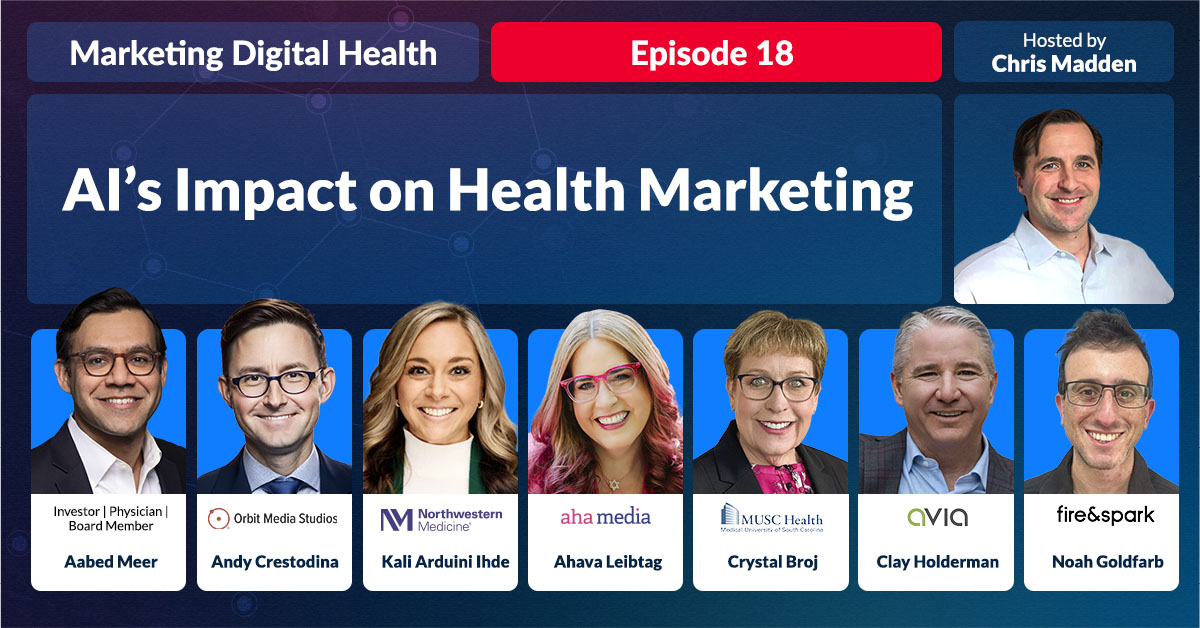
Dr. Aabed Meer
He brings a rare blend of clinical training and hands-on operating experience to healthcare investing. A physician by background, he’s spent the last 15 years backing and building companies across the healthcare landscape. Throughout his career, Dr. Meer has rolled up his sleeves alongside founders and management teams—helping shape strategy, hire leadership, navigate complex payor dynamics, and scale operations. He’s also known for his ability to spot emerging themes early and back companies with a real mission.
I use AI to find deficiencies—and then go make that thing better. Data-driven empathy, that’s marketing. AI can help you do that through gap analysis.
Andy Crestodina
The co-founder and CMO of Orbit Media, a web development and website optimization agency. Andy is also an author and speaker, known for distilling complex SEO and content strategy concepts into practical, actionable tactics. As a leader at the intersection of content and technology, Andy’s insights are especially relevant as AI transforms how we think about visibility and value in marketing.
AI isn’t going to replace humans, but people using AI will certainly outperform people not using AI.
Kali Arduini Ihde
The Director of Ventures & Innovation at Northwestern Medicine, where she leads system-wide efforts to find, evaluate, pilot, and prove the value of emerging technologies in clinical and operational settings. From AI tools to drones & robots, Kali’s team plays a critical role in shaping how a major hospital system embraces innovation while maintaining patient safety, clinical alignment, and scalability.
When patients are faced with something… they’re going to start online… and you better be the one who stops their scroll.
Ahava Leibtag
The founder and CEO of Aha Media Group, a 60-person content strategy agency focused on healthcare communication. A pioneer in plain language and patient-centered messaging, Ahava helps organizations simplify complex topics into powerful stories that engage and convert. She’s also leading the agency’s repositioning toward full-funnel digital marketing strategy in response to AI and evolving healthcare needs.
We can’t always hire our way out of this… That’s where we see some of these AI tools coming into play—to augment our staff and let them actually perform higher-level tasks.
Crystal Broj
The Chief Digital Transformation Officer at MUSC Health, where she builds, tests, and scales technologies that redefine how patients access care. From AI-driven appointment scheduling to tech-enabled referral management, Crystal is leading one of the most forward-thinking digital transformations inside a hospital system—and translating innovation into measurable ROI and improved patient experience.
The role for co-creation in AI is so important… Many of those bringing forward new technologies are nascent in healthcare. They don’t understand the workflows or the risks involved.
Clay Holderman
CEO of Avia, a digital transformation and innovation partner to health systems across the U.S. With deep experience in health system leadership, Clay now helps guide systems through the complexities of change management, applied AI, and operational transformation—especially at a time when economic pressures, demographic shifts, and emerging technologies are forcing an inflection point in the industry.
What AI lets us do is offload repetitive button-pushing work… and free up people for the human work of strategy and analysis.
Noah Goldfarb
The Director of SEO Strategy at Fire&Spark, a digital health SEO agency, where he helps growth leaders scale organic patient acquisition in highly competitive, high-compliance environments. With a specialty in content strategy and generative AI search, Noah brings a sharp, tested perspective to what actually drives growth in search today—and where teams often go wrong.
Chris Madden:
AI isn’t just hype anymore, it’s here. It’s powerful, and it’s already reshaping the way we think about patient acquisition and digital health. From smarter automation to predictive analytics and even creative content generation, AI is giving marketers and growth leaders new tools to scale faster than ever.
This is marketing digital health, and I’m your host, Chris Madden. A lot of people hear AI and jump straight to panic, job loss, doom, loops of regulation, robots taking over. But what if we flip the scripts? What if AI could remove repetitive work, unlock insights you’ve never had before, and actually enhance the human side of healthcare?
Today we’re talking with experts on the front lines of digital health, innovation leaders who are using tech like AI and automation to drive growth, improve care, and get ahead of the competition. Let’s jump in with our first guest, Dr. Aabed Meer. Dr. Aabed Meer is a physician and investor. We first introduced Dr. Meir in episode one, when he contributed to our discussion around why marketing digital health matters.
Dr. Aabed Meer:
AI is in many ways already proving its value, especially when it comes to administrative automation. We’re still in the early days, but there are use cases, for example, in prior authorization and clinical decision support, where you can see the path of AI adding value.
I would say AI, at least in this moment, should be thought of as a copilot rather than a replacement, and the most successful applications will likely augment, for example, clinical decision making rather than replace human judgment. Now, there are challenges to adoption. You have to think about trust. You have to think about regulatory hurdles.
You have to think about integration with legacy systems, and those are some of the barriers that we are going to have to think through as AI becomes more prevalent in healthcare, and we should expect AI to have an increasing role in healthcare. Obviously, we want to be mindful of how quickly it’s adopted and how thoughtfully it’s adopted, but by and large, I do think that there are very real use cases that would benefit from AI.
Chris Madden:
I was at a conference recently where a panel was talking about something that really stuck with me, how different our tolerance is for human error versus machine error. We’re used to doctors and nurses making mistakes. They’re human. But the idea of an AI making a mistake, people tense up right away.
Especially in healthcare, where getting it wrong isn’t just a bug, but it could cost a patient their life. That’s the tension we’re all working through right now. How do we balance excitement about innovation with the responsibility to keep people safe?
Dr. Aabed Meer:
A lot of the time it’s about life and death, and so the bar is and should be incredibly high for adopting technologies.
There likely is a certain comfort to be derived with human judgment versus technology. People are people and people are perhaps more likely to trust other people than technology or a black box, and so there’s a level of comfort related to what you’re already used to. And part of what we are doing as not just an industry but as a society is getting comfortable with that transition.
And even one of the examples that we were talking about earlier, if you think about how people buy clothes, 15, 20 years ago, people had a lot more comfort going into a store, looking at the clothes they were going to buy, trying them on, and then buying them. Whereas today, a lot of folks have gotten comfortable with the idea of just buying things online.
And even during the pandemic, folks were buying entire houses without having visited them in person. And so there’s a level of comfort that one gains over a period of time, and in parallel, technology also gets better, and the product or solution that’s being delivered is better than what was being delivered years ago.
And so there, that’s one component of it. And the other component of it I wonder is, if it’s going into something and saying, yes, you are going to have a 1 percent or a 5 percent error rate, maybe accepting that can be a challenge versus assuming that, yes, we can assume a hundred percent success even though you may not achieve a hundred percent success if it’s purely human delivered care, for example.
I suspect those are some of the issues that we’re going to have to work through and think through as again, not just an industry, but as a society.
Chris Madden:
AI is speeding up innovation. Noah Goldfarb is the director of SEO Strategy at Fire and Spark. We introduced Noah in episode six around content strategy for digital health. And for companies like Fire and Spark, the goal isn’t to avoid AI. It’s to learn it, test it, and figure out how to use it well. You can’t shy away from what you don’t understand.
In this space, the teams that experiment are the ones that grow.
Noah Goldfarb:
Our workflow has changed significantly internally within the past few months. We’ve hired our very first innovation project manager to keep us all on track, so it’s a full-time job within our company now. And then we have a new core value, which we’re calling Innovate every day, which literally means what it sounds like, which is every day we’re trying something new.
And most of those things don’t work out. The technology isn’t there. Maybe it wasn’t the best idea. Maybe there was a reason we’re doing it the old way. But overall, we’ve overhauled a significant number of our core processes and deliverables that we produce for our clients. We were actually also just looking through all of our software expenses, and we probably have 20 new tools now, and we just had decided to cut half of them because they just weren’t very effective after testing them.
So there are some things that are largely automatable. One of our awesome analysts just posted the other day within our community, our team, Slack, about the keyword research assistant she made, which since automating a lot of the manual steps that we had to take, literally going into tools like hres and SEMrush, plugging in competitors, downloading their data, formatting it in a spreadsheet so someone can assess it and start to analyze it and understand the information in there.
That’s the sort of thing that there’s just very little reason to have one of our team members using their precious time pressing buttons when they could be doing the hard work, the human work of actually assessing and developing a strategy for targeting those keywords, for deciding how to prioritize like we’ve been talking about.
We also feel strongly about the way that AI is used in content creation. So probably the most common thing people hear about or think about when they hear using AI for SEO is okay, we’re just going to use ChatGPT, maybe we’ll use an API because we’re fancy and a Google sheet and we will have ChatGPT write a thousand articles for us and we’ll make sure they’re keyword targeted.
And what we see there is there are some companies who are doing that and it is absolutely working for them. They are ranking. I would consider that to be a very risky and shortsighted strategy, because what you end up with when everybody has the ability to create content using ChatGPT with the click of a button is a bunch of content that looks like it was created using ChatGPT at the click of a button.
And what that means is it’s essentially a race to the middle, because it creates mediocre content. It doesn’t create trashy content all the time, but mediocre most often. And so if everybody’s creating mediocre content, somebody still needs to show up first. That’s what SEO is all about. And the person that shows up first, if Google’s doing its job well, is the person that is doing more or doing better than mediocre, doing better than everybody else that’s trying to target that keyword.
So in short, we use AI in our content process for topic ideation, for coming up with briefs, even writing first drafts if we have an expert or a professional writer that is then going to take it and make it excellent. We use it for QA, proofreading. We use it throughout our process, but it’s just about figuring out, especially within your particular space, where is a human the thing that’s going to push this over the top and make it something that stands out from everything else that I’m competing against.
Chris Madden:
Ahava Leibtag is the founder and CEO of AHA Media Group. We introduced Ahava Leibtag in episode four around storytelling and trust. For Ahava Leibtag, AI isn’t replacing anything. It’s adding value. She sees it as an opportunity to challenge companies to evolve, stand out, and build better systems.
That’s the theme we’re hearing more and more. AI isn’t here to take over. It’s here to improve the work we’re already doing.
Ahava Leibtag:
I’m actually pretty proud of myself for this one, because when AI first came out, everybody was panicked about what it was going to do to companies like mine, where copywriting was a core skillset that we offered.
When I experimented with it, when you first read it, you’re like, wow. And then you start reading it and you’re like, Ugh, this is terrible. Like a fourth grader probably could
Kali Arduini Ihde:
have
Ahava Leibtag:
done a better job on this. But I knew almost right away that the problem wasn’t going to be with content creation and AI, because I definitely think that there are places where you can use it for that.
I knew that the problem was going to come from search. So the top of the funnel has shrunk completely for a lot of healthcare marketers because when somebody goes to Google now and asks it a question that normally it would’ve gotten links in response, it’s now just getting the answer right on the page and the credit isn’t going to the publishers who created all this content, who has trained these large language models on what the answer that they should give is.
So now you’ve missed out on your educational opportunity. For example, if you used to type in supraventricular tachycardia, let’s talk about it, Hopkins would come up and Mayo would come up and Cleveland Clinic would come up and maybe an academic medical center close to you would come up and you would get an article that would teach you about what supraventricular tachycardia was.
Now it just tells you right on the page. So the question is what do you do next? And let’s take it even a step further now. People aren’t even going to Google. They’re going into ChatGPT, and they’re going into Perplexity and they’re going into Claude. And now you have AI assisted search on the AI mode.
Just came out on Google. What is a marketer supposed to do now? Like literally my top of my funnel has completely shrunk, and so I think it’s a really exciting time in healthcare content creation because you’re going to have to get bolder, smarter about grabbing people’s attention, about educating them, about healthcare concepts.
You’re going to have to try to grab those spots on Google, which is going to be a land grab for everybody. But I also think that the thing that people miss is that when people are searching and they just want an answer, that’s one thing. But if they’re searching because they’re looking for care, they’re going to keep going and they’re going to land on your pages.
And then your pages have to be really well constructed and written so that they’re convinced that you are the place to go and you’re going to need to have video to support that. And your needs are going to have images that explain what SVT is to support that. So I think the opposite of not needing content anymore.
You’re going to need even better content, and you’re going to need to be smarter and more strategic about what you’re really saying and doing. So there are people that just look at the search element, or they look at the content creation element, or they look at the patient journey element and we’ve got to look at it all and understand that.
When patients are faced with something, no matter what it really is, when it’s in their healthcare orbit, they’re feeling scared. They’re going to start online because we’re just trained to do that with almost everything now. And you better be the one who stops their scroll and gets them to pay attention and say, okay, this is the brand that I want to help me. You got to be thinking about it all. It’s just getting more and more, I think, complex, but I think it’s also just getting more exciting.
Chris Madden:
Andy Crestodina is the co-founder and chief marketing officer of Orbit Media. We introduce Andy in episode one around why marketing digital health matters. For him, AI doesn’t change everything. He’s not panicking. He’s not reinventing the wheel. He’s just asking how it can help him serve his audience better.
That’s the part of this conversation I appreciate the most. Staying grounded. AI is just another tool. The strategy, the message, the mission, all that still starts with us.
Andy Crestodina:
It feels new. Everything feels new. We all feel disrupted, but the foundation really hasn’t changed. Your prospect’s information needs have not dramatically changed their emotional triggers. The story in the life of a person who needs some procedure or healthcare, a person who has a question, the psychology of our audiences hasn’t changed, and that’s the starting point for everything in marketing, of course, is like, who are they? Where are they? What do they need? How can I help them in that moment?
What AI has done is given us new tools for finding that person, for satisfying that person’s information needs. It’s very famous for writing, and I’m bored by that. I’m tired. I don’t use AI for writing. I don’t think that’s a very interesting use case for AI. I know that a lot of people are excited to more efficiently produce articles or pages using AI. I worry about them because if you create a page using AI, that is not going to be a very differentiated piece of content at all. In fact, your audience could probably write that same prompt and get that same content.
So for a lot of things, it is really the last thing you should be writing is something that can be written by AI. What I love about AI and my best use cases for it are all analysis. Visitor lands on page. That page is talking about a procedure. What other questions? AI can in seconds. If I train it carefully by giving it the persona or generating a persona with AI, it knows my audience very well. It can tell me in seconds what I missed.
What objections does this visitor have that are not addressed on the page? What questions does this visitor have that are not answered on the page? What proof points are missing? What marketing claims that I make that are not supported with evidence? So in other words, I’m using AI not to find deficiencies. I use it to find deficiencies and then go make that thing better.
Because that person really, they may be in pain, they may be stressed, they may have a lot of, how can I help them if I don’t know their point of view? So I think a model for AI for the future will be to just create synthetic members of an audience and then talk to them, show them things, ask them what else they need. What’s missing from this? Would you click on that? Are these keywords you use? There are AI startups in healthcare that are, for example, helping train doctors by creating synthetic patients and having the doctors practice their bedside manner on an artificial human. That’s going to be a standard way for training and for research in the context of marketing.
Use AI for persona driven gap analysis, and you can get better results from any of your pages or posts or any asset you’re producing very quickly because it will either validate that you covered all your bases or it’ll point out that there’s something important that you missed. Data-driven empathy, that’s marketing. AI can help you do that through gap analysis.
Chris Madden:
Andy gives us a good reminder. AI isn’t everything. There’s still the human element to healthcare and to life that can’t be automated. Empathy, trust, connection, live and real experiences. That’s what people remember. AI can help support that, but it can’t replace it.
So for example, take a page about a cardiologist and the visitor’s wondering like, is this, how does the doctor feel about this procedure? Your best answer to that, the best messenger for that message is the doctor themselves. So the ultimate way to answer that question on that page would be to video the doctor talking about their passion for offering that service or performing that procedure. AI can’t do that. AI can’t make a page that personal or that human.
All the key success factors for content on the internet, it’s very visual, it’s very structured. It’s interconnected with other pieces of content, internally linked to other pages. It’s using video. It takes a standard as a strong point of view. AI doesn’t do almost any of that stuff. It’s far better for helping with planning, analysis, strategy research, not very good at making the thing itself because the thing itself should be very visual, very collaborative, very human, very personal.
My view on this may change, but today, no. I’d say make it yourself. Do it by hand and do it with tender loving care because your visitor really needs your help.
Chris Madden:
Our next expert is looking ahead, thinking about the long-term impact and direction of AI. Callie Arduini Iday is the Director of Ventures and Innovation at Northwestern Medicine. We introduced Callie in episode one around why marketing digital health matters. She brings us back to the heart of it all: patients.
No matter how smart the tech gets, the priority has to stay the same. Taking care of the people.
Kali Arduini Ihde:
In the near term, the next few years, it’s going to continue being about AI and how do we make these burdensome processes and these people intense activities that have so many multiple steps and complexities within healthcare and is often operational and process. When you think of prior auths or you think of the complexity between patients, their insurance companies, healthcare providers, everyone, it’s just so complex and I think that’s where AI is really going to continue to be able to chip away at the complexity and automate where it makes sense.
But to me, the long-term direction is really the concept of personalized and precision medicine and really catering, not just the treatments to me as an individual patient, me with my specific background, my specific lifestyle, my specific neighborhood. Taking that into account as you’re developing my treatment plans, but also taking into account the latest in medical discovery.
I’ve heard all sorts of stats that say that every day, every minute, the amount of medical discovery and new published information just is so overwhelming that no clinician, no physician can know what’s out there and what the best potential treatment would be. And that’s where I think a lot of technology can do that. Scanning of all the studies that are out there and surface what are the best approaches, and then we can make that available to physicians as they’re talking and to patients before they even see patients.
We can just bring all of that information together, whether it’s from the electronic health record and it’s from the patient’s history, or it’s from what are the latest discoveries in healthcare that can really cater those first conversations with patients while still making the process easier, but really cater exactly the treatment, exactly what’s going to happen to them as a person, as an individual.
Chris Madden:
I was curious how working in digital health and AI has affected Callie personally, how she’s balancing the rapid pace of innovation with the very real changes of healthcare today.
Kali Arduini Ihde:
It has certainly made me more aware of all the different ways that technology can help in care, whether that’s in fitness and wellness and being able to track and monitor and get recommendations that way.
I will also say less about my health specifically, but just more about how I do the work that I do every day. Being the leader of the team that needs to help the organization understand what ChatGPT is and what generative AI is has made it so that I know how it works and I use it daily. And those kind of tools that you’ll hear people say AI isn’t necessarily going to replace humans, but people using AI will certainly outperform people not using AI.
And I feel like I am now one of those people using AI to be more effective, be more efficient, do things in a faster way. And I’ll say that helps, not just in the work that I do, but in my personal life as well. And so it’s great to use these tools both again in the work, but also in my personal life because the same kind of administrative burden that physicians have in the work that they do, we all probably have in our personal lives too, trying to plan a trip or figure out what we’re going to do for birthdays or figure out how to write a card or a letter to somebody.
And so again, just using the tools available to take some of that burden off of each of us in our day-to-day lives, and me personally in mine, has also been really great.
Chris Madden:
Now I have the pleasure of introducing a new guest to the series. Crystal Broj is the Chief Digital Transformation Officer at MUSC Health, where she builds, tests and scales technologies that redefine how patients access care. From AI driven appointment scheduling to tech enabled referral management, Crystal is leading one of the most forward thinking digital transformations inside a hospital system and translating innovation into measurable ROI and improved patient experience.
For her, AI doesn’t need to do everything. It’s best when it clears out the tasks that don’t need human to human interaction. The stuff that slows us down. That’s how teams get more time back for real connection, strategy, and care.
Crystal Broj:
Our system has been growing quite a bit in the past, I’d say five years. I think it’s nine hospitals that we’ve acquired. We are a rescue hospital system for the state of South Carolina. So if a hospital is going under, usually the state asks us to come in and help that hospital. So that’s one of the ways that we’ve grown.
We’re building because like seven people a day move into South Carolina because it’s beautiful here, so everybody come on down. With that, they need all the services, including healthcare, and so we can’t always hire our way out of this. There’s just too many jobs and things to take care of. And so that’s really where we see some of these AI tools coming into play, is being able to augment our staff so that you get rid of stupid stuff out of the system and let them actually perform those higher tasks, whether it is higher documentation or the more difficult prior auths or the more difficult phone call where you maybe need to change an appointment.
But if you do that, then you have to move your MRI. And if you do that, you have to get another prior authorization. That’s something that really takes a person to do. But if you’re calling because you don’t remember what time your appointment is tomorrow, you really don’t need to talk to a person.
Chris Madden:
I loved Crystal’s enthusiasm for AI, especially how she’s actually testing it to see where it saves time and improves workflows. It’s one thing to talk about innovation, it’s another to put it into practice.
Crystal Broj:
Something that I’m super excited about is putting the ability to do AI agents in the hands of our staff, whether it’s a back office person or a clinician. Now, both of our key partners, Amelia and notable, have a AI agent builder that we can deploy with our clinicians, and we’ve done a couple of hackathons with this.
We call it a flow gym, because the tool’s called Flow Builder. And we brought in maybe 20 clinicians for a two day session where they learned about prompt engineering. Then they learned how to use the tool and then they built workflows that actually worked within two days. And we had a little contest and there was a winner with the trophy and stuff like that.
But they also are going to have the opportunity to see those actually be turned into live projects. We also did an AI exchange with some of our researchers. Same type of a thing where they don’t need to connect to the EHR to, for example, one of the winning ones was prescriptions before hospital stay. So check to see if you had this or this so that they could call you and tell you to stop taking that prescription a week before, for example, because we don’t have enough nurses to call and just say, you’re on this. Stop and take this, or don’t take this.
So that was a win-win, not in production yet, but definitely going that way and a lot more of those types of things where you can actually interact with the patient in other ways, making it easier for the patient. But the researchers is very exciting because they have a lot of things where they have to check against government regulations. They have to check against the protocol. They have to build an IRB and all these things.
Setting up a trial, clinical trial can take hours and hours and hours and hours at a time. And they were able to feed in the protocols and the information and check the latest resources from a government website, hold that all together, and then get a document that they could then tweak.
Of course, they’re always going to be a human in the loop and see what the result would be. And with prompt engineering, say, write this as if it’s being turned into, I don’t know, whatever, CD, C or this or that. So they took a process that could take between six and eight hours, and in two days they built a process that’s repeatable, that took, I don’t know, five minutes when it eventually ran, saving that time so that then they can do other things, like actually find matches to patients for clinical trials.
We’re also piloting a software for clinical trials right now that will actually match patient to a trial, see if they meet the criteria or get tossed out so that then only the smallest list goes to a researcher to see if they qualify based on X, Y, Z criteria. So I think there’s still years of AI agents that we can build and we can train people that want to skill up to actually build these workflows and do some of the work that if they all came to me with every single idea, we would never be able to get to them, even though we have a tool, because eight people can only do so much.
But being able to go, oh, you want to be able to notify a patient about, here’s a workflow. Why don’t you work on the workflow? And then you can do it from there. So I’m very excited about that possibility.
Chris Madden:
Next, I’m bringing Clay Holderman into the conversation. Clay Holderman is the CEO of ea. We introduced Clay in episode 13 around partnerships for growth. He’s looking at AI from the health system side, specifically the different tools and platforms that are already being used by hospitals and care teams.
Clay Holderman:
Obvious sweet spot was in consumerism and consumer journey, so we did a lot of work in digital front door. That’s evolved today into experience orchestration, which is getting away from, yeah, you can do a registration or you can do a pre schedule and booking, or you can do your forms online. Very transactional to can we actually be predictive and proactive and personalized like a retail experience would be in healthcare.
That will be our traditional types of engagements, but more and more people are coming to us and saying, we are being overwhelmed by the onslaught of new companies, bringing Gen AI to bear with promises, and we’re becoming fragmented and it’s becoming very, very expensive to manage all of these APIs.
Can you help us? App rationalization. Can you help us with the strategy of our entire digital ecosystem? When do we choose to use the EMR that we have invested hundreds of millions of dollars in, even if their offering might only get 80 percent of the functionality of a best in class startup? And when do we really need to differentiate and invest outside of the EMR or the ERP, the core systems of record so that we can create a differentiation in the market and how we build the business case around that?
Chris Madden:
Tech in healthcare is a different beast. It’s not like retail or banking or travel. The stakes are higher, the regulations are stricter, and the systems are way more complex. That’s why adopting new technology in this space takes more than a good pitch. It takes a real plan.
Clay Holderman:
For more than a decade, we’ve been comparing healthcare consumer experience with industries like airline travel, booking, banking, and then the holy grail would be to be Amazon, serving up what’s you’re most likely to want, or Netflix, what’s you’re most likely to watch, or Spotify.
Healthcare’s long hidden behind complexity and regulation, and we allow consumer journeys to be completely fragmented and we’ll say it’s in the name of HIPAA or in the name of regulation, and in reality, there is so much more, especially as technology allows us to personalize more. As Gen AI is now full scale in implementation, there’s so much more personalization we can do without sacrificing data privacy and security.
Chris Madden:
I asked Clay to dive deeper into how hospitals are adopting the new AI tech and whether this technology might eventually replace the legacy tech stacks that health systems are still running on today.
Clay Holderman:
Health systems have put hundreds of millions of dollars, sometimes a billion dollars into a few core systems of record. And that would be their electronic medical record. That would be their ERP, their enterprise resource planning system. Sometimes their HRIS and these systems kind of dictate the backbone of everything else they do strategy wise, because they either have to API into these systems, interface with these systems, architect around these systems, manage updates with these systems, manage data in and out of these systems, or they have to settle for what those systems are bringing forward.
So we pay a lot of attention to Epic and Oracle Health and what’s on their AI roadmap. What will they be bringing forward? Really a lot of business planning around when can you get a real return on investment now for something that might be three to five years to maturity in your core system of records roadmap.
In my experience, the ERPs are bringing forward these automated tools, truly a agentic AI or autonomous decision making inside of the AI at a faster rate than the EMRs actually are, when they’re actually able to automate entire complex workflows or strings of workflows in areas like revenue cycle or finance and accounting or human resource administration.
But the role for being a co-creator and not leaving the creation of these really powerful AI technologies is, it’s so important for health systems to fill because many of those in tech startups and many of those who are bringing forward the new technologies are nascent in the healthcare environment. They don’t really understand the workflows. They don’t understand the regulatory complexity. They don’t understand the risks involved, and so we need to be co-creating in that space and not just be a receiver and consumer of those technologies.
Chris Madden:
There are a lot of wins coming from AI right now. New efficiencies, new insight, new path to scale. Noah opens up about what he thinks this leads to long term. How will AI actually restructure healthcare as we know it?
Noah Goldfarb:
My prediction is that more and more things like PR, things like online community engagement, how people talk about you, what your reviews look like across various platforms. Those are going to be the kinds of things that help ChatGPT or Gemini or any of these tools determine who to trust and who to show.
What we are doing in that respect as an agency is we’re expanding the ways that we help our clients, and that includes online community engagement. So when there is an opportunity to, in a valuable and authentic way, engage in a Reddit community, in a Facebook group, we should be doing so. Again, we don’t want to astroturf, but we want to be helpful, be transparent, and just provide valuable information and hopefully in doing so, build the awareness and also the perception of that brand online.
Also, it’s been a cliche for a while, but search is changing beyond just text. So video and audio and graphics are becoming more entwined with the way that people search across different platforms. Lots of people search on TikTok now. How are you showing up on TikTok? Is it just that you’re producing videos that you think are interesting? Is it that you’re doing an influencer marketing strategy?
No matter what it is, if you have video assets, you should be leveraging them as well as you possibly can. That means creating awesome content that shows up well within TikTok, but also being able to repurpose those assets so that they’re showing up well on YouTube and Instagram and Pinterest and any other platform. And on your website and in Google search as well.
I think there is going to be a lot of overlap in what SEO looks like and what people have called it, GEO. We prefer the term organic demand generation, which is just organically, however people are searching across the web. How are you getting in front of them? The way that you’re showing up across the web and demonstrating your trust across the web and authenticity and engaging with actual people is going to become more and more important.
Chris Madden:
Noah shifts gears back into SEO and what AI might mean for search content and digital discovery in the years to come.
Noah Goldfarb:
I think that people on both ends of the SEO forecasting spectrum are wrong. A lot of people who are very dour about SEO are overly pessimistic. And the reason I think that is people are going to continue to search. Like the size of the pie, so to speak, to use a marketing term, is not shrinking. If anything, it’s going to be growing.
There’s going to be more searches performed, more people looking for information in more ways. If you’re going to ignore that and just say ChatGPT, if Gemini, if they choose to show me, great. But if not, they can show my competitors. I think that’s going to be a long-term mistake, because people are still going to be searching for information when they’re making conversion decisions.
So that’s why I’m not so pessimistic about the future of SEO. On the other end of the spectrum, there’s the people that are then SEO is going to continue pretty much exactly as it has. Or what they’ll say is we need to rethink SEO in a way that actually takes the onus off of SEO. What you’ll often hear is people saying the new metric you need to care about is visibility or the new metric you need to care about is impressions because fewer people are clicking through to websites.
The really valuable KPI is just getting shown, and I firmly disagree. It’s great to get shown. You’d rather show up somewhere than not show up there. But I think any kind of marketing that runs away from accountability to actual business growth is just going to be less essential to business overall.
So I think the answer is that SEO is going to change, probably quite dramatically. And the way we think about optimizing for search is going to change, and the activities we do are likely going to change. It’s like it’s still going to need to be about content creation, high value asset creation. But over time, as we get better data, as the tools improve, we’re going to understand, and very importantly, as people change the way that they search for information, so it’s not just the tech changing, but search behavior changing,
We’re going to get a better understanding of the new way that decisions are made and the impact that could have on the day-to-day activities of an SEO could be fairly minimal, but it also could be fairly dramatic. The test that I have in my head is what I call the my mom test, which is I am waiting for my mom to tell me that she is using ChatGPT or the one of those nifty little answer boxes at the top of Google to make any sort of conversion decision in her life.
And I think that’s interesting because marketers, we think about this all the time. We’re probably already using these tools when making conversion decisions, but we are not representative of the majority of the public. Once the majority of the public starts adopting these tools and doing so frequently, we’re going to get a much better understanding of how their decision making is changing along with the technology.
And then the last forecast I’ll make is there’s been a lot of concern about ChatGPT in particular. That’s probably the LLM with the biggest name recognition. My money is going to be on Google until they give me a reason to not put it on them. So the thing I’m watching most closely at the moment is the recently rolled out, I think it’s in beta still, AI mode, which is essentially an AI overview that you can chat with.
It’s nothing too fancy right now, but if you had to put your attention on one single tool to understand what SEO is going to have to be about over the next year or two, I’d be watching what Google does with AI mode.
Chris Madden:
And that’s a wrap on today’s episode. We heard from leaders across the industry embracing AI, not as a replacement, but as a catalyst. It’s a way to unlock smarter decision making, scale, operational efficiency, and personalized patient experiences like never before.
Whether you’re a marketer, products leader, or founder, the message is clear. The teams who lean into AI now through experimenting, refinement, and application won’t just keep up, but they’ll lead. And the best part, you don’t need to go all in overnight. Start small by automating a workflow. Use AI for creative testing. Build smarter targeting with AI.
Do whatever you can do to get closer to your audience in a faster, more meaningful way. Because in healthcare, growth isn’t just about volume, it’s about connection. And AI is becoming one of the tools that makes connections scalable without losing the human touch.
But AI isn’t the only shift. Episode 19, our next episode, looks at consent based infrastructure and the technical pivots needed to build privacy first, sustainable growth.