
Paid Social
Paid Social for Digital Health Brands
Paid social is the channel that creates new demand, not just fulfills existing search. Matchnode runs Meta and TikTok programs for digital health brands, pairing high-volume creative with HIPAA-compliant signal so the algorithm finds the next right patient at scale.
Talk to Us About Your ProgramMeta Business Partner · TikTok for Business Partner

Paid Social Built for Digital Health Performance
Matchnode runs paid social for digital health brands on Meta (Facebook and Instagram) and TikTok, with the heaviest investment on Meta because that is where most digital health audiences are. We feed the algorithm clean technical signal and a steady cadence of creative tests so it can find the next right patient at the right stage of the funnel.
Matchnode is a Meta Business Partner and TikTok for Business Partner running paid social media advertising for digital health, telehealth, and digital therapeutic brands. About 90 percent of the paid social work in our book is on Meta across Facebook, Instagram, and the full placement set. TikTok is a real but secondary channel for the brands and creative formats it fits. Other social-adjacent platforms (LinkedIn, Reddit, Pinterest, Snapchat) live on our More Ad Platforms page.
Platforms we run: Meta (Facebook, Instagram, all placements) as the workhorse, TikTok as the secondary channel.
Who it is for: Digital health, telehealth, and digital therapeutic brands ready to scale paid social as a primary acquisition channel.
Credentials: Meta Business Partner and TikTok for Business Partner. HIPAA-compliant tracking and LegitScript support for telehealth clients.
How we run it: Broad audiences, high-cadence creative testing, server-side conversions API, weekly strategy connecting tests to your business goals.
Paid Social Reaches People Before They Search
Search ads are at their best when someone already knows what they want and types it into a search box. Paid social works further upstream. It puts the right offer in front of the right person before they have ever searched for it, then pulls them through the rest of the funnel from there.
That matters in digital health, where most patients move through stages before they are ready to book. Someone might be condition-aware (they know they have brain fog and headaches) but not yet solution-aware (they have not connected those symptoms to perimenopause). Search cannot reach that person at scale because they are not searching for the answer yet. Paid social can. Meta and TikTok can suggest the category, the symptom pattern, and the path to a solution, and bring a brand-new audience into your funnel.
Paid social also keeps working all the way down the funnel. The same campaign structure introduces a new condition framing to a cold audience, retargets visitors who started but did not finish an intake form, and brings back lapsed patients with a new offer. That is what we mean by demand generation: not just creating new awareness, but pulling that awareness through to a booked appointment.

Unaware
Doesn't know there is a problem. Paid social introduces the category.
Condition-Aware
Knows the symptom (brain fog, fatigue, anxiety). Doesn't know the cause.
Solution-Aware
Now considering categories. Comparing options, reading, asking peers.
Ready to Book
Searching by name, ready for the booking flow. Google catches them here.
The takeawaySearch captures the demand that already exists. Paid social creates new demand and pulls it through. Most digital health brands need both, but the second one is what creates new growth.
AI-Driven and Creative-Led
Meta and TikTok have both turned into AI-driven ad platforms. The algorithm decides who sees which creative, when, and on which placement. The advertiser's job is no longer to micro-target an audience by interest layer, the way it was five years ago. The advertiser's job is to give the algorithm two things: clean technical signal about what a real conversion looks like, and a steady stream of creative options to test against broad audiences. Get those two things right, and the algorithm finds the next right patient on its own.
That is why we say creative is the new targeting. We build broad audience structures (often broader than clients expect) and let creative do the work of pulling the right person out of the audience. A perimenopause ad with a specific message and a specific visual will find the right woman in her forties even when the audience is "all women, 35 to 60, in 50 states." A scroll-stopping TikTok creator video will find the right twenty-something even when the audience is "all U.S. adults under 35." The creative is the targeting.
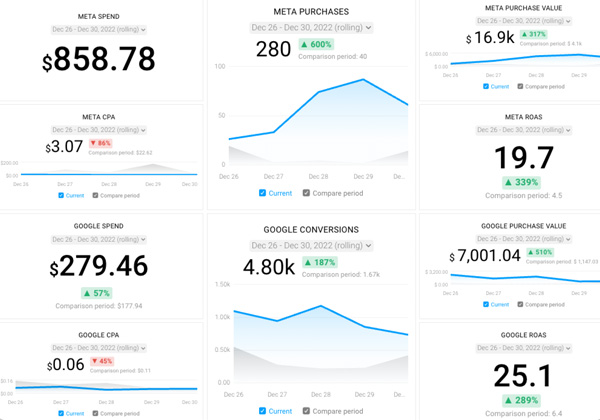
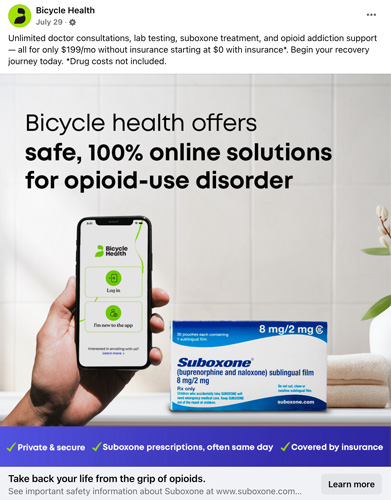
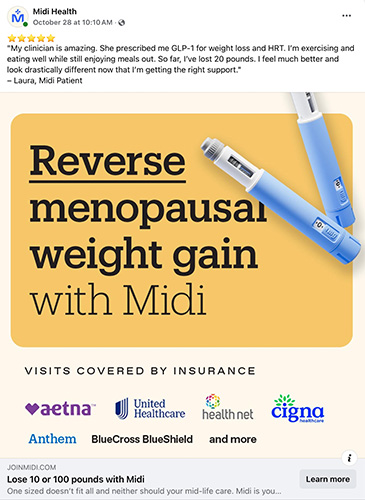
The third piece, the one that ties it all together, is strategy. Our strategy team is in your business goals every week. Not just the campaign objective inside Meta Ads Manager, but the underlying business goal: bookings per market, cost per qualified intake, retention by acquisition channel, lifetime value by creative concept. Every test we ship is connected to a specific business question we are trying to answer for you. That is what stops paid social from devolving into endless creative iteration with no thread back to the P&L.
The model in one lineClean signal in, high-cadence creative out, strategy connects both to the business. The algorithm does the targeting.
We Wrote the Book on
Marketing Digital Health
24 episodes. 24 chapters. One framework for marketing digital health. We turned conversations with the founders, CMOs, and compliance leaders shaping this space into a podcast and a book.
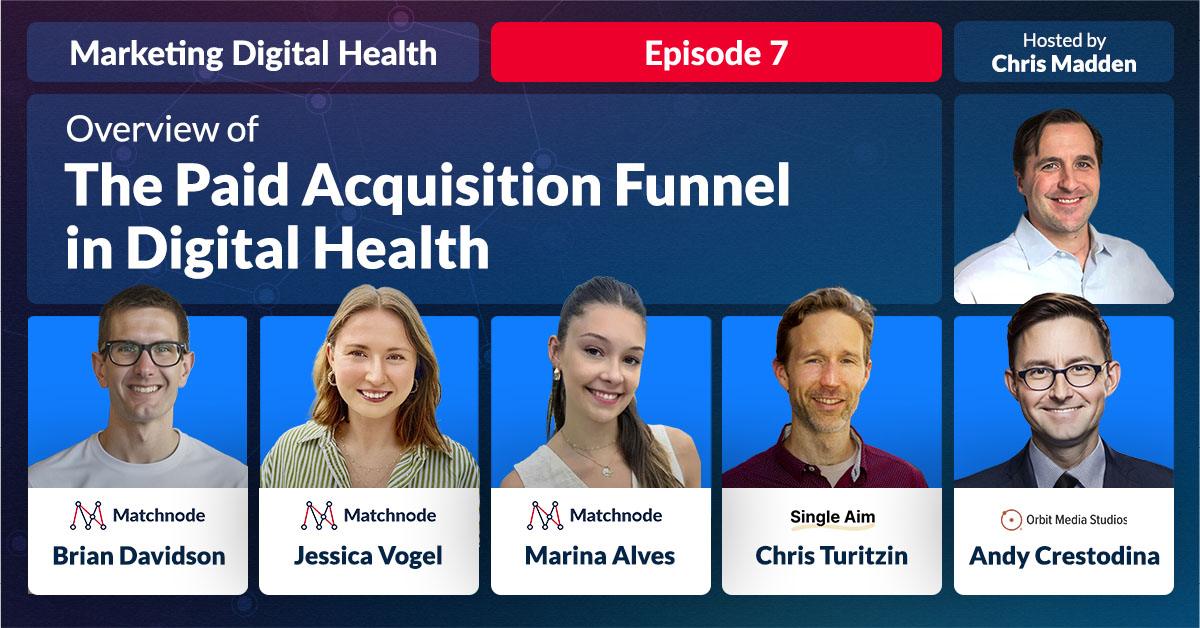
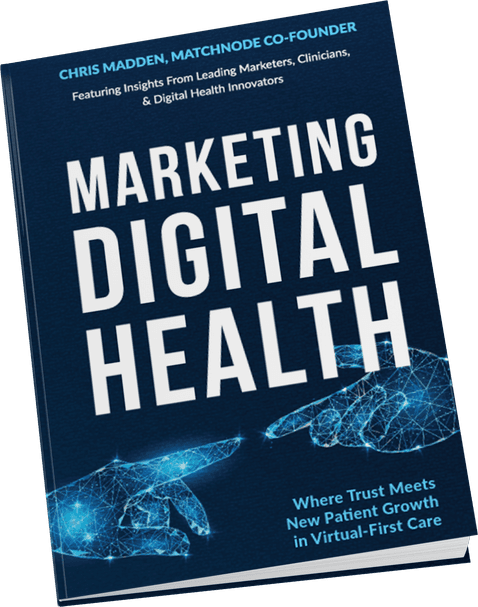
The definitive guide to growing a digital health brand. Available now on Amazon.
Get the Book →UGC Is the Format Clients Keep Asking For
Static, polished, and traditional creative still earn their place. UGC is the piece we are putting the most new resources into right now because it is scaling, our best clients keep asking for more of it, and the wins on Meta and TikTok port across to Reels, Spark Ads, and YouTube Shorts. We source three creator types, with the mix tuned to brand and category.
Patient Testimonials
Highest-trust format when the patient is willing. Uploads run through our HIPAA-compliant intake so consent and category eligibility are documented before the asset is touched.
Healthcare Influencers
Credentialed voices with built-in audiences: OB-GYNs, therapists, RDs, NPs, certified coaches in the brand's category, brought in when clinician framing or audience overlap matters.
Everyday Creators With the Condition
The most common use case. Real people who match the patient profile, paid in the $100 to $300 range per video, briefed tightly, native-feeling assets at the cadence paid social demands.
Matchnode UGC Sourcing Platform · the operational backbone we built to source creators, manage outreach, capture HIPAA-compliant patient uploads, and track which concepts convert on which campaigns.
Meta Ads on Facebook and Instagram
Meta is where the bulk of paid social budget for digital health goes, and it is where most of our work happens. Facebook and Instagram together cover the placement surface where digital health audiences actually spend time: scrolling Reels, scanning the feed, tapping through Stories, and pausing on a creator's Instagram post. Inside Meta Ads Manager, those placements all live in one campaign structure powered by the same algorithm.
Why Meta Is the Default for Digital Health
The audience scale is unmatched for U.S. healthcare. Facebook still indexes high for women over 40, the demographic at the center of perimenopause, hormone health, weight management, and chronic-condition categories. Instagram and Reels skew younger and reach the fertility, mental health, sexual wellness, and dermatology audiences. The advantage of running both inside one Meta account is that the algorithm optimizes across them together, so a winning creative can find its right placement and right audience without you having to predict it up front.
For brands with a HIPAA-compliant offer, Meta also has the most mature healthcare advertising track record of any social platform. The special ad category restrictions are well documented, the appeals process is workable when an ad gets flagged in error, and the measurement tools (CAPI, AEM, Lift) are in active development. That is why Meta is the workhorse and TikTok is the complement, not the other way around.
Where Meta Drives the Most Lift
Patient acquisition for telehealth: menopause, hormone health, mental health, weight loss, dermatology, sexual wellness, fertility.
Digital therapeutics: condition-aware audiences who need to be educated and converted in the same flow.
Brand and demand-gen: introducing a new category framing to women 35 to 60, the audience Facebook still owns at scale.
The Placements That Matter, and What Each One Is For
We do not turn off placements by default; the algorithm chooses where each creative lands. But knowing what each placement does helps us brief the creative team and read the reporting.
Facebook Feed
The center of gravity for women 35 to 60. Long-form caption + still or video. Where most of our condition-awareness creative wins.
Instagram Feed
Visual-led, premium-feel creative. Brand and product. Strong for younger and aspirational digital health categories.
Reels (Instagram and Facebook)
The fastest-growing placement on Meta. Short vertical video, often creator-driven, often the cheapest CPM in the account.
Stories
Vertical, intimate, scrollable in seconds. Strong for retargeting and offers. Pairs well with Reels in the same ad set.
Marketplace
Underrated for hybrid telehealth-plus-in-person and local services. Buyer-mindset moment, lower CPMs, light competition.
Audience Network
Apps and sites outside Meta, served by Meta. Lowest CPMs, useful as scale layer once core placements are saturated.
TikTok Ads for Younger Digital Health Audiences
TikTok is a real channel for digital health, but it is not a fit for every brand. We treat it as the complement to Meta, not a replacement. About one in ten dollars of paid social budget across our book runs on TikTok. When it works, it is one of the best demand-generation engines on the internet for younger digital health audiences. When it does not, it is usually because the brand's creative does not match the platform.
Where TikTok Earns Its Spend
TikTok is the strongest paid social channel we run for digital health categories that skew under 35: fertility, sexual wellness, mental health, dermatology, weight management, and a growing slice of women's health. The audience is there to learn, often through creators they trust. The cost per impression tends to run lower than Meta, and the discovery surface (For You) is closer to TV than to social, in the sense that the algorithm is genuinely deciding what each user sees with very little dependence on prior follows.
Polished brand spots almost always lose to native-feeling, creator-driven video. Brands that already have a creator pipeline or are willing to build one tend to scale on TikTok. Brands that try to repurpose their Meta video assets without a TikTok-native edit tend to underperform.
Where TikTok Drives the Most Lift
Younger digital health audiences: fertility, mental health, sexual wellness, weight management.
Brands with a creator strategy: Spark Ads on real creator content consistently outperform brand-produced video.
Categories that benefit from education: conditions where a creator's lived experience is the most credible introduction.
Spark Ads
Boosted creator content with the creator's handle attached. The highest-performing format in most TikTok accounts because it lives inside the platform's native creator economy.
In-Feed Ads
Native-built vertical video that drops into the For You feed. Best when shot for TikTok and edited TikTok-first, not lifted from a Meta cutdown.
TikTok Lives
Run around launches, promotions, and Q&A moments. A real-time format that pairs with creator partnerships and can compound a campaign window.
Healthcare Advertising on TikTok
TikTok's healthcare ad policies are stricter and less consistent than Meta's. Prescription drug ads are tightly restricted, sexual wellness has its own rules, and approved categories vary by region. We run TikTok creative through the platform's pre-flight and category review with eyes open: about 10 to 20 percent of healthcare ad concepts get knocked back the first time and need adjustment. That is why Meta Business Manager remains the foundation and TikTok layers on once a brand's creative engine and approval pattern are established.
Tracking on TikTok runs through the Events API (TikTok's CAPI equivalent) plus the standard Pixel. The same HIPAA-compliant data pipeline our Technical Services team builds for Meta also feeds TikTok, so signal quality stays consistent across both platforms.

HIPAA, LegitScript, and Meta's Health Categories
Healthcare advertisers do not get to ignore the rules that retail and SaaS advertisers can. Every paid social client we work with goes through a compliance baseline before the first dollar runs. The pipeline we build is aligned with HHS HIPAA guidance: PHI never leaves your environment in a form Meta or TikTok can ingest, and conversion events sent server-side are scrubbed before they hit the platform.
For telehealth brands prescribing scheduled medications or operating in regulated categories, LegitScript certification is usually a Meta and TikTok requirement before ads can run. We support that process and have shepherded multiple brands through it.
Beyond LegitScript, the current Meta advertising policy on medical weight loss ads is one of the most-asked-about category rules we deal with. Three rules drive most of the creative review:
- No before-and-after imagery. Weight-loss visual narratives that imply a guaranteed transformation get rejected.
- No implied diagnosis. Ads cannot imply a personal health attribute about the viewer ("are you struggling with...").
- No pricing-and-prescribing combos. GLP-1 and related categories get pre-flight review, and ads that pair a price with a prescription claim get held.
The same logic applies to hormone, fertility, mental health, and substance-use creative. TikTok layers its own healthcare and special-ad-category rules on top. We brief creative against those rules before production, not after.
How Paid Social Fits Into the Matchnode Program
Paid social for digital health is one channel inside a full-funnel program. Google Ads catches existing demand, paid social creates new demand, technical services keep the signal clean across both, and the rest of the platform mix shows up when the audience and creative call for it.
Google Ads
Google Premier Partner running Search, Performance Max, Demand Gen, YouTube, and AI Max. Pairs with paid social to fulfill the demand paid social creates.
Read more →Technical Services
Server-side tracking, HIPAA-compliant CAPI and Events API, and the CDP foundation every paid social program runs on top of.
Read more →More Ad Platforms
Programmatic, CTV, audio, Reddit, LinkedIn, Bing, and Nextdoor when the audience and creative call for it.
Read more →Why is Meta the workhorse and TikTok the secondary platform?
Audience scale and ad-platform maturity. Facebook and Instagram together still cover the broadest U.S. healthcare audience, especially women 35 to 60, who anchor most digital health categories. Meta also has the most mature healthcare advertising track record, the best server-side tracking via the Conversions API, and the cleanest appeals process when an ad gets flagged. TikTok is real, but it earns its spend in a narrower audience (mostly under 35) and a narrower creative format range. Across our book of business, roughly 90 percent of paid social spend goes to Meta and 10 percent goes to TikTok.
What does "creative is the new targeting" actually mean for our account?
It means the audience filters that used to drive performance (interest layers, narrow demographics, custom audiences stacked five deep) have been quietly demoted by Meta's algorithm. Broad audiences plus high-quality creative consistently outperform narrow audiences plus mediocre creative. So we structure accounts with broad audience definitions and put the testing energy into creative variety. The right ad finds the right person inside a broad audience because the algorithm is reading the engagement signal in real time. The targeting work that used to live in audience setup now lives in the creative brief.
How does paid social work for demand generation versus Google?
Google captures demand that already exists. Someone searches for "menopause hormone therapy near me" and Google connects them to an ad. Paid social creates demand. Someone is scrolling Reels, sees a creator describing brain fog and irregular cycles, and learns for the first time that what she has been experiencing might be perimenopause. She may have never typed "perimenopause" into Google in her life, but after that ad she is now in your funnel. Most digital health brands need both: paid social to fill the funnel, Google to convert it at the bottom. Paid social is what creates new growth.
Do you run Facebook and Instagram as separate campaigns?
Almost never. Inside Meta Ads Manager, Facebook, Instagram, Reels, Stories, Marketplace, and Audience Network all live under one campaign structure. We let Meta's algorithm choose where each creative lands, because it optimizes across placements much better than we can predict. We do read placement-level reporting and use it to brief creative (vertical for Reels and Stories, square or 4:5 for Feed), but we do not split the buy by network or placement.
How much creative volume does a healthy paid social program need?
More than most brands plan for. The number depends on spend level and category, but a good rule of thumb is six to twelve net-new creative concepts per month, with multiple variations per concept (different hooks, different lengths, different captions). The goal is a steady pipeline so the algorithm always has fresh creative to choose from. Brands that ship one or two new ads per month tend to plateau within a quarter. Brands that ship eight to ten per month tend to keep finding new winners.
What is the Conversions API, and why is it not optional?
The Conversions API (CAPI) is Meta's server-to-server way of sending conversion events. Since iOS 14 and Apple's App Tracking Transparency, the browser-side Pixel loses a meaningful share of conversion signal. CAPI sends those conversions directly from your server or CDP, deduped against the Pixel, so the algorithm sees what actually happened. Without CAPI, you are giving the algorithm a half-blurred picture of who converts, and your cost per acquisition will look worse than it is. Our Technical Services team handles the CAPI implementation in a HIPAA-compliant pipeline. See the Technical Services page.
Are there healthcare categories Meta and TikTok will not let us advertise?
Yes, and the rules differ between the two platforms. Meta restricts certain prescription drug categories, controlled substances, before-and-after weight-loss imagery, and ads that imply a personal health attribute about the viewer. Meta's special ad categories (housing, employment, credit, social issues, plus some health classifications) restrict targeting by age, gender, geography, and interests. TikTok is stricter on prescription drug ads and sexual wellness, and approval is less consistent platform-side. We brief creative against both rule sets before production and walk new clients through what is and is not feasible in their category.
How do you measure paid social if Meta's reporting is not the source of truth?
Meta's in-platform reporting is one input, not the truth. We measure paid social through a combination of platform reporting, server-side conversion data sent through CAPI, and a unified view in your CDP or analytics stack that tracks the full journey from ad click to qualified intake to paid conversion. For larger spend levels we layer in incrementality testing and Meta Lift studies. The principle is the same in every program: never trust a single platform's view of its own performance, always reconcile against your own data.
Does Matchnode produce paid social creative, or do we bring our own?
Both work. Most of our digital health clients are running a hybrid: in-house brand creative for top-of-funnel and high-production launches, and Matchnode-produced or creator-sourced UGC for the high-cadence testing pipeline. The performance creative for paid social usually looks different from the brand creative produced for the website. We can run either model, what we will not do is starve the testing pipeline. If creative volume is too low, no targeting or bidding decision will make up for it.
How long until paid social is meaningfully working?
Honest answer: it depends on offer-market fit and creative inventory at start. Brands with a working offer and a few creative concepts already shot tend to find first signs of life inside two to four weeks and a stable cost-per-acquisition by week six to eight. Brands starting from zero creative and an unproven offer take longer, often three to four months before the algorithm has enough signal and creative to optimize against. We will tell you which one your account looks like before we start.
Ready to Build a Paid Social Program That Compounds?
If you are running paid social for digital health brands and want a partner that pairs technical signal, high-cadence creative, and strategy connected to your business goals, let's talk. We will look at your account, your creative pipeline, and your tracking, and tell you the next two moves that matter.
Book a Strategy Call